
EA Verdict
Scalping Robot Pro EA Review (2026): What the Signal, Drawdown and Version Gap Really Show
By Benjamin Lee · Updated · 27 min read
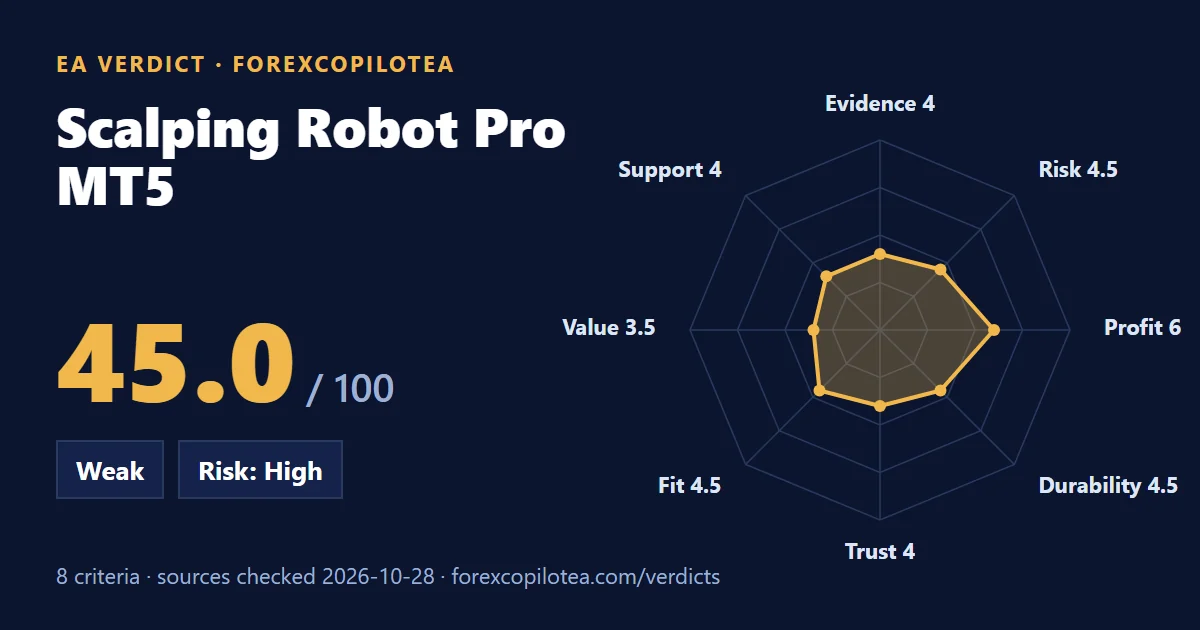
Scalping Robot Pro MT5 is a paid XAUUSD scalper designed for the one-minute chart. Its MQL5 listing describes spread, news, volatility, candle and tick filters, optional AI screening for geopolitical events, and several account-protection functions. The linked vendor-run signal gives this review something more useful than a sales claim: 824 trades, a 2.11 profit factor and a public account history. But the same signal reports 25.83% equity drawdown and eight consecutive losing trades, while its record is only about seven weeks old. There is also a version mismatch: the product page reports version 7.1, yet its FAQ still says 7.0; ForexCopilotEA's own separate store mock listing says v3.0. We score the MQL5 product, not our mock listing, and we disclose our commercial interest before the scorecard. Verdict: 45.0/100, Weak band, High risk. These are findings about public evidence on 28 October 2026, not a forecast of returns.
Key takeaways
- Scalping Robot Pro earns 45.0/100 and a High risk label. A positive platform signal is evidence to inspect, not proof that future returns will be positive or that every customer's execution will match it.
- The linked signal reports 824 trades, 78.03% winners, a 2.11 profit factor and $3.41 expected payoff. The average win is $8.30, while the average loss is $13.96: losses are larger, so the win rate and the ability to contain losing runs matter.
- The same signal reports 18.26% maximal balance drawdown, 9.76% relative balance drawdown and 25.83% equity drawdown. It also shows eight consecutive losers with a cumulative loss of $543.76. Those are material warnings, not footnotes to a profit factor.
- The MQL5 page lists version 7.1, updated 21 October 2026, but its FAQ still refers to version 7.0. The separate ForexCopilotEA mock listing says v3.0; that is a different listing, not evidence that the MQL5 product is version 3.0.
- The $1,599 special price is stated through 28 October, with $1,999 next and $2,999 as an intended final price. Promotional wording is not evidence that the software is worth that amount; verify the checkout price and current version before paying.
- The listing says the EA needs at least $1,000, offers a free demo, and provides a manual and Telegram group after purchase. We could not independently verify the protection claims, signal-to-product version match, signal execution comparability, or results at other brokers.
- 45.0 / 100
- weighted score; Weak band, recalculated from eight published criteria
- 25.83%
- reported equity drawdown on the linked, vendor-run signal
- 7 weeks
- approximate signal history at our 28 Oct 2026 check
The verdict: a real signal, a short record and serious drawdown to weigh
The most defensible conclusion is neither “the EA works” nor “the EA fails.” The MQL5 product page links to a signal with enough trades to inspect its aggregate statistics. It is an appreciable improvement on a screenshot or a backtest-only sales pitch. Yet a signal run by the seller is not an independent trial of the product. It represents a particular account, broker, configuration, execution path and period; it does not establish that an ordinary buyer can reproduce the same results. Around seven weeks also cannot tell us how the strategy behaves through different gold regimes, a sustained news shock, a broker outage or an extended period of poor fills.
The key tension is that the headline statistics look attractive while the account-level risk deserves close attention. A 78.03% win rate and 2.11 profit factor are not guarantees or risk-adjusted returns. Average losses exceed average wins, the platform signal has logged eight losses in a row, and its largest listed equity drawdown is 25.83%. A trader who sees only the win rate may underestimate how much capital and emotional tolerance a run of losses can require. A trader who sees only the profit factor may mistake a historical average for an expected outcome.
Our Weak verdict reflects that mixture. Public, platform-generated signal data earns credit for being checkable. Short duration, seller operation and unclear version equivalence keep the evidence score modest. We score risk as High because the observed equity decline is substantial and the vendor's daily drawdown protections are claims we could not test. Cost is a further constraint: a four-figure licence is difficult to justify from seven weeks of seller-run evidence alone. This is not a recommendation to buy or avoid for every trader. It is a request to test carefully, preserve enough capital for losses, and avoid treating the listing's safeguards as a substitute for your own controls. The weighted total is 45.0 out of 100.
45.0 / 100
Weighted verdict score
Weak
Verdict band
High
Risk label
| Criterion | Weight | Score | Best evidence | Points |
|---|---|---|---|---|
| Verified evidence | 20 | 4/10 | Grade A | 8.0 |
| Risk and drawdown behaviour | 20 | 4.5/10 | Grade A | 9.0 |
| Profitability quality | 15 | 6/10 | Grade A | 9.0 |
| Sustainability | 15 | 4.5/10 | Grade B | 6.8 |
| Transparency and trust | 10 | 4/10 | Grade B | 4.0 |
| Practical fit | 10 | 4.5/10 | Grade B | 4.5 |
| Cost and value | 5 | 3.5/10 | Grade B | 1.8 |
| Support and usability | 5 | 4/10 | Grade B | 2.0 |
| Total | 100 | 45.0 |
What is Scalping Robot Pro MT5?
The product reviewed is the MQL5 Market listing titled Scalping Robot Pro MT5, product ID 149463, sold by MQL TOOLS SL. Its description presents an automated gold scalper for XAUUSD, operating on M1 (the one-minute timeframe). It describes a system that filters market conditions before entering, rather than a general-purpose multi-pair trend EA. Its market is narrow: gold, one-minute data and short-horizon execution. That focus can make broker spreads, latency, tick quality, commission and slippage central to live results. The listing's product description is the seller's explanation of its design, not an independent audit of the source code.
The stated filters are news, volatility, spread, candle behavior and tick behavior. The description also offers an optional AI geopolitical filter. In principle, such filters could be intended to avoid periods when trading conditions or price moves are considered unsuitable. The listing does not, by itself, establish how each filter is calculated, whether it is enabled by default, how often it blocks trades, what data the AI filter uses, or how the system behaves when that input is unavailable. Buyers should not infer that the word “AI” means the EA understands events reliably or can predict how markets will react. The claimed feature is a reason to ask for a precise manual and to test the setting, not a performance result.
The seller says the EA can place a stop loss and take profit, trail stops and apply daily drawdown protections. These are relevant features for an automated strategy, but the listing is not proof that every loss is capped at a predictable amount. Stops can be affected by gaps, price jumps, execution delays and broker rules; a daily limit can depend on the exact balance/equity definition and server time. The cited material does not show source code, a public configuration file, a stop-distance study or a controlled test of what happens when limits trigger. Treat the description as a claim about intended functionality until you have tested the demo and independently checked how the controls behave.
| Listing detail | What it reasonably tells you | What it does not prove |
|---|---|---|
| XAUUSD M1 gold scalper | The stated instrument and chart timeframe are specific. | That the EA is profitable on every gold feed, account type or broker. |
| News, volatility, spread, candle and tick filters | The seller describes several entry-condition filters. | How they are implemented, their default settings, or that they reduce losses. |
| Optional AI geopolitical filter | An additional filter is described as optional. | That it interprets events correctly, avoids all event risk or improves returns. |
| Stop loss, take profit, trailing and daily drawdown protections | The seller says these controls are available. | That losses cannot exceed the stop, that equity is protected through gaps, or that the controls worked on the signal. |
| $1,000 stated minimum | This is the seller's stated starting capital. | That $1,000 is adequate for a particular broker, leverage, lot size or drawdown. |
The version discrepancy: MQL5 says 7.1, its FAQ still says 7.0, our mock says 3.0
Version control is material when a seller links a live record to a product. On the date checked, the MQL5 product page's metadata showed current version 7.1, updated 21 October 2026. However, the product description's FAQ still said the current version was 7.0. Those statements conflict. The separate ForexCopilotEA mock product page says v3.0. That third figure belongs to our separate store listing and must not be presented as the MQL5 product's version. We have kept those identities separate throughout this review.
The version gap does not prove that the linked signal uses an old build, a different build or the wrong EA. It means the cited pages do not establish which exact build generated the 824-trade record, nor whether it matches the 7.1 download available on 28 October. A software update might change entry filters, risk settings, timing or order handling; a small cosmetic change might not. Without a build identifier on the signal or an explicit vendor statement connecting the signal account to product version 7.1, readers should not assume equivalence. The FAQ could simply be stale, but the uncertainty itself is real and should be corrected by the seller.
What the linked live signal shows
The MQL5 listing links to signal 2390372, which was publicly visible when checked on 28 October 2026. It is operated by the vendor and had approximately seven weeks of history at that point. The platform summary reported 824 trades, a 78.03% win rate, a 2.11 profit factor and expected payoff of $3.41. It also reported 130 trades a week and a 24-minute average holding time. The signal is worth examining because it provides trade-level platform reporting, but it is a single account rather than a multi-account study. The result is also tied to one signal provider's broker and settings; the listing and signal pages do not establish that a customer's account will receive comparable prices or fills.
| Signal statistic | Reported value | How to read it |
|---|---|---|
| Closed trades | 824 | A meaningful count for an early snapshot, but not a long history across market regimes. |
| Win rate | 78.03% | A majority of closed trades were profitable; it does not show loss size or future hit rate. |
| Profit factor | 2.11 | Reported gross profit divided by gross loss over this observed signal period. |
| Expected payoff | $3.41 per trade | Platform-reported average result per trade in account currency; the page's denomination should be checked. |
| Average win / loss | $8.30 / -$13.96 | The average losing trade is larger than the average winning trade. |
| Trading frequency | 130 trades a week | High turnover can magnify the effect of costs, execution quality and changes in trade selection. |
| Average holding time | 24 minutes | The signal is short-horizon; its realized fill quality may differ from a subscriber's. |
| Maximum deposit load | 15.36% | A platform exposure measure, not a guarantee of capped loss or a recommended allocation. |
| Maximal balance drawdown | $543.76 (18.26%) | The reported maximum balance decline and related percentage; retain the exact platform field labels. |
| Relative balance drawdown | 9.76% | A different signal statistic; it should not be substituted for the maximal balance DD. |
| Equity drawdown | 25.83% | The largest reported equity decline, including open-trade effects; this is the most cautionary figure here. |
| Longest losing run | 8 trades; -$543.76 | One reported sequence; a future sequence can be longer or more costly. |
Several numbers deserve to sit next to each other. First, the 78.03% win rate does not mean that roughly four out of five future trades will win. It is a historical share of closed outcomes on this signal. Second, the average loss of $13.96 is about 1.68 times the $8.30 average win. With that payoff asymmetry, the strategy needs a sufficiently high win rate after costs; losing streaks can erase many small gains. The average and the longest observed loss sequence are not maximum possible losses. Third, 25.83% equity drawdown is not contradicted by a 9.76% relative balance drawdown: those are separate platform measures, and one includes equity behavior that balance-only figures may not capture. We report each under its own name instead of choosing the most flattering.
The signal has also generated platform notices during its early life. The public page initially showed new-account and low-sample warnings in September, then displayed notices concerning high monthly growth and trading frequency. Those notices provide context, not a platform endorsement. “High monthly growth” is not a stable expected return, and “too frequent trades” is a prompt to inspect how the account behaves, not a prediction that activity will continue. The signal is seller-run and only around seven weeks old at the review date. A short run with rapid growth can be unusually sensitive to a handful of market sessions and should not be annualized or treated as a sustainable income rate.
The $543.76 amount appears both as the maximal balance drawdown amount and as the loss across the reported eight-trade losing sequence. That coincidence makes the number tangible, but it does not mean the whole account could only lose that amount. It is a historical figure on one account, with a particular balance and configuration, and it does not cap the next sequence. Likewise, 15.36% maximum deposit load is not interchangeable with risk per trade or maximum loss. Prospective users need the starting capital, lot size, leverage, stop distances, and equity curve to translate the signal metrics into a personal risk estimate.
Risk in practice: why a gold M1 scalper can behave differently on your account
Scalping is sensitive to small differences in execution because entries and exits are frequent and the intended price movement can be limited. The EA's own listing emphasizes spread and tick filters, which is an implicit acknowledgment that market conditions matter. A buyer can still encounter a wider spread at the moment an order is sent, slippage when the price moves, requotes or partial fills, a different commission schedule, server latency, or a symbol specification that changes the point value. Those differences can transform the average outcome. The seller's filters may reject some unfavorable conditions, but the sources do not show what fills the signal received compared with what a buyer's broker would have offered.
Gold can also move sharply around scheduled data and unscheduled headlines. A news filter may reduce trading near events if correctly configured, but cannot eliminate gaps or guarantee that the next move is predictable. An AI geopolitical filter, if enabled, is not a substitute for an understanding of what data it consumes, how frequently it updates, or how it fails. If the external service, network or platform becomes unavailable, a user needs to know whether the EA stops trading safely or continues without the filter. The sales listing does not document these failure modes. Treat them as questions for the vendor and demo scenarios, not as evidence of a defect.
A stop loss can make an exit rule explicit without making the realized loss mathematically fixed. The execution price can differ from the stop during a fast move or a price gap. A daily drawdown guard also needs a definition: does it measure equity or balance, include commissions and swaps, reset at broker midnight or another server time, and close open trades or merely refuse new ones? Does it apply to one chart, all symbols, or a single EA instance? The product listing claims protection features but the cited pages do not answer these operational questions. Until the manual and a demo test do, we cannot credit the claim as a verified loss ceiling.
The 8-loss sequence is particularly useful as a stress-test starting point. It is not a worst case: it is only the longest run observed in the early signal. A trader should ask what the EA would do after eight consecutive losses, whether it changes lot size, pauses, continues at the same risk, or resets any daily limit. The signal's reported loss of $543.76 cannot be converted into a safe personal account size without knowing the provider's account balance and settings over the period. Do not simply scale the number linearly from the seller-run account; trade sizing, margin, fills and percentage drawdowns may not scale linearly.
Does the signal prove the current product works?
It proves that the MQL5 signal page reports a certain history for the signal account. It does not, from the public information reviewed, prove which precise software build ran there, whether the signal account's parameters are representative, or whether the same trades can be reproduced by a customer. The MQL5 listing's product page and signal link create a relevant association, but association is not a full test protocol. We did not find a public version identifier tied to signal 2390372 that resolves the 7.1/7.0 inconsistency. Nor do the provided sources identify the signal's broker settings, complete configuration or a separate independent account.
There are several plausible explanations for a version discrepancy: the FAQ might not have been updated, the signal might have moved to the new build, or the signal might still be running a prior build. The public evidence we have cannot tell which is true. It would be inaccurate to state that the signal certainly uses the wrong version; it would also be inaccurate to assume it definitely uses the latest version. A versioned changelog, signal-side EA identification and a vendor response would turn this from a material unknown into a checkable fact. Until then, the signal is useful as a record associated with the product, but not as clean proof of the exact 7.1 build.
Price, trial and support: evaluate the purchase without the countdown
The MQL5 listing showed a $1,599 special price stated through 28 October 2026, followed by a stated $1,999 price and an intended final price of $2,999. Because the check date is the stated deadline, a buyer reading this later must open the live page and confirm the actual checkout amount, currency, tax and any applicable platform terms. The future prices are what the listing says will happen; they are not proof that a price change has taken place or that the product's value has increased. The page also contains stale price language, so a deadline or “final” label should be treated as seller messaging rather than independent evidence of scarcity or quality.
At $1,599, this is already a substantial upfront commitment for an EA whose public linked signal is approximately seven weeks old and run by the seller. The $1,999 and $2,999 figures would raise the burden of proof further if they become the active prices. Price alone does not determine value: some strategies cost more because of development or support, and a cheaper product can still be poor value. But value should be assessed against evidence, licence terms, support, opportunity cost and the capital a user needs to operate the strategy. A $1,000 stated account minimum plus a four-figure purchase can mean that the real financial commitment is far above the licence price.
The listing says a free demo is available. Use it to learn installation, chart attachment, alerts, parameter behavior and whether the software operates on your broker's gold symbol. Confirm exactly what the demo allows: a Strategy Tester demo may not provide the same forward-testing access as a live licensed build. We do not infer which mode applies from the words “free demo.” A meaningful test needs to run for enough time to encounter different market conditions, and should be compared with the public signal without risking money. Do not buy solely because a sale deadline is near; the main unanswered questions—exact version, execution conditions, longer history and drawdown behavior—will not disappear because a discount expires.
The seller says a manual and access to a Telegram group are provided after purchase. That may be helpful, but it limits what a prospective buyer can evaluate before paying. Ask whether the manual documents every input, the default lot sizing, the daily drawdown definition, symbol suffix handling, platform requirements, event-filter behavior, signal version and update policy. Ask what support covers and whether continued access depends on a subscription or group membership. The product page is not enough to determine response times or the quality of troubleshooting, so support receives limited credit rather than a strong rating.
| Question | Why it matters | What would count as a useful answer |
|---|---|---|
| Which version runs signal 2390372? | The current listing says 7.1; the FAQ says 7.0. | A dated statement identifying the signal's exact build and settings. |
| How is daily drawdown calculated? | A protection claim is only meaningful with a clear trigger and action. | Whether it measures equity/balance, reset time, scope and handling of open positions. |
| What does the free demo permit? | Tester access and forward-demo access are not equivalent. | A clear description of which features, durations and account types it supports. |
| What are the licence and activation rules? | The listing shows 12 activations; hardware changes can matter. | Current platform terms on transfers, resets and what consumes an activation. |
| Which broker conditions did the signal use? | Spreads, commission and execution affect high-frequency results. | Broker, symbol, account type and a documented comparison of execution assumptions. |
| What price applies at checkout today? | The page states dates and future prices that may be stale. | The amount shown in the current MQL5 checkout, including any taxes or platform fees. |
Who might consider it, and who should pass?
The product is most relevant to a trader already using MetaTrader 5, with a gold symbol whose contract specifications they understand, reliable connectivity, and a willingness to run a long demo before deciding. A user should be comfortable checking the EA's behavior, reading the manual, managing the VPS or terminal, monitoring account equity, and stopping the system if execution or drawdown departs from expectations. The seller's $1,000 minimum is a stated threshold, not a personalized recommendation; the account one individual needs depends on lot size, leverage, stops, broker and tolerance for loss. The 25.83% signal equity drawdown makes it especially important not to equate a vendor minimum with a safe minimum.
It is a poor fit for a buyer who needs stable income, cannot afford a deep drawdown, expects the AI filter to prevent losses, or wants a system whose logic and complete set files can be reviewed before purchase. It is also a poor fit if the price would consume money needed for bills, if the account cannot tolerate multiple losses, or if the user cannot monitor a short-term strategy during outages and abnormal conditions. The available evidence does not show compatibility with any particular prop-firm rules. Do not assume a broker or evaluation provider permits this EA, its trade frequency, news activity, or its holding pattern; verify the rules directly.
We would not judge fit from the 130 trades a week in isolation. High activity can make the signal appear statistically rich, but it also multiplies exposure to transaction costs and makes a one-week result less representative of a year. A user whose spread and commission differ from the seller's can have a very different expectancy even if trade direction matches. The 24-minute average holding time does not mean that every position closes in 24 minutes or that the EA cannot hold during a volatile move. Read the actual position rules, and do not assume that “scalper” means risk is short-lived or bounded.
A cautious evaluation plan before risking capital
Step 1: Verify which product you are testing
Open the MQL5 Market page for product 149463 and confirm its seller, live version, price and licence terms. Keep it separate from ForexCopilotEA's v3.0 mock store listing. Save the build number and date so that a later test is not confused with an update.
Step 2: Read the manual and clarify the settings
Before live use, obtain the full inputs, lot-sizing logic, stop and trailing behavior, daily limit definition, trading hours, event-filter behavior and fail-safe behavior. Ask the seller to reconcile v7.1 metadata with the v7.0 FAQ and identify the signal's build.
Step 3: Run the demo on your own MT5 setup
Use the same broker, symbol suffix, account type and VPS conditions you would use later. Confirm that the software connects, places and closes demo orders as described. Observe what happens when a filter is toggled or a platform connection is interrupted, without introducing real-money risk.
Step 4: Measure costs and execution
Record spread, commission, slippage, rejected orders, latency, average win and average loss. Compare your trades against the public signal when possible, while remembering that the accounts may not be directly comparable. Include every cost rather than looking only at gross profit.
Step 5: Stress the losing sequence and drawdown
Plan for more than the eight-loss sequence already observed. Estimate loss using your own trade sizes and the actual stops, and decide in advance what equity decline makes you stop the test. Do not treat $543.76 as a maximum loss or infer a safe balance from the vendor's account.
Step 6: Check rules and keep a stop condition
Confirm your broker's EA and news rules and any prop-firm restrictions directly. Define when you will pause the software: unusual execution, unexpected order size, a disabled safeguard, unexplained version change, or a drawdown limit you set for yourself.
A demo cannot prove that the strategy will be profitable live; it can expose practical incompatibilities and confusing behavior before your money is involved. Nor does a clean demo erase the short signal history. The point of the test plan is not to optimize settings until a pleasing result appears. That can overfit the same period that made the seller's signal look good. Use a fixed test window, note the settings before starting, preserve the full trade log, and be transparent with yourself about negative results. If the vendor cannot clarify basic version and risk-control details, that unresolved uncertainty is itself a reasonable reason not to proceed.
Scoring detail: how we reached 45.0/100
Each criterion is scored from 0 to 10, multiplied by its published weight, and contributes to the 100-point total. The evidence grade describes the source type, not a confidence interval. A platform-built signal can receive grade A as a checkable platform record while still scoring only 4/10 because it is short, vendor-run and not tied to a confirmed product build. Similarly, a listing can be a grade B source for what the vendor says without validating the feature's effectiveness. See the methodology and scoring anchors for definitions.
| Criterion | Score | Weighted points | Why |
|---|---|---|---|
| Verified evidence (weight 20) | 4 / 10 | 8.0 | One public platform signal with 824 trades and checkable statistics, but only about seven weeks old, seller-run and not conclusively linked to version 7.1. |
| Risk and drawdown behaviour (weight 20) | 4.5 / 10 | 9.0 | The signal reports 25.83% equity drawdown and eight consecutive losses. Stop, trailing and daily protections are stated by the seller, not independently tested. |
| Profitability quality (weight 15) | 6 / 10 | 9.0 | Profit factor 2.11 and payoff $3.41 are positive on the short sample, offset by average losses larger than wins and significant drawdown. |
| Sustainability (weight 15) | 4.5 / 10 | 6.8 | Filters are described, but logic, robustness, a long history and operation across market regimes are not demonstrated. |
| Transparency and trust (weight 10) | 4 / 10 | 4.0 | Public listing, signal and free demo help; version inconsistency, stale price language and post-purchase-only support material reduce transparency. |
| Practical fit (weight 10) | 4.5 / 10 | 4.5 | Specific to MT5 XAUUSD M1 and a stated $1,000 minimum; broker conditions, execution, VPS and prop-firm compatibility remain unclear. |
| Cost and value (weight 5) | 3.5 / 10 | 1.8 | The stated special price is $1,599, rising by the listing's own terms, while available evidence is too short to establish value at a four-figure cost. |
| Support and usability (weight 5) | 4 / 10 | 2.0 | Free demo plus a manual and Telegram group are stated, but the manual is post-purchase and public support quality is not verifiable. |
- Verified evidence (20%). The signal is platform-visible, a meaningful strength. We reduce the score because it is seller-run and about seven weeks old, with no confirmed signal-side version identity or independent account.
- Risk and drawdown (20%). 25.83% equity drawdown and an eight-loss run are material. Vendor-described protections may be useful, but cannot be credited as a verified cap without their operating definitions and test evidence.
- Profitability quality (15%). The snapshot has a 2.11 profit factor and positive expected payoff. The gap between average wins and losses and the short observation window temper the result.
- Sustainability (15%). A gold M1 filter strategy may be designed to adapt to conditions, but the public sources do not show whether it remains effective across years or varying execution regimes.
- Transparency and trust (10%). The seller discloses a live signal and describes features, but the unresolved 7.1/7.0 mismatch and changing price language make basic purchase facts harder to assess.
- Practical fit (10%). XAUUSD M1 and the $1,000 stated minimum narrow the likely audience. Broker execution and operational requirements are insufficiently described.
- Cost and value (5%). A demo is valuable, but the purchase price is large relative to the available proof and would sit alongside account funding and possible VPS costs.
- Support and usability (5%). The manual and Telegram group could help after purchase, but their content and responsiveness are not publicly demonstrated.
What we could not verify
These are not minor omissions that can be filled by assuming the best. Version identity affects whether a signal is relevant to the offered download. Drawdown rules affect how an account can behave in a losing spell. Broker conditions affect the economics of a high-frequency gold strategy. The correct response to each gap is either more primary evidence or an explicit unknown, not a confident conclusion. We will update this review if the seller publishes a version-matched record, clearer documentation or evidence that changes the assessment.
Sources and review date
- MQL5 Market: Scalping Robot Pro MT5, product 149463Product description, price, version metadata, stated requirements and signal link; opened 28 October 2026.
- MQL5 Signal: Scalping Robot Pro, 2390372Platform statistics, drawdown, trading frequency and signal warnings; checked 28 October 2026. Vendor-operated account.
- ForexCopilotEA Scalping Robot listingA separate store listing; bundled mock product metadata shows v3.0 and is not established as the same build.
- ForexCopilotEA verdict methodologyShared scoring weights, criteria and source grades used in this review.
Scalping Robot Pro EA review: frequently asked questions
Frequently asked questions
Is Scalping Robot Pro EA profitable?
The linked MQL5 signal showed a profit factor of 2.11 and $3.41 expected payoff across 824 trades at the 28 October 2026 check. That is a positive historical snapshot, not proof of future profitability. The signal is vendor-run and about seven weeks old, has 25.83% reported equity drawdown, and does not establish that buyers will obtain the same execution. No return is guaranteed.
What is the current version of Scalping Robot Pro MT5?
The MQL5 page metadata showed version 7.1, updated 21 October 2026, while the product FAQ still referred to version 7.0. ForexCopilotEA's separate mock listing shows v3.0, but that is not the MQL5 product version. Confirm the build at the MQL5 checkout and ask the seller which build is running on signal 2390372.
How risky is Scalping Robot Pro?
We label it High risk. The linked signal reported maximal balance drawdown of $543.76 (18.26%), relative balance drawdown of 9.76%, equity drawdown of 25.83%, and eight consecutive losing trades totaling $543.76. The listing claims stop, trailing and daily drawdown controls, but we have not independently verified their operation. Past drawdown does not cap future losses.
How much money does the seller say I need?
The MQL5 listing states a $1,000 minimum. That is the seller's stated threshold, not a personalized or independently validated safe balance. Your actual risk depends on lot size, leverage, broker terms, stops, slippage and the drawdown you can afford. Do not fund the account with essential or borrowed money.
What does Scalping Robot Pro trade?
The product description presents an MT5 EA for XAUUSD, gold, on the one-minute chart. It describes news, volatility, spread, candle and tick filters, with an optional AI geopolitical filter. These are seller-described features; the public sources do not show source code or independently establish how well each filter works.
Is there a free demo?
The MQL5 product listing says a free demo is available. Confirm what the demo allows on the current listing—such as tester access versus forward demo use—and test it on your own broker conditions before risking money. A demo can help identify compatibility issues, but cannot establish that the system will make a profit.
What is the price of Scalping Robot Pro?
On 28 October 2026, the listing stated a $1,599 special price through that date, then $1,999 and an intended final price of $2,999. Because the listing also contains stale price language, these statements should not be treated as a guaranteed future schedule. Check the live MQL5 checkout for the amount that actually applies.
Is ForexCopilotEA's Scalping Robot the same product?
No equivalence is established. ForexCopilotEA has a separate store mock listing showing v3.0, while this verdict reviews MQL5 product 149463, titled Scalping Robot Pro MT5, whose page showed v7.1. Compare the exact product, seller, build, licence, price and support terms before purchasing.