
Evidence
Do Forex Expert Advisors Really Work? What the Evidence Says, and How to Test One Yourself
By Benjamin Lee · Updated · 11 min read
An Expert Advisor works in one sense for certain: it places trades by the rules it was given, without hesitation or sleep. Whether those rules make money is a separate question, and it is the one buyers actually care about. The honest answer is that some EAs earn in some conditions, most do not earn enough to justify the risk, and a sales page cannot tell you which is which. This guide sets out what the regulators say, the five reasons most EAs disappoint, the kind of evidence that is worth trusting, and a four-week test you can run before real money is involved.
Key takeaways
- An EA executes rules. It does not create an edge, so it works only if the rules have one that survives costs and changing markets.
- ESMA cites national regulator analyses finding that 74-89% of retail CFD accounts typically lose money. That is the baseline for all retail traders, not a figure for EAs, and it is the reason to test before you trust.
- The US CFTC warns that bots promising very high or assured returns are a fraud pattern, and that fake balances can be built on MetaTrader demo accounts.
- Trust a verified live record on one account over any backtest, screenshot or advertised percentage.
- A backtest is a claim. Out-of-sample data, real ticks with costs, a demo forward test and a small live start are how you turn a claim into evidence.
The short answer: two different questions
People ask whether EAs work and mean two things. The first is whether the software does what it says: opens a trade when the rule fires, places the stop, closes at the target. A competent EA does this reliably, and it is the whole point of automation. The second is whether following those rules makes money after spread, commission, swap and slippage, in the market you will actually trade, for longer than the period it was tuned on. That is much harder, and automation does nothing to make it easier.
An EA is a way of executing a trading idea consistently. If the idea has a real edge, the EA applies it without the emotional mistakes a person makes. If the idea has no edge, the EA applies that consistently too, and loses consistently. Read what an Expert Advisor does in MetaTrader 5 if you want the mechanics first, and come back here for the question of evidence.
- 74-89%
- of retail CFD accounts typically lose money (national regulator analyses cited by ESMA, 2018)
- 30:1
- maximum EU retail leverage on major currency pairs; gold is limited to 20:1
- 50%
- of required margin is the level at which EU brokers must close retail positions
Be careful with the first figure. It describes retail trading on leveraged products as a whole, mostly done by hand, and says nothing specific about EAs. It matters here for a simple reason: it is the starting point. A buyer who assumes an EA changes those odds without checking has not earned that assumption. The guide to EA trading under ESMA rules explains the limits behind the other two figures.
What an EA can and cannot do
| An EA can | An EA cannot |
|---|---|
| Follow the same rules on every signal, including the boring ones | Make a rule profitable that was not profitable before |
| Trade around the clock on a VPS without tiredness or fear | Predict a sudden change in the market |
| Apply a stop and a position size every time | Remove spread, commission, swap or slippage |
| Test an idea quickly on years of history | Tell you whether the history resembles the future |
| Remove the urge to close a winner early or hold a loser | Protect you from a design that risks too much |
The right column is where most disappointment comes from. The CFTC puts it plainly in its advisory on trading bots: "AI technology can't predict the future". The same applies to any rule-based system, however advanced the marketing sounds.
Five reasons most EAs disappoint
| Reason | What happens | How to spot it |
|---|---|---|
| Overfitting | Settings are tuned until the past looks good. The EA has learned the noise in one data set, not a repeatable pattern. | A sharp profit peak at one exact setting, no out-of-sample test, a result that falls apart when a parameter moves a little |
| Hidden risk | A grid or martingale wins small amounts often and has not yet met the one move that breaks it. | A very high win rate, a very small average win, no stop on every trade |
| Costs left out | The test used zero or tiny spread and no commission. Live trading pays both on every trade. | More trades per year means a bigger effect; a scalper tested on open prices is the worst case |
| Changing conditions | The edge belonged to one market mood and faded when volatility, spreads or correlations changed. | A record that covers one trending year, or one broker and one account |
| Selection bias | You see the survivors. A seller can show the best of many versions, accounts or periods. | A record that is a screenshot, or a different version from the one on sale |
The first reason deserves a closer look because it is the most common and the least visible. Bailey, Borwein, López de Prado and Zhu describe how testing enough variations of a strategy on the same history will almost always turn up one that looks excellent by chance. The more variations tried, the better the best one looks, and the less it means. Our guide to optimising an EA without overfitting shows how to check for it.
- Martingale
- Grid
- Trend
- Scalper
What the regulators say about trading bots
The US Commodity Futures Trading Commission has published a customer advisory titled "AI Won't Turn Trading Bots into Money Machines". It is written about fraud, but the patterns it lists are the same ones a careful buyer should look for in any bot marketing.
- Promises of unreasonably high returns, or returns presented as assured, and claims of gains in the tens of thousands of percent or "100 percent 'win' rates".
- Marketing that says no trading experience is needed.
- Referral bonuses and affiliate payouts that reward bringing in new buyers.
- Fake customer accounts and balances created on MetaTrader demo accounts.
- Promotion by social media influencers and strangers met online.
One case in the advisory involved a promise of at least 10 percent a month. The CFTC points out that this is more than 200 percent a year. That is a useful yardstick for any advertised monthly figure: multiply it by twelve and ask whether any honest, long-lived strategy could sustain it. The fourth item is the one most relevant to MetaTrader users, because a demo account can show any balance the creator likes. That is why the guide to verifying an EA track record insists on records the seller cannot edit.
What counts as evidence, from strongest to weakest
How much to trust each kind of proof
Grade A: Independent proof
- A live record on a platform that builds it from broker trade history, such as an MQL5 signal or a verified Myfxbook account
- At least 12 months, on one account, for the exact version on sale
- Deposits and withdrawals that do not distort the curve
Grade B: Checkable vendor material
- A product page, manual and set files you can read before paying
- A demo or trial you can run yourself
- Settings that let you reproduce the seller's test
Grade C: Claim only
- A screenshot
- An advertised percentage
- A review that links to nothing
Grade D: Conflicted or anonymous
- A reviewer paid per sale
- A testimonial from an account you cannot identify
- A record on an account the seller can reset
The four grades are the same ones used in our EA Verdicts, where each reviewed EA is scored on eight published criteria. Evidence quality carries the largest weight, because without it the other seven are guesses. You can read the full scoring method, or filter every scored EA by design, risk label and score in the EA screener.
A worked example: the same EA at three evidence levels
Numbers on their own mean little until you see them next to what stands behind them. The table below scores three hypothetical EA profiles with the EA strategy check, which counts red flags in a backtest or live record. None of these is a real product. They exist to show how the same headline numbers change meaning as the evidence behind them changes.
| Measure | Profile A: plausible | Profile B: A with proof | Profile C: sales page |
|---|---|---|---|
| Test length and trades | 3 years, 420 trades | 3 years, 420 trades | 1 year, 90 trades |
| Profit factor and drawdown | 1.4 and 18% | 1.4 and 18% | 4.2 and 8% |
| Net profit and win rate | 54% and 52% | 54% and 52% | 310% and 91% |
| Average win and loss | 21 and 20 | 21 and 20 | 4 and 38 |
| Design, stops, costs | Trend, stop on every trade, real ticks with costs | Same as A | Grid, no hard stop, open prices, no costs |
| Out-of-sample and live record | None, none | Yes, 12 months or more | None, none |
| Strategy check score | 80: two warnings (no out-of-sample test, no live record) | 100: no red flags | 0: three critical flags and six warnings |
Profile C is the one that looks best on an advertisement: a 91% win rate, a drawdown of 8% and 310% growth. It is also the profile with the most problems. Each average win of 4 is set against an average loss of 38, so a single bad run erases months of gains. The test used open prices and no costs, the sample is small, and a grid with no hard stop has not yet met a market that breaks it. Profile A looks plain by comparison and scores better, because the evidence behind it is sounder. Profile B is the same plain numbers with proof, which is what you are looking for.
A four-week test before you risk real money
Step 1: Backtest on real ticks, with costs
Run the exact settings on real tick data with your broker's spread and commission. The Strategy Tester guide walks through the settings, and the backtest report guide shows what to read first.
Step 2: Check it on data it has not seen
Hold back a period the optimiser never touched, or run a walk-forward analysis. A strategy that only works on the data it was tuned on has not shown an edge.
Step 3: Forward test on a demo account for at least four weeks
Use your own broker and the same settings. The first 30 days plan sets out what to watch each week.
Step 4: Start live small, with a loss limit written in advance
Size the account so the tested maximum drawdown is a loss you can accept. The account size guide has worked examples, and the drawdown guide covers what to do when it arrives.
Step 5: Compare live with the backtest of the same week
A small, steady gap from costs is normal. A large or growing one has a cause you can find, as the guide on why live results differ from backtests explains.
So, do forex EAs work?
Some do, for a while, in the conditions they were built for. Many do not, and the ones that fail often looked the best on paper. An EA that works is not a mystery product. It is a rule set with a real edge, risk that is bounded and shown, a record you can verify, and a size that suits the account. Take away any one of those and the odds move against you.
The practical stance is neither belief nor dismissal. Treat every EA, including the ones we sell, as a claim to be tested. We sell EAs, so weigh what we say accordingly, which is why we publish the scoring method and the red flags we look for. Use the EA buying checklist before you pay anyone, and the lot size calculator to turn a risk limit into a lot size. An EA that survives that process has earned a small live start, nothing more.
Sources and further reading
- CFTC Customer Advisory: AI Won't Turn Trading Bots into Money MachinesA US regulator's warning about trading-bot claims of unrealistically high returns.
- ESMA: ESMA agrees to prohibit binary options and restrict CFDs to protect retail investorsThe EU leverage limits, margin close-out, negative balance protection and risk-warning rules for retail CFD accounts.
- Bailey, Borwein, López de Prado and Zhu: Pseudo-Mathematics and Financial Charlatanism (Notices of the AMS, May 2014)A plain-language account of how backtest overfitting produces strategies that fail out of sample.
- Myfxbook Help: VerificationHow a trading account's track record is verified on Myfxbook.
- MQL5 Signals: signal list and statisticsThe statistics MQL5 shows for each signal provider, including growth, drawdown, weeks and subscribers.
- MetaTrader 5 Help: Strategy TestingThe Strategy Tester: testing modes, settings and forward testing.
Frequently asked questions
Do forex EAs really work?
An EA reliably does what its rules say. Whether the rules make money after costs, and keep doing so when the market changes, depends on the strategy and has to be shown with evidence. Some EAs earn in some conditions and many do not, so test any EA on real ticks and a demo account before real money.
Can an EA make money consistently?
Some strategies earn over long periods, but no honest seller can promise a steady monthly figure. Markets change and every strategy has losing runs. Look for a verified live record of 12 months or more, drawdown you can accept, and settings that hold up when you vary them slightly.
Are forex robots a scam?
Some are. The US CFTC warns about bots that promise very high or assured returns, claim near-perfect win rates, or show balances made on demo accounts. Many EAs are not scams but simply do not earn enough for their risk. The checks in this guide separate the two.
How much can a forex EA realistically make?
There is no honest standard figure. The CFTC points out that a promised 10 percent a month works out to more than 200 percent a year. Judge an EA by return against drawdown over a long verified record, not by a monthly target.
Is a high win rate a sign of a good EA?
No. A win rate near 90% often comes with small wins and large losses, which is the shape of a grid or martingale that has not yet met its worst move. Read the average win against the average loss and the maximum drawdown together with the win rate.
How long should I test an EA before using real money?
At least four weeks on a demo account at your broker after a real-ticks backtest with costs, then a small live start. Longer is better, because it gives the EA a chance to meet different conditions.
Do EAs work better than trading by hand?
They remove emotional mistakes and trade without tiring, which helps a strategy that already has an edge. They do not give a losing idea an edge. The regulators' figure for retail CFD accounts applies to trading generally, so automation alone changes little unless the rules are sound.
Expert Advisors in these styles
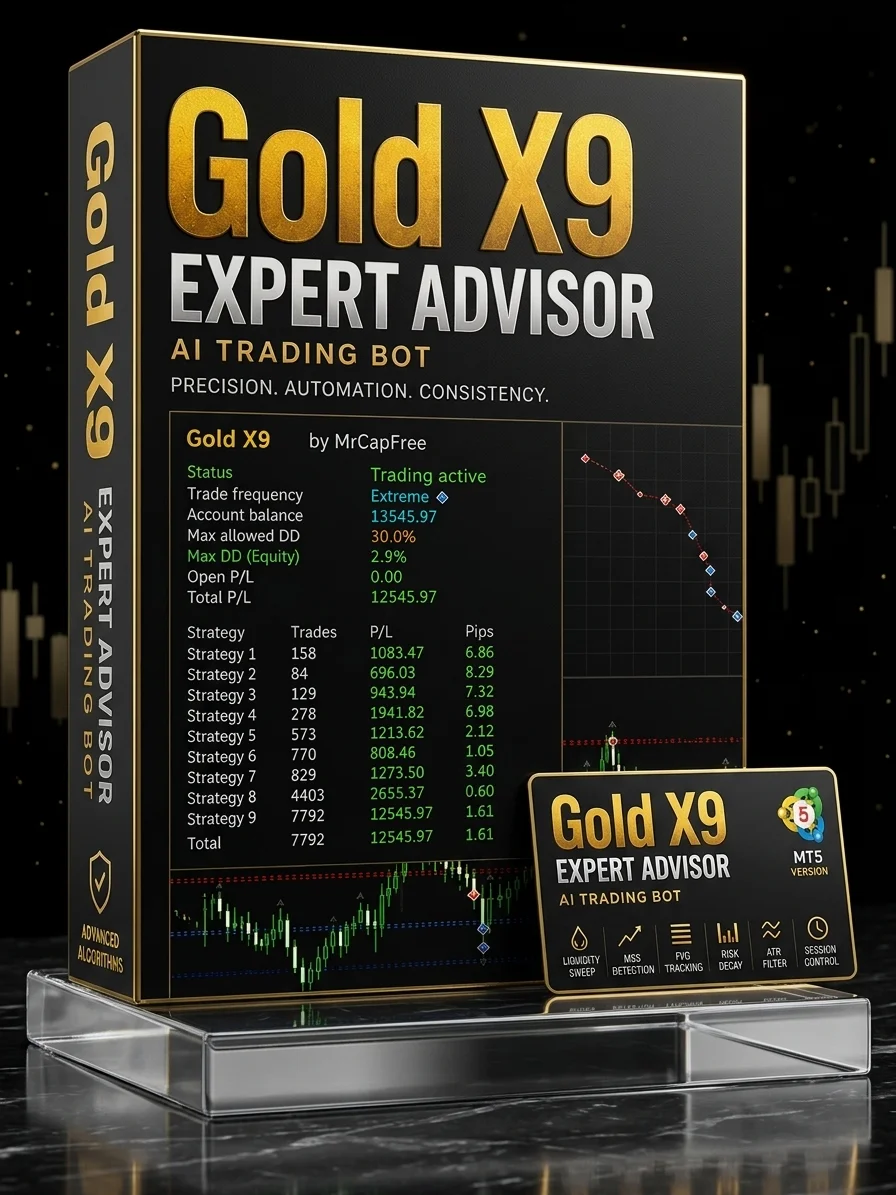
Apply the checks above to any of these before you buy: read the manual, run your own backtest, and start on demo.

Keep reading
- Buying guideEA Buying Checklist: 15 Questions to Ask Before You Pay15 questions to ask before buying an MT5 Expert Advisor: who built it, licence terms, backtest proof, risk logic, support and refunds, with a printable checklist.
- VerificationHow to Verify an EA Track Record: Myfxbook and MQL5How to read an EA track record on Myfxbook or MQL5 Signals: what verification proves, the numbers to check, fake-record tricks, and a 12-point checklist.
- BacktestingWhy EA Live Results Differ From Backtests (and What to Do)Why EA live results differ from backtests: spread, slippage, delay, data, overfitting and more. Eleven causes, how to check each and how to close the gap.
- OptimisationHow to Optimize an EA in MT5 Without OverfittingHow to optimise an EA in MT5 without overfitting: tester modes and criteria, how many inputs to use, plateaus versus spikes, forward testing and a process.
- StrategyMartingale Strategy Risks: Are Martingale EAs Safe?The maths of the martingale strategy in forex: how doubling works, how often a ruinous losing streak comes, how EAs disguise it, and a checklist to spot one.