
EA Verdict #2
The Gold Reaper EA Review (2026): 102 Weeks of Live Signal Data, Scored on 8 Criteria
By Benjamin Lee · Updated · 29 min read
Most gold EAs sell you a backtest. The Gold Reaper does something rarer: its developer runs a public MQL5 live signal that has been trading since October 2024, and anyone can open it. We read that record statistic by statistic, put it beside an independent stress test, the Market listing, its buyers' reviews and a third-party review, and scored the EA on the same eight criteria as every verdict here. The result is 59.3 out of 100, a Medium risk label and a more interesting story than a simple yes or no: strong evidence, a thin payoff per trade, and a drawdown that depends almost entirely on how much money you put in.
Key takeaways
- The Gold Reaper scores 59.3 out of 100 (band: Mixed) with a Medium risk label at the recommended capital. It is the first verdict in this series with a grade A record behind it, and the evidence earned the highest score in this series so far.
- The MQL5 signal shows 102 weeks, 895 trades, a 72% win rate and a profit factor of 2.33. But an average loss larger than the average win means the system lives on its win rate, and MQL5 itself flags that 80% of the growth arrived in 31 days.
- Drawdown is a sizing question, not a fixed number. An independent test puts the stressed drawdown at 7% on $8,000 and 96% on the $600 minimum deposit, with the same EA and the same trades.
- Reviews and the signal's own page show the other side: breakout fakeouts, weekend-gap fills, and copy-trading subscribers whose trades did not copy or slipped. A signal's numbers are not the numbers a buyer or copier receives.
- Our store lists an EA under the Gold Reaper name, so this is a review of a product we sell. It is scored by the same published method, and that disclosure leads the article.
- 59.3 / 100
- weighted verdict score on eight published criteria
- 102 weeks
- live MQL5 signal record read on 17 Oct 2026, 895 trades
- 7% to 96%
- stressed drawdown from $8,000 down to the $600 minimum, same EA, per an independent test
The verdict at a glance: a real record, a fragile minimum deposit
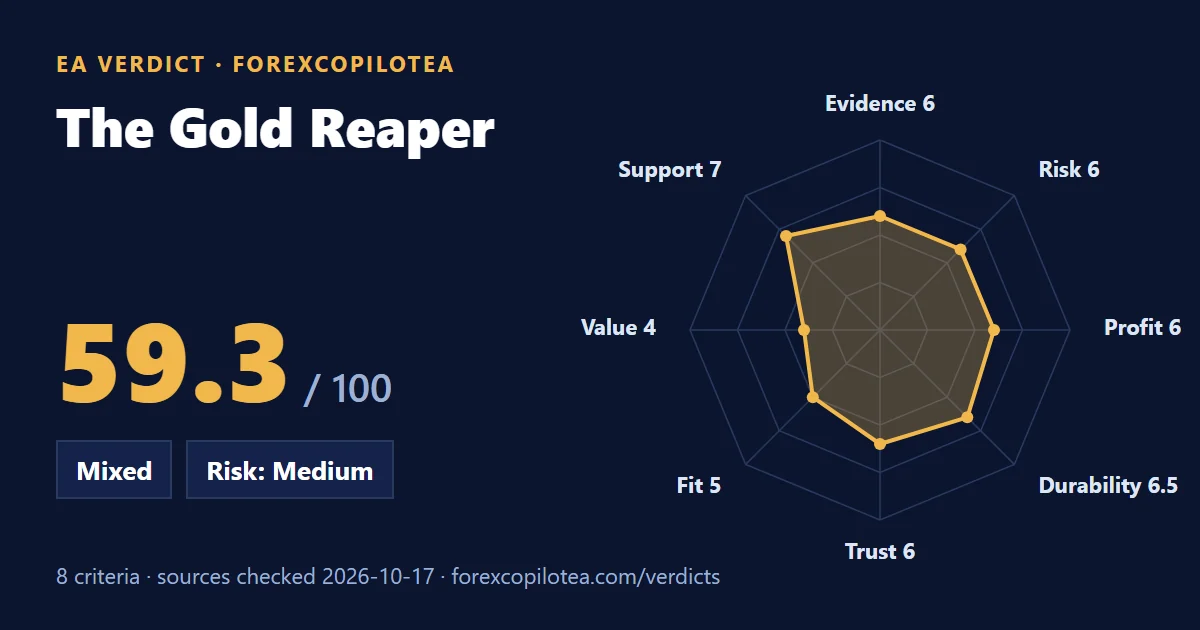
A verdict is a set of trade-offs, so here is the shape of this one before any detail. The Gold Reaper holds up where the last verdict did not: it has a long, platform-hosted, public record. It loses points where most breakout systems do: a modest payoff per trade, lumpy returns, and a drawdown that explodes on a small account. The table and radar show how the 59.3 was built.
59.3 / 100
Weighted verdict score
Mixed
Verdict band
Medium
Risk label
| Criterion | Weight | Score | Best evidence | Points |
|---|---|---|---|---|
| Verified evidence | 20 | 6/10 | Grade A | 12.0 |
| Risk and drawdown behaviour | 20 | 6/10 | Grade A | 12.0 |
| Profitability quality | 15 | 6/10 | Grade A | 9.0 |
| Sustainability | 15 | 6.5/10 | Grade B | 9.8 |
| Transparency and trust | 10 | 6/10 | Grade B | 6.0 |
| Practical fit | 10 | 5/10 | Grade B | 5.0 |
| Cost and value | 5 | 4/10 | Grade B | 2.0 |
| Support and usability | 5 | 7/10 | Grade B | 3.5 |
| Total | 100 | 59.3 |
What The Gold Reaper actually is
The Gold Reaper MT5 is an Expert Advisor for MetaTrader 5 sold by Profalgo Limited of Malta, run by developer Wim Schrynemakers. The seller profile shows a 4.1 rating from 1,010 votes, 27 products and 29 signals. The Market listing describes a breakout system for gold: it places pending orders beyond support and resistance levels it builds, across several timeframes at once, and the setup guide recommends the H1 chart. It was published on 1 February 2024 and showed version 5.4 on 14 October 2026.
It is not one strategy but several. An independent reviewer counted eight (daily, four-hour and hourly levels, by his own reading), while the NYCServers review says nine. Neither figure comes from an official table, which is a small but telling point about how much of the engine is visible from outside. The vendor's own pitch is that several internal strategies spread risk, and that randomisation of entries, exits and trailing values stops two accounts at one broker from trading identically.
| Item | What the listing says |
|---|---|
| Seller | Profalgo Limited (Wim Schrynemakers), Malta. Seller rating 4.1 from 1,010 votes. |
| Strategy | Breakouts of support and resistance across multiple timeframes. Every trade has a stop loss and take profit, plus trailing stop and trailing take profit. 'No grid / No martingale.' |
| Risk controls | Lot size derived from a maximum-allowed-drawdown input; optional maximum daily drawdown that closes trades and pending orders; Friday stop hour; optional NFP news filter; maximum spread. |
| Price | $949 to buy (the description says final price $990). Rental: $399 for 3 months, $499 for 6 months, $699 for a year. Ten activations. |
| Minimum balance | $600. |
| Reach | 34,316 demo downloads, 142 purchases a month, rating 4.49 from 117 reviews and 334 comments. |
| Extras | Set file for prop firms, manual, live signal link, on-chart info panel. |
How we judged it, and who has something to sell
Evidence on EAs is never neutral, so here is every party and its stake, ours included.
- The vendor sells the EA and runs the signal. His record is public and checkable, which is the point, but he also has every reason to run the signal well.
- ForexCopilotEA sells a listing called Gold Reaper. We gain if you buy it, which is why this verdict opens with that fact and why it applies the same rules we applied to Quantum Queen X.
- Diego Arribas Lopez wrote the independent MQL5 stress test. He says he has no tie to the developer, but he builds and sells competing EAs and the article carries Axi broker affiliate links.
- NYCServers reviewed it and sells the VPS hosting its pages promote. Its page does not carry a date we could read, so we treat its figures as undated.
- Buyers and signal subscribers wrote the reviews. Testimony, not data.
Evidence ladder: what each rung of proof held for The Gold Reaper
Grade A: Independent proof
- The MQL5 live signal 2265877: platform-hosted trade statistics for 102 weeks. The vendor operates it, so we weigh it below a fully independent record, but its numbers are generated from broker trades, not typed in.
- MetaQuotes and Myfxbook documentation used for how the Strategy Tester and track-record verification work.
Grade B: Checkable vendor material
- The Market listing: version, price, inputs, rating, dated reviews and developer replies.
- The free demo, the set file and the manual, which a buyer can inspect.
Grade C: Claim only
- 'No grid / no martingale / no risky risk management' as a sales claim; the signal's statistics are consistent with it, but they do not prove it for every setting.
- The NYCServers backtest and Myfxbook figures, which we could not date or trace to an account.
Grade D: Conflicted or anonymous
- Review sites that sell VPS hosting, competing EAs or affiliate broker accounts.
- 'Free download' copies of paid EAs: nothing on them can be trusted, and cracked files are a standard way to catch malware.
Grades C and D are reported but never scored as proof. A grade A record lifts the cap on the evidence criterion, and it has done so here, which is the biggest difference between this verdict and the last one.
102 weeks on a live MQL5 signal: what the record shows
The vendor's live signal, named Gold Reaper New V2 2, has been trading XAUUSD since 22 October 2024 on a CapitalPointTrading MT5 account at 1:500 leverage. At 35 dollars a month it has 68 subscribers. Because MQL5 generates the statistics from the broker's trade history, they are the closest thing this market has to an audited record. Here are the figures as we read them on 17 October 2026.
| Measure | Value | What it tells you |
|---|---|---|
| Time live | 102 weeks (started 22 Oct 2024) | Just under two years: long enough to span several gold regimes, not long enough to settle every doubt. |
| Deposit and flows | $1,602.85 start; $0 deposits; $100 withdrawn | No top-ups to mask drawdown. The curve is the account's own. |
| Result | Profit $5,350.18; balance $6,853.03; growth shown as 353.71% | MQL5's growth figure compounds; profit over the starting deposit is about 334%. |
| Trades | 895; 646 wins (72.17%); 249 losses | A high win rate, which the payoff section shows is necessary. |
| Profit factor | 2.33 | $9,359.19 gross profit against $4,009.01 gross loss. |
| Average win and loss | $14.49 win; $16.10 loss | The average loss is larger than the average win. |
| Drawdown | 6.58% maximal by balance; 16.89% relative by balance; 7.18% relative by equity | Three different drawdown measures; the largest reading is 16.89%. |
| Activity | About 4 trades a week; 4-hour average hold; trading on 31.5% of days | Sparse and bursty, as a breakout system should be. |
| Stated risk | '30% max DD' | A ceiling the vendor sets in the signal description, not a measured result. |
Read that table slowly, because two numbers in it pull in opposite directions. A profit factor of 2.33 and a recovery factor above 11 describe a system that has paid well for the risk it has run on this account. An average loss bigger than the average win describes one with little room for a bad patch. Both are true at once, and the next sections explain why.
The warning MQL5 itself prints
The signal page carries an automated notice that 80% of the growth came within 31 days, 4.36% of the signal's 711-day life. Earlier snapshots in its log show the same pattern: 29 days on 15 June, 26 days on 23 April, with notices saying the share of days for 80% of growth is 'too low'. In plain terms, most of the return arrived in a few bursts, and long stretches in between were flat or negative. The independent reviewer recorded +309% on 27 September; we read +353.71% on 17 October. Roughly 45 percentage points in three weeks is exactly what a burst looks like.
- Share of days that produced 80% of the growth4.36% (31 days)
MQL5 status notice, 17 Oct 2026.
- Share of growth produced in those days80%
The other 680 days produced the remaining 20%.
The signal also has gaps worth stating plainly. Its account tab labels it 'Running Latest Version of the EA' but shows no version number, and the independent reviewer, on 27 September, found an older version listed and noted its numbers are not comparable to a Strategy Tester run of the Market product. We therefore treat 'latest version' as a vendor statement we cannot check. The account type, real or demo, is not shown, and there is no month-by-month table or open-position view without a login. And the page's own warning log records 'no trading activity' notices from April to October 2026, including six idle days on 15 October. None of that is a defect in a breakout EA, which can sit still for days. It is a reason to judge the EA over months, not weeks.
How a breakout system makes money, and how it loses it
To judge The Gold Reaper you need to understand the family it belongs to, because its risks are the family's risks. A breakout system waits for price to leave a range and joins the move. The Gold Reaper does it with pending orders placed beyond levels it calculates, with a stop loss and a take profit on each trade. The same idea is explained from first principles in our VWAP breakout research; the picture below shows the single most important thing about it.
Where a grid wins small and loses big, a breakout system tends to lose small and win in bursts. That is a healthier shape, because each loss is capped by a stop placed before the trade, and the signal's own numbers match it: a worst consecutive loss of about $460 across five trades against a balance of several thousand. It is also why the equity curve looks like a staircase with long landings, not a ramp.
The cost of the shape is clustering. Fakeouts do not arrive one at a time; they arrive in choppy weeks. A reviewer on the Market page puts it bluntly, calling it a breakout system with frequent fakeouts that cause short-term losses. Another reports early losses on positions filled across a weekend gap, to which the developer replied that the Friday Stop Hour setting prevents it. Both complaints are structural, not scandalous: a breakout system is exposed to the exact moments breakouts fail, and the settings that manage that exposure are the buyer's to choose.
The overlap finding that matters most
The independent stress test found something a headline win rate hides: the sub-strategies are not independent. One strategy lost on 186 days, and another lost on 134 of the same days; a different pair overlapped on 19 of 38. About a third of the losses in the test's worst stress window came from a single strategy. Remove that strategy and the historical drawdown fell from 8.46% to 5.6%, at a cost of about $1,500 in profit. The practical lesson: eight strategies are not eight lottery tickets. They share days, so when one has a bad day several often do.
A 72% win rate with a payoff below one: the maths of living on your win rate
Look again at the signal's averages: $14.49 per winning trade, $16.10 per losing trade. Divide the average loss by the sum of both and you get the win rate a system needs just to break even: 16.10 / (14.49 + 16.10), which is 52.6%. The signal's actual win rate is 72.17%. That gap of about 20 percentage points is the whole cushion between a profitable record and a flat one.
Expectancy, the average profit per trade, follows: 0.7217 times 14.49, minus 0.2783 times 16.10, equals about $5.98, which is exactly the expected payoff MQL5 prints. Try it with your own figures below, and drop the win rate by ten points to see how quickly a payoff below one stops being a comfortable edge.
Interactive: win rate is not edge
- Expected result per trade
- +0.35
- Profit factor
- 1.64
- Break-even win rate
- 33%
At these numbers the system has a positive edge before costs. Add spread, commission and slippage per trade and re-check.
Why this matters beyond arithmetic: the NYCServers review lists a Myfxbook account for The Gold Reaper with a win rate of 72%, an average win of $20.94 and an average loss of $51.05. Breakeven there is 70.9%, so a 72% win rate left roughly one point of cushion, and the page reports a profit factor of 1.08 and a maximum drawdown of 41.66%. Same win rate as the signal, a very different payoff, a very different outcome. That page gives no date, no account link and no number of weeks, so we cannot say which version or risk setting produced it, and we grade it C. What we can say is that the same EA can show a profit factor of 2.33 or 1.08 depending on settings, broker and period, and that the win rate alone tells you almost nothing.
Drawdown depends on how much money you put in
This is the section that decides whether The Gold Reaper suits you. The EA sizes its lots from the account balance and a maximum-allowed-drawdown input. The independent reviewer's key finding is that this is a lot-sizing input, not a cap on losses: it tells the EA how big to trade, not when to stop. And at the minimum lot size the broker allows, a small account cannot trade small enough.
- $8,000 account7.2%
Comfortable.
- $4,000 account (the test's reference)14.3%
The test's planning figure, not the 8.46% historical one.
- $2,000 account28.7%
Close to the vendor's stated 30% ceiling.
- $1,000 account57.4%
More than half the account in a stressed run.
- $600 account (the listed minimum)95.6%
The vendor's minimum balance, stressed, leaves almost nothing.
Read that chart as the most important sentence in this verdict. The vendor's listed minimum deposit is $600; the independent stress test puts the 95th-percentile drawdown at the minimum lot size on a $600 account at 95.6%. The test measures drawdown between daily closes as a percentage of starting capital, uses 1-minute OHLC data and fixed 0.01 lots per strategy, so it is a model and not a promise. But it is the only independent attempt we found to answer 'what happens to a small account', and the answer is unambiguous: the minimum is a technical floor, not a safety level.
The signal's own drawdown, 16.89% relative by balance, sits between the $4,000 and $2,000 rows, which fits a signal account of a few thousand dollars. Our guides on drawdown and lot size and risk explain why the account you run it on matters more than the EA.
Interactive: drawdown recovery
Gain needed to get back to break-even
+42.9%
Blue: equity left. Red: equity lost.
Consecutive losing trades to reach this drawdown: 36
A drawdown has to be earned back, and the maths is not symmetrical. Lose 29% (the $2,000 row) and you need a 40% gain to recover; lose 57% and you need 133%; lose 96% and you need more than 2,000%. The comfortable rows are comfortable partly because they keep you out of that region.
The independent test, and its limits
The MQL5 blog test by Diego Arribas Lopez, published 14 October 2026, is the most thorough outside look we found, and its headline numbers are worth knowing. On Axi data from February 2020 to September 2026, using 1-minute OHLC modelling with a $4,000 reference deposit and fixed 0.01 lots, all eight strategies together earned $9,578.50. Fifty-three of 56 strategy-years were positive (2020 and 2026 are partial years). The worst historical drawdown was 8.46%, about $339. On a real-tick cross-check from November 2025 to April 2026, the win rate fell from 78.26% to 71.38% and money drawdown rose from $219.57 to $243.74: worse, without collapsing.
Its Monte Carlo stress test ran 1,000 scenarios built from 10-day blocks, with all strategies kept in sync, 10% of trades skipped at random and results scaled between 0.85 and 1.15 times. In 664 of the 1,000 scenarios the drawdown was worse than the historical 8.46%. The 95th percentile was 14.34% and the 99th was 17.89%. The author's conclusion is to plan on about 14%, not 8.46%, and he scores the EA 8 out of 10 with one big asterisk for small accounts. He would not run it on one.
Now the limits, because they are real. The test is a model run on history, not a live record. Spread, leverage and trade count are not stated, commission is zero in the reports, and Auto trade-frequency mode was not tested. The author sells competing EAs and uses broker affiliate links, which he discloses. The strategy timeframes are his own inference. For a general framework to check any such test yourself, see our guides to reading a backtest report and to whether backtests can be manipulated. Nothing here contradicts the live signal; it complements it. But two models and one live account are still a small sample of the market.
What buyers and signal subscribers say
The Market listing shows 4.49 from 117 reviews and 334 comments. Unlike the last verdict, the split here is closer to a normal distribution of experience: mostly satisfied buyers, a few unhappy ones, and a developer who replies with specifics. The dated reviews we could read tell a consistent story.
- Positive: a buyer reports passing a funded account and six months of payouts with low drawdown (14 September); another calls it efficient and easy for a beginner to set up (15 October); another reports a gain over about two and a half months, noting multi-day gaps then bursts of profit.
- Negative: a one-star review from 26 September reports losses after a month. The developer replies that the buyer saw about 5% drawdown on default settings while backtests allow up to about 30%, and recommends visual backtests.
- Structural: early losses from weekend-gap fills (answered with the Friday Stop Hour setting) and a reminder that breakouts bring frequent fakeouts.
- Setup friction: the AutoGMT news filter needs worldtimeserver.com on the terminal's allowed URL list, and at least one buyer asked about the prompt.
The signal page has its own 16 reviews and a 4.1 average, and they are a more useful warning than the product reviews. Several are not about the strategy at all; they are about copy trading. Subscribers report that trades were not copied, that broker symbol suffixes broke the mapping, that a $1,000 follower account against a leader balance of about $5,000 produced no copies, and that slippage turned the shown results into lower profits. One long-term reviewer compared it with five other gold signals and noted it was the only one with several consecutive losing days. A signal's numbers describe the signal account. A copier's results depend on their broker, deposit and latency.
Where the sources disagree
| Source | Refers to | Headline figures |
|---|---|---|
| MQL5 listing, 17 Oct 2026 | The Gold Reaper MT5 5.4 | Rating 4.49 from 117 reviews; $949; 142 purchases a month; 34,316 demo downloads; minimum balance $600. |
| MQL5 signal, 17 Oct 2026 | Gold Reaper New V2 2 | 353.71% growth in 102 weeks; 16.89% relative drawdown; profit factor 2.33; 72.17% win rate; payoff below one. |
| MQL5 blog test, 14 Oct 2026 | The Gold Reaper 4.6 | Backtest drawdown 8.46%; stressed 95th percentile 14.34%; 53 of 56 strategy-years positive; 8 out of 10 with a small-account asterisk. Listing then 4.45 from 115 reviews. |
| NYCServers (undated) | The Gold Reaper (version unknown) | Rating 4.46 from 92 reviews; $599, rental from $299; minimum balance $300; nine strategies; Myfxbook gain 14.98% with 41.66% drawdown and profit factor 1.08; backtest profit factor 2.72 and 12.43% drawdown. |
Three things stand out. First, the price: NYCServers shows $599 and a $300 minimum balance, the listing now shows $949 and $600. The listing's own copy talks of a final price of $990, so this is a rising-price mechanism like the last verdict's, only faster and without a published staircase. Second, the strategy count differs by one. Third, and most useful, the drawdown estimates range from 8.46% (backtest) to 16.89% (signal) to 41.66% (an undated Myfxbook account at moderate risk). They are not contradictions. They are the same EA run at different sizes, brokers and periods, which is exactly the point of the drawdown section.
The real price of The Gold Reaper
The sticker price on the Market is $949 to own, or $399, $499 and $699 to rent for three months, six months and a year. Renting is the sensible way to run a verification period: three months on your own broker costs well under half the purchase price, long enough to see a fakeout week, and it ends by itself. If the demo and the rental both pass your checks, buying is a separate decision.
Add the costs the sticker leaves out. A VPS is recommended for a 24/5 breakout system with pending orders. Slippage and the broker matter more than usual: the signal's own page lists slippage by broker, with most brokers near zero and a few not. And capital: on the evidence above, the account that makes the EA behave is $2,000 to $4,000 or more, which dwarfs the licence fee. The signal subscription at $35 a month looks like the cheap alternative, but as the buyers section shows, copy trading brings its own drag. Our store's listing is a separate sale; read its product page for its own version, terms and price.
Can your account actually run it?
- Capital. Plan around $2,000 as a floor for a 29% stressed drawdown and $4,000 for around 14%. The $600 minimum is technical.
- Broker. Tight spreads and clean pending-order execution matter. See our guide to spread, slippage and swap and to running EAs on gold.
- Hosting. A VPS keeps the EA running through the pending-order window. See the VPS guide.
- Prop firms. The listing calls it prop-firm ready and ships a set file, and the daily drawdown limit can close everything before a firm's limit. Rules vary and change; read how to use EAs with prop firms and check the firm's current terms before you pay a challenge fee.
- Weekends. Set the Friday Stop Hour. A weekend gap through a pending order is one of the few ways a stop-protected breakout system still takes a bigger loss than planned.
Will it last? Gold, breakouts and a moving target
Breakout systems need movement. Gold in a long, directional phase is their best friend; gold in a tight, choppy range is their worst. The 53-of-56 positive strategy-years across 2020 to 2026 suggest the edge has crossed several regimes, which is rare among gold EAs and counts in its favour. So does the product's age (published February 2024), the vendor's long catalogue of products and signals, and a release cadence that put version 5.4 on the listing on 14 October 2026.
Against it: the strategies overlap, so diversification is weaker than the count of eight implies; the record's best returns are concentrated in short bursts; and a constantly updated product means the version you buy may differ from the one on the signal. Our durability score reflects that balance: better than the last verdict, below a product with a multi-year, multi-regime verified record.
Criterion by criterion: how the 59.3 was built
Each score below is out of 10, multiplied by the criterion's weight, and sits inside the tier described by the written scoring anchors. The reasoning is short on purpose; the sections above carry the evidence.
| Criterion | Score | Points | Why |
|---|---|---|---|
| Verified evidence (weight 20) | 6 / 10 | 12.0 | A 102-week platform-hosted signal with 895 trades lifts the cap and earns real credit. Held back by the vendor operating it, a version the page calls latest but does not number, growth concentrated in 31 days, an unstated account type and no independent record of the exact current build. |
| Risk and drawdown (weight 20) | 6 / 10 | 12.0 | A stop on every trade, a daily drawdown limit and a signal drawdown of 16.89% earn credit. Held back because drawdown depends sharply on deposit (95.6% stressed at the $600 minimum), and a lot-size input is not a loss cap. Label Medium at the recommended capital, High at the minimum. |
| Profitability quality (weight 15) | 6 / 10 | 9.0 | Profit factor 2.33 and expectancy of $5.98 per trade on the signal, 53 of 56 positive strategy-years in the test. Held back by an average loss larger than the average win, lumpy returns and a profit factor of 1.08 on an undated account. |
| Sustainability (weight 15) | 6.5 / 10 | 9.8 | Nearly three years on the Market, several regimes survived in testing, frequent updates. Held back by overlapping strategies and version drift. |
| Transparency and trust (weight 10) | 6 / 10 | 6.0 | Public signal, manual, set file, documented inputs, specific developer replies. Held back by urgency pricing, an unofficial strategy count and a signal whose version match cannot be checked. |
| Practical fit (weight 10) | 5 / 10 | 5.0 | A prop set file and an info panel help. Held back by the $600 minimum that the test shows is fragile, broker slippage and gap sensitivity. |
| Cost and value (weight 5) | 4 / 10 | 2.0 | Premium and rising price, though a rental offers a low-cost test. Value depends on having the capital to run it properly. |
| Support and usability (weight 5) | 7 / 10 | 3.5 | A free demo with 34,316 downloads, a manual, a prop set file, an on-chart panel and replies to reviewers. Held back by small setup friction. |
Who it suits, and who should walk away
It may suit a trader with $2,000 to $4,000 or more earmarked for one gold strategy, who accepts breakout behaviour (small losses, bursts of profit, quiet weeks), who will rent or demo first, and who runs it on their own broker with a VPS and a Friday stop. The independent reviewer's own advice is that it works best as one gold component in a diversified portfolio, not as a whole-account solution.
It does not suit a trader trying to grow a $500 to $1,000 account, anyone who wants smooth monthly returns, anyone planning to copy the signal and expect the signal's numbers, and anyone who judges the EA by one month. If that is you, read our guide to spotting EA scams and forward testing on demo first.
If you want to test it: a 12-week plan
A breakout system needs more patience to test than a grid, because its edge shows up across choppy and trending stretches. Twelve weeks is a minimum, and the rental option is built for exactly this.
Step 1: Backtest the demo, with default settings and with a changed maximum drawdown
Use XAUUSD with real ticks and your broker's spread. Note the maximum equity drawdown at your intended account size, then change the maximum-allowed-drawdown input and watch how drawdown moves.
Step 2: Run it forward on a demo account for 12 weeks
Same broker, same account type, on a VPS. Log slippage, fills across the Friday close and the gap of any weekend.
Step 3: Compare your demo with the signal
Open the signal and compare trade counts, average win and loss and drawdown. A large gap points to your broker, settings or version, and is worth knowing before real money.
Step 4: Size from the drawdown, not the deposit
Choose the stressed drawdown you could accept and set the lot-sizing and daily drawdown limit to match, using the account-size chart above as a guide.
Step 5: Set a total-loss rule outside the EA
A fixed percentage of the account, enforced by an account-level stop or a manual rule.
Step 6: Rent before you buy
If the demo passes, a three-month rental on a small live account extends the test at limited cost.
What would move this score
- A signal or Myfxbook account running the current Market version on a regulated broker for 12 months or more, with growth spread more evenly across months. This is the largest single gain available.
- A published, official strategy table with each sub-strategy's timeframe and role. This raises trust and clarifies the overlap question.
- Official guidance on minimum capital that matches the stress-test results, rather than a $600 floor.
- A second independent stress test by someone with no competing product.
- Downward risks: a deeper drawdown on the live signal, a signal gap or removal, or a pattern of unresolved reports from buyers.
The vendor, or any reader holding verified records for the current build, can send them through the contact page. We will recalculate and log the change with the date at the top of this page.
How it compares with the last verdict
Set it beside our Quantum Queen X verdict, which scored 36.5 with a High risk label. The difference is not the strategy type alone. It is that The Gold Reaper has a public, platform-hosted record, a stop on every trade and a developer who shows his inputs, so the evidence criterion moves from 3 to 6 and the risk label from High to Medium. A grid and a breakout system can both be good, but the breakout system's losses are bounded before the trade, and the grid's are not. For a framework on choosing between them, see our strategy comparison and our gold category.
Sources and when they were opened
- MQL5 Market: The Gold Reaper MT5, Profalgo Limited (listing, reviews, developer replies), opened 17 October 2026Version, price, rental prices, inputs, requirements, rating, dated reviews and developer replies. Figures change; re-check before buying.
- MQL5 Signals: Gold Reaper New V2 2 (signal 2265877), opened 17 October 2026Platform-hosted statistics for 102 weeks, drawdown measures, status warnings and 16 subscriber reviews. Run by the vendor.
- MQL5 blog: The Gold Reaper MT5 Review, I Tried to Break It (14 October 2026)Independent stress test of version 4.6; the author builds competing EAs and uses broker affiliate links.
- NYCServers: The Gold Reaper Review (undated)Third-party review with undated Myfxbook and backtest figures; sells VPS hosting.
- MQL5 Market: Gold Reaper EA, Andrea Gerina (a different product)Cited only to distinguish it from The Gold Reaper MT5.
- Myfxbook Help: VerificationHow a trading account's track record is verified on Myfxbook.
- MetaTrader 5 Help: Testing ReportWhat each figure in the tester's report means, including drawdown.
- MetaTrader 5 Help: Strategy TestingThe Strategy Tester: testing modes, settings and forward testing.
- CFTC Customer Advisory: AI Won't Turn Trading Bots into Money MachinesA US regulator's warning about trading-bot claims of unusually high returns.
Frequently asked questions
Is The Gold Reaper EA legit?
It has a public MQL5 live signal running since October 2024 with 895 trades and a profit factor of 2.33, a seller with a long product history, and a developer who answers reviewers. That is more verifiable evidence than most gold EAs offer. It is not a promise of profit: drawdown depends heavily on account size and the signal's growth is concentrated in short bursts.
Does The Gold Reaper use martingale or grid?
The listing says no grid and no martingale, and every trade has a stop loss and take profit. The signal's statistics, a capped worst losing run and an average loss near the average win, are consistent with that. It is a breakout system, so its main risks are fakeouts, gap fills and overlapping losses between its sub-strategies.
What is the minimum deposit for The Gold Reaper?
The listing states $600. An independent stress test found that at minimum lot size a $600 account could see a 95th-percentile drawdown of about 95.6%, against 14.3% on $4,000 and 7.2% on $8,000. Treat $600 as a technical floor and plan on $2,000 to $4,000 or more.
How much does The Gold Reaper cost?
The MQL5 listing showed $949 to buy on 17 October 2026, with a stated final price of $990, or $399 for three months, $499 for six months and $699 for a year to rent. A third-party review had shown $599 earlier, so the price has risen. Add a VPS and the capital needed to run it safely.
Is The Gold Reaper good for prop firm challenges?
The listing calls it prop-firm ready and ships a set file, and its daily drawdown limit can close all trades before a firm's limit. Firm rules vary and change, and a $600-account drawdown profile is far too high for a challenge. Read the firm's current rules and run a demo under the same limits first.
Should I subscribe to the Gold Reaper signal instead of buying the EA?
Be cautious. The signal costs $35 a month, but several subscribers report trades that did not copy, symbol mapping failures and slippage, and the seller's own note recommends the real EA over copying. A signal's numbers describe the signal account, not a follower's.
Is 'Gold Reaper EA' the same as 'The Gold Reaper MT5'?
No. 'Gold Reaper EA' from seller Andrea Gerina is a different EMA trend-following product listed at $2,000. This verdict covers The Gold Reaper MT5 by Profalgo Limited (MQL5 product 111357). Check the seller name before you buy.
How was the 59.3 score calculated?
Eight weighted criteria (evidence 20, risk 20, profitability 15, sustainability 15, trust 10, fit 10, cost 5, support 5), each scored out of ten. Sources are graded A to D and unverified claims cannot count as proof. We sell a listing called Gold Reaper, which is disclosed at the top, and the same method scored Quantum Queen X at 36.5.
Gold Expert Advisors in our store
We sell these, so weigh that interest. Put the same eight questions to any of them before you buy: read the manual, run your own backtest, and start on demo.



Keep reading
- EA Verdict #1Quantum Queen X Review: Verdict and Risk (2026)Is Quantum Queen X worth $1,199.99? Independent EA verdict: 36.5/100, High risk. Evidence, drawdown, trust and cost scored from sources opened 17 Oct 2026.
- EA Verdict #3Global Trade Plan EA Review: Verdict and Risk (2026)Is Global Trade Plan EA worth $299? Independent EA verdict: 42.8/100, Medium risk. Verified Myfxbook record, drawdown, trust and cost scored, 17 Oct 2026.
- ResearchVWAP "Holy Grail" and Gold Breakout EAsWhat the VWAP and opening-range research really shows, why it does not transfer to XAUUSD unchanged, and a pre-registered protocol for testing any gold breakout EA.
- Strategy comparisonWhich EA Strategy Wins Long Term?Compare MT5 Expert Advisor strategy types, from scalping and grid to hedging and arbitrage: how each earns, how each fails, and which tend to survive long term.