
EA Verdict #1
Quantum Queen X Review (2026): The 5,000% Claim vs the Evidence, Scored on 8 Criteria
By Benjamin Lee · Updated · 29 min read
It costs $1,199.99. Its developer talks about 5,000% growth across 30 months. Its MQL5 page shows 4.14 stars from 86 reviews, and a comment section where buyers describe both quick profits and wiped accounts. We read the listing, every public comment we could load, the developer's replies and four outside reviews, then scored Quantum Queen X on eight criteria with a published method. The result is 36.5 out of 100, a High risk label, and a plain conclusion: the sales claim is much bigger than the proof behind it.
Key takeaways
- Quantum Queen X scores 36.5 out of 100 (band: Avoid for now) with a High risk label. The score is held down mostly by missing independent evidence, not by a proven failure.
- We found no independently verified live track record for Quantum Queen X itself. The product was published on 14 July 2026, so any long record belongs to the original Quantum Queen, which the vendor says it replaced.
- It is a gold grid system. A grid wins often and small, then takes its losses all at once. Reviewers report accounts of $700 to $3,000 going to near zero within days or weeks. The vendor says its risk controls exist and that losses are part of trading.
- Buyers have alleged incentivised reviews, an edited live signal and falsified backtests. The developer denies all of it publicly. None of it is proven, and we do not call the product a scam.
- If you still want to look at it, the free demo and an eight-week forward test cost nothing and answer more than any review can. A step-by-step plan is below.
- 36.5 / 100
- weighted verdict score on eight published criteria
- 4.14
- MQL5 rating from 86 reviews on 17 Oct 2026, down from 5.0 on 7 reviews in late July
- 0
- independently verified live records found for the X version
The verdict at a glance: where the points came from, and where they went
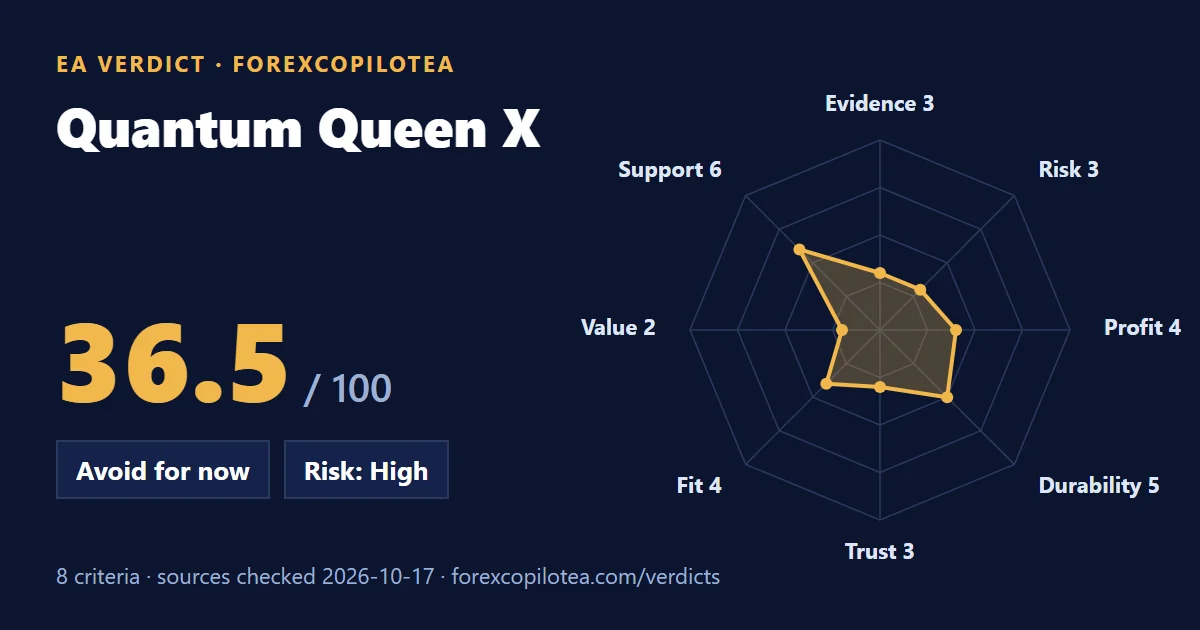
Most EA reviews hand you a star rating and a feeling. This one hands you the working. Eight criteria, each with a fixed weight, each scored out of ten, and each score tied to evidence of a stated quality. The full method is on the methodology page. The table and radar below are the result.
36.5 / 100
Weighted verdict score
Avoid for now
Verdict band
High
Risk label
| Criterion | Weight | Score | Best evidence | Points |
|---|---|---|---|---|
| Verified evidence | 20 | 3/10 | Grade C | 6.0 |
| Risk and drawdown behaviour | 20 | 3/10 | Grade C | 6.0 |
| Profitability quality | 15 | 4/10 | Grade C | 6.0 |
| Sustainability | 15 | 5/10 | Grade B | 7.5 |
| Transparency and trust | 10 | 3/10 | Grade B | 3.0 |
| Practical fit | 10 | 4/10 | Grade B | 4.0 |
| Cost and value | 5 | 2/10 | Grade B | 1.0 |
| Support and usability | 5 | 6/10 | Grade B | 3.0 |
| Total | 100 | 36.5 |
Read the shape before the number. A tall, even polygon would mean a product that is good at most things. This one is lopsided: usable and actively maintained, but thin exactly where a buyer of a grid system most needs thickness, which is proof that it survives bad weeks and a vendor who shows his working.
What Quantum Queen X actually is
Quantum Queen X MT5 is an Expert Advisor for MetaTrader 5, sold on the MQL5 Market by Bogdan Ion Puscasu, whose seller profile carries a 4.7 rating from about 2,800 reviews. It trades one symbol, gold (XAUUSD), and the listing describes it as 'an elite trend-following grid system that builds positions intelligently'. It was published on 14 July 2026 as the successor to the original Quantum Queen, which a reviewer at NYCServers reports as discontinued, and it was last updated to version 4.4 on 31 July 2026.
Under the hood it keeps what the vendor calls the same proven core engine as the original. What changed is the menu around it: 12 built-in strategies instead of the original's smaller set, nine of them switched on in the default preset (up from seven), plus a Custom Mode that lets the buyer turn individual strategies on or off. Four set files ship for specific broker and risk combinations.
| Item | What the listing says |
|---|---|
| Platform and symbol | MetaTrader 5, hedging account, XAUUSD only. Brokers that quote gold to three decimals are not supported. |
| Version and dates | 4.4. Published 14 Jul 2026, last updated 31 Jul 2026. |
| Price | $1,199.99, one-time. Rises $50 for every 10 purchases, final price $1,999. Ten activations. |
| Deposit and leverage | Minimum $500 at 1:500 leverage, $1,000 recommended. Leverage of 1:100 or more required. |
| Hosting | VPS marked mandatory for 24/7 operation. |
| Strategies | 12 built in, nine on by default, Custom Mode to switch them individually. |
| Set files | Four: VT Markets or IC Markets Raw at medium risk, the same at low risk, Roboforex ECN, Fusion Zero. |
| Manual | Delivered after purchase by private message to the seller. |
| Reach | 11,322 demo downloads, 39 purchases a month, rating 4.14, 86 reviews and 142 comments. |
Two details in that table matter more than they look. First, the manual arrives after you pay, so you cannot read the risk controls before buying; the public description names no stop-loss, equity-stop or news-filter setting, only that 'capital preservation remains one of the core principles'. Second, the price climbs with sales: the more people buy, the more the next buyer pays. That is a pricing mechanism, not evidence of quality, and we come back to it in the cost section.
How we judged it, and who has something to sell
A verdict is only as good as its sources, so here is the uncomfortable part first. Almost everything written about Quantum Queen on the open web comes from someone with a stake in it. That includes us.
- The vendor sells the EA and answers critics in the comments of his own listing. His statements are useful and are reported, but a sales claim is a claim.
- NYCServers published two Quantum Queen reviews and sells the MT5 VPS hosting that its own review calls mandatory for the EA. Its X review (22 July 2026) ends with advice to watch and test, not to buy on performance expectations.
- Forex Robot Lab published a data-led review of the original. Its author sells EAs on MQL5, so he competes in the same category, and the page does not say whether any link earns commission.
- Oreshnikbot analysed four public Myfxbook accounts. It discloses no affiliate relationship and says it has not run the EA itself.
- Buyers wrote the MQL5 comments. Some are verifiable only by their own say-so, and some may be competitors, friends of the vendor or bots. We read them as testimony, not data.
- ForexCopilotEA sells MetaTrader 5 Expert Advisors, including gold systems that compete with this one. We neither sell Quantum Queen X nor earn from it, but you should weigh our interest too.
Evidence ladder: what each rung of proof held for Quantum Queen X
Grade A: Independent proof
- MetaQuotes and Myfxbook documentation, used for how hedging accounts, the Strategy Tester and track-record verification work.
- No independent, verified live performance record for Quantum Queen X. This is the single biggest gap in the verdict.
Grade B: Checkable vendor material
- The MQL5 listing: price, version, requirements, rating, the dated comments and the developer's replies.
- The free demo, which anyone can download and run.
Grade C: Claim only
- The vendor's 5,000% growth over 30 months of live trading, quoted in a reply and not tied to a record we could open.
- Reviewers' self-reported profits and losses, and the figures Oreshnikbot reports from four Myfxbook pages we did not open ourselves.
Grade D: Conflicted or anonymous
- Review sites that sell the VPS, competing EAs or related services, and anonymous commenters.
- 'Free download' pages for Quantum Queen: pirated copies of paid EAs are a common way to catch malware, and nothing on them can be trusted.
Grades C and D are reported but never scored as proof. That is why the evidence criterion is capped at 4 out of 10 unless a grade A record exists, and why the score in this verdict will move when new proof arrives, in either direction.
The 5,000% claim: what is proven and what is not
In a reply to a buyer on 13 October 2026, the developer cites 'over 30 months of live trading and over 5,000% growth'. It is the biggest number attached to the product and the first one every buyer meets. So test it the way you would test any extraordinary claim: who can check it, and what would it prove if true?
Problem 1: it is not a record of this product
Quantum Queen X went on sale on 14 July 2026. Thirty months of trading must therefore belong to the original Quantum Queen, or to the engine behind it. The vendor says the engine is shared, which is a fair argument, but 'same engine' is not 'same results'. The X version runs nine strategies by default where the original ran fewer, and a different mix of strategies is a different risk profile. A track record travels with the exact configuration that produced it.
Problem 2: the record is disputed
Three buyers allege that the live signal was edited or removed, and two say deposits were added during drawdowns, which would lower the drawdown the signal reports. A fourth reports the signal facing a drawdown above 85%. The developer replies that deposits and withdrawals are normal, that the signal ran for 30 months and that a signal hosted on MQL5 cannot be manipulated. We could not open a current signal for the X version from the listing, which links a public channel and a sibling product but no signal. We make no finding on the allegations; we note only that the claim cannot currently be checked by a buyer.
Problem 3: percentage growth hides the money flow
Percentage gain is the easiest number in trading to inflate, because it depends on the starting balance. A $100 account that makes $900 shows 900%; so does a $10,000 account that makes $90,000, and only one of those is hard. The Forex Robot Lab review of the original's official signal reports a growth figure of around 900% from a $100 start, with roughly $6,000 deposited and about $7,600 withdrawn along the way. Deposits and withdrawals inside the record make the curve a poor guide to what a single deposit would have done. Myfxbook explains in its verification documentation how a track record becomes verified. A verified account with a long history, one broker and a stable deposit is the standard to look for.
Five sources, five different sets of numbers
Here is a small thing that tells you a lot: put every public figure about Quantum Queen on one table and they do not agree. Some of that is time passing. Some of it is different products, a different starting point, and different settings. All of it is a reason to trust nobody's headline.
| Source | Product | Headline figures |
|---|---|---|
| MQL5 listing, 17 Oct 2026 | Quantum Queen X 4.4 | Rating 4.14 from 86 reviews, 142 comments, $1,199.99, 11,322 demo downloads, 39 purchases a month. |
| NYCServers review, 22 Jul 2026 | Quantum Queen X 4.3 | Rating 5.0 from 7 reviews, $1,099.99, 2,006 downloads, about 97 purchases a month. No backtest, drawdown or profit figures. Verdict: watch and test. |
| NYCServers review of the original | Quantum Queen | 4.98 from over 400 reviews, $1,299.99, claims of +214% growth, about 12% a month and drawdown under 22%, with no linked record. Martingale removed in version 2.0 (May 2025). |
| Forex Robot Lab, Nov 2025 data | Quantum Queen (original) | Official signal about +900%, win rate about 76%, profit factor about 2.8, maximum drawdown above 36%, margin use up to 94%. |
| Oreshnikbot, four Myfxbook accounts | Quantum Queen (original) | One account +2,093% with 25.47% drawdown; one account down 96.6% in 12 days; one +244% ending with $31.11; one demo +95.5% with 2.79% drawdown. |
Look at the first two rows together. In under three months, with the product itself unchanged apart from a point release, the rating moved from 5.0 to 4.14, the review count from 7 to 86 and the reported purchase rate from about 97 a month to 39. A rating of five stars on seven reviews is an anecdote; 4.14 on 86 is the start of a distribution. And in the second row, a drawdown of under 22% claimed for the original sits beside above 36% reported from its official signal and 97% on one buyer's account. The difference between those numbers is the whole story of grid trading: the headline drawdown depends on whose account and when.
- Vendor-quoted, per NYCServers (no linked record)under 22%
A claim, not a record.
- Oreshnikbot: vendor's own Myfxbook account25.47%
Reported as the best case.
- Forex Robot Lab: official signal, Nov 2025above 36%
Also reports peak margin use of 94%.
- Oreshnikbot: XM account, 12 days in Oct 202597.06%
A $10,000 deposit, about $9,900 withdrawn per the report.
Inside the engine: how a gold grid makes money, and how it loses it
To judge Quantum Queen X you do not need its code, which the vendor keeps closed. You need to understand the family it belongs to, because its risk is the family's risk. The listing calls it a trend-following grid. The Forex Robot Lab review describes the original's behaviour as scalping combined with averaging down over a small price range, adds buy positions at tight intervals as price moves against it, then closes the whole basket once it is collectively in profit, and records 3,071 buys against 230 sells in its backtest. Our guide to martingale and grid EAs covers the mechanics in depth; here is the part that matters for this verdict.
A grid is a machine for being right often. Because it keeps adding buys as price falls, it only needs a modest bounce to close a basket in profit, so its win rate is high: Forex Robot Lab reports about 76% for the original's signal. The catch is the shape of the losses. The wins are small and frequent; the losses are rare and large, because the basket was growing the whole time price was falling. You are paid in small coins for years and then charged in one lump.
A pure martingale makes the lump worse by raising the lot size at each step. The NYCServers review says version 2.0, released in May 2025, removed martingale from all the original's strategies, and the X listing does not say whether lot multiplication is back. We could not confirm either way, so we make no claim. Removing martingale reduces how fast the basket grows. It does not remove the grid's central exposure to a long, one-way move against the open positions.
A worked example, with invented numbers
The vendor does not publish lot size, grid spacing or position caps, so this is arithmetic, not the EA's settings. On most brokers one standard lot of gold is 100 ounces, so a 0.02 lot position is 2 ounces and moves $2 for every $1 gold moves. Suppose ten such buys are open. If gold falls another $30, the floating loss grows by 10 positions times 2 ounces times $30, which is $600, on top of whatever was already underwater. The vendor's minimum deposit is $500 and the recommended one is $1,000. That is the whole problem in one line: the cost of a normal bad move can be larger than the account the product is sold to.
Now the recovery arithmetic, which is unforgiving. Lose 25% and you need a 33% gain to be whole. Lose 36% and you need a 56% gain. Lose 97%, as one account in the Oreshnikbot sample reportedly did in twelve days, and you need a gain of roughly 3,200%. Try your own numbers below.
Interactive: drawdown recovery
Gain needed to get back to break-even
+42.9%
Blue: equity left. Red: equity lost.
Consecutive losing trades to reach this drawdown: 36
The vendor's answer, in replies to critics, is that the system includes drawdown control, a maximum number of open positions and low-risk presets, and that the manual describes them. That may well be true, and it is exactly why the manual should be public. A buyer deciding whether a $1,000 account can survive a grid should be able to read how the controls work before paying. Today they cannot.
What real accounts and real buyers say
We loaded the dated comments under the MQL5 listing on 17 October 2026. Of the 142 the page counts, 20 distinct comments were readable in our capture, written between 26 September and 16 October. The sample is small and it is not random, so treat the split as a mood, not a measurement. Our reading of those 20: five positive, two neutral or blank, thirteen negative.
- Negative: reported losses, blown accounts or warnings13 of 20
Includes 7 posted on 7 October alone.
- Positive: satisfied, profitable, or recommending5 of 20
Posted 26 Sep to 12 Oct, mostly after days or weeks of use.
- Neutral or blank2 of 20
One comment carried no text.
Look at what the positive comments have in common: they come from the first week or two. 'After a week of using Quantum Queen, I'm very satisfied with the profit.' 'The first week has been smooth and consistent.' One buyer reports two profitable months with a fixed 0.02 lot, a cap of ten positions and a $200 stop loss. Those are the settings of someone managing the risk from outside the EA, which is worth noticing. The negative comments cluster around a different moment: seven of the 20 were posted on 7 October, describing losses in the days before.
- A buyer reports running original parameters at 0.01 lot on about €700 and reaching zero between 5 and 7 October.
- A buyer reports an account falling from about $2,500 on 1 October to $20 by 7 October.
- A buyer who paid $1,199 plus VAT reports two accounts going to zero, on a $3,000 account at low-to-medium risk, adding that 'any bot worth 50 USD could lose the same amount'.
- Another buyer reports a $2,000 account lost after nearly a month of testing.
These are self-reports and we cannot verify them. Nor could we tell from the page whether the losses followed the vendor's recommended presets, a particular broker or a particular lot size. The developer replies to these buyers with regret, noting that even conservative settings cannot remove losses, and pointing to the risk presets and the drawdown protection described in the manual. We did not run the EA in a live account, so we cannot say who is right in any single case. What the pattern does suggest is simple: the honeymoon is the first week, and a grid's real exam is a fast, one-sided move.
What the outside Myfxbook analysis adds
Oreshnikbot reviewed four public accounts running the original. The vendor's own account, active since April 2024, shows +2,093% with 25.47% maximum drawdown, $7,210 deposited and $9,625 withdrawn, labelled by the author as the best case. A $10,000 account at XM, run for twelve days in October 2025, lost 96.6% with a maximum drawdown of 97.06%, while $9,900 had been withdrawn, which the author reads as the owner taking most of the money out first. An FBS account shows +244% growth after $15,106 in deposits and $23,952 in withdrawals, with a balance of $31.11. A demo account shows +95.51% with 2.79% drawdown and no withdrawals. The author says the vendor does not appear to maintain a verified Myfxbook account, that the logic is not publicly disclosed and that the correct reading is neither 'buy' nor 'avoid', because the setup matters more than the EA.
We did not open those four Myfxbook pages ourselves, so we grade this material C: reported, checkable by you, but not yet checked by us. It does support one point we are confident about. The same EA produced the best and the worst outcomes in this sample. A product with a spread that wide is a product whose results depend more on the buyer's lot size, deposit and timing than on anything the vendor can promise.
The allegations, and what the developer says back
Four serious claims appear in the public comments. We report them because they affect trust, and we report the developer's answers in the same breath, because an allegation is not a finding.
| Allegation | Raised by | Developer's reply | Our status |
|---|---|---|---|
| Five-star reviews are incentivised with free EAs | Two buyers | Says he has never asked anyone for a five-star review in exchange for a free EA, and says one critic demanded a refund while threatening a negative review. | Unproven. The listing does offer a chance of a free sibling EA on purchase, and does not link it to reviews. |
| The live signal was edited, with deposits added in drawdowns, and later removed; one buyer reports it facing a drawdown above 85% | Four buyers | Says deposits and withdrawals are normal, the signal ran for 30 months, and a signal hosted on MQL5 cannot be manipulated. To the 85% claim he answers that the label of scam is misleading and cites the product's ranking and 5,000% growth. | Unproven. No current signal link on the listing, so a buyer cannot check it. |
| Backtests were falsified or over-optimised | Two buyers | Says backtests closely match live results. | Unproven. The vendor's backtest settings are not published in a form a buyer can reproduce. |
| Negative comments were deleted from the group chat | One buyer | Does not address it directly. | Unverifiable from public pages. |
One further allegation is worth a sentence: that the X version was published on 14 July 2026 because the previous version had blown accounts. That is a motive, and motives cannot be established from a listing. What can be said is neutral: a new product name resets the visible record, and a buyer who wants a long record must ask which version produced it. Our rule of thumb for all of the above is the one we apply to any vendor. The remedy for a disputed track record is not a more forceful denial or a more forceful accusation. It is a verified account, open to inspection, running the exact product on sale.
Profitability: impressive-looking numbers on weak footing
The most detailed public backtest we found is by the Forex Robot Lab author, run on the original: XAUUSD, 1 January 2005 to 28 November 2025, $10,000 start, a 30-point spread, default parameters, 98% history quality, about 25.5 million ticks. It reports 3,301 trades, a profit factor of 3.40, net profit above $4,300 at a fixed 0.01 lot, a maximum equity drawdown of about $2,284 and a longest losing streak of 22 trades totalling about $537.
On its face that is a handsome profile. Two features keep it from scoring higher. First, the test is not on the X version. Second, the same author notes that real trades begin around 2018 rather than 2005, and wonders whether unfavourable periods are filtered out. That is the author's inference, not a confirmed finding, but it points to the right question for any backtest: does the strategy trade through all the years it claims to cover? Our guide to reading a backtest report and our note on whether backtests can be manipulated explain how to check.
There is also a scale trap. NYCServers quotes a vendor-side backtest of the original from 2018 to 2024 in which $10,000 becomes more than $21 million, with an 87.85% win rate and 18.64% drawdown. The Forex Robot Lab fixed-lot run turns $10,000 into roughly $14,300. Both can be arithmetically honest. The first compounds, so lot size grows with the balance; the second does not. Compounding explains the gap, and it also explains why the first figure is the least informative: compounded results get dominated by the last few good years and say nothing about what the same lot size would do in the worst one.
Return against drawdown is the sturdier measure. The fixed-lot backtest earns about 1.9 times its maximum equity drawdown. That is respectable, and it is also not the profile of a machine that turns a small account into a large one without taking large risks. The two things you can read from this section with confidence are that the edge is plausible and that no independent party has measured it on the product you would be buying.
Will it last? Gold, regimes and a relaunch
A trend-following grid on gold is a bet on a particular kind of market. It likes gold that trends with pullbacks small enough for baskets to close, and it dislikes sharp, one-way moves against a long position. The backtest's lopsided 3,071 buys to 230 sells fits that: the system leans long. A strategy that leans one way is making a regime bet, and regime bets do not announce the day they stop working. Our guide to running EAs on gold goes through what makes the metal different.
In its favour: the vendor has shipped point releases quickly (4.3 on 22 July, 4.4 on 31 July), his seller profile carries about 2,800 ratings, and the engine has been in the field for years. Against: the product's logic is closed, the strategy mix changed in the relaunch, and a relaunch means the visible track record of the exact product restarts at zero. We scored durability at the midpoint: real signs of upkeep, but no evidence yet that this configuration has been through a hard year.
The real price of Quantum Queen X
The sticker price is $1,199.99. NYCServers recorded the price as $1,099.99 on 22 July. The vendor's stated rule is $50 more after every 10 purchases, ending at $1,999. Here is what that staircase looks like from where you would be standing.
Dynamic pricing is legal and common, and it does one thing very well: it makes waiting feel expensive. That is a sales mechanism, and it is worth separating from the question that matters, which is whether the evidence is worth the price today. Waiting for evidence costs nothing. Whatever you decide, read the refund terms on the Market page before you pay, because a rising price is a poor reason to skip that step.
Then add what the listing calls mandatory. A VPS is required for 24/7 running, which is a recurring bill the sticker price leaves out. Add the broker conditions (a hedging account with two-decimal gold, ideally a raw-spread ECN account), and the capital: the vendor's own recommendation is $1,000, and the buyers describing losses were funding accounts of $700 to $3,000. For a trader starting with $1,000, the EA can cost more than the account it trades. That is not a reason to avoid it by itself, but it is a reason to count the total, not the sticker.
Can your account actually run it?
- Broker. Hedging account, gold quoted to two decimals, low spread. The set files name VT Markets, IC Markets Raw, Roboforex ECN and Fusion Zero. Not every retail gold account will qualify.
- Leverage. The vendor recommends 1:500. NYCServers notes that this level may require an offshore broker, which brings its own protections and risks. Our broker guide covers what to check.
- VPS. Mandatory according to the listing. See our VPS guide.
- Prop firms. Grid and hedging approaches are restricted or disallowed by many firms, and both the NYCServers and Forex Robot Lab authors advise against prop use. See why some EAs do not suit prop firms.
- Account size. The vendor's $500 minimum is a technical floor, not a safety level. Reviewers describe losses on accounts well above it.
Criterion by criterion: how the 36.5 was built
Each score below is out of 10, multiplied by the criterion's weight, and sits inside the tier described by the written scoring anchors. The reasoning is short on purpose; the sections above carry the evidence.
| Criterion | Score | Points | Why |
|---|---|---|---|
| Verified evidence (weight 20) | 3 / 10 | 6.0 | Nothing independent measures the X version. Not zero, because the listing is checkable, dated comments are public and a free demo lets anyone test it. Capped at 4 by our rule; the open disputes put it at 3. |
| Risk and drawdown (weight 20) | 3 / 10 | 6.0 | A grid with no published hard stop, drawdowns from under 22% claimed to 97% reported, and buyer reports of near-total losses. Vendor-named drawdown control and position caps earn the points above zero. Label High, not Extreme: the total-loss reports are unverified here. |
| Profitability quality (weight 15) | 4 / 10 | 6.0 | A plausible edge on the original: profit factor 3.40 in an outside backtest, about 1.9 times return on maximum equity drawdown. Not on X, and the signal growth figures mix in deposits and withdrawals. |
| Sustainability (weight 15) | 5 / 10 | 7.5 | Quick updates and an established vendor, offset by a long-biased, regime-dependent design, a changed strategy mix and a relaunch that resets the record. |
| Transparency and trust (weight 10) | 3 / 10 | 3.0 | Closed logic, a manual after payment, a free-EA bonus on purchase and open disputes. Credit for a vendor who answers critics by name, in public. |
| Practical fit (weight 10) | 4 / 10 | 4.0 | Narrow broker conditions, mandatory VPS, high recommended leverage, poor prop-firm fit, and a minimum deposit below the capital that survives its drawdown. |
| Cost and value (weight 5) | 2 / 10 | 1.0 | Premium, rising price plus VPS and deposit, with no verified record to match. The first criterion to move if proof appears. |
| Support and usability (weight 5) | 6 / 10 | 3.0 | A free demo with over 11,000 downloads, four set files, ten activations and a vendor who replies. Held back by a manual behind a private message. |
Who might consider it, and who should walk away
It may suit an experienced trader who already understands grid risk, has money they can afford to lose in full, runs the product on demo for weeks first, and sizes the live account so that a gold move against the whole basket is survivable. That person is not buying a promise. They are buying a tool whose behaviour they have measured.
It does not suit a first-time EA buyer with a $500 to $1,000 account, anyone who expects a smooth curve, anyone planning to use it on a prop-firm challenge, and anyone buying because the price will rise next week. If any of those describes you, the sensible next step is our guide to spotting EA scams and our grid and martingale risk guide, not a checkout page.
If you still want to test it: an eight-week plan that costs nothing
The listing offers a free demo and the MetaTrader 5 Strategy Tester is free. That means you can gather your own grade A evidence before spending a cent. This plan follows the workflow in our forward-testing guide.
Step 1: Backtest with real ticks
Run the demo in the Strategy Tester using real tick data, a spread that matches your broker, and the preset you would actually use. Note the maximum equity drawdown, not the balance one. How to read the report.
Step 2: Run it forward on a demo account for eight weeks
Use the exact broker and account type you would trade live, on a VPS, so the test includes real spreads, requotes and swaps. Log every week.
Step 3: Find its worst week and measure it
Record the deepest floating loss on equity, the number of positions open and how long recovery took. A grid is judged on its worst day.
Step 4: Stress the size
Project the worst floating loss at your intended lot size against your intended deposit. If it exceeds what you can lose, the lot size is wrong, not the maths.
Step 5: Set your own hard stop
Decide a total-loss limit in advance (a fixed percentage of the account) and enforce it outside the EA, with an account-level equity stop or a manual rule. Do not rely only on the product's internal controls.
Step 6: Go live small, if at all
If the demo passes, start with a sum you can lose completely and treat the first live month as a continuation of the test, not a result.
What would raise this score
The score is not a verdict on a person. It is a measure of what can be checked. Here is what would move it, in order of effect.
- A verified Myfxbook or broker-verified record for Quantum Queen X, 12 months or more, on one account. This alone could add as much as 10 weighted points through the evidence criterion and lift the profitability score too.
- A public manual describing every drawdown control, and the set file values. Raises trust, risk and support together.
- A published, reproducible backtest with settings, ticks source and every year traded.
- An independent test of the X version by someone with nothing to sell.
- Resolution of the public disputes about reviews and the signal, whichever way the facts fall.
If you are the developer, or hold any of the above, contact us with the evidence. We will recalculate and log the change with the date at the top of this page.
How to compare it with other gold EAs
Do not compare names; compare answers. Put the same eight questions to every gold EA you consider, including ours: is there an independent record for this exact version, what is the worst drawdown measured on equity, is there a hard stop, what does it cost in total, and can I read the manual first? Our strategy comparison shows how grid, martingale, scalper and trend systems differ in the shape of their risk, and our gold EA category lists the gold systems we sell, each with its own manual and set file. We have a commercial interest in that suggestion, so apply this page's method to us too. Our Gold Reaper verdict applies the same method to a breakout system, with a very different result.
Sources and when they were opened
- MQL5 Market: Quantum Queen X MT5 (listing, comments and developer replies), opened 17 October 2026Version, price, requirements, rating, comments, developer replies and the stated pricing rule. Figures change; re-check before buying.
- NYCServers: Quantum Queen X Review (22 July 2026)Third-party review of version 4.3; sells MT5 VPS hosting. Ends with a watch-and-test conclusion.
- NYCServers: Quantum Queen EA Review (original product)Source of the vendor-side claims for the original (version 2.0 martingale removal, 4.98 rating, drawdown and growth claims). Promotes its own VPS service.
- Forex Robot Lab: Quantum Queen MT5 ReviewOwn backtest and signal analysis of the original; author sells EAs on MQL5.
- Oreshnikbot: Quantum Queen EA review of four Myfxbook accountsSecondary analysis of public Myfxbook accounts for the original; we did not open the accounts ourselves.
- Myfxbook Help: VerificationHow a trading account's track record is verified on Myfxbook.
- CFTC Customer Advisory: AI Won't Turn Trading Bots into Money MachinesA US regulator's warning about trading-bot claims of unusually high returns.
- MetaTrader 5 Help: Testing ReportWhat each figure in the tester's report means, including drawdown.
- MetaTrader 5 Help: Basic Principles of Trading OperationsOrders, deals and positions, and how netting and hedging accounts differ.
Frequently asked questions
Is Quantum Queen X a scam?
We have no evidence that it is, and we do not say so. We found no independently verified live record for the X version, buyers have alleged incentivised reviews and an edited signal, and the developer denies this publicly. Those allegations are unproven. What we can say is that its risk is high and its track record cannot currently be checked.
Does Quantum Queen X use martingale?
The X listing does not say. NYCServers reports that version 2.0 of the original, in May 2025, removed martingale from all strategies. It is still described as a grid system, which means it adds positions as price moves against it. Removing martingale slows the basket's growth but does not remove the grid's exposure to a long one-way move.
How much does Quantum Queen X cost in total?
The listing price was $1,199.99 on 17 October 2026, rising $50 for every 10 purchases to a final $1,999. Add a mandatory VPS, a hedging account with two-decimal gold and the deposit itself: the vendor recommends $1,000, and reviewers describe losses on accounts of $700 to $3,000.
What minimum deposit does Quantum Queen X need?
The vendor states $500 at 1:500 leverage as the minimum and $1,000 as recommended, with 1:100 leverage as the floor. Treat the minimum as a technical limit rather than a safety margin: a ten-position grid at 0.02 lot can lose $600 on a $30 gold move, as the worked example in this verdict shows.
Can I use Quantum Queen X on a prop firm challenge?
It is not recommended. Reviewers at NYCServers and Forex Robot Lab both advise against prop use, and many firms restrict grid and hedging approaches or impose daily and total drawdown limits that a grid can breach. Check each firm's current rules before using any EA.
Is there a free way to test Quantum Queen X?
Yes. The MQL5 listing offers a free demo, and the MetaTrader 5 Strategy Tester is free. Backtest with real ticks, forward test on a demo account at your broker for eight weeks, and measure the worst floating loss on equity before paying.
How is this verdict score calculated?
Eight criteria with fixed weights (evidence 20, risk 20, profitability 15, sustainability 15, trust 10, fit 10, cost 5, support 5), each scored out of ten and weighted to a total of 100. Sources are graded A to D and unverified claims cannot count as proof. The full method is on the methodology page.
Gold Expert Advisors in our store
We sell these, so weigh that interest. Put the same eight questions to any of them before you buy: read the manual, run your own backtest, and start on demo.



Keep reading
- EA Verdict #2The Gold Reaper EA Review: Verdict and Risk (2026)Is The Gold Reaper worth $949? Independent EA verdict: 59.3/100, Medium risk. Live signal, drawdown, trust and cost scored from sources opened 17 Oct 2026.
- Strategy comparisonWhich EA Strategy Wins Long Term?Compare MT5 Expert Advisor strategy types, from scalping and grid to hedging and arbitrage: how each earns, how each fails, and which tend to survive long term.
- BacktestingHow to Read an MT5 Backtest ReportLearn to read an MT5 Strategy Tester report line by line: drawdown, profit factor, Z-score, trade quality, robustness checks and the red flags that expose a weak EA.