
EA Verdict #16
Aikon EA Review (2026): Four New Signals, Optional Recovery and a $1,097 Price
By Benjamin Lee · Updated · 22 min read
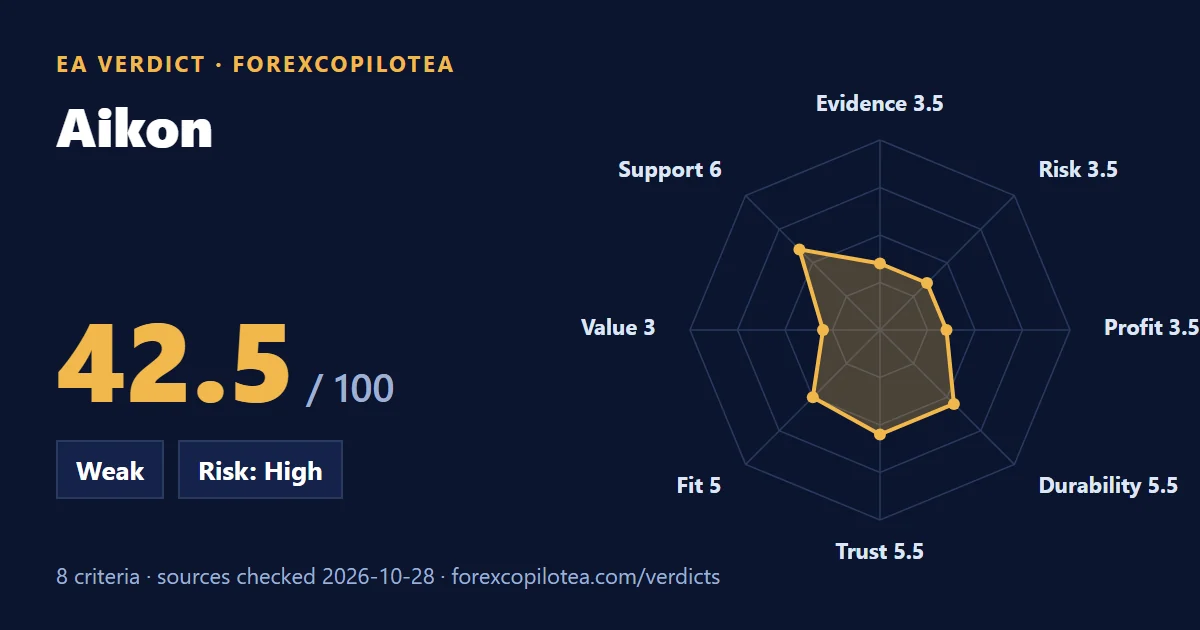
Aikon MT5 is presented as an AI-powered trading system with Forex and Gold profiles, conversational controls, account coordination and an optional Forex Recovery mode. Its developer has published four fresh MQL5 signals specifically to build a forward record for Aikon, rather than asking readers to attribute years of mixed legacy-account history to the new product. That separation is unusually helpful. It also means the record is extremely short: the four accounts began on 2 October 2026 and had only 10 to 32 trades apiece when we checked them on 28 October. The Market price was $1,097.97, with a stated plan to rise toward $4,997. We score the new public evidence, not the vendor's older systems or feature claims. The result is 42.5/100, Weak band and High risk: interesting transparency and product scope, but no basis yet for calling the strategy proven.
Key takeaways
- Aikon scores 42.5/100 (Weak) and High risk. The score reflects a new, vendor-run forward record and optional recovery functionality; it is not a forecast of the product's returns.
- Four new signals started on 2 October with $500 each. Their records contained 10 to 32 trades apiece by the review date, so the high-looking profit factors describe tiny early samples.
- The developer's blog explicitly distinguishes these Aikon-only accounts from older legacy accounts that included prior systems, existing positions, withdrawals and capital transfers. We do not combine those histories.
- Aikon offers single-entry Forex and Gold profiles as well as an optional Forex Recovery mode that can add and manage positions. These modes have different risk shapes and should not be judged as one strategy.
- The Market listed $1,097.97 and a planned progression toward $4,997. External AI provider costs are additional, according to the listing.
- The strongest positive evidence is transparent attribution and a free demo. The main unknown is whether future results across longer periods will support the product's broad feature claims.
- 42.5 / 100
- weighted score; Weak band across eight criteria
- 10–32 trades
- trade counts on four new vendor-run signals at the review date
- $1,097.97
- MQL5 listing price on 28 October 2026; external AI costs may apply
The verdict: unusually clear attribution, but an early record
Aikon is not just described as a conventional signal generator. The product page presents an operating layer around an MT5 account: configurable Forex and Gold profiles, optional Recovery, AI-assisted market analysis, a conversational interface called Ask Aikon, and Master/Node coordination for multiple terminals. That scope is ambitious. The question for a buyer is not whether the page lists capabilities; it is what the available evidence can actually establish about the trading behavior and the controls that matter when an account is exposed to risk.
The clean forward record is the most persuasive part of the public evidence. On 2 October 2026, the developer announced four Aikon-only signal accounts, each funded at $500. The same post says the older accounts are being wound down and may contain positions opened by earlier products, and acknowledges that capital may be withdrawn from those accounts and redeployed into the new ones. Rather than retroactively relabel all prior performance as Aikon, the developer says the new signals are the primary forward record. That is a useful disclosure because it gives readers a clear boundary for attribution.
That boundary also makes the current evidence very limited. At the 28 October check, the new signals had been running for only a few weeks, with 10, 14 or 32 trades. A small sequence can produce a high profit factor or win rate by chance, especially when position sizes are small and the trade outcomes are clustered. None of the four records spans a full year, a broad range of conditions or even a statistically persuasive number of trades. They show that the accounts have begun trading; they do not establish how the strategy behaves in a deep drawdown or a changing market.
Our 42.5 result gives credit for honest record separation and an unusually detailed public product description. It withholds points because the live evidence is young, the core decision logic is not independently audited, the system's modes differ materially and the asking price is high relative to what is known. The Weak band is not a verdict on the developer's intentions. It is a measure of how much a buyer can verify before purchasing.
42.5 / 100
Weighted verdict score
Weak
Verdict band
High
Risk label
| Criterion | Weight | Score | Best evidence | Points |
|---|---|---|---|---|
| Verified evidence | 20 | 3.5/10 | Grade A | 7.0 |
| Risk and drawdown behaviour | 20 | 3.5/10 | Grade B | 7.0 |
| Profitability quality | 15 | 3.5/10 | Grade A | 5.3 |
| Sustainability | 15 | 5.5/10 | Grade B | 8.3 |
| Transparency and trust | 10 | 5.5/10 | Grade B | 5.5 |
| Practical fit | 10 | 5/10 | Grade B | 5.0 |
| Cost and value | 5 | 3/10 | Grade B | 1.5 |
| Support and usability | 5 | 6/10 | Grade B | 3.0 |
| Total | 100 | 42.5 |
What is Aikon MT5?
The MQL5 listing describes Aikon as an Expert Advisor for MetaTrader 5 that can analyze markets, open trades and manage positions under enabled settings. It offers Forex and Gold single-entry profiles, including stop-loss behavior, alongside an optional Forex Recovery approach. The product also describes AI-selected symbols, Ask Aikon, temporary monitoring plans, portfolio and capital controls, and a Master/Node structure for connecting accounts. A user can ask questions about the operation or prepare changes through a conversation, with requested changes presented for confirmation.
That is a vendor description, not a third-party technical audit. The product page does not establish that an AI model has a persistent trading edge, that its recommendations are accurate, or that automated behavior will be profitable. The word “AI” can refer to very different things: market classification, text generation, an interface that invokes tools, or an algorithm whose parameters change. A prospective buyer should ask which decisions are made by deterministic EA rules, which require an external model, which operate without a network connection, and what happens if a provider is unavailable or returns an unusable answer.
| Published feature | Reasonable interpretation | Not established by the public page |
|---|---|---|
| Forex and Gold single-entry profiles | The EA offers profiles described as individual entries with configured exits. | That every live signal uses these settings or that stop losses cap all realized loss. |
| Optional Forex Recovery | A separate mode can add and manage positions under its rules. | That recovery will succeed, has bounded exposure, or is equivalent in risk to single-entry mode. |
| Ask Aikon and Telegram | A conversational tool can inspect account state and prepare operational changes. | That AI analysis is correct, secure in every setup, or independent of provider/API availability. |
| Capital controls and protected reserve | The product describes operating allocations and restrictions on new campaigns. | That reserves leave the brokerage account or cannot be lost. |
| Master/Node fleet | Multiple connected accounts can be coordinated. | That multi-account operation diversifies risk or avoids correlated exposure. |
The listing states that routine trading can continue while the conversation is closed and that requested operational changes go through a review-and-confirm process. That is a useful distinction: conversational assistance is not described as an unconditional trade authorization. Buyers should still inspect the exact permission model, what a connected Node can accept, how account identifiers are matched, and what happens when the terminal is disconnected. A review of this product page cannot certify an installation's access controls or account safety. Keep API keys private, understand what information is sent to any external provider, and test non-trading commands before enabling live orders.
Four Aikon signals: what the short records show
The developer's 2 October blog provides direct links to four new MQL5 signals and says each started with $500. This is better than asking readers to infer which portions of a mixed portfolio belong to the product. The signals themselves provide platform-generated trade statistics. Each account is still vendor-operated, and each covers only a few weeks. MQL5 statistics are a checkable record of that signal account, not proof of the EA's source code, the version used or the outcome a subscriber will receive.
| Signal | Trades | Win rate | Profit factor | Balance / equity DD |
|---|---|---|---|---|
| Aikon Quick Start Recovery (2393883) | 32 | 71.87% | 4.48 | 0.28% / 1.83% |
| Aikon Node (2393885) | 32 | 71.87% | 2.79 | 0.99% / 2.88% |
| Aikon Node Deep Seek (2393886) | 14 | 64.28% | 4.29 | 1.52% / 6.54% |
| Aikon Node 4 (2393890) | 10 | 70.00% | 4.81 | 0.15% / 4.91% |
The profit factors range from 2.79 to 4.81, and the reported expected payoffs range from $0.57 to $2.21. Those numbers are arithmetic summaries of each signal's small set of closed trades. They should not be projected forward or compared as if the four accounts were controlled experiments: different configurations, symbols and position management can produce different results. The sample of 10 trades is particularly fragile; a single large win or loss could materially change the ratio. Even the 32-trade records are too short to show a reliable frequency of losing streaks.
Drawdown figures also need both balance and equity context. Balance drawdown measures closed-account value, while equity drawdown can include floating losses on open positions. The four signals' reported equity drawdowns were higher than their balance figures, especially on Node Deep Seek and Node 4. This difference is a reminder that closed-trade statistics alone can understate risk while positions remain open. It does not show that the accounts will later lose those amounts, but it does show why floating exposure belongs in any assessment.
The most important strength is not the early return statistic: it is that the developer labels these as a fresh forward record and preserves legacy history separately. The most important limitation is duration. The accounts began on the same date, are managed by the vendor, and are not independent samples of different operators. More signals do not automatically mean more independent evidence if they share the same decisions, software and operator.
Why the legacy accounts should not be counted as Aikon results
In the linked blog post, the vendor explains that older public accounts include systems that preceded Aikon, withdrawals, difficult periods, open losses and trades already in progress during the transition. The post says the legacy accounts are being retired and that capital may be withdrawn and redeployed into the new signal accounts. It explicitly avoids presenting the full old history as if every trade had been generated by Aikon. That is an important attribution caveat, especially because readers may see large lifetime growth figures on older accounts and assume that they represent the new product.
The same disclosure means a reviewer should not treat the new accounts as entirely new outside capital or assume that a clean start erases the vendor's broader trading history. The blog says the combined starting capital is $2,000, while clarifying that it does not necessarily represent $2,000 of new outside money. Both statements can be true: the accounts offer a clean product-specific trading record even though some of the cash may have moved from older accounts. That is why we use the signal performance as a forward record and do not infer capital provenance beyond what the vendor says.
A sensible future update would preserve each signal link, its start date, account currency, balance and equity drawdown, deposits and withdrawals, settings or profile, and any software version changes. If an account is closed or replaced, historical data should remain accessible so the record does not become survivorship-biased. At the time of this review, the forward record is too young for those longer-run questions to be answered.
Recovery mode: optional does not mean low risk
Aikon's Forex Recovery mode is optional, but the product page says it can add and manage positions under configured recovery rules. That makes its risk profile materially different from a single-entry strategy with a stop. Depending on the implementation, recovery approaches can hold multiple positions, increase exposure as price moves against a campaign, or rely on price eventually moving back. The available public description does not specify enough detail to calculate maximum campaign risk, so this review does not assume that the mode is a martingale or a grid; it does treat the potential for added exposure as something that deserves close examination.
A buyer should request a complete explanation of when positions are added, how lots are sized, what maximum number of entries is permitted, whether there is a hard account-level stop, how swaps and gaps are handled, and whether a campaign can remain open through a weekend. Ask what equity threshold blocks new entries and whether it also closes existing trades. A stop on an individual order does not necessarily cap risk across a multi-position campaign if additional trades can be added later.
Do not infer recovery safety from the small drawdown seen in a signal with 10, 14 or 32 trades. A system can appear benign before encountering the adverse sequence it was designed to recover from. Test the exact mode and settings on a demo and in a sufficiently long, realistic historical study; also look at open positions and worst floating loss, not just closed trades. No short signal can establish that a recovery method will always recover.
Price, external AI charges and the total cost of ownership
On 28 October 2026, the MQL5 listing showed $1,097.97 and said one purchase remained at that tier before a planned step to $1,197.97, with a stated final price of $4,997. Price tiers may create urgency, but a countdown or limited allocation does not increase the quality of the trading evidence. With only a few weeks of forward data, buyers cannot estimate how long a licence might take to offset its purchase cost—and a licence does not guarantee that the system will earn anything.
The product page also says external AI provider charges are separate. The actual cost depends on the provider, model, number of requests and how much the user relies on AI-assisted features. A buyer should ask whether the EA continues its essential trading and management functions if the provider is unavailable, how usage is capped, and whether the account sends market or personal information to an external provider. Calculate the software price, subscription or API use, VPS, broker commissions and spreads together. The public listing does not provide a complete lifetime operating-cost estimate.
For anyone considering the connected-account architecture, the important question is not simply how many terminals can be linked; it is what each account is allowed to do and how a command is scoped. Ask how account identity is verified when a Master prepares a change for a Node, whether an operator can target the wrong account, which actions require confirmation, and how the event is recorded. The seller describes per-account eligibility, settings and capital controls, but the public page is not an independent test of those boundaries. A buyer should first practice with a demo account that contains no funds and confirm that a request to pause or adjust one account cannot affect another unintentionally.
The same care applies to AI configuration. The listing says Quick Start can use one provider, model and API key to initialize primary functions. The key is a credential: follow the product's official setup guidance, never paste it into a public chat or send it to support unless the vendor's secure process explicitly requires that. Review provider permissions and billing limits, rotate a key through the provider if it is exposed, and determine whether the EA stores it locally or transmits it through a service. We could not verify those implementation details from the public product page, so prospective users should ask before connecting an account.
Temporary plans and monitoring objectives are another feature whose boundaries deserve attention. A natural-language instruction such as watching a symbol until a deadline must be converted into explicit conditions, expiry and action limits. Confirm that the plan cannot continue indefinitely, create trades outside the allowed profile or override the account's capital restrictions. The product page says plans are reviewed and confirmed before they run; a demo should be used to see exactly what is displayed and what will happen after confirmation. A conversational interface is convenient only when its operational consequences are legible.
A free demo is useful for learning the interface, checking broker compatibility and observing how settings behave. It is not proof of profitability. Use the demo to confirm which profile is selected, how the terminal communicates with any connected Node, whether a Telegram request requires explicit confirmation, how capital limits appear, and what happens after a disconnection. A premium price is not itself proof of quality, and a low-cost trial cannot substitute for a long, independently verified record.
Who Aikon may fit, and who should wait
- It may fit a technically comfortable MT5 user who wants account monitoring and conversational operations, understands that AI providers may incur separate costs, and is willing to observe the product on demo while its record matures.
- It may fit an experienced operator who can distinguish a single-entry profile from Recovery mode, keep position sizing conservative, and validate account permissions and alerts before going live.
- It does not fit someone who wants a verified long-term track record today. The forward signal histories were weeks old and contained only 10 to 32 trades on the review date.
- It does not fit anyone who is relying on AI branding as evidence of predictive accuracy or who assumes “protected reserve” has been withdrawn from the broker account.
- It is a poor fit for a buyer who would need to borrow or risk essential funds to pay the price, or who cannot tolerate open positions and drawdowns.
- It is not a shortcut to prop-firm approval. The product's controls and examples do not establish compliance with any firm's current rules.
What a useful Aikon validation plan would need to show
A buyer considering a longer test should first decide which product mode is being evaluated. A single-entry Forex profile, a Gold configuration and Forex Recovery can have different trade frequency, exposure and exit behavior. Results from one mode should not be used as evidence for another unless the vendor publishes the exact settings, symbol list, account leverage and version. For the same reason, a signal that does not disclose its full configuration cannot validate every profile advertised on the product page.
A more informative record would cover a substantial period and include complete deposits, withdrawals, open equity, lot sizing, and every position in a recovery sequence. Readers should compare realized balance with floating equity and inspect the worst peak-to-trough decline rather than judging only the final account value. The record should also identify broker, account type, leverage, spread conditions and the software version. These details help distinguish a strategy result from a favorable funding event or execution environment; they still would not guarantee that another account receives the same fills.
The four new signals are a start toward that kind of evidence, not a substitute for it. Their small trade counts mean that a handful of outcomes can move the headline metrics substantially. It is also too early to know whether the product's AI-assisted tools change trade selection, merely summarize market context or operate as optional user controls. A responsible follow-up would compare published settings and signal trades against the documented mode, note any software updates, and preserve the original snapshot so that later results do not overwrite early risk periods.
Readers should also distinguish a visible feature from a measured outcome. A chat interface can make settings easier to query, and account coordination can simplify administration, but neither proves that trades are better or safer. If AI analysis is part of the decision process, useful documentation would identify which provider is called, what data is sent, whether the service can block or modify orders, and how the terminal behaves when that service is unavailable. The product page describes functionality, but the public signals do not isolate its effect. We therefore do not treat AI branding or a list of controls as evidence of predictive performance.
The score is a snapshot of publicly inspectable information, not a recommendation to copy a signal or a personalized suitability assessment. A buyer should be able to lose the entire amount placed at risk, including any purchase price, and should not rely on short-term performance for essential expenses. If the vendor publishes longer, mode-specific history or verifiable account settings, those facts could justify a review update. Until then, a demo and careful observation can answer operational questions, but they cannot turn a small sample into proof of a durable trading edge.
How the Aikon score was calculated
We score eight criteria using the same weights and published anchors as the rest of the verdict series: verified evidence 20, risk 20, profitability 15, sustainability 15, transparency and trust 10, practical fit 10, cost 5, and support 5. Each criterion is scored out of ten, then weighted to a total out of 100. A grade A means a source is platform-generated and checkable; it does not mean the vendor is independent or the data has been audited by a third party. The source grade and criterion score answer different questions.
| Criterion | Score | Points | Why |
|---|---|---|---|
| Verified evidence (weight 20) | 3.5 / 10 | 7.0 | Four platform-built forward signals are linked, but each began on 2 October 2026, has only 10 to 32 trades and is vendor-operated; the older portfolio is explicitly a different record. |
| Risk and drawdown behaviour (weight 20) | 3.5 / 10 | 7.0 | Single-entry profiles are distinct from optional Forex Recovery, which can add positions; early equity drawdown ranges from 1.83% to 6.54%, with no useful long-run stress sample. |
| Profitability quality (weight 15) | 3.5 / 10 | 5.3 | The four fresh signals report positive profit factors, but 10 to 32 trades per account over a few weeks cannot establish a durable edge or meaningful return distribution. |
| Sustainability (weight 15) | 5.5 / 10 | 8.3 | A broad, actively described system with account coordination and user controls; however, the feature set is complex, dependent on external AI services in places, and live evidence is new. |
| Transparency and trust (weight 10) | 5.5 / 10 | 5.5 | The developer openly separates the clean AIKON forward record from legacy accounts and explains capital movements; AI efficacy and product claims remain vendor-described rather than independently audited. |
| Practical fit (weight 10) | 5 / 10 | 5.0 | Profiles can target Forex and Gold and support connected accounts, but users must understand recovery exposure, provider API costs, MT5 uptime and the operational complexity. |
| Cost and value (weight 5) | 3 / 10 | 1.5 | $1,097.97 on 28 October, with another planned price step and a $4,997 target, is premium pricing against a forward record measured in weeks. |
| Support and usability (weight 5) | 6 / 10 | 3.0 | A free demo, extensive product explanations, Ask Aikon and Telegram access are described; some capabilities require setup and external AI service charges. |
The evidence score recognizes the four public forward signals and the explicit legacy-history disclosure. It remains low because the records are short and vendor-run. Risk reflects the distinction between single-entry and recovery configurations and the lack of a long stress sample. Profitability is not inferred from short-term profit factors; the signal metrics are included because they are checkable snapshots, but they do not yet demonstrate persistence. Cost is held back by premium pricing against a new product-specific record. The weighted total is 42.5 out of 100.
Questions to ask before buying or connecting an account
Sources and review date
- MQL5 Market: Aikon MT5, product 191992Vendor product description, current price, features and seller-provided operating claims; opened 28 October 2026.
- William Brandon Autry: Aikon forward-record explanation, 2 October 2026Vendor explanation of the new Aikon-only signal accounts and how the legacy portfolio is being separated.
- MQL5 Signal: Aikon Quick Start Recovery, 2393883Platform statistics for one vendor-operated account; the short history is not independent proof.
- MQL5 Signal: Aikon Node, 2393885Platform statistics for one vendor-operated account; checked 28 October 2026.
- MQL5 Signal: Aikon Node Deep Seek, 2393886Platform statistics for one vendor-operated account; checked 28 October 2026.
- MQL5 Signal: Aikon Node 4, 2393890Platform statistics for one vendor-operated account; checked 28 October 2026.
- ForexCopilotEA verdict methodologyScoring criteria and source grades used in this review.
Frequently asked questions
Is Aikon EA profitable?
The four fresh MQL5 signals showed positive platform statistics when checked, but each had only 10 to 32 trades after beginning on 2 October 2026. That is too little history to establish that Aikon is profitable over time. The accounts are vendor-run and the results are not a promise of future performance.
What is Aikon EA?
Aikon MT5 is an Expert Advisor presented as a configurable trading and account-management system. The product page describes Forex and Gold profiles, optional Forex Recovery, AI-assisted functions, conversational controls and connected account coordination. These are vendor-described capabilities; they should not be mistaken for independent proof of a trading edge.
Does Aikon use martingale or recovery trading?
The Market listing describes an optional Forex Recovery mode that can add and manage positions, as well as single-entry profiles. The public material we checked is not detailed enough to classify the Recovery algorithm as a specific grid or martingale design. Ask for the entry-sizing rules, maximum exposure and account-level stop before enabling it.
How much does Aikon cost?
The MQL5 Market listing showed $1,097.97 on 28 October 2026 and described planned price steps toward $4,997. External AI provider charges are separate, and a VPS or brokerage costs may also apply. Verify the current checkout price and calculate recurring costs before purchase.
Are the Aikon signals independently verified?
MQL5 provides platform statistics for the linked accounts, which makes the trades checkable on the platform. The accounts are operated by the vendor, however, and their short histories are not an independent trial or audit. The developer's blog explicitly separates them from earlier legacy accounts.
Does Aikon's protected reserve guarantee that money is safe?
No. The product page says protected reserve remains inside the trading account and is an operating allocation, not a withdrawal or a guarantee against loss. Treat all account equity as exposed to trading and broker risks unless money has actually been withdrawn.
Does Ask Aikon place trades on its own?
The listing says Aikon trades under enabled rules and that requested operational changes are proposed for confirmation. It also describes temporary plans that continue after confirmation. Buyers should test the exact permission flow and settings in a demo and not assume that every feature requires the same type of approval.
How was this Aikon verdict scored?
We scored eight published criteria and weighted them to 42.5/100. The review gives credit for the new, clearly attributed signals and detailed product description, while limiting the score for the short vendor-run history, Recovery-mode uncertainty and high price. ForexCopilotEA sells a separate listing, which is disclosed at the top.
Gold Expert Advisors in our store
We sell these, so weigh that interest. Put the same eight questions to any of them before you buy: read the manual, run your own backtest, and start on demo.

Keep reading
- EA Verdict #14One Man Army EA Review: Verdict and Risk (2026)Is One Man Army EA worth $599? Independent EA verdict: 56.0/100, Medium risk. A 55-week MQL5 signal, 546 trades and a 0.41 payoff ratio scored, checked 28 Oct 2026.
- EA Verdict #13MoonDog EA Review: Verdict and Risk (2026)Is MoonDog EA worth $299? Independent EA verdict: 51.5/100, Medium risk. Five breakout modules, ONNX filters and two live MQL5 signals scored, 28 Oct 2026.
- Strategy comparisonWhich EA Strategy Wins Long Term?Compare MT5 Expert Advisor strategy types, from scalping and grid to hedging and arbitrage: how each earns, how each fails, and which tend to survive long term.