
EA Verdict #13
MoonDog EA Review (2026): A Five-Module Gold Breakout EA With Two ONNX Filters, Two Live Signals and a Product Page That Says It Is Closing
By Benjamin Lee · Updated · 23 min read
MoonDog is a gold breakout Expert Advisor for MetaTrader 5 that runs five independent breakout modules from one chart, adds two embedded ONNX models as optional entry filters, puts a stop loss on every trade and says it uses no martingale and no recovery grid. Its listing sells it for $299, or $199 a month to rent, links two live MQL5 signals, and carries a 4.4 rating from 45 reviews. It also announces that MoonDog will be removed from sale before an update 'exclusive to existing owners', and its developer's weekly recap compares two small accounts over a single week. We read the listing and the reviews we could open, two of the developer's blog posts and both signals line by line, and scored MoonDog on the same eight criteria as every verdict here. The result is 51.5 out of 100 and a Medium risk label: a real, actively developed breakout system with healthy-looking but very young records.
Key takeaways
- MoonDog scores 51.5 out of 100 (band: Weak) with a Medium risk label. It has verified live signals, a stop on every trade and a developer who explains the design, but every record is under four months old, vendor-run and at one broker.
- The two signals (MQL5 signals 2381309 and 2386840, both at Global Prime) show +410.6% in 16 weeks on 259 trades and +166.9% in 14 weeks on 192 trades, with profit factors of 2.20 and 2.09 and win rates near 68.7%. They started with only 60.08 and 98.71 USD, so the percentages are large and the dollar profits are 246.71 and 164.75 USD.
- The nominal trade plan is a 20-pip stop against a 140 to 150 pip target, which is roughly 7 to 1. The live average win is 2.54 USD against an average loss of 2.53 USD. The system is not collecting big targets; it is closing early through its MoonLock profit protection and relying on a 69% hit rate.
- Balance drawdowns are 20.1% and 15.3%, equity drawdowns 2.4% and 0.6%, and the peak deposit load was 21.8% on the first signal. On accounts this small, a 0.01 lot is a large fraction of the balance.
- We sell a listing for MoonDog. It shows version 4.21 against 4.22 on the Market and, unlike the Market product, ships with no setfile and no manual. Treat it as a separate purchase with its own price and terms.
- 51.5 / 100
- weighted verdict score on eight published criteria
- PF 2.20 and 2.09
- profit factors of the two live MQL5 signals, over 259 and 192 trades, from accounts that started with 60 and 99 USD
- $299 or $199/mo
- Market price to buy or rent for a month on 28 Oct 2026, with a free demo
The verdict at a glance: a tidy design and a record that is still a few months old
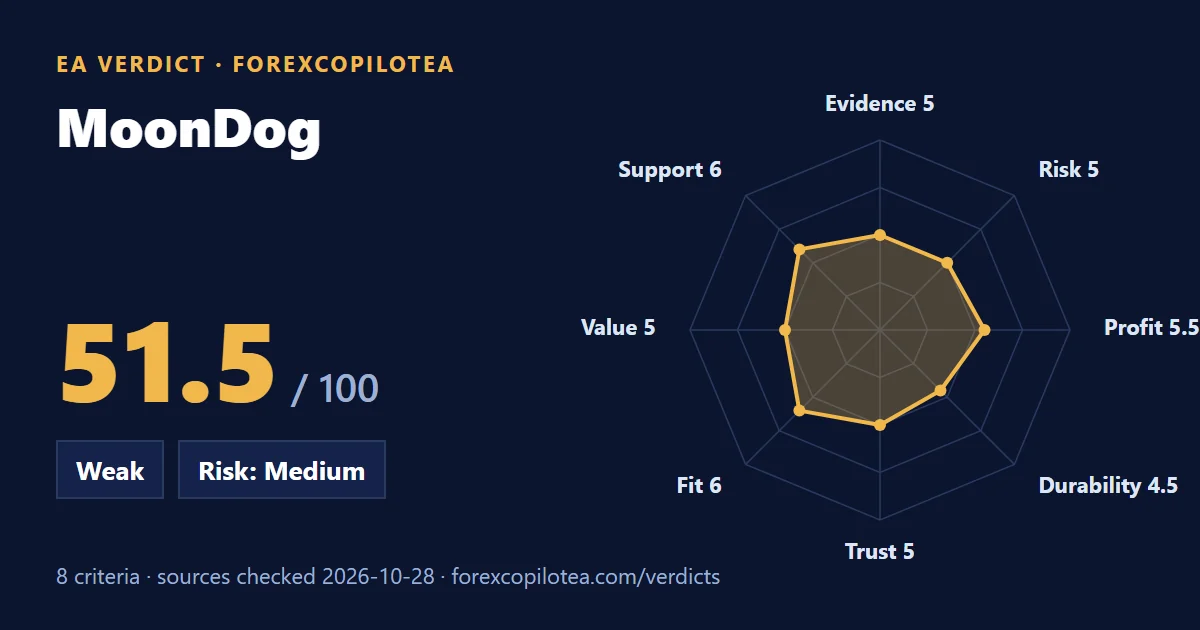
MoonDog earns points for transparency and for design. The developer explains how each module, filter and protection works, publishes a user guide and a broker guide, supplies four SET files and links two live signals with the caveat that they may include earlier versions. It loses points on how little time the evidence covers. Sixteen weeks and 259 trades on a 60 dollar account is a good start and not a track record, and the product page itself says the product is about to be withdrawn for a major update. The scorecard and radar show how the total was built.
51.5 / 100
Weighted verdict score
Weak
Verdict band
Medium
Risk label
| Criterion | Weight | Score | Best evidence | Points |
|---|---|---|---|---|
| Verified evidence | 20 | 5/10 | Grade A | 10.0 |
| Risk and drawdown behaviour | 20 | 5/10 | Grade A | 10.0 |
| Profitability quality | 15 | 5.5/10 | Grade A | 8.3 |
| Sustainability | 15 | 4.5/10 | Grade B | 6.8 |
| Transparency and trust | 10 | 5/10 | Grade B | 5.0 |
| Practical fit | 10 | 6/10 | Grade B | 6.0 |
| Cost and value | 5 | 5/10 | Grade B | 2.5 |
| Support and usability | 5 | 6/10 | Grade B | 3.0 |
| Total | 100 | 51.5 |
What MoonDog actually is
MoonDog EA is an Expert Advisor for MetaTrader 5, sold on the MQL5 Market by James Vito Armin Bianchini of Switzerland, whose seller profile shows a 4.4 rating from 45 votes, one product and two signals. It was published on 2 July 2026, showed version 4.22 and was last updated on 25 October 2026, with 15 activations per licence. It is a multi-strategy breakout system for XAUUSD only, with every strategy running from one chart.
The design has four layers. The first is nine breakout modules. Five are the originals, called Moon Nova, Moon Apex, Moon Zenith, Moon Pulse and Moon Eclipse, and the developer added four optional ones, Moon Orbit, Moon Halo, Moon Titan and Moon Comet, which are off by default. Each module looks for its own market structure and prepares a complete plan: direction, a pending Buy Stop or Sell Stop, stop loss, take profit and expiry. The second layer is the ONNX filters. Two small neural-network models run locally inside MetaTrader 5, and in the default 'Conservative 2x ONNX' mode they filter entries and recheck pending orders; two other modes keep the entry filter only or switch ONNX off. The developer's own blog post describes the models as a 'quality judge' and an 'independent confirmation', and says they only accept or reject a candidate the breakout modules have already produced; they do not invent trades.
The third layer is trade management. Every position carries its own stop loss, 20 gold pips by default, and a take profit of 140 pips on Moon Apex and 150 on the others. 'MoonLock' tracks the best floating profit of a trade and, in its classic form, aims to protect 50% of that peak after activation; an adaptive version tailors activation and protection per strategy. A 'Spike Shield' reduces some early exits during abnormal spread spikes. The fourth layer is protection: NFP, CPI and FOMC windows pause new entries and request removal of pending orders, a weekend shield is on by default, and a wide-spread guard and general news filter are optional. Position sizing can be a fixed lot, a percentage of risk, or an ONNX-score-based adaptive size that the listing says does not increase after losses.
| Item | What the vendor says |
|---|---|
| Seller | James Vito Armin Bianchini, Switzerland. Seller rating 4.4 from 45 votes; 1 product, 2 signals. |
| Price | $299 to buy or $199 to rent for one month on 28 Oct 2026, with a free demo and 15 activations. The page also says MoonDog 'will be removed from sale before the update' and the update 'will be exclusive to existing owners'. |
| Strategy | XAUUSD only. Nine breakout modules (five by default, four optional) that place pending Buy Stop and Sell Stop orders; two local ONNX models as optional filters. |
| Risk controls | Own stop loss and take profit on every position (default 20 pips stop, 140 to 150 pips target); MoonLock profit protection; Spike Shield; NFP, CPI and FOMC pause; weekend shield; optional spread and news filters; daily-loss controls. No martingale, recovery grid, loss averaging or larger trades after a loss. |
| Setups | Four SET files: default five strategies with classic MoonLock; five with adaptive MoonLock; all nine with classic; all nine with adaptive. Fixed 0.01 lot in the supplied sets. |
| Requirements | MetaTrader 5, XAUUSD, one chart, a reliable VPS recommended for the virtual protection, Strategy Tester on real ticks for backtests. |
| Track record | Two live signals, with a note that they 'may include earlier MoonDog versions or different settings'. |
| Reach | 5,830 free demo downloads, rating 4.4 from 45 reviews, 229 comments, '104 purchases per month' shown on the page. |
| Versions | 4.22, updated 25 Oct 2026. The page links a complete user guide for version 4.18. |
How we judged it, and who has something to sell
Evidence on EAs is never neutral. Here is every party near this product and what each stands to gain, ours included.
- The developer sells the EA, rents it, sells signal subscriptions (100 USD a month on both signals, with no subscribers shown) and writes the blog posts. His record is public, which counts for something, and it is also his sales page.
- MQL5 and MetaQuotes host the Market, the reviews, the blogs and the signals. The signal statistics and the 'high risk of negative slippage when copying deals' notice are the platform's own.
- Buyers who wrote reviews are, in the part of the page we could read, all positive and all recent, written in the weeks after buying. Testimony, not data, and none can be checked from outside.
- ForexCopilotEA sells a listing for this EA. We gain if you buy it, which is why this verdict opens with that fact and applies the same rules as every other.
Evidence ladder: what each rung of proof held for MoonDog
Grade A: Independent proof
- MQL5 signals 2381309 and 2386840, at GlobalPrime-Trade: platform-built statistics for 16 and 14 weeks and 259 and 192 trades. The vendor runs the accounts, so his interest is noted, but the figures are computed from broker history and the platform's notices are its own.
- MetaQuotes and Myfxbook documentation, used for how testing reports and verified records work.
Grade B: Checkable vendor material
- The Market listing: version, price, the nine modules, MoonLock and ONNX options, the SET files, the user guide, dated reviews and replies.
- The developer's two blog posts, which explain the design, and the free demo, which runs in the Strategy Tester only.
Grade C: Claim only
- The weekly recap for 17 to 21 August 2026: +31.42% for the Market Edition and +28.86% for the Dual-ONNX Beta on two small accounts, with 25 and 10 closed trades. The post itself calls ten trades 'still only 10 trades'.
- 'The two models make the strategies more selective': the claim is plausible and no test shows how much filtering helps or harms.
- Backtests on real ticks, which the listing advises but publishes none.
Grade D: Conflicted, anonymous or unverifiable
- Short positive reviews that praise the developer's honesty and responsiveness; they may be genuine and are not independently checkable.
- 'Take your spot before sales close': a sales message, not a measure of quality.
What the two live signals show, number by number
Platform-computed signal statistics are the best public evidence a vendor can show. They still have limits: the vendor runs the account, the broker is one broker, the record is short, and the page itself warns that these signals 'may include earlier MoonDog versions or different settings'. With those limits in mind, here is what the two MoonDog signals show on 28 October 2026.
| Statistic | MoonDog EA (2381309) | MoonDog EA 2 AI BETA TEST (2386840) |
|---|---|---|
| Broker, leverage | GlobalPrime-Trade, 1:500 | GlobalPrime-Trade, 1:500 |
| Started, age | 8 Jul 2026, 16 weeks | 16 Aug 2026, 14 weeks |
| Growth, initial deposit | +410.64% on 60.08 USD | +166.90% on 98.71 USD |
| Profit, balance | 246.71 USD, 306.79 USD | 164.75 USD, 263.46 USD |
| Trades, win rate | 259 trades, 68.72% win rate | 192 trades, 68.75% win rate |
| Profit factor, expected payoff | 2.20, 0.95 USD per trade | 2.09, 0.86 USD per trade |
| Average win, average loss | 2.54 USD, minus 2.53 USD | 2.39 USD, minus 2.51 USD |
| Best, worst trade | 15.35 USD, minus 6.14 USD | 15.01 USD, minus 6.14 USD |
| Longest winning, losing run | 20 wins, 7 losses (minus 14.91 USD) | 13 wins, 5 losses (minus 22.50 USD) |
| Maximal drawdown by balance | 32.13 USD, 20.26% | 22.86 USD, 12.32% |
| Relative drawdown by balance, by equity | 20.14%, 2.36% | 15.26%, 0.57% |
| Recovery factor, Sharpe ratio | 7.68, 0.30 | 7.21, 0.25 |
| Maximum deposit load | 21.76% | 9.61% |
| Monthly growth, annual forecast | 2.89%, 35.08% | 0.48%, 5.83% |
Three things stand out. First, the signals look like each other: win rates of 68.7%, profit factors of 2.2 and 2.1, and an average loss almost equal to the average win. The second signal is labelled as the AI beta, and its numbers are not better than the plain one over its shorter life; the developer's own recap says the experiment is not yet enough evidence. Second, the dollar figures are small. A start of 60 dollars grows to 307, and the worst single trade of minus 6.14 USD is 10% of the starting balance, which is why a 0.01 lot produces a balance drawdown of 20.1% while the equity drawdown is 2.4%. The percentages describe small accounts, and scaling to a larger one at the same lot changes every ratio.
Third, the shape is a win-rate system and not a payoff system. The nominal plan is a 20-pip stop and a 150-pip target, a payoff of about 7.5 to 1, and a system collecting that target would win perhaps one trade in four. These signals win seven in ten and earn about as much on a win as they lose on a loss, which means MoonLock is closing most winners long before the target. That is a legitimate design; it also means the edge is the hit rate, and a run of choppy gold with false breakouts can break it. The longest losing run was only seven trades, in 259, but a stretch of false breakouts would be the first thing to show. Both signals also carry the platform notice 'high risk of negative slippage when copying deals', which fits one-minute holds and pending orders on gold.
- Main signal, by balance20.1%
32.13 USD on a 60 USD start
- Main signal, by equity2.4%
relative equity drawdown
- AI beta, by balance15.3%
22.86 USD on a 99 USD start
- AI beta, by equity0.6%
relative equity drawdown
The developer's weekly recap adds one more data point and should be read as marketing. For 17 to 21 August 2026 it reports the Market Edition at +31.42% (25 closed trades, 20 wins, a profit factor of 6.89 and a maximum closed-balance drawdown of 3.08%) and the Dual-ONNX Beta at +28.86% (10 closed trades, 10 wins, no closed loss). The post is candid that ten trades prove little, and that the beta traded less because the models rejected setups. We do not use the weekly figures in the score; the platform statistics above cover a longer period and include the quieter weeks.
How a pending-order breakout system makes and loses money
A pending-order breakout system places a Buy Stop above recent highs and a Sell Stop below recent lows and waits to be triggered. The bet is that a move through a level will keep going. On gold that works on the days a session trends and fails when price pokes through a level and falls back, which is the 'fake breakout' the developer describes. MoonDog's answer to false breakouts has three parts: nine modules that each define a different structure, ONNX models that can veto a candidate, and MoonLock, which exits a trade that has moved in favour and then fades.
The payoff arithmetic is simple to check on the main signal. A win rate of 68.72% times an average win of 2.54 USD is 1.75 USD; a loss rate of 31.27% times 2.53 USD is 0.79 USD; the difference, 0.96 USD, is the 0.95 USD expected payoff the platform reports. The edge exists and it is small per trade, which is why the spread and the slippage at the broker matter so much. A wider spread on a one-minute hold can erase it, and the listing's advice about a reliable broker and a VPS is not decoration.
Interactive: win rate is not edge
- Expected result per trade
- +0.35
- Profit factor
- 1.64
- Break-even win rate
- 33%
At these numbers the system has a positive edge before costs. Add spread, commission and slippage per trade and re-check.
Risk: a stop on every trade, but several strategies at once
MoonDog is a better-behaved design than a grid. Every trade has a stop, nothing is added to a loser, and the worst trade on either signal was minus 6.14 USD. That keeps the label at Medium and not High. The risks that remain are the ones a multi-module breakout EA carries.
- Stacked exposure. The listing says that if several strategies hold positions together, total exposure can be higher than the risk selected for one trade, and that enabling all nine strategies may increase the number of positions open at once. The peak deposit load of 21.8% on the first signal is that effect.
- Regime dependence. Breakout systems earn in trends and bleed in ranges. The first review in the page text mentions that gold has been 'rather choppy lately'; the signals are 16 and 14 weeks of one stretch of gold.
- Execution risk. Pending orders can trigger or be cancelled late at some brokers. The listing says no EA can guarantee that a broker cancels a pending order before it triggers, and MoonLock closes at market, so the final price can differ from the protected level.
- Version risk. The guide is for 4.18, the product is 4.22, the signals may run earlier versions, and a larger update is announced. Check the version you receive against the version you tested.
- Size risk. The signals risk a fixed 0.01 lot on accounts of 60 to 300 dollars. A buyer who raises the lot size to chase the percentage growth multiplies every drawdown above.
Interactive: drawdown recovery
Gain needed to get back to break-even
+42.9%
Blue: equity left. Red: equity lost.
Consecutive losing trades to reach this drawdown: 36
What buyers say
The listing shows a 4.4 rating from 45 reviews. We could read three of them in the page text, all from October 2026, and we weigh them as testimony. One buyer, who has used it since 27 September first on demo and then live, calls it 'very stable and well designed', likes the combination of modules, protection logic and trade management, and says he is waiting to see how it behaves 'when gold enters a stronger and more sustained trend'. Another reports 'stable performance and consistently encouraging results' after three weeks of live trading and praises the developer's honesty. A third is a single line of surprise.
Two cautions apply. All three are weeks old, so they describe the first impression, not a full cycle. And reviews on a recently launched product come mostly from buyers who are ahead. The first reviewer's own remark, that the market has been choppy and the real test is a strong trend, is the most useful sentence in them.
Price: $299 or $199 a month, and a product that is about to close
The Market price on 28 October 2026 was $299 to buy or $199 for a month of rental, with a free demo of 5,830 downloads. Two details deserve attention. The listing says MoonDog will be taken off sale before a major update with new strategies, and that the update will be 'exclusive to existing owners'. That is both a reason to decide quickly and a reason not to: a buyer would get the new version for free, and a buyer who waits would face an unknown product and an unknown price. Treat the closing notice as the developer's plan and not as a fact about quality, and run the demo first.
The rental option is useful. For $199 a buyer can run the live product for a month on a demo or small account, which is a way to test on one's own broker and VPS before paying $299. A month is too short to judge a breakout system, however, and the rental alone costs two thirds of the purchase price. Remember the other costs: a VPS, and a broker with gold spreads low enough for one-minute holds. If you buy from a source other than the Market, such as our own listing, the price, version and delivery are different. Our listing is a separate purchase with its own terms, and it ships the compiled file without a setfile or manual, so read what is included before you pay.
The score, criterion by criterion: 51.5 out of 100
| Criterion | Score | Points | Why |
|---|---|---|---|
| Verified evidence (weight 20) | 5 / 10 | 10.0 | Two platform-built MQL5 signals at Global Prime with 259 and 192 trades, 16 and 14 weeks old; but both are vendor-run, started with 60 and 99 USD, may include earlier versions and settings, and are under four months. |
| Risk and drawdown behaviour (weight 20) | 5 / 10 | 10.0 | A stop on every trade and no martingale, grid or loss averaging stated; verified balance drawdowns of 20.1% and 15.3% on tiny accounts, a 21.8% peak deposit load, and several strategies that can hold positions together. |
| Profitability quality (weight 15) | 5.5 / 10 | 8.3 | Verified profit factors of 2.20 and 2.09 and a 68.7% win rate; but the average win equals the average loss, so the result rests on the hit rate, and one signal's monthly growth is 0.48%. |
| Sustainability (weight 15) | 4.5 / 10 | 6.8 | A single-product developer who updates often (4.18 to 4.22 in weeks) and adds modules; but the product is under four months old, its own page says it will be pulled from sale before a major update, and live history is short. |
| Transparency and trust (weight 10) | 5 / 10 | 5.0 | Candid 'not a holy-grail system' text, a user guide and signals that carry a 'may include earlier versions' caveat; against that, 'take your spot before sales close', 'AI' branding on two ONNX models and a vendor weekly recap built on one week. |
| Practical fit (weight 10) | 6 / 10 | 6.0 | XAUUSD only, one chart, four supplied SET files, a 0.01 lot default, news and weekend protection and a VPS for the virtual protection; slippage warnings on copying and a dependence on broker execution of pending orders. |
| Cost and value (weight 5) | 5 / 10 | 2.5 | $299 to buy or $199 for a month's rent with a free demo (5,830 downloads); the rental lowers the cost of testing, but $199 a month is large against signals that started with under 100 USD. |
| Support and usability (weight 5) | 6 / 10 | 3.0 | A developer who answers reviews and invites questions after purchase, a user guide, a broker guide and SET files; the signals and the recap are the vendor's own. |
The total is 51.5 out of 100. The grade A on evidence is earned by two platform-built signals; the score stays at 5 because both are vendor-run, at a single broker, under four months old, started with under 100 dollars and may not run the version a buyer receives. Risk, at 5, gets credit for a stop on every trade, no grid or martingale and small equity drawdowns, and loses it for stacked strategies, a 21.8% deposit load and balance drawdowns near 20% on tiny accounts. Profitability is positive and thin per trade, and sustainability is the criterion that most needs time.
Who MoonDog fits, and who it does not
- It fits a trader who wants a gold-only breakout system with a stop on every trade, is happy to start at 0.01 lot, runs a VPS on a low-spread account, and will judge it over months and not weeks.
- It does not fit anyone who needs steady monthly returns, who will scale the lot after a good week, or who does not want to learn four SET files and a profit-protection mechanism.
- It is risky for prop-firm challenges with tight daily limits unless risk is set very low: several strategies can hold positions together, and pending orders can fill badly around news.
- It is a poor choice for a buyer who is paying mainly because the sale is about to close. Run the demo, or rent for a month, before buying.
How it compares with other gold EAs we have scored
Gold House is a swing-breakout gold EA with two older, larger signals and a thinner edge per trade; Gold Snap is a shorter-hold gold breakout system with three signals. MoonDog's records are younger than either, and its profit factors are higher over a few months. Its 51.5 reflects that young record and a better risk shape than the grids we have scored, such as Wave Rider. For how breakout, grid and scalper designs differ, see our strategy comparison and our gold EA category.
Questions to put to the developer before you pay
- Which version does each signal run, and with which SET file and ONNX mode?
- Can you publish a real-tick backtest and an audited live record for the default setup?
- How much does the ONNX filter change the result in a test, and on what data were the models trained?
- What happens to existing owners when the update ships, and will the product return to sale and at what price?
- What is the largest balance drawdown you have seen on any account, and at what lot size?
- How many positions can the nine strategies hold at once, and what is the worst-case exposure with all nine enabled?
- What do you advise for a 1,000 USD account: lot size, SET file and ONNX mode?
Sources and when they were opened
- MQL5 Market: MoonDog EA (product 183924), opened 28 October 2026Source of the price, rental price, version, modules, ONNX modes, risk settings, readable reviews and the developer's statements. Written by the vendor and by buyers.
- MQL5 Signals: MoonDog EA (signal 2381309), opened 28 October 2026Source of the main signal's figures and notices. The vendor operates the account.
- MQL5 Signals: MoonDog EA 2 AI BETA TEST (signal 2386840), opened 28 October 2026Source of the second signal's figures and notices. The vendor operates the account.
- MQL5 blog: MoonDog vNext Is Coming Soon, 16 August 2026The developer's description of the nine modules and the two ONNX models. A vendor preview of features not all released.
- MQL5 blog: 25 Trades vs 10, MoonDog weekly recap, 21 August 2026The developer's one-week comparison of two small accounts. A vendor claim, not used in the score.
- Myfxbook Help: VerificationHow a trading account's track record is verified on Myfxbook.
- MetaTrader 5 Help: Testing ReportWhat each figure in the tester's report means, including drawdown.
- MetaTrader 5 Help: Strategy TestingThe Strategy Tester: testing modes, settings and forward testing.
- ESMA: ESMA agrees to prohibit binary options and restrict CFDs to protect retail investorsThe EU leverage limits, margin close-out, negative balance protection and risk-warning rules for retail CFD accounts.
- CFTC Customer Advisory: AI Won't Turn Trading Bots into Money MachinesA US regulator's warning about trading-bot claims of unusually high returns.
Frequently asked questions
Is MoonDog EA legit?
It is a real, actively developed product with a documented design, two public signals with 259 and 192 trades, regular updates and a developer who explains the system and replies to reviews, rated 4.4 from 45 reviews on the MQL5 Market. We do not allege wrongdoing. Its records are under four months old, which is why it scores 51.5 out of 100 with a Medium risk label.
Does MoonDog use martingale or a grid?
The listing says no martingale, no recovery grid, no loss averaging and no larger trades after a loss, and that every position has its own stop loss and take profit. The signals are consistent with that: the worst trade on either was minus 6.14 USD. We cannot read the code, so this rests on the listing and the signals.
How much does MoonDog cost?
The MQL5 Market price on 28 October 2026 was $299 to buy or $199 to rent for one month, with a free demo. A VPS and a low-spread gold account are extra. The listing also says MoonDog will be removed from sale before a major update that will be exclusive to existing owners. Sellers differ in price, version and delivery, so read the terms of whichever seller you use.
What does the ONNX filter in MoonDog do?
Two small neural-network models run locally in MetaTrader 5 and can veto a breakout candidate that the nine strategy modules have already produced. In the default mode they filter entries and recheck pending orders. They do not predict prices or create trades, and we could find no test that shows how much they help.
What drawdown does MoonDog have?
On the vendor's signals the maximum drawdown by balance was 20.1% and 15.3%, with equity drawdowns of 2.4% and 0.6%. Both accounts started with under 100 dollars at a 0.01 lot, so the percentages are large for small dollar amounts. Size your own account from the worst trade and the longest losing run, not from the percentages.
What is the minimum deposit for MoonDog?
No minimum is stated. The supplied SET files use a fixed 0.01 lot and the vendor's signals started at 60 and 99 USD, but a 0.01 lot on such an account produced a balance drawdown near 20%. Treat several hundred dollars as a sensible floor for the default setup and test on demo first.
How was the score calculated?
Eight weighted criteria (evidence 20, risk 20, profitability 15, sustainability 15, trust 10, fit 10, cost 5, support 5), each scored out of ten against written anchors. Sources are graded A to D and unverified claims cannot count as proof. We sell a listing for this EA, which is disclosed at the top. The total here is 51.5 out of 100.
Gold Expert Advisors in our store
We sell these, so weigh that interest. Put the same eight questions to any of them before you buy: read the manual, run your own backtest, and start on demo.



Keep reading
- EA Verdict #12Gold House EA Review: Verdict and Risk (2026)Is Gold House worth $749? Independent EA verdict: 52.3/100, Medium risk. Two live MQL5 signals, 68 reviews and a rising price ladder scored, checked 28 Oct 2026.
- EA Verdict #9Gold Snap EA Review: Verdict and Risk (2026)Is Gold Snap worth $399? Independent EA verdict: 56.0/100, Medium risk. Three live signals, 31 reviews and a backtest dispute scored, checked 21 Oct 2026.
- Risk managementEA in Drawdown: What to Do (and What Not to Do)What to do when your Expert Advisor is in drawdown: separate normal from broken, check the logs, compare with the backtest, and decide to hold, reduce or stop.
- Strategy comparisonWhich EA Strategy Wins Long Term?Compare MT5 Expert Advisor strategy types, from scalping and grid to hedging and arbitrage: how each earns, how each fails, and which tend to survive long term.