
EA Verdict #9
Gold Snap EA Review (2026): A Gold Breakout EA With Three Live Signals, 4.63 Stars and an 'Only 3 Left' Price
By Benjamin Lee · Updated · 22 min read
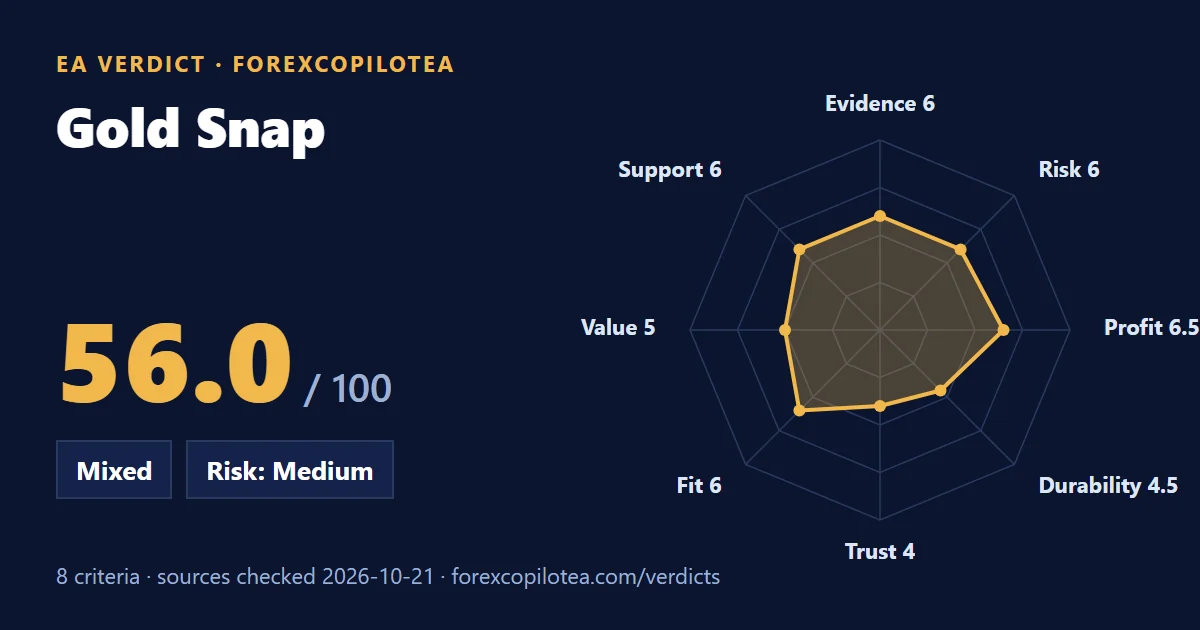
Gold Snap is a gold breakout Expert Advisor that holds trades for minutes, says it uses no grid and no martingale, and links not one but three live MQL5 signals from its listing. All three are profitable, all three have small drawdowns, and the listing carries a 4.63 rating from 31 reviews. It also has an 'only 3 copies left' price message that has been on the page since the spring, a buyer who says the backtest only works for the last two years, and settings that are sent by private message after purchase. We read the listing, 20 reviews and every developer reply, opened all three signals and scored Gold Snap on the same eight criteria as every verdict here. The result is 56.0 out of 100 and a Medium risk label: the best-evidenced of the five EAs we scored this week, held back by short records, one broker and some marketing we would ask the developer to change.
Key takeaways
- Gold Snap scores 56.0 out of 100 (band: Mixed) with a Medium risk label. It has the strongest verified evidence of the five verdicts published this week, but every record is under 12 months, vendor-run and at one broker.
- The three signals (MQL5 signals 2362714, 2372603 and 2379945) show +223% in 36 weeks, +183% in 33 weeks and +38% in 15 weeks, with profit factors of 2.51, 2.24 and 1.95, and balance drawdowns of 15.2%, 14.2% and 10.6%. Equity drawdowns are under 4% on all three.
- The average loss is bigger than the average win on every signal (23.68 against 15.15 USD on the first), so the 71% to 80% win rates are what carry the result. The edge depends on keeping that hit rate, and the platform has flagged that most of the growth came in just a few days.
- A buyer alleges the backtest is misleading: with ticks shifted back ten years, results are negative from 2016 to 2024 and positive only from 2025. We cannot verify it. It is exactly the kind of regime question a six-month live record cannot answer.
- We sell a listing for Gold Snap, and it is version 2.0 against 2.3 on the Market. Treat our listing and the Market product as different purchases, and check the version before relying on any number here.
- 56.0 / 100
- weighted verdict score on eight published criteria
- 3 signals
- live MQL5 signals linked from the listing: +223%, +183% and +38%, all profitable, 15 to 36 weeks old
- $399
- Market price on 21 Oct 2026 against a stated $799, with 'only 3 left' at the launch rate
The verdict at a glance: real evidence, short records and some marketing to clean up
Gold Snap earns its points the hard way: by showing live accounts. Three signals are more than most listings offer, they are consistent with each other, and their drawdowns are small. It loses points for what a six-month record cannot show, for the fact that the vendor runs every account at one broker, for a payoff ratio below one and for the way the product is sold. The scorecard and radar show how the total was built.
56.0 / 100
Weighted verdict score
Mixed
Verdict band
Medium
Risk label
| Criterion | Weight | Score | Best evidence | Points |
|---|---|---|---|---|
| Verified evidence | 20 | 6/10 | Grade A | 12.0 |
| Risk and drawdown behaviour | 20 | 6/10 | Grade A | 12.0 |
| Profitability quality | 15 | 6.5/10 | Grade A | 9.8 |
| Sustainability | 15 | 4.5/10 | Grade B | 6.8 |
| Transparency and trust | 10 | 4/10 | Grade B | 4.0 |
| Practical fit | 10 | 6/10 | Grade B | 6.0 |
| Cost and value | 5 | 5/10 | Grade B | 2.5 |
| Support and usability | 5 | 6/10 | Grade B | 3.0 |
| Total | 100 | 56.0 |
What Gold Snap actually is
Gold Snap is an Expert Advisor for MetaTrader 5, sold on the MQL5 Market by Chen Jia Qi of China (MQL5 login walter2008), whose seller profile shows a 4.1 rating from 285 votes, 5 products and 11 signals, with a website at tradingvisionx.com. It trades gold (XAUUSD) on any timeframe. It was published on 11 April 2026 and showed version 2.3, updated on 15 October 2026. The developer calls it a 'fast profit capture system' and the sister product of Gold House, a longer-hold breakout EA sold by the same seller.
The design, as stated, is a breakout system with a faster exit rhythm. It locks in profit sooner than a trend follower would, uses an adaptive set of stop loss, take profit and trailing settings for different price ranges, and says there is no grid and no martingale, with 'defined risk boundaries'. The listing publishes no input list. Recommended settings, a user guide and a bonus EA arrive by private message after purchase.
| Item | What the vendor says |
|---|---|
| Seller | Chen Jia Qi (walter2008), China. Seller rating 4.1 from 285 votes; 5 products, 11 signals. Sister products: Gold House ($749), Cosmos Orion ($299), TrendMaster FX. |
| Price | $399 on 21 Oct 2026 against a stated $799. The page says a launch offer of 50% off applies to 'the first 10 buyers (only 3 left)' and ends when sold out. Buyers also get a free EA 'for personal use'. No rental option. |
| Strategy | XAUUSD or GOLD, any timeframe. Breakout logic with a faster exit rhythm; adaptive stop loss, take profit and trailing; no grid, no martingale. |
| Requirements | $100 minimum deposit, $200 or more recommended, leverage 1:30 or higher, a VPS, and a low-spread ECN or RAW account with a gold spread within 25 points. |
| Track record | Three live signals: 2362714 (started 5 Mar 2026), 2372603 (7 May 2026) and 2379945 (30 Jun 2026, version 2.1), all at Tickmill. |
| Reach | 4,385 free demo downloads, 10 activations per licence, rating 4.63 from 31 reviews, 65 comments. |
| Inputs and manual | None listed. A guide, recommended settings and installation help come by private message after purchase. |
How we judged it, and who has something to sell
Evidence on EAs is never neutral. Here is every party near this product and what each stands to gain, ours included.
- The developer sells the EA, sells signal subscriptions (999 USD a month each) and runs the live accounts. His records are public, which counts for something, and they are also his sales page.
- MQL5 and MetaQuotes host the Market, the reviews and the signals. The signal statistics are computed by the platform from broker history, and its warnings are the platform's own.
- Buyers who wrote reviews are mostly satisfied, with a few critical voices. Testimony, not data, and each is unverifiable from outside.
- ForexCopilotEA sells a listing for this EA. We gain if you buy it, which is why this verdict opens with that fact and applies the same rules as every other.
Evidence ladder: what each rung of proof held for Gold Snap
Grade A: Independent proof
- MQL5 signals 2362714, 2372603 and 2379945 at Tickmill-Live: platform-built statistics for 36, 33 and 15 weeks. The vendor runs the accounts, so his interest is noted, but the figures are computed from broker history.
- MetaQuotes and Myfxbook documentation, used for how testing reports and verified records work.
Grade B: Checkable vendor material
- The Market listing: version, price, requirements, dated reviews and developer replies.
- The free demo, which runs in the Strategy Tester only.
Grade C: Claim only
- 'No grid, no martingale, defined risk boundaries': design statements we cannot audit without the code, though the signals' trade statistics are consistent with them.
- Reviewer claims of 'about 20% in three months', 'trades match the author's live signals' and 'not over-optimised'.
Grade D: Conflicted or anonymous
- Pages that offer the EA for free or by licence key, and one-line reviews with no detail. Nothing on them is used as proof.
The three live signals
The signals are the heart of this verdict. They are three separate accounts, all at Tickmill, all trading gold, at 1:100 or 1:500 leverage, with no deposits or withdrawals. They start from 400, 500 and 2,000 USD and were opened on 5 March, 7 May and 30 June 2026. Read side by side they tell a consistent story, and that consistency is worth something: it is much harder to cherry-pick three accounts than one.
| Measure | Signal 2362714 | Signal 2372603 ('Live 2') | Signal 2379945 ('3 v2 2') |
|---|---|---|---|
| Started / age | 5 Mar 2026, 36 weeks | 7 May 2026, 33 weeks | 30 Jun 2026, 15 weeks |
| Start / balance | 400 / 1,292.83 USD | 500 / 1,414.88 USD | 2,000 / 2,761.45 USD |
| Growth | +223.21% | +182.98% | +38.07% |
| Trades / win rate | 123 / 79.7% | 102 / 78.4% | 46 / 71.7% |
| Profit factor | 2.51 | 2.24 | 1.95 |
| Average win / loss | +15.15 / -23.68 USD | +20.63 / -33.44 USD | +47.26 / -61.38 USD |
| Expected payoff | +7.26 USD | +8.97 USD | +16.55 USD |
| Worst trade | -35.39 USD | -53.49 USD | -103.07 USD |
| Max drawdown by balance | 15.2% | 14.2% | 10.6% |
| Max drawdown by equity | 3.6% | 2.7% | 2.2% |
| Longest losing streak | 4 trades (-110.19 USD) | 3 trades (-82.23 USD) | 2 trades (-169.98 USD) |
| Average hold | 4 minutes | 4 minutes | 6 minutes |
- Signal 2362714 (36 weeks)2.51
- Signal 2372603 (33 weeks)2.24
- Signal 2379945 (15 weeks)1.95
What the drawdowns say, and which one to quote
Each signal reports two drawdowns, and they are far apart. The balance drawdown (10% to 15%) is measured on closed trades. The equity drawdown (2% to 4%) includes open positions. With trades that last four minutes, the equity measure barely moves, because there is rarely a large floating loss to see. That is a good property, and it also means the equity figure flatters the risk: the number that counts for an account is how much it fell on closed results, and that is the 10% to 15%. We quote both and rely on the larger.
The payoff ratio problem
On all three signals the average loss is larger than the average win, by a factor of 1.3 to 1.6. That means the strategy has to win more than half of its trades just to break even, and here it needs roughly 61% to 62% on the first two signals. They win 78% to 80%, so there is a comfortable margin. The third signal wins 71.7% against a break-even of about 56.5%. The cushion is real, and it is also the thing to watch: if the hit rate falls from 79% toward 65%, the profit factor falls toward 1 quickly.
Interactive: win rate is not edge
- Expected result per trade
- +0.35
- Profit factor
- 1.64
- Break-even win rate
- 33%
At these numbers the system has a positive edge before costs. Add spread, commission and slippage per trade and re-check.
The platform's warnings
MQL5's own warnings add context. On the third signal the platform flagged on 1 September, 18 September, 6 October and 9 October that 80% of the growth came within three to five days, and repeatedly that the share of days making up that 80% was too low. In plain terms the profit arrives in bursts: a few good days, a long wait, a few more. The platform also warns on all three of 'a high risk of negative slippage when copying deals' and that 'no swaps are charged on the signal account'. A trade that lasts four minutes with a stop a few dollars wide is highly sensitive to the exact price you get, so a subscriber, or a buyer on a different broker, should expect different numbers.
The backtest allegation
On 23 July 2026 a buyer wrote that Gold Snap's backtest results are misleading. He says that when he shifted the historical tick data back ten years, the EA lost money from about 2016 to 2024 and was profitable only from 2025, and he called it fraud and offered his test results. We have not seen his files and the developer has not answered that review specifically. The developer replied to a different negative review on 29 July that the live signals perform well and asked for details by private message.
We do not accept or reject the allegation. It is, however, a reasonable question, whatever its wording. A gold breakout EA built in 2025 and 2026 was designed in a market where gold trended hard and volatility was high. Whether its rules also work on 2016 to 2024 data, when gold was slower, is a question about regime dependence, and no live record of 36 weeks can answer it. We recommend any buyer run the strategy tester over several years, not only the recent one, and compare. Our walk-forward guide shows how to separate a robust rule from one that fits a recent window.
What buyers say, and what reviews cannot tell you
The listing shows a 4.63 rating from 31 reviews. We could read 20, dated from 1 June to 17 October 2026. Most are positive, and they are more specific than the average praise: several mention trades matching the author's live signals, a high profit factor, a short holding time of about 7 to 9 minutes, and a developer who replies within a day.
- The long-term users. A buyer who has used it since April, first on demo and then live, praises robustness and a high profit factor and hopes for larger monthly profits. Another has run it five months and notes occasional losing streaks but overall profit. A third reports about 20% over three months with stable performance.
- The cost view. One buyer calls it one of the most expensive bots he has bought, while liking the short hold time and the support.
- The trailing-stop complaint. A buyer on 27 August reported a trailing stop failing on one day and the EA re-entering the same level to give back a profit. The developer replied that re-entry near the same breakout level is part of the strategy logic and that retry counts were optimised on historical data. He later says recent performance is good.
- The critical reviews. One is the backtest allegation above. Another, 'very very bad', has no detail, and the developer asked for details privately.
- The developer's replies. They are prompt and specific in several cases (time zones explain a 24-hour wait, users usually adjust only lot size or risk), and they do not address the backtest allegation.
The real price of Gold Snap
The price on 21 October was $399 against a stated $799, with a launch offer of 50% off for 'the first 10 buyers (only 3 left)'. The listing was published on 11 April and has 31 reviews and 4,385 demo downloads, so the 'first 10 buyers' have long since been and gone. A scarcity message that stays the same for six months tells the buyer nothing about demand, and we score it as pressure, not as information. The free personal-use EA bundled with the purchase is a similar incentive.
| Cost | Typical figure | Note |
|---|---|---|
| Licence | $399 listed | One-off. Ours is a separate sale at its own price. |
| VPS | $10 to $30 a month | Recommended; for a scalper, near the broker's server. See our VPS setup guide. |
| Broker conditions | Raw spread plus commission | A low-spread ECN or RAW account with gold spread within 25 points, per the listing. |
| Account | $100 minimum, $200+ advised | The signals started from 400, 500 and 2,000 USD. |
| Your time | 12 weeks of demo | The test plan below. The free demo runs in the tester only, so a forward demo needs a purchase or our listing. |
Can your account actually run it?
The setup is light: gold, any timeframe, a VPS and a good account. The listing recommends leverage of 1:30 or higher, which means it should run under European retail limits, and a $100 minimum. In practice a trade that holds for four to six minutes with a stop of a few dollars is almost entirely a spread-and-slippage game, and the figure that matters is your own broker's gold spread at the moments the EA trades. The listing's 25-point cap is a sensible filter, and a buyer on a broker with wider gold spreads should expect fewer trades and different results.
On size: the signals risk very small amounts per trade (a worst loss of 35 to 103 USD on accounts of 400 to 2,000 USD, i.e. roughly 3% to 9% of the 400 USD account at its worst), so a $100 account is a technical floor and not a comfortable one. See how much money to run an EA and our lot sizing guide. On prop firms the listing makes no claim, and extremely short holds can run into minimum-holding-time rules; our scalping brokers research and FTMO guide cover what to check first.
Will it last?
Sustainability asks whether an edge survives a different market. The facts are mixed. The developer is active, with updates as recent as 15 October, a family of related products and eleven signals. Against that, Gold Snap's logic is closed, the live record is 36 weeks at its longest, and the breakout rules are built around a gold market that has been unusually kind to breakout systems in 2025 and 2026. The backtest allegation, true or not, is a reminder that regime dependence is the main long-run risk. A burst-shaped profit curve, where 80% of growth arrives in three to five days, is also what a strategy that needs volatility looks like.
What we could not see
Criterion by criterion: how the 56.0 was built
Each score below is out of 10, multiplied by the criterion's weight, and sits inside the tier described by the written scoring anchors. The reasoning is short on purpose; the sections above carry the evidence.
| Criterion | Score | Points | Why |
|---|---|---|---|
| Verified evidence (weight 20) | 6 / 10 | 12.0 | Three platform-built live signals, 15 to 36 weeks, all positive. Vendor-run, one broker, under 12 months and one on a different version, so the method keeps it in the 5 to 6.5 tier. |
| Risk and drawdown behaviour (weight 20) | 6 / 10 | 12.0 | A stop on every trade and no grid or martingale, with balance drawdowns of 10% to 15% and equity drawdowns under 4%. Inputs unpublished and sizing guidance rests on three small accounts. Label Medium. |
| Profitability quality (weight 15) | 6.5 / 10 | 9.8 | Profit factors of 2.51, 2.24 and 1.95 and positive expectancy throughout, held back by an average loss above the average win, growth concentrated in a few days and short records. |
| Sustainability (weight 15) | 4.5 / 10 | 6.8 | An active developer and frequent updates, offset by closed logic, a regime-dependent breakout design, six to eight months of live history and an unresolved backtest allegation. |
| Transparency and trust (weight 10) | 4 / 10 | 4.0 | Public signals and prompt replies, offset by 'only 3 left' wording that has lasted six months, a bundled EA incentive, no inputs before purchase and the unanswered backtest allegation. |
| Practical fit (weight 10) | 6 / 10 | 6.0 | A $100 minimum, any timeframe and a gold spread cap; slippage warnings and a dependence on a low-spread ECN or RAW account are the limits. |
| Cost and value (weight 5) | 5 / 10 | 2.5 | $399 against a stated $799 with a free demo and a short positive record; the scarcity message weakens the anchor. |
| Support and usability (weight 5) | 6 / 10 | 3.0 | Free demo with 4,385 downloads, replies within a day and a guide on request; the settings arrive only after purchase. |
Who it might suit, and who should walk away
- It might suit a trader who wants a short-hold gold breakout system with a stop on every trade, who has or will open a low-spread ECN or RAW account, and who will run a multi-year tester check before trusting it.
- It might suit someone who likes to see evidence: three live accounts they can open, and a developer who explains his logic in replies.
- Walk away if you expect the 'only 3 left' price to be a reason to hurry. The message has stood since April.
- Walk away if your broker's gold spread is wide or its execution slow. The system's edge lives in a few dollars per trade.
- Walk away if you cannot afford to lose the whole account, or you expect steady monthly profit. The signals show profit arriving in bursts.
If you want to test it: a 12-week plan
Step 1: Weeks 1 to 2: read the signals
Open all three. Note the profit factor, the average win and loss, and the platform warnings. Work out the break-even win rate for each.
Step 2: Weeks 2 to 4: run the demo in the tester over several years
Use real ticks on your broker's gold data for at least 2018 to the present, not only 2025 and 2026. Record the profit factor by year.
Step 3: Weeks 4 to 10: forward-test on a demo
Same version, same broker, minimum lot. Record every trade with the spread at entry and the slippage. Compare with the signals.
Step 4: Weeks 10 to 12: decide with numbers
Continue only if your demo profit factor is above 1.5, your win rate is above the break-even line with a margin and the tester's older years are not deeply negative.
Step 5: Start small, and only if it passed
Fund an amount you can lose completely and treat the first live month as part of the test.
Ten questions to put to the developer before you pay
A developer with a real edge can answer these in a paragraph. Vague or missing answers are information too, and they are the fastest way to close the gaps this verdict could not.
- Can you publish a multi-year backtest of the current version, with the tick data source and settings, covering 2016 to the present?
- How do you answer the 23 July allegation that results are negative from 2016 to 2024 on shifted data?
- Which version has each signal been running, and when did each change version?
- Do you have a live record at a broker other than Tickmill?
- What are the lot size and risk setting on each signal?
- Why has the 'first 10 buyers, only 3 left' wording been on the page since April, and what is the real pricing rule?
- Can the guide and recommended settings be shared before purchase?
- What are the terms and support of the bonus EA that comes with a purchase?
- How does the EA behave when spread widens or slippage exceeds the stop distance, and what protections exist?
- What is the refund policy, and what happens if results on my broker differ from the signals?
What would move this score
- A 12-month verified record on the current version at a second broker. This alone could lift evidence into the 7 to 8.5 tier.
- A published multi-year backtest and an answer to the allegation. This helps sustainability and trust.
- Inputs and the guide published before purchase. This helps trust and support.
- A fixed price without scarcity wording. This lifts trust and cost.
- Downward risks: a drawdown that breaks the pattern, a reset record, or a version change that breaks the history.
The developer, or any reader with the signals open, can send corrections through the contact page. We will recalculate and log the change with the date at the top of this page.
How it compares with the other verdicts
Next to Quantum Commander and ThunderGold Scalper, two gold or index systems with a stop on every trade, Gold Snap is the one with several positive live records. Next to The Gold Reaper at 59.3, which has a longer record, its 56.0 reflects how much shorter its proof is. Next to the grids (Quantum Queen X at 36.5 and Wave Rider at 43.0) it carries less structural risk. For how these system types differ, see our strategy comparison and our track-record guide.
Sources and when they were opened
- MQL5 Market: Gold Snap (product 172673), opened 21 October 2026Source of the price, version, requirements, rating, 20 of 31 reviews and the developer's replies. Written by the vendor and by buyers.
- MQL5 Signals: Gold Snap (signal 2362714), opened 21 October 2026Source of the first signal's figures and platform warnings. The vendor operates the account.
- MQL5 Signals: Gold Snap Live 2 (signal 2372603), opened 21 October 2026Source of the second signal's figures and platform warnings. The vendor operates the account.
- MQL5 Signals: Gold Snap 3 v2 2 (signal 2379945), opened 21 October 2026Source of the third signal's figures, including the 80%-of-growth warnings. The vendor operates the account.
- Myfxbook Help: VerificationHow a trading account's track record is verified on Myfxbook.
- MetaTrader 5 Help: Testing ReportWhat each figure in the tester's report means, including drawdown.
- MetaTrader 5 Help: Strategy TestingThe Strategy Tester: testing modes, settings and forward testing.
- CFTC Customer Advisory: AI Won't Turn Trading Bots into Money MachinesA US regulator's warning about trading-bot claims of unusually high returns.
Frequently asked questions
Is Gold Snap legit?
It is a real product with three public live signals, a documented design, frequent updates and a developer who replies to reviews, rated 4.63 from 31 reviews on the MQL5 Market. We do not allege wrongdoing. The proof is promising but short, so it scores 56.0 out of 100 with a Medium risk label.
Does Gold Snap use a grid or martingale?
The listing says no. It describes breakout entries with a stop loss, take profit and trailing stop on each trade, a short holding time and no grid or martingale. The signals' statistics (average hold of four to six minutes, small worst losses) are consistent with that, though the inputs are sent only after purchase.
What drawdown does Gold Snap have?
On the three signals the maximum drawdown by balance was 15.2%, 14.2% and 10.6%, and by equity 3.6%, 2.7% and 2.2%. The records are 15 to 36 weeks old, all at Tickmill, so treat them as early evidence. The balance figure is the one to plan around.
How much does Gold Snap cost?
The MQL5 Market price on 21 October 2026 was $399 against a stated $799, with an 'only 3 left' launch message. A VPS and a low-spread ECN or RAW account are extra. A free demo is available and runs in the Strategy Tester. Sellers differ in price, version and terms, so read the terms of whichever seller you use.
What is the minimum deposit for Gold Snap?
The listing states $100, recommends $200 or more and asks for leverage of 1:30 or higher, a VPS and a gold spread within 25 points. Treat $100 as a technical floor: the signals started from 400 to 2,000 USD and their worst single losses were 35 to 103 USD.
Is the Gold Snap backtest reliable?
We cannot say. A buyer alleges that on tick data shifted back ten years the EA is negative from 2016 to 2024 and positive only from 2025, which the developer has not answered. Run the tester over several years on your own broker's data before you trust any single-window backtest.
How was the score calculated?
Eight weighted criteria (evidence 20, risk 20, profitability 15, sustainability 15, trust 10, fit 10, cost 5, support 5), each scored out of ten against written anchors. Sources are graded A to D and unverified claims cannot count as proof. We sell a listing for this EA, which is disclosed at the top. The total here is 56.0 out of 100.
Gold Expert Advisors in our store
We sell these, so weigh that interest. Put the same eight questions to any of them before you buy: read the manual, run your own backtest, and start on demo.


Keep reading
- EA Verdict #7Quantum Commander EA Review: Verdict and Risk (2026)Is Quantum Commander worth $899.99? Independent EA verdict: 41.0/100, Medium risk. US30 trend system, a live signal at -12% after 10 weeks, reviews scored.
- EA Verdict #8ThunderGold Scalper EA Review: Verdict (2026)Is ThunderGold Scalper worth $199? Independent EA verdict: 39.0/100, Medium risk. Reviews over time, the missing live signal and broker limits scored, 21 Oct 2026.
- BacktestingWalk-Forward Analysis in MT5: A Practical GuideWalk-forward analysis for MT5 Expert Advisors: in-sample and out-of-sample periods, the tester's Forward setting, a manual rolling process and how to read results.
- VerificationHow to Verify an EA Track Record: Myfxbook and MQL5How to read an EA track record on Myfxbook or MQL5 Signals: what verification proves, the numbers to check, fake-record tricks, and a 12-point checklist.