
EA Verdict #7
Quantum Commander EA Review (2026): A US30 Trend EA, a 4.8 Rating and a Signal That Is Down 12%
By Benjamin Lee · Updated · 24 min read
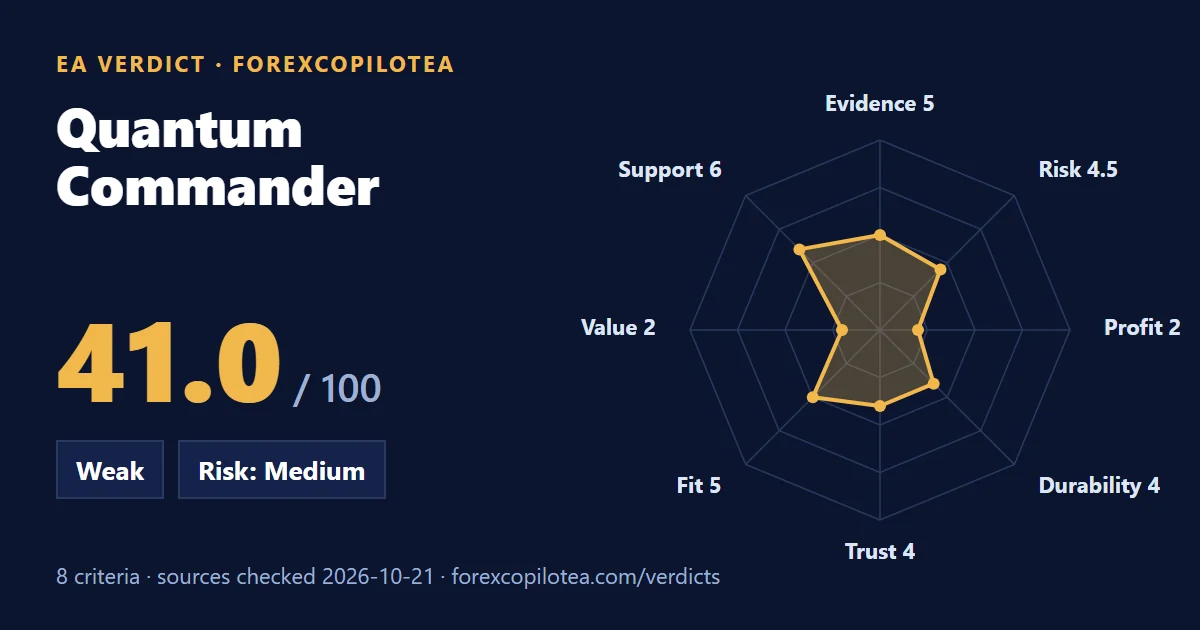
Quantum Commander is a US30 (Dow Jones) Expert Advisor from one of the best-known sellers on the MQL5 Market. It is not a grid, it is not a martingale, it opens one trade at a time with a stop and a trailing stop, and its listing carries a 4.8 rating from 26 reviews. It also has a public live signal, which is rare, and that signal is down 12.25% after ten weeks. We read the listing, the reviews and the developer's replies, then opened the signal and checked it against the claims, and scored Quantum Commander on the same eight criteria as every verdict here. The result is 41.0 out of 100 and a Medium risk label: a clean design and a responsive vendor, with the only verified numbers pointing the wrong way.
Key takeaways
- Quantum Commander scores 41.0 out of 100 (band: Weak) with a Medium risk label. The design is bounded by a stop on every trade; the score is held down by a verified record that is short and negative.
- The vendor's live signal (MQL5 signal 2388460) shows -12.25% on a 1,000 USD account after 10 weeks and 78 trades: 69% winners, but an average win of 13.88 USD against an average loss of 36.34 USD, a profit factor of 0.86 and an expected payoff of -1.57 USD per trade.
- A 69% win rate sounds high until you work out what it needs. With these averages the strategy has to win 72% of the time just to break even, so the signal is losing by about three points of win rate, not by bad luck alone. Ten weeks is also too short to say that will persist.
- The reviews on the listing are warm (4.8 from 26) but almost all were written in the first weeks, many say it is 'too early to judge', and one praised 'every trade closed in profit' in the first days. The signal tells a different story after ten weeks.
- We sell a listing for Quantum Commander, and it is version 1.4 against version 3.0 on the Market. Treat our listing and the Market product as different purchases, and check the version before relying on any number here.
- 41.0 / 100
- weighted verdict score on eight published criteria
- -12.25%
- growth of the vendor's live signal after 10 weeks and 78 trades, on a 1,000 USD start
- $899.99
- Market price on 21 Oct 2026, with a stated 'final price' of $1,999 and no date for the rise
The verdict at a glance: a tidy design, a vendor who answers, and a record that has not paid yet
Quantum Commander earns points where a trend system should: every trade has a stop, there is one position at a time, and there is nothing hidden behind a grid. It loses points on the numbers a buyer cares about most. The one record anybody can open is ten weeks old, run by the seller, and negative. The scorecard and radar show how the total was built; the sections after them show why.
41.0 / 100
Weighted verdict score
Weak
Verdict band
Medium
Risk label
| Criterion | Weight | Score | Best evidence | Points |
|---|---|---|---|---|
| Verified evidence | 20 | 5/10 | Grade A | 10.0 |
| Risk and drawdown behaviour | 20 | 4.5/10 | Grade B | 9.0 |
| Profitability quality | 15 | 2/10 | Grade A | 3.0 |
| Sustainability | 15 | 4/10 | Grade B | 6.0 |
| Transparency and trust | 10 | 4/10 | Grade B | 4.0 |
| Practical fit | 10 | 5/10 | Grade B | 5.0 |
| Cost and value | 5 | 2/10 | Grade B | 1.0 |
| Support and usability | 5 | 6/10 | Grade B | 3.0 |
| Total | 100 | 41.0 |
What Quantum Commander actually is
Quantum Commander is an Expert Advisor for MetaTrader 5, sold on the MQL5 Market by Bogdan Ion Puscasu, whose seller profile carries a 4.7 rating from about 2,800 votes and 12 products. It was published on 1 September 2026, reached version 3.0 on 20 September and trades one symbol only: US30, the Dow Jones index. The listing describes a trend-following design that waits for pullbacks inside an established trend instead of chasing extended moves.
The design choices are conservative on paper. Every trade opens with a fixed stop loss and take profit; a dynamic trailing stop locks in gains; there is only one open position at a time; there is no grid, no martingale, no averaging into losers and no escalating lot sizes, which the developer calls a linear exposure model. One unusual rule is worth noting: the exit on an opposite signal uses the M1 chart, and a losing trade may be closed early when a valid opposite signal appears.
| Item | What the vendor says |
|---|---|
| Seller | Bogdan Ion Puscasu (weredeu), seller rating 4.7 from about 2,800 votes, 12 products, 6 signals. |
| Price | $899.99 on 21 Oct 2026, described as a special launch discount with a 'final price $1999'. The page gives no date or sales count for the increase. Buyers are also offered other Quantum EAs free on request. |
| Strategy | US30 only, any chart timeframe. Trend pullback entries; fixed stop and take profit; dynamic trailing stop; one position at a time; M1 opposite-signal exit. |
| Requirements | Hedging account. $500 minimum deposit at 1:500 leverage, $1,000 or more recommended, 1:100 minimum. Brokers named: VT Markets, TMGM, StarTrader or any ECN, RAW or low-spread account. VPS mandatory for 24/5 operation. |
| Track record | Live signal 2388460 on IC Markets (ICMarketsSC-MT5-3), started 27 Aug 2026. A public MQL5 channel. |
| Reach | 2,320 free demo downloads, 10 activations per licence, rating 4.8 from 26 reviews and 25 comments. |
| Versions | 3.0, published 1 Sep 2026, updated 20 Sep 2026. Reviewers say stop management changed after launch. |
How we judged it, and who has something to sell
Evidence on EAs is never neutral. Here is every party near this product and what each stands to gain, ours included.
- The developer sells the EA, sells signal subscriptions (999 USD a month for this one), and runs the live account. His record is public, which counts for something, and it is also his sales page.
- MQL5 and MetaQuotes host the Market, the reviews and the signals. The signal statistics are computed by the platform from the account's trade history, and its warnings are the platform's own.
- Buyers who wrote reviews are mostly early customers who rated within days of launch. Testimony, not data, and each is unverifiable from outside.
- ForexCopilotEA sells a listing for this EA. We gain if you buy it, which is why this verdict opens with that fact and applies the same rules as every other.
Evidence ladder: what each rung of proof held for Quantum Commander
Grade A: Independent proof
- MQL5 signal 2388460, 'Quantum Commander', at ICMarketsSC-MT5-3: platform-built statistics for 10 weeks and 78 trades. The vendor runs the account, so his interest is noted, but the figures are computed from broker history.
- MetaQuotes and Myfxbook documentation, used for how testing reports and verified records work.
Grade B: Checkable vendor material
- The Market listing: version, price, requirements, dated reviews and developer replies.
- The free demo, which runs in the Strategy Tester only, and the vendor's other signals, which show how his earlier systems aged.
Grade C: Claim only
- 'Linear exposure', 'no averaging' and 'every trade has a stop': design statements we can read but cannot audit without the code or the trade list.
- Reviews that say 'all trades closed in profit' or 'low drawdown' without a link to a record.
Grade D: Conflicted or anonymous
- Pages that offer the EA for free or by licence key. Nothing on them is used as proof.
The live signal: ten weeks, 78 trades, and a loss
The signal is the most useful thing on the page, and it is a credit to the vendor that it exists. It trades US30 only, on a hedging IC Markets account with 1:500 leverage, from a 1,000.08 USD start on 27 August 2026. It had no deposits or withdrawals, so the curve is not dressed up. On 21 October it showed a balance of 882.44 USD, a growth figure of -12.25% and no subscribers.
| Measure | Value | What it means |
|---|---|---|
| Age | 10 weeks, started 27 Aug 2026 | Under the 12 months our method asks for. Too short to separate skill from a good or bad fortnight. |
| Trades | 78 (54 winners, 24 losers) | A modest sample. Roughly 9 trades a week, average hold about 2 hours. |
| Win rate | 69.23% | High on its face. See the break-even sum below. |
| Average win / loss | +13.88 USD / -36.34 USD | Payoff ratio of 0.38: each loser costs 2.6 winners. |
| Profit factor | 0.86 (0.85 in the author's table) | Below 1 means gross loss exceeded gross profit: 749.60 won, 872.14 lost. |
| Expected payoff | -1.57 USD per trade | The average trade lost money. |
| Best / worst trade | +37.00 USD / -200.35 USD | The worst single loss is about five times the best win. |
| Sharpe / recovery factor | -0.04 / -0.26 | Negative: the account did not recover what it lost. |
| Drawdown | 37.7% by balance, 15.7% by equity | The page also shows a 10% figure in a summary table. Always ask which basis a drawdown number uses. |
| Deposit load | 17.27% maximum | A moderate margin load, so size is not what hurt it. |
A note on the figures. MQL5 pages are generated from the account, but one page can show the same measure two ways: the signal prints both 0.86 and 0.85 for profit factor, three drawdown readings, and two readings for the longest losing streak. We quote the figure printed in the statistics block and name the basis, and where the page disagrees with itself we say so rather than choose the friendlier number.
- Break-even win rate at these averages72.4%
36.34 / (13.88 + 36.34)
- Win rate the signal achieved69.2%
54 winners in 78 trades
The break-even sum, step by step
Most buyers look at the win rate first. For any strategy with a stop and a target, the number that matters is how often it must win to break even, and that comes from the average win and average loss: loss divided by win plus loss. Here that is 36.34 divided by 50.22, or 72.4%. The signal won 69.2% of its trades, so it fell short by about three percentage points, and over 78 trades that gap is the whole loss. The calculator below runs the same arithmetic for any strategy. Set the win rate to 69 and the sliders to the signal's ratio (about 1.4 won against 3.6 lost) and it returns a negative expectancy and a break-even win rate of 72%.
Interactive: win rate is not edge
- Expected result per trade
- +0.35
- Profit factor
- 1.64
- Break-even win rate
- 33%
At these numbers the system has a positive edge before costs. Add spread, commission and slippage per trade and re-check.
This is not a verdict on the strategy's future. Three points of win rate over 78 trades is within the noise of a short sample, and a trend system with a payoff ratio below one is a design that needs a high hit rate. What the signal does show is that the EA currently sits on the wrong side of its own break-even line, with the lot size and settings the vendor chose to publish.
The platform's warnings
MQL5 attaches dated warnings to signals, and they are worth reading as part of the record. At the start the signal carried the standard 'newly opened account, results may be of random nature' and 'number of deals too small' notices; the second was removed on 10 September. The platform then flagged, on 9, 16 and 27 September, that '80% of growth was achieved within 1 day', and on 10, 18 and 29 September that the 'share of days for 80% of growth is too low'. In plain terms, the early profit came from a few days and then reversed. That is the shape of a young record that has not found its level yet, not evidence of a flaw in the design.
Which version is the record?
The signal began on 27 August, five days before the product was listed on 1 September. The listing then moved to 3.0 on 20 September. One reviewer notes that updates since launch included changes to stop management, and the developer told another that an update addressed trade management. Nothing on the signal page says which version was running in which week. That is one of our material gaps: the record may not be the exact version on sale, and the first ten weeks cannot be cleanly assigned to it.
The vendor's other signals: context, not proof
The author's signal page lists six signals under 999 USD a month each. They are the best available clue to how his systems behave over time, and they are not evidence for Commander. Quantum King shows +392% over 61 weeks (554 trades, profit factor 2.29, 29% drawdown); Quantum Emperor +210% over 59 weeks (1,111 trades, profit factor 2.11, 31% drawdown); Quantum Titan +98% over 32 weeks (136 trades, profit factor 2.24, 15% drawdown); Quantum OmniGold +47% over 19 weeks (profit factor 1.19, 32% drawdown); Quantum Valhalla +7% over 5 weeks (16 trades); and Quantum Commander -12% over 10 weeks.
- Quantum King (61 weeks)+392%
- Quantum Emperor (59 weeks)+210%
- Quantum Titan (32 weeks)+98%
- Quantum OmniGold (19 weeks)+47%
- Quantum Valhalla (5 weeks)+7%
- Quantum Commander (10 weeks)-12%
No bar: the signal is below its starting balance.
Two readings are fair. The kind one is that the older systems earned their growth over many months, and ten weeks is simply early for Commander, whose design is also the only one on the list that is neither gold nor a grid. The cautious one is that of the six, the newest two are the weakest, and a vendor with a long hit list will always have a few young records. We scored Commander on its own record, not on the family's reputation, and the family's reputation is the reason many buyers will give it the benefit of the doubt. That is a reason to run the demo, not a reason to skip it.
What buyers say, and what reviews cannot tell you
The listing shows a 4.8 rating from 26 reviews. We could read 20 of them. The pattern is consistent: they are warm, they praise support and the absence of a grid, and almost all of them were written in the first weeks after the 1 September launch, with the latest on 16 October. Several say it outright: 'waiting to see results', 'too early to judge live results', 'plans to test on demo first'.
- The cautious ones. A buyer on 16 September wrote that he lost 110 USD over three losing trades and won 54 USD over nine winners, and asked for changes to trade management. The vendor replied that an update addressed it. That is the payoff problem the signal later confirms, seen in the first week.
- The enthusiastic ones. A day-one buyer reported a trade every day since launch with all of them closed in profit, and said it matched the live signal. That can have been true then. The signal's own warnings show most of its growth arrived in a few days, and it has since fallen.
- The diversifiers. Several buyers use Quantum King or other EAs and bought Commander because it is not a gold grid. That is a sensible reason, and it says nothing about this product's own edge.
- The vendor's replies. Almost every review has a same-week thank-you, and some carry specifics: do not use five lots, the M1 exit is part of the design, the signal matches the account. That is good support. It is also a sales channel, and the replies do not address the signal's drawdown.
The real price of Quantum Commander
The price on 21 October was $899.99, listed as a special discount with a stated final price of $1,999. The page does not say when, or after how many sales, the price rises, so there is no way to tell whether $899.99 is a launch rate or the ordinary one. Two further incentives sit on the page: free extra Quantum EAs on request, and a 'new buyers only' tone that is normal on the Market and still counts as pressure. We do not penalise a vendor for marketing. We do score that the price rises on an undefined schedule while the only verified record is a loss.
| Cost | Typical figure | Note |
|---|---|---|
| Licence | $899.99 listed | One-off. Rising to a stated $1,999 on an undefined schedule. Ours is a separate sale at its own price. |
| VPS | $10 to $30 a month | Mandatory per the listing for 24/5 operation; see our VPS setup guide. |
| Broker conditions | Raw spread plus commission | ECN, RAW or a low-spread account on US30, with a hedging setup. |
| Account | $500 minimum, $1,000+ advised | The signal's account started at 1,000 USD and its balance drawdown reached 37%. |
| Your time | 12 weeks of demo | The test plan below. The free demo runs in the tester only, so a forward demo needs a purchase or our listing. |
Can your account actually run it?
The setup is plain: a hedging account, a US30 symbol with an ECN or RAW spread, 1:100 leverage or better and a VPS. Brokers differ in how they quote the Dow (US30, DJ30, WS30, US30.cash), in contract size and in how wide the spread gets at the open, and a trend system that enters on pullbacks and exits on an M1 signal is more sensitive to spread than one that holds for days. The vendor names three brokers; if yours is not one of them, run a real-ticks backtest and a demo first, as our strategy tester guide explains.
On size: the minimum is $500 and $1,000 is recommended. The signal shows what a $1,000 account looked like in practice: a deposit load of 17% at most and a balance drawdown of 37%. A reader who starts at $500 with the same lot size has the same percentage swings on half the cushion. A reviewer was told not to use five lots. Size is the lever the buyer controls, and it is the one that decides whether a losing quarter is a pause or the end of the account. See how much money to run an EA and our guide to lot sizing.
On prop firms: the listing makes no prop-firm claim. A single-index trend EA with a trailing stop can fit a challenge's rules, but the daily-loss limit and the news restrictions on US30 need checking against the firm's terms. Our FTMO guide covers what to test first.
Will it last?
Sustainability asks whether an edge survives a different market. The facts we have are thin and mostly about the vendor, not the product. The vendor is established, with a seller rating of 4.7 across about 2,800 votes, regular updates and a family of older signals that have run for months. Against that, Commander is ten weeks old, the logic is closed, it trades one index in one regime, and the stop management was changed after launch. A trend-following system on an index tends to make its money in a few large moves and give back small amounts in between, which fits a payoff that looks poor in a quiet fortnight. Whether that holds is exactly what a longer record would show.
What we could not see
We also could not read the second page of reviews or the 25 comments, so a complaint there would be missing from this verdict. If you find one that bears on the score, send it through the contact page.
Criterion by criterion: how the 41.0 was built
Each score below is out of 10, multiplied by the criterion's weight, and sits inside the tier described by the written scoring anchors. The reasoning is short on purpose; the sections above carry the evidence.
| Criterion | Score | Points | Why |
|---|---|---|---|
| Verified evidence (weight 20) | 5 / 10 | 10.0 | A platform-built signal exists, but it is 10 weeks old, vendor-run, carries early-account and concentration warnings and may span more than one version. Everything else is checkable vendor material. |
| Risk and drawdown behaviour (weight 20) | 4.5 / 10 | 9.0 | Bounded per trade by a stop, with no grid or martingale, which is a real strength. Held down by a 37.7% balance drawdown in ten weeks and an average loss 2.6 times the average win. Label Medium. |
| Profitability quality (weight 15) | 2 / 10 | 3.0 | The only verified profit factor is 0.86 and the expected payoff is negative over 78 trades. Short-sample noise cannot be ruled out, but we cannot score what is not shown. |
| Sustainability (weight 15) | 4 / 10 | 6.0 | An established vendor with frequent updates, offset by closed logic, a single index, a ten-week record and stop-management changes after launch. |
| Transparency and trust (weight 10) | 4 / 10 | 4.0 | Public signal, specific replies and no sign of deleted criticism. Offset by a 'final price' with no date, free extra EAs as an incentive and a manual that arrives after purchase. |
| Practical fit (weight 10) | 5 / 10 | 5.0 | Hedging, a named ECN broker, a mandatory VPS and one index. The $500 minimum is close to the size at which the signal's drawdown would be uncomfortable. |
| Cost and value (weight 5) | 2 / 10 | 1.0 | $899.99 rising toward $1,999 with a negative verified record; the free demo and the public signal are the mitigations. |
| Support and usability (weight 5) | 6 / 10 | 3.0 | Free demo with 2,320 downloads, a public channel and fast replies to reviews, with the manual and settings by private message after purchase. |
Who it might suit, and who should walk away
- It might suit a trader who already runs gold systems and wants an uncorrelated index strategy with a stop on every trade, who will start on demo, and who understands that a payoff below one needs a high win rate.
- It might suit someone who values a vendor who answers, and who will let the signal run longer before sizing up.
- Walk away if you expect the 4.8 rating to predict the next three months. The signal says the first ten weeks were negative.
- Walk away if you are buying because of the 'final price' of $1,999. A price that rises on an undefined schedule is a reason to take your time.
- Walk away if your account is under $500 or you cannot run a VPS. Both are requirements, not suggestions.
If you want to test it: a 12-week plan
Step 1: Weeks 1 to 2: read the record
Open signal 2388460 and note the balance, the profit factor and the worst trade. Write down the break-even win rate and compare it with the achieved one.
Step 2: Weeks 2 to 4: run the demo in the tester
Use real ticks, your broker's US30 specification and the vendor's stated settings. Check the average win and loss against the signal's 13.88 and 36.34.
Step 3: Weeks 4 to 10: forward-test on a demo
Same version, same broker conditions, minimum lot. Record every trade in a sheet. Compare your payoff ratio with the signal's.
Step 4: Weeks 10 to 12: decide with numbers
Continue only if your demo win rate beats its own break-even point and the drawdown is one you could live with at the size you would use.
Step 5: Start small, and only if it passed
Fund an amount you can lose completely and treat the first live month as part of the test.
Ten questions to put to the developer before you pay
A developer with a real edge can answer these in a paragraph. Vague or missing answers are information too, and they are the fastest way to close the gaps this verdict could not.
- Which version of Quantum Commander has the live signal been running in each week since 27 August, and when did the stop management change?
- What lot size and risk setting does the signal use, and what is the stop distance in points?
- Why is the average loss 2.6 times the average win, and is that the intended payoff of the 3.0 settings?
- Which drawdown figure do you consider the right one: 15.7% by equity, 37.7% by balance or the 10% in the summary table?
- What is the maximum number of consecutive losers in the backtest, and how does the signal compare?
- When and after how many sales does the price rise from $899.99 toward $1,999?
- What are the terms of the free extra EAs offered to buyers, and do they come with support?
- Can the manual and the recommended settings be shared before purchase?
- How does the M1 opposite-signal exit behave in a fast market, and how often has it closed a trade early?
- What is the refund policy, and what happens if results on my broker differ from the signal?
What would move this score
- A 12-month verified record on the current version, with the monthly table visible and a profit factor above 1. This alone could lift evidence and profitability into the 7 to 8.5 tier.
- A signal that crosses its own break-even line, with the payoff ratio stated. This helps profitability and trust together.
- A fixed price and a dated rise, without a free-bonus incentive. These raise trust and cost.
- A manual and settings published before purchase. This helps trust and support.
- Downward risks: a deeper drawdown on the signal, a reset record, or a version change that breaks the history.
The developer, or any reader with the signal open, can send corrections through the contact page. We will recalculate and log the change with the date at the top of this page.
How it compares with the other verdicts
Next to Quantum Titan, the same vendor's gold system with a 32-week signal that scored 51.0, Commander is cleaner by design (no grid) and weaker on proof (ten weeks, negative). Next to Quantum Queen X at 36.5, a gold grid with no record, it gives you a record to read and a stop on every trade. Next to Wave Rider at 43.0 and The Gold Reaper at 59.3, its 41.0 lands where a young, vendor-run record usually lands. For how these system types differ, see our strategy comparison and our track-record guide.
Sources and when they were opened
- MQL5 Market: Quantum Commander (product 182942), opened 21 October 2026Source of the price, version, requirements, strategy claims, rating, reviews and the developer's replies. Written by the vendor.
- MQL5 Signals: Quantum Commander (signal 2388460), opened 21 October 2026Source of every performance figure and platform warning in this verdict. The vendor operates the account.
- MQL5 Signals: author Bogdan Ion Puscasu (weredeu), opened 21 October 2026Source of the vendor's other five signals and their statistics.
- MQL5 Market: seller page for Bogdan Ion Puscasu, opened 21 October 2026Source of the seller rating, product list and prices.
- Myfxbook Help: VerificationHow a trading account's track record is verified on Myfxbook.
- MetaTrader 5 Help: Testing ReportWhat each figure in the tester's report means, including drawdown.
- MetaTrader 5 Help: Strategy TestingThe Strategy Tester: testing modes, settings and forward testing.
- CFTC Customer Advisory: AI Won't Turn Trading Bots into Money MachinesA US regulator's warning about trading-bot claims of unusually high returns.
Frequently asked questions
Is Quantum Commander legit?
It is a real product with a documented design, a public live signal, frequent updates and a vendor who answers reviews, rated 4.8 from 26 reviews on the MQL5 Market. We do not allege wrongdoing. The proof is thin and currently negative: the vendor's signal is down 12.25% after ten weeks, which is why it scores 41.0 out of 100 with a Medium risk label.
Does Quantum Commander use a grid or martingale?
No. The listing says it opens one position at a time with a fixed stop loss and take profit, a trailing stop and no grid, martingale, averaging or escalating lots. We read that as a design statement we cannot audit without the code, but the signal's trade statistics (one trade at a time, 9 trades a week, no outsized baskets) are consistent with it.
What drawdown does Quantum Commander have?
On the vendor's live signal the maximum drawdown was 37.7% by balance and 15.7% by equity after ten weeks, and a 10% figure appears in one summary table. Those are three readings of the same account, so check which one a seller quotes. The signal's starting balance was 1,000 USD.
How much does Quantum Commander cost?
The MQL5 Market price on 21 October 2026 was $899.99 against a stated final price of $1,999, with no date for the rise. A VPS and an ECN or RAW hedging account are extra. A free demo is available and runs in the Strategy Tester. Sellers differ in price, version and terms, so read the terms of whichever seller you use.
What is the minimum deposit for Quantum Commander?
The listing states $500 at 1:500 leverage, recommends $1,000 or more and asks for a hedging account and 1:100 leverage at least. Treat $500 as a technical floor: the vendor's own signal on a 1,000 USD account saw a 37.7% balance drawdown within ten weeks.
Is a 69% win rate good?
Not by itself. A win rate only means something next to the average win and loss. On this signal the average win is 13.88 USD and the average loss 36.34 USD, so the strategy needs to win about 72.4% of the time to break even, and it won 69.2%. That is why a high win rate still produced a loss.
How was the score calculated?
Eight weighted criteria (evidence 20, risk 20, profitability 15, sustainability 15, trust 10, fit 10, cost 5, support 5), each scored out of ten against written anchors. Sources are graded A to D and unverified claims cannot count as proof. We sell a listing for this EA, which is disclosed at the top, and the same method scored Quantum Titan at 51.0 and Wave Rider at 43.0. The total here is 41.0 out of 100.
Gold Expert Advisors in our store
We sell these, so weigh that interest. Put the same eight questions to any of them before you buy: read the manual, run your own backtest, and start on demo.


Keep reading
- EA Verdict #4Quantum Titan EA Review: Verdict and Risk (2026)Is Quantum Titan worth $1,299.99? Independent EA verdict: 51.0/100, Medium risk. Live signal, drawdown, trust and cost scored from sources opened 17 Oct 2026.
- EA Verdict #1Quantum Queen X Review: Verdict and Risk (2026)Is Quantum Queen X worth $1,199.99? Independent EA verdict: 36.5/100, High risk. Evidence, drawdown, trust and cost scored from sources opened 17 Oct 2026.
- VerificationHow to Verify an EA Track Record: Myfxbook and MQL5How to read an EA track record on Myfxbook or MQL5 Signals: what verification proves, the numbers to check, fake-record tricks, and a 12-point checklist.
- Strategy comparisonWhich EA Strategy Wins Long Term?Compare MT5 Expert Advisor strategy types, from scalping and grid to hedging and arbitrage: how each earns, how each fails, and which tend to survive long term.