
EA Verdict #4
Quantum Titan EA Review (2026): 87% Winners, a Payoff Below One and 32 Weeks of Live Signal Data
By Benjamin Lee · Updated · 32 min read
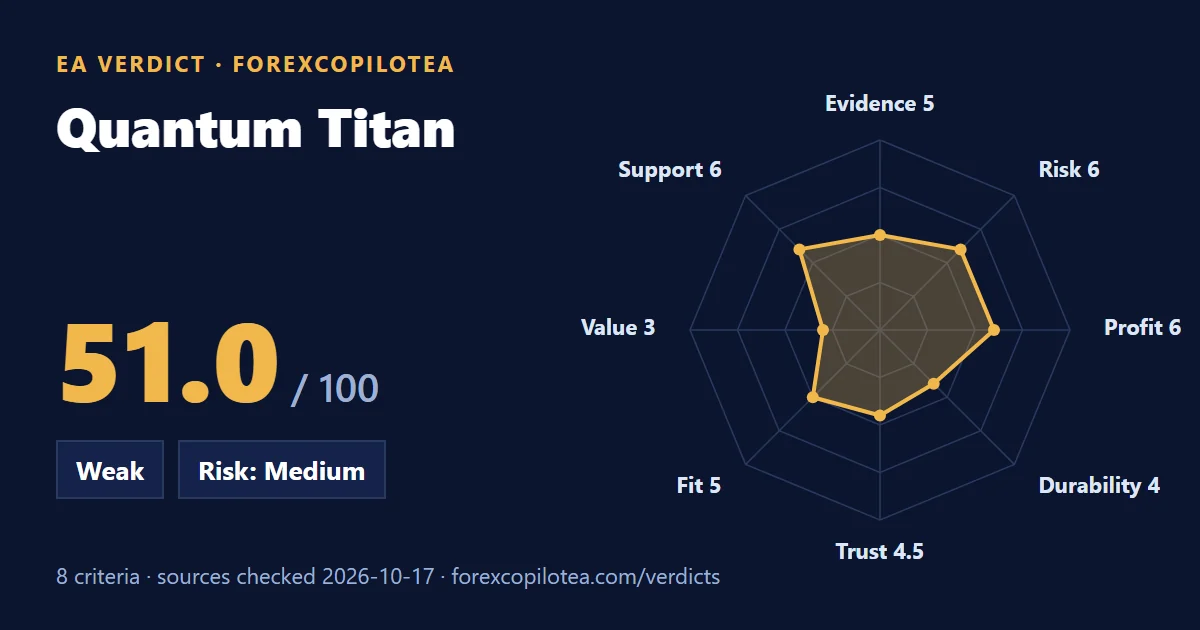
Quantum Titan is the newest gold robot from the developer behind the Quantum family, and it arrives with something its sibling Quantum Queen X did not have when we scored it: a public MQL5 live signal that anyone can open. The signal shows a €50,000 account that has grown 96.65% in about 32 weeks, an 87.3% win rate, a profit factor of 2.22 and a worst equity drawdown of 14.59%. Those are strong numbers. They also sit on 134 trades, an average loss three times the size of an average win, and a single winning streak that supplied about three quarters of the profit. We scored the product on the same eight criteria as every verdict here. The result is 51.0 out of 100 and a Medium risk label: a real record with a solid shape, too short and too lumpy to carry a $1,299.99 licence on its own.
Key takeaways
- Quantum Titan scores 51.0 out of 100 (band: Weak) with a Medium risk label. A platform-built MQL5 signal earned real credit, and it lifts the score well above Quantum Queen X (36.5), but a record of about 32 weeks, run by the vendor, keeps it below the Mixed band that the 102-week Gold Reaper signal reached (59.3).
- The signal shows +96.65%, 134 trades, 117 winners (87.31%), profit factor 2.22 and a maximum equity drawdown of 14.59%. The average win is €751.53 and the average loss €2,329.55, a payoff of 0.32, so the system lives on its win rate. The break-even win rate at that payoff is 75.6%.
- One run of 37 consecutive winners accounts for €36,328.12 of the €48,326.24 profit, about 75%. Without it, our arithmetic puts the profit factor near 1.30 and the cushion over break-even at about four points, not twelve. MQL5's own warning log flagged the concentration of growth.
- Average holding time is about three minutes, and MQL5 warns of a high risk of negative slippage for people who copy the signal. The signal's own price is 999 a month with 0 subscribers; the licence is $1,299.99 with a stated final price of $1,999 and a cap of 1,000 lifetime licences.
- We do not sell Quantum Titan and earn nothing from it. We do sell competing gold systems, and we scored this product by the published method, with the same grading rules as every other verdict.
- 51.0 / 100
- weighted verdict score on eight published criteria
- 87.31%
- win rate on 134 trades in the live MQL5 signal, with an average win of 0.32 times the average loss
- 14.59%
- maximum equity drawdown on the signal's €50,000 account, about 32 weeks in
The verdict at a glance: a clean curve that is still short and lumpy
A verdict is a set of trade-offs, so here is the shape of this one before any detail. Quantum Titan is the most checkable Quantum product we have read. It has a platform-hosted live record, a public manual with its risk levels spelled out, a free demo, a stop on every trade by the vendor's description and a drawdown that looks modest beside the gain. It loses points where short, fast, high-win-rate systems usually lose them: a record of about 32 weeks, a payoff well below one, profit concentrated in a few runs, and a price that has no refund path.
51.0 / 100
Weighted verdict score
Weak
Verdict band
Medium
Risk label
| Criterion | Weight | Score | Best evidence | Points |
|---|---|---|---|---|
| Verified evidence | 20 | 5/10 | Grade A | 10.0 |
| Risk and drawdown behaviour | 20 | 6/10 | Grade A | 12.0 |
| Profitability quality | 15 | 6/10 | Grade A | 9.0 |
| Sustainability | 15 | 4/10 | Grade C | 6.0 |
| Transparency and trust | 10 | 4.5/10 | Grade B | 4.5 |
| Practical fit | 10 | 5/10 | Grade B | 5.0 |
| Cost and value | 5 | 3/10 | Grade B | 1.5 |
| Support and usability | 5 | 6/10 | Grade B | 3.0 |
| Total | 100 | 51.0 |
What Quantum Titan actually is
Quantum Titan MT5 is an Expert Advisor for MetaTrader 5 that trades one symbol, gold (XAUUSD). It is sold on the MQL5 Market by Bogdan Ion Puscasu, whose seller profile shows a 4.7 rating from about 2,800 votes, 12 products and 5 signals. The listing describes selective entries 'designed to trade only when conditions align', short trades with a predefined stop loss and a trailing stop, and no grid. It was published on 7 August 2026 and showed version 3.4, updated on 14 October 2026.
The vendor's manual adds the mechanics the listing leaves out. The EA runs two independent cores, A and B, each with its own magic number and settings. Core A offers a Classic and an Anticipated entry style, and Anticipated, the default, enters slightly earlier. Timeframes are built in, so the buyer does not choose one. Risk is set through eight automatic levels, a fixed lot, a percentage or a balance-based method. That menu matters, because the same product can behave very differently on two accounts.
| Item | What the vendor says |
|---|---|
| Seller | Bogdan Ion Puscasu, CEO of Incredible Traders, Romania. Seller rating 4.7 from about 2,800 votes. |
| Price | $1,299.99 'launch' price, with a stated final price of $1,999. No rental. A bundle offer of another Quantum EA is mentioned, with details 'by private message'. |
| Scarcity claim | Limited to 1,000 lifetime licences worldwide; 'no longer available' once they are claimed. |
| Strategy | Gold only, selective entries, short holds, two cores, an optional recovery mode. No grid, and no martingale 'in the recommended default configuration'. |
| Risk controls | A predefined stop loss on every trade (a $5 or $10 stop per 0.01 lot, by mode), trailing stop, profit protection, a maximum drawdown input that closes trades, and an optional slippage guard. |
| Requirements | Hedging account, RAW or ECN spreads (the manual says 'mandatory'), no 3-digit gold quotes, VPS. Minimum deposit $500, $1,000 or more recommended. Leverage from 1:100, 1:500 recommended. |
| Brokers named | VT Markets, TMGM, StarTrader, RoboForex and IC Markets, and Coinexx for US customers. |
| Reach | 10,232 free demo downloads, 36 purchases a month, rating 4.73 from 50 reviews, 10 activations per licence. |
| Performance claim | Links the live signal described below. A developer reply in September cited more than €37,000 in profit on it. |
How we judged it, and who has something to sell
Evidence on EAs is never neutral. Here is every party near this product and its stake.
- The vendor sells the EA, sells the signal subscription and runs the live account. The record is public and generated by the platform from broker trades, which is the point, but the person running it is also the person selling the licence.
- MQL5 and MetaQuotes host the signal and the Market. The statistics are computed by the platform, and its warnings are the platform's own, not the vendor's.
- Buyers who wrote reviews were mostly a few days to a few weeks into use. Testimony, not data, and they sit under a vendor who replies to almost every one.
- Resellers and review sites that list the product for free download or an 'original key' have no connection to the vendor that we could see. We do not rely on them, and we would not use the files they offer.
- ForexCopilotEA sells competing gold systems. We gain nothing if you buy Quantum Titan, and we gain something if you buy a rival. That is why the disclosure opens this page.
Evidence ladder: what each rung of proof held for Quantum Titan
Grade A: Independent proof
- MQL5 live signal 2362973 at VantageMarkets-Live 4: platform-hosted statistics built from broker trade history, about 32 weeks and 134 trades. The vendor operates it, so we weigh it below a fully independent account.
- MQL5's own warning log for the signal, and MetaQuotes and Myfxbook documentation used for how testing reports and verified records work.
Grade B: Checkable vendor material
- The Market listing: version, price, requirements, dated reviews and developer replies.
- The public manual: cores, risk levels, stop-loss modes, recovery mode and inputs. The free demo, which anyone can run.
Grade C: Claim only
- 'No grid, no martingale' in the default configuration, and the limit of 1,000 lifetime licences: sales claims. The signal's statistics are consistent with the first but cannot prove it for every setting.
- Review claims such as 'about 17% net in the first month' on a stated account size, which no one can open.
Grade D: Conflicted or anonymous
- Pages that offer the EA for free or by 'original licence key', and any review whose author we cannot identify or who sells a rival. None of it is used as proof.
Under the written anchors, a verified record under 12 months sits in the 5 to 6.5 tier on evidence, and we take the lower end because the vendor runs it, the version match is unknown and growth is concentrated. A 12-month record on the version being sold, with the monthly table visible, would lift it.
The live signal: what the record shows
The signal is an MQL5 account called Quantum Titan at VantageMarkets-Live 4, leverage 1:500, funded with €50,000, 100% algorithmic, trading XAUUSD only. We read every figure below from the signal page on 17 October 2026 and checked them against a screenshot of its header. Several of them are linked by simple arithmetic, and we checked that too: gross profit of €87,928.55 over 117 winners gives the €751.53 average win, and gross loss of €39,602.31 over 17 losers gives the €2,329.55 average loss.
| Measure | Value | What it tells you |
|---|---|---|
| Growth and profit | +96.65%; profit €48,326.24 on a €50,000 deposit; equity and balance €98,326.24 | Positive and substantial after about 32 weeks. No deposits or withdrawals, so the growth figure is not distorted by cash flows. |
| Trades | 134 (67 long, 67 short); 117 winners (87.31%), 17 losers | A small sample. Seventeen losing trades is not much to judge a loss tail by. |
| Profit factor | 2.22 (gross profit €87,928.55; gross loss €39,602.31) | A healthy edge in the sample. It rests on the win rate, not on the payoff. |
| Average win and loss | +€751.53 against -€2,329.55 | The average loss is 3.1 times the average win: a payoff of 0.32. |
| Best and worst trade | +€2,577.46 and -€2,887.06 | The worst loss is only about 24% larger than the average loss, which is what a fixed stop looks like. |
| Streaks | 37 consecutive wins worth €36,328.12; at most 2 consecutive losses, -€5,504.23 | One long run of wins supplies about 75% of the profit. Two losses in a row cost 11% of the deposit. |
| Drawdown | 11.83% by balance (€6,820.24); 14.59% by equity (€7,880.69); max deposit load 10.60% | Moderate against the gain. Equity drawdown, which includes open trades, is the figure to plan around. |
| Recovery factor and Sharpe | 7.09 and 0.32 (MQL5's own calculations) | Recovery factor is profit divided by the balance drawdown. We lean on neither number. |
| Holding and activity | Average hold 3 minutes; 111 trading days (50.23%); trading activity 0.28% | Very short trades, one or two a day when it trades at all. |
| Copy economics | Signal price 999 a month; 0 subscribers; 0 signal reviews; slippage 'No data' | Nobody has copied it on a paid plan, so nothing is known about how it copies. |
Two readings of one record. The first: a real-money account that has more than doubled in about 32 weeks with a drawdown of 14.59%, 67 longs and 67 shorts so it was not just riding one direction, and no loss larger than €2,887 in 134 trades. The second: 134 trades is a thin sample, the profit is concentrated, and the record belongs to a vendor with a licence to sell. Both are true. A sales page quotes the first and leaves out the second.
How long is the record, really?
The signal page prints 'Weeks: 32' next to 'Started: 2026.07.25'. Those two cannot both be the date of the first trade, because 25 July to 17 October is 12 weeks. The page also shows 111 trading days at 50.23% of days, which implies a lifetime of about 221 days, and its own warning log of 21 May counts '73 days of the signal's entire lifetime'. Put those together and the account's first day falls around 8 March 2026. We read 25 July as the date the account was listed as a public signal, and we treat the record as about 32 weeks long. That is our inference from the page's own numbers, and we flag it.
It matters for a second reason. The Market listing was published on 7 August 2026, five months after the signal began, and is now at version 3.4 after updates through 14 October. The page does not say which version produced which part of the curve. A record that spans several versions of a closed-source EA is not the record of the version you would buy today, and our scoring anchors count that as a material gap.
87% wins and a payoff of 0.32: what the maths says
Divide the average win by the average loss and you get the payoff: €751.53 over €2,329.55 is about 0.32. The system wins about 87 times in 100 and each loss takes back more than three wins. A strategy with that payoff needs a win rate of 1 divided by 1.32, which is 75.6%, just to break even. The signal's 87.31% clears it by 11.7 percentage points. That cushion is the entire edge, so the question is how safe it is.
A 134-trade sample carries a margin of error. Treating each trade as a coin flip with a true win rate p, a 95% interval around the observed 87.3% runs from roughly 81% to 92%. Even the low end is above the 75.6% break-even line, which is the reassuring half of the picture. The other half is that the payoff has its own uncertainty, and with only 17 losses the average loss is a thin estimate. If a few more losses arrive at the worst size, €2,887 and up, the payoff falls and the break-even rate rises.
- Break-even win rate at a payoff of 0.3275.6%
1 divided by (1 + 751.53/2,329.55). Below this, the system loses money.
- Low end of a 95% interval on the observed rateabout 81%
Our estimate for 117 wins in 134 trades.
- Observed win rate on the signal87.31%
117 wins, 17 losses, read 17 October 2026.
Use the calculator below to see how little room a low-payoff system has. Enter a win rate near 87% and an average win about a third of the average loss and expectancy is positive; lower the win rate to 76% and it falls to roughly zero.
Interactive: win rate is not edge
- Expected result per trade
- +0.35
- Profit factor
- 1.64
- Break-even win rate
- 33%
At these numbers the system has a positive edge before costs. Add spread, commission and slippage per trade and re-check.
In money terms the signal earned €360.64 a trade on average, about 0.72% of the starting deposit, over 134 trades. That is a comfortable margin per trade on gold at this size, and it is also the number a wider spread, a slipped fill or a different broker eats into first.
One winning streak did most of the work
The signal page lists its longest run of consecutive winners as 37 trades worth €36,328.12. Read as one unbroken run, that is about 75% of the €48,326.24 total profit, earned in 37 of 134 trades. Strip it out and the other 97 trades, which include all 17 losers, made €11,998.12, about €124 a trade.
- Profit from the 37-trade winning streakabout 75%
€36,328.12 of €48,326.24.
- Win rate on the other 97 trades80 of 97 (82.5%)
Still above its own break-even rate, but by less.
- Break-even win rate on the other 97 trades78.3%
Average win of about €645 against the same €2,329.55 loss.
On the rest of the record, then, the cushion over break-even is about four points, not twelve, and the profit factor is about 1.30 against the headline 2.22. That is not an accusation: every system has its best run, and removing it is a deliberately harsh test. It is a measure of how much the headline depends on one stretch of good conditions repeating.
MQL5's own warning log points the same way. It raised 'share of days for 80% of growth is too low' repeatedly between April and June, including an entry on 21 May that read '80% of growth achieved within 2 days', 2.74% of the 73 days the signal had existed. We do not know whether that warning is still active today. The pattern is the same as in the Gold Reaper signal, where MQL5 flagged that 80% of growth arrived in a month. Lumpy returns are normal for fast breakout and scalping systems, and they make a 32-week record weaker evidence than its percentage suggests.
Drawdown: what the signal did, and what it could do
The signal's worst equity drawdown is 14.59%, €7,880.69 from its peak, with a balance drawdown of 11.83%. For a system that trades gold in three-minute bursts that is moderate, and it is inside the 25% line that our 7 to 8.5 risk tier uses; other gaps hold the risk score lower. Look at how it is built. The average loss is €2,329.55, or 4.66% of the starting deposit, and the worst is €2,887.06, 5.77%. The largest drawdown on record is therefore about three and a half average losses, and the two consecutive losses the signal has had cost €5,504.23, 11% of the deposit.
- Average losing trade (-€2,329.55)4.66%
17 losers in 134 trades.
- Worst losing trade (-€2,887.06)5.77%
About 24% larger than the average loss.
- Two consecutive losses (-€5,504.23)11.0%
The longest losing run so far.
- Maximum equity drawdown (€7,880.69)14.59%
About three and a half average losses.
Two points follow. First, the loss distribution is consistent with a fixed stop on every trade, because no loss is larger than about 1.24 times the average, which is what the vendor says the EA does. We call it consistent, not proven: we have not seen the trade list or the code. Second, with three losses in a row at the worst size the drawdown would go past 17%, with four past 23%, and the signal has had a maximum of two in a row. A longer record, with more than 17 losing trades, would say whether runs of three or four are rare or just not yet seen.
Interactive: drawdown recovery
Gain needed to get back to break-even
+42.9%
Blue: equity left. Red: equity lost.
Consecutive losing trades to reach this drawdown: 36
A 14.59% drawdown needs a gain of about 17.1% to recover. On this signal that is a few weeks of average results, which is comfortable. The calculator shows how quickly that arithmetic turns against a trader as the drawdown grows. Our guide to drawdown and its companion on lot size and risk cover how to size against the number you measure, not the one you hope for.
The recovery mode: a martingale-style option, off by default
The manual describes a setting called recovery mode: after a losing trade, the next trade's lot size rises to try to win the loss back, controlled by a RecoveryMultiplier. It is off by default, and the manual advises against changing the defaults. That is a fair warning and a fair design: a loss-recovery option exists, it is disclosed in public, and the vendor says the recommended configuration does not use it.
It still matters to a buyer, for two reasons. The listing's 'no martingale' claim is made 'in the recommended default configuration', not for the product as a whole. And the record we can see cannot tell us whether recovery mode was ever on: the signal's loss sizes are tightly clustered and never above €2,887, which fits a signal with the mode off, but a mode that has not been triggered leaves the same footprint. A risk label of Medium assumes the defaults. Turning recovery on moves the product toward the grid and martingale family that cannot be rated better than High on our anchors. Our strategy comparison explains why.
Three-minute trades: what speed does to a record
The average holding time is about three minutes, and the account trades on 111 of roughly 221 days, typically one or two trades each. Systems like this have a particular set of weaknesses, and they matter most to anyone who copies the signal instead of running the EA.
- Slippage. MQL5 prints 'High risk of negative slippage when copying deals' on the signal page. A trade that lasts three minutes and targets a few dollars of gold can be gone before a copier's order arrives.
- Spread and commission. The manual calls a RAW or ECN account with very low spreads 'mandatory', and says the EA is not compatible with brokers that quote gold with three decimal digits. The signal's result is the result at one broker, VantageMarkets-Live 4, which is not among the brokers we saw the vendor name. Your spread and commission are not that account's.
- Execution. The EA has to run continuously, so a VPS is needed. The listing calls it mandatory and the manual says 'highly recommended'; read that as: assume you need one.
- Slippage guard. The manual lists an optional $1 to $2 guard that skips a trade if price has moved too far before entry. It is a sensible control and also means a tight setting will miss some of the trades that made the signal's profit.
None of this is unusual for fast gold systems. Our guides to spread and slippage and scalping EAs explain each cost. The practical rule is the one we gave for the Global Trade Plan verdict: a scalper's record is as portable as the broker, spread and VPS that produced it. Run your own demo through the same hours before you believe the signal's numbers apply to you.
What buyers say, and what reviews cannot tell you
The listing shows a rating of 4.73 from 50 reviews. The reviews we could read, from September and October 2026, are almost all positive: reviewers praise the short, selective trades, the support, and results that 'match the signal'. One reports about 17% net in a first month on a $5,200 account, another about 6% in ten days, another ten wins and one loss in two weeks. These are self-reported and unverifiable, and several come from people a few days into use.
Two entries are less rosy and worth reading. One reviewer on 10 September said the demo results were strong but live results were 'very mixed' and similar to other breakout EAs; the vendor replied the same day, pointed to the live signal and said drawdowns are normal. Another reviewer on 11 September said early losses came from running an account too small for the risk setting, and recovered afterwards. That second report fits the manual's own warning: the risk level, not the EA, decides how much a loss hurts.
Read reviews for what they cannot do. Every review is under three months old, because the product was published in August. The vendor replied to almost every one, usually within a week and in similar terms. We read no review that gave a lot size or a broker alongside a result, so none can be checked. They tell you that early buyers were mostly satisfied and that support answers. They do not tell you how the EA behaves through a bad quarter.
The real price of Quantum Titan
The Market price on 17 October 2026 was $1,299.99, described as a 'special launch discount' on a stated final price of $1,999, about 54% higher. There is no rental, and we found no refund terms: MQL5 Market purchases are generally final. A licence allows 10 activations.
The scarcity claim deserves a plain look. The page says only 1,000 lifetime licences will ever be sold. At the 36 purchases a month the listing shows, 1,000 licences would last about 28 months, so a buyer does not need to rush to beat a sell-out, and a countdown to the higher price is a pricing tactic, not a reason to skip a test. We treat limited-licence wording as pressure and note that the claim cannot be checked from outside.
Then there is the size of the licence against the account. The minimum deposit is $500 and the vendor recommends $1,000 or more, so the licence costs 2.6 times the minimum deposit and 1.3 times the recommended one. Add the costs the sticker leaves out: a VPS, a RAW or ECN broker account, and enough capital that the minimum lot does not make every stop a major event. On the signal itself, the subscription is 999 a month. Even if a copier's €5,000 account matched the signal's average monthly growth of 10.60%, that is about €530 a month against a €999 fee, before slippage. The signal is a record to read, not a product to buy at that price.
To be fair, the free demo is real (10,232 people downloaded it) and it removes most of the price risk of a test. The risk starts when the licence is bought.
Can your account actually run it?
- Capital. The minimum is $500, and the vendor recommends $1,000 or more. The signal runs on €50,000, 50 to 100 times that. On a small account the minimum lot makes each stop a large share of the balance. Treat anything under about $2,000 as a test account.
- Account type. A hedging account is required. Netting accounts, which some regulated brokers and US venues impose, will not do.
- Broker. RAW or ECN spreads are 'mandatory' per the manual, and gold must not be quoted with three decimals. The vendor's named brokers are VT Markets, TMGM, StarTrader, RoboForex and IC Markets, with Coinexx for the US. See our broker guide and gold guide.
- Leverage. 1:100 minimum, 1:500 recommended; the signal runs 1:500. Check what your regulator allows.
- Hosting. Assume you need a VPS. Running it on more than one chart creates duplicate trades, and the manual advises against closing and reopening the EA while trades are open.
- News filter. NFP days are avoided by default, and the manual recommends avoiding FOMC days as well.
- Prop firms. The manual's FAQ says Titan can be used to pass challenges at the Very Low risk level. The signal does not run at a stated level, and a 14.59% equity drawdown would exceed the loss limit of many challenges. Read how EAs and prop firms mix before trying.
Will it last?
About 32 weeks of data, one symbol and one set of market conditions give little to build durability on. The vendor is established, with a long product list, active updates (version 3.4 three months after launch) and a public manual, which counts for something. But the logic is closed, the signal spans versions we cannot tell apart, and the strongest part of the record may be the 37-trade run described above. There are no multi-year verified results, no published backtest with reproducible settings, and no information on what the EA does when gold stops trending. Our backtest-report guide explains what a reproducible one would show. The score is low for now and has room to rise.
What we could not see
We also did not see a backtest with stated settings, a Strategy Tester report, a set file (the listing describes 'plug and play' defaults, not named set files) or an independent third-party review. The vendor's description of a 'maximum drawdown protection mechanism' has no stated default threshold in the manual we read, and the manual itself carries no live results or drawdown figures and does not link the signal.
Criterion by criterion: how the 51.0 was built
Each score below is out of 10, multiplied by the criterion's weight, and sits inside the tier described by the written scoring anchors. The reasoning is short on purpose; the sections above carry the evidence.
| Criterion | Score | Points | Why |
|---|---|---|---|
| Verified evidence (weight 20) | 5 / 10 | 10.0 | A platform-built MQL5 signal earns real credit. Held back by a record of about 32 weeks (under 12 months), vendor operation, an unknown version match, growth concentrated in one winning run and a start date that does not reconcile. |
| Risk and drawdown (weight 20) | 6 / 10 | 12.0 | A stop on every trade by the vendor's description, consistent with the loss sizes, and a verified 14.59% equity drawdown. Held back by 17 losing trades, a 4.7% average loss, a recovery mode in the settings and a drawdown that depends on an unstated risk level. Label Medium, assuming the defaults. |
| Profitability quality (weight 15) | 6 / 10 | 9.0 | Verified profit factor 2.22 and positive expectancy, with no deposits or withdrawals. Held back by a payoff of 0.32, 75% of profit from one run, a profit factor near 1.30 without it, and a short record. |
| Sustainability (weight 15) | 4 / 10 | 6.0 | An established vendor with active updates, offset by closed logic, one symbol, about 32 weeks and no sign of how the edge behaves outside the sampled conditions. |
| Transparency and trust (weight 10) | 4.5 / 10 | 4.5 | A public manual, a live signal and active replies, offset by a 'launch' price rising to $1,999, a limited-licence countdown, a generic reply style, no refund path and figures that do not reconcile on the signal page. |
| Practical fit (weight 10) | 5 / 10 | 5.0 | Mainstream account type and sensible requirements, but a hedging and RAW or ECN account, a VPS, a minimum far below the capital behind the signal and the sensitivity of three-minute trades to spread and slippage. |
| Cost and value (weight 5) | 3 / 10 | 1.5 | A premium licence with a rising stated price and no rental, against a record under 12 months; the free demo is the mitigation. |
| Support and usability (weight 5) | 6 / 10 | 3.0 | A free demo, a detailed public manual, optimised defaults and quick replies; some friction from broker and VPS requirements and no named set files. |
Who it might suit, and who should walk away
It may suit an experienced gold trader with a RAW or ECN hedging account, a low-latency VPS and capital well above the minimum, who will run the free demo for months, set the risk level from a measured drawdown and treat any live money as the second stage of the test. The vendor's public manual and the signal give that kind of buyer more to work with than most gold EAs do.
It does not suit anyone who is buying on the 97% headline, who expects a small account to behave like a €50,000 one, who would pick a higher risk level to speed things up, or who plans to copy the paid signal on a modest balance. If you are unsure, start with our guide to spotting EA scams; this product is not one, but the checks are the same.
If you want to test it: a 12-week plan
Step 1: Open the signal yourself
Read the statistics, warnings and any monthly table on the signal page. Compare the start date, the weeks and the trade count with this verdict, and note anything that changed.
Step 2: Run the free demo on your own broker
Use a RAW or ECN hedging demo with the spreads you would trade. Log the spread at entry and every stop. A fast system's edge lives in these numbers.
Step 3: Backtest on real ticks
Use XAUUSD on your broker's data, with its real spread and commission. Note maximum equity drawdown and compare it with the signal's 14.59%. How to read the report.
Step 4: Forward-test for 12 weeks
A demo on the same broker, account type and VPS you would use live. Our forward-testing guide says what to log. The signal is 32 weeks old; your demo should cover a bad stretch, not only a good one.
Step 5: Keep recovery mode off and start low
Leave the defaults alone, pick a risk level from your measured drawdown, not from the vendor's, and set a total-loss rule outside the EA.
Step 6: Start small, and only if it passed
Fund an amount you can lose completely, and treat the first live month as part of the test.
Ten questions to put to the vendor before you pay
A vendor with a real edge can answer these in a paragraph. Vague or missing answers are information too, and they are the fastest way to close the gaps this verdict could not.
- Which risk level, stop-loss mode and money-management method does signal 2362973 use, and has recovery mode ever been on?
- On what date did the signal's account make its first trade, and why does the page show 25 July as the start next to 32 weeks?
- Which version of Quantum Titan produced each part of the record, and what changed in each release?
- What produced the 37-trade winning streak, and what does the record look like without it?
- What lot size and which stop-loss mode did the account use, and how does that scale to a $1,000 account?
- What is the refund policy, and what does a buyer get if the EA fails to match the signal on their broker?
- Is the 1,000-licence limit enforced, how many have been sold, and what is the date and rule for the move to $1,999?
- What spread, commission and slippage did the signal average per trade, and at what typical lot size?
- What is the default maximum-drawdown threshold, and was it ever triggered on the signal?
- Why is the signal listed at VantageMarkets-Live 4 when the vendor's named brokers are VT Markets, TMGM, StarTrader and RoboForex?
What would move this score
- A 12-month verified record on the current version, with the monthly table visible and the version history published. This alone could lift evidence into the 7 to 8.5 tier.
- A profit that stays positive without its best run, with the profit factor holding above 1.5 after the 37-trade streak is removed. That would move profitability up.
- A longer loss history, showing that runs of three or four losers are rare and bounded by the stop, and the settings the signal uses. This helps risk.
- A refund path, a fixed price and an end to the countdown. These raise trust and cost together.
- Subscribers who copy the signal with published slippage data. Right now 'No data' is all the page can say.
- Downward risks: a deeper drawdown, a visible loss of the edge, a record that is reset, or recovery mode shown to be in use.
The vendor, or any reader with the signal open, can send corrections through the contact page. We will recalculate and log the change with the date at the top of this page.
How it compares with the other verdicts
Next to the same developer's Quantum Queen X, which scored 36.5 as a grid system with no verified record of its own, Quantum Titan is a clear step up: a bounded-risk design with a public, platform-built record and a manual that explains its risk levels. Next to The Gold Reaper, which scored 59.3 on a 102-week signal, it has the lower drawdown and the higher win rate but about a third of the history. Next to Global Trade Plan, which scored 42.8, it has the stronger numbers and a cleaner record of similar length, and the same family of caveats: a short record, a vendor-run account and a thin cushion over break-even. For how these system types differ, see our strategy comparison and our gold category.
Sources and when they were opened
- MQL5 Signals: Quantum Titan (signal 2362973), opened 17 October 2026Source of every performance figure and platform warning in this verdict: growth, trades, drawdown, streaks, subscribers, price and warning log. The vendor operates the account.
- MQL5 Market: Quantum Titan MT5 (product 113770), opened 17 October 2026Source of the price, version, requirements, rating, reviews and the developer's replies. Written by the vendor.
- Incredible Traders: Quantum Titan EA Comprehensive Manual, opened 17 October 2026Source of the cores, risk levels, stop-loss modes, recovery mode, broker and VPS requirements. Written by the vendor; it carries no live results.
- Myfxbook Help: VerificationHow a trading account's track record is verified on Myfxbook.
- MetaTrader 5 Help: Testing ReportWhat each figure in the tester's report means, including drawdown.
- MetaTrader 5 Help: Strategy TestingThe Strategy Tester: testing modes, settings and forward testing.
- CFTC Customer Advisory: AI Won't Turn Trading Bots into Money MachinesA US regulator's warning about trading-bot claims of unusually high returns.
Frequently asked questions
Is Quantum Titan EA legit?
It is a real product with a public MQL5 live signal built from broker trade history: +96.65% in about 32 weeks, 134 trades, an 87.31% win rate, a profit factor of 2.22 and a 14.59% maximum equity drawdown. The vendor says it uses stops, no grid and no martingale in its default configuration. We do not allege wrongdoing. The record is short, run by the seller, and concentrated, which is why it scores 51.0 out of 100 and not higher.
What drawdown does Quantum Titan have?
The signal's worst drawdown is 14.59% by equity and 11.83% by balance, on a €50,000 account. The signal does not state which risk level, stop-loss mode or lot method it uses, and the product lets a buyer choose from eight risk levels, so your drawdown can differ widely from this number. Check the signal page and measure your own on a demo.
How much does Quantum Titan cost?
The MQL5 Market price on 17 October 2026 was $1,299.99, a 'launch' price with a stated final price of $1,999, and no rental. The signal subscription is priced at 999 a month. Add a VPS and a RAW or ECN hedging broker account. A free demo is available, and we found no refund terms.
Does Quantum Titan use martingale or grid?
The listing says it uses no grid and no martingale in the recommended default configuration, and the signal's losses are tightly clustered with at most two in a row, which fits that. The manual describes a recovery mode that raises lot size after a loss, off by default. Whether it was ever on during the signal cannot be seen from outside, so the Medium risk label assumes the defaults.
What is the minimum deposit for Quantum Titan?
The listing states a minimum deposit of $500 and recommends $1,000 or more, with leverage of 1:100 or more and a hedging account. The signal runs on €50,000, so treat the minimum as a technical floor. On a small account the minimum lot makes each stop a much larger share of the balance than on the signal.
Can you copy the Quantum Titan signal instead of buying the EA?
You can subscribe on MQL5, priced at 999 a month, and it had 0 subscribers when we read it. The page shows no slippage data and warns of a high risk of negative slippage when copying, because the average trade lasts about three minutes. At the signal's 10.60% average monthly growth, a €5,000 copier would earn about €530 against the €999 fee, before slippage. The signal is better used as a record to study.
How was the 51.0 score calculated?
Eight weighted criteria (evidence 20, risk 20, profitability 15, sustainability 15, trust 10, fit 10, cost 5, support 5), each scored out of ten against written anchors. Sources are graded A to D and unverified claims cannot count as proof. We do not sell Quantum Titan; the same method scored Gold Reaper at 59.3, Global Trade Plan at 42.8 and Quantum Queen X at 36.5.
Gold Expert Advisors in our store
We sell these, so weigh that interest. Put the same eight questions to any of them before you buy: read the manual, run your own backtest, and start on demo.


Keep reading
- EA Verdict #1Quantum Queen X Review: Verdict and Risk (2026)Is Quantum Queen X worth $1,199.99? Independent EA verdict: 36.5/100, High risk. Evidence, drawdown, trust and cost scored from sources opened 17 Oct 2026.
- EA Verdict #2The Gold Reaper EA Review: Verdict and Risk (2026)Is The Gold Reaper worth $949? Independent EA verdict: 59.3/100, Medium risk. Live signal, drawdown, trust and cost scored from sources opened 17 Oct 2026.
- EA Verdict #3Global Trade Plan EA Review: Verdict and Risk (2026)Is Global Trade Plan EA worth $299? Independent EA verdict: 42.8/100, Medium risk. Verified Myfxbook record, drawdown, trust and cost scored, 17 Oct 2026.
- Strategy comparisonWhich EA Strategy Wins Long Term?Compare MT5 Expert Advisor strategy types, from scalping and grid to hedging and arbitrage: how each earns, how each fails, and which tend to survive long term.