
EA Verdict #5
Wave Rider EA Review (2026): A Grid by Default, a Three-Week Signal and 46 Reviews
By Benjamin Lee · Updated · 25 min read
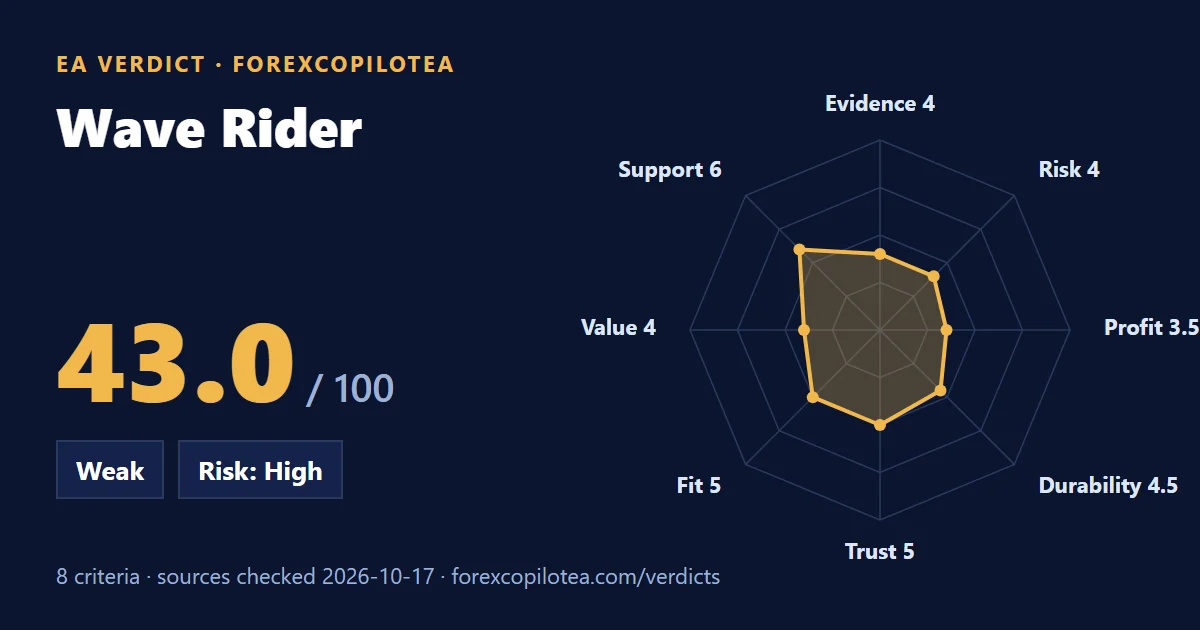
Wave Rider is a gold Expert Advisor with an unusually open developer: a long public manual, version notes that admit what failed, answers to nearly every review, and a rating of 4.81 from 46 reviewers. It is also, by default, a grid, and the one live signal the developer points to is about a month old, with nine trades and no loss to learn from. We read the listing, the reviews and the developer's replies, the manual and the signal, then scored Wave Rider on the same eight criteria as every verdict here. The result is 43.0 out of 100 and a High risk label: strong on transparency and support, thin on proof, and a design whose danger only shows up in the rare deep basket.
Key takeaways
- Wave Rider scores 43.0 out of 100 (band: Weak) with a High risk label. The label is set by the default design, a grid with 'intelligent recovery', not by any proven failure; the Single Position mode removes it.
- The developer's 'Main Signal' (MQL5 signal 2391460) shows 9 trades, all wins, +5.07% on €400 and a profit factor of 76. A sample that small, with no losing trade, cannot show how a grid behaves in the deep baskets that decide whether it survives. We graded it as a record in name only.
- A buyer reported losing $10,000 across four accounts after 13 grid levels went the wrong way. The developer replied that equity protection exists and that 'WR can't blow account'. We report both as claims; the screenshots are in the comments and we have not verified either side.
- The listing says 'Single Position' mode has a '98% win rate'. At that win rate a stop 49 times the size of the target still breaks even, so the number says nothing without the payoff, which the page does not give.
- We sell a listing for Wave Rider (v5.61 here, against 5.71 on the MQL5 Market), so this is a review of a product we sell. The score came from the published method, and the disclosure comes first.
- 43.0 / 100
- weighted verdict score on eight published criteria
- 9 trades
- in the developer's Main Signal: 100% winners, about a month of data, no loss to judge a grid by
- $249
- Market price on 17 Oct 2026 against a stated regular price of $499, with a countdown ahead of a 'WR6' launch
The verdict at a glance: an open developer and a record too short to test the design
Wave Rider earns points where good vendors usually earn them: it documents its inputs in public, ships frequent updates, explains its failures in the version notes and answers its critics by name. It loses points where it matters most to a buyer of a grid: the record is a month old, the risk label follows the default design, and the strongest numbers on the page are claims. The table and radar show how the 43.0 was built.
43.0 / 100
Weighted verdict score
Weak
Verdict band
High
Risk label
| Criterion | Weight | Score | Best evidence | Points |
|---|---|---|---|---|
| Verified evidence | 20 | 4/10 | Grade A | 8.0 |
| Risk and drawdown behaviour | 20 | 4/10 | Grade C | 8.0 |
| Profitability quality | 15 | 3.5/10 | Grade C | 5.3 |
| Sustainability | 15 | 4.5/10 | Grade B | 6.8 |
| Transparency and trust | 10 | 5/10 | Grade B | 5.0 |
| Practical fit | 10 | 5/10 | Grade B | 5.0 |
| Cost and value | 5 | 4/10 | Grade B | 2.0 |
| Support and usability | 5 | 6/10 | Grade B | 3.0 |
| Total | 100 | 43.0 |
What Wave Rider actually is
Wave Rider EA MT5 is an Expert Advisor for MetaTrader 5, sold on the MQL5 Market by Adam Hrncir of the Czech Republic, whose seller profile shows a 4.6 rating from 75 votes, 2 products and 3 signals. It trades gold (XAUUSD) from any chart, using seven built-in strategies: support and resistance, pullback, trend breakout, M5 bounce, smart-money volume, momentum continuation and an optional impulse strategy. It was published on 25 February 2026 and showed version 5.71, updated on 12 September 2026.
The defining choice is how it exits. The default is a 'Recovery (Grid)' mode: the first position opens normally, and if price moves against it the EA adds positions at set distances and closes the whole basket from a weighted breakeven price. The alternative, 'Single Position (SL/TP)', opens one trade with a stop and a target, no recovery. The developer's manual, published on 2 March 2026 and updated to version 5.71, documents both, plus four matched recovery 'personalities': Wide (Slow), Wide (Fast), Static and Hybrid.
| Item | What the vendor says |
|---|---|
| Seller | Adam Hrncir, Czech Republic. Seller rating 4.6 from 75 votes; 2 products, 3 signals. |
| Price | $249, described as a 'very limited price' with a countdown ('LESS > 48h' on the page) ahead of a 'WR6 launch'; the stated regular price is $499. 10 activations. |
| Strategy | Seven gold strategies with higher-timeframe trend and lower-timeframe confirmation. Most trades 'close in under 30 minutes'. Default exit is grid recovery; optional Single Position mode with SL/TP and trailing. |
| Risk controls | Daily drawdown limit that closes the EA's positions and pauses trading, a no-entry zone near all-time highs, a Dynamic Exit for sharp adverse moves, a news filter, and hard ceilings on basket volume and position count (the values are not stated on the page). |
| Requirements | Hedging account, XAUUSD, any timeframe. Minimum deposit $300 at 0.01 lot; $800 or more recommended for grid recovery; about $150 for Single Position. Leverage 1:100 minimum, 1:500 recommended. ECN or RAW spreads. VPS recommended. |
| Testing advice | Back-test 2025 to the present with real ticks; history before 2025 is 'not trusted'. Version 5.0 testing described as 'thousands of positions across multiple broker feeds'. |
| Reach | 4,337 free demo downloads, 27 purchases a month, rating 4.81 from 46 reviews, 263 comments. |
| Upgrade warning | Version 5.x changed magic numbers and several input names. Close all Wave Rider positions before updating and do not load old 4.x set files. |
How we judged it, and who has something to sell
Evidence on EAs is never neutral. Here is every party near this product and its stake, ours included.
- The developer sells the EA, sells signal subscriptions (99 USD a month for the Main Signal) and runs the live accounts. His record is public, which counts for something, and it is also his sales page.
- MQL5 and MetaQuotes host the Market, the reviews and the signals. The signal statistics are computed by the platform, and its warnings are the platform's own.
- Buyers who wrote reviews include very satisfied users and at least one who alleges large losses. Testimony, not data, and each is unverifiable from outside.
- ForexCopilotEA sells a listing for this EA. We gain if you buy it, which is why this verdict opens with that fact and applies the same rules as every other.
Evidence ladder: what each rung of proof held for Wave Rider
Grade A: Independent proof
- MQL5 signal 2391460, 'WR High Risk Default Settings', at VTMarkets-Live 6: platform-built statistics for about three weeks and 9 trades. The vendor runs it, and it is too short to carry weight.
- MetaQuotes and Myfxbook documentation, used for how testing reports and verified records work.
Grade B: Checkable vendor material
- The Market listing: version, price, requirements, dated reviews and developer replies.
- The public manual (version 5.71), the free demo and the stated defaults, which a buyer can inspect.
Grade C: Claim only
- '98% win rate' for Single Position mode, 'thousands of positions across multiple broker feeds', 'WR can't blow account' and the 'Broker performance' comments: sales or defence claims with no record behind them that we could open.
- Buyer claims on both sides: 'maximum drawdown only around 20% on Very High Risk' and 'lost $10,000, blew 4 accounts'.
Grade D: Conflicted or anonymous
- Pages that offer the EA for free or by 'original licence key'. Nothing on them is used as proof.
Under the written anchors, a verified record needs real substance to count: three weeks and nine trades is below it. We treat the signal as a record in name, and score evidence in the 3 to 4.5 tier, where the proof is mostly checkable vendor material. A 12-month signal with a visible monthly table, including at least one deep basket, would lift it.
The live signal: what a nine-trade record shows
The listing's 'Main Signal (default settings)' is MQL5 signal 2391460, named 'WR High Risk Default Settings', at VTMarkets-Live 6, funded with €400, leverage 1:500. The page prints 3 weeks and a start of 15 September 2026. We read every figure below on 17 October 2026.
| Measure | Value | What it tells you |
|---|---|---|
| Growth and profit | +5.07%; profit €20.27 on €400; equity and balance €420.27 | Positive and tiny in money terms. No deposits or withdrawals. |
| Trades | 9 closed, 9 winners (100%), 0 losers | No loss at all: nothing to measure the risk side of the design against. |
| Profit factor | 76.07 (gross profit €20.54, gross loss €0.27) | Not meaningful. The only 'loss' is €0.27 of costs, so the ratio is a quirk of the sample. |
| Average win and best trade | €2.28 and €3.41 | Small trades, consistent with a minimum-lot scalper on a small account. |
| Activity | Average hold 48 minutes; 6 trading days (28.57%); about 1 trade a week | Barely active, so there is little to draw a pattern from. |
| Drawdown and load | Max deposit load 1.89%; drawdown negligible | No basket of any depth has occurred. |
| Platform warnings | 'Newly opened account', 'number of deals too small to evaluate', and 'share of trading days too low' | MQL5's own message is that this is too early to judge. |
| Copy economics | 99 USD a month; 0 subscribers; slippage 'No data' | Nobody has paid to copy it. |
Be fair to the developer: he calls it the 'Main Signal (default settings)', not a track record, and a grid that has not yet needed recovery will look like this. That is exactly the point. A nine-trade, no-loss record is what a grid, a single-position scalper and a blown-up system all look like in their first weeks. It says the EA runs and trades. It cannot say how the recovery logic behaves when price keeps going the wrong way.
The author runs two other signals: 'GoldenShot High Risk' (a different product, 8 weeks, 34 trades) and a '30 USD per month' signal called 'Next Project'. Neither is Wave Rider, so neither counts as evidence for it. The developer also points to a 'Broker performance' comment on the listing; it is a vendor post inside the comments, graded C.
The default is a grid: what that means for risk
A grid wins often and small, and takes its losses in a few large events. The listing describes the default recovery as 'intelligent grid recovery with progressive spacing, trailing stop, and breakeven tracking' and 'your backup plan when the market moves against you'. The manual adds that 'grid recovery can hold several positions during a sustained move' and that matched recovery choices 'reduce unsafe configuration mistakes but do not guarantee recovery'. These are candid statements, and they are the reason we label the design High risk.
The vendor deserves credit for what it does about this: a daily drawdown limit that closes the EA's positions and pauses trading, a Dynamic Exit for sharp adverse moves, 'hard ceilings on both total basket volume and position count', and an option to turn recovery off entirely. The page does not state the ceilings or the default drawdown limit, so a buyer cannot judge how deep a basket may go before the controls act. Our anchors reserve the better risk tiers for products where the worst case is bounded by design and shown.
Four recovery personalities, and the developer's own warning
The listing offers Wide (Slow), Wide (Fast), Static and Hybrid, each built as a package so that spacing, target, depth and lot behaviour 'move together'. Of Wide (Fast) it says: 'In testing it delivered more activity and more profit. It also delivered more drawdown, and I am not going to pretend otherwise.' That is the sort of sentence we like to see. It also tells a buyer that the product's drawdown depends on which personality they pick, and none of the numbers behind that statement are on the page.
An allegation, and the developer's reply
On 16 June 2026 a reviewer wrote: 'Lost 10.000 USD. Blew 4 of my accounts. Wave Rider opened 13 Grids in the wrong direction... I used the latest Version of the EA. Game Over. Too risky this EA.' The developer replied on 13 July: 'Even if we hit equity protection one day, it wont erase all the profits it setup correctly. WR can't blow account and its easily back testable. Ur either spreading misinformation or you have turned off your DD protection. WR is transparent EA with live signal where everyone can verify whats going on.'
We cannot verify either account. The reviewer says the screenshots are in the comments; the developer says the protection settings were off or the claim is false. What we can say is that the allegation is exactly the failure a grid is known for, that it was made against the then-latest version, and that the reply points to a 'live signal where everyone can verify'. The Main Signal the listing links today began on 15 September, two months after that reply, and is nine trades long. A strong answer to this review would be a deep basket, in a long record, that the controls handled.
Other reviewers report the opposite: one who runs the 'Very High Risk' setting says the maximum drawdown 'has only reached around 20%', another calls it 'a grid but safe'. These are also self-reported and unverifiable. Taken together, the reviews show what one would expect of a grid: many satisfied users in a good quarter and a vocal loss in a bad one.
The '98% win rate': what it can and cannot tell you
For Single Position mode the listing says 'one trade, fixed stop loss, fixed take profit... With 98% Win Rate'. Win rate alone does not tell you whether a system makes money; the payoff does. At a 98% win rate, the break-even payoff is 0.02 divided by 0.98, about 0.02. In plain terms, the average win only has to be 2% of the average loss for the system to break even, which means a stop 49 times the size of the target still has no edge or loss. Any scalper can show a 98% win rate if it sets a distant stop and a close target.
That is not a charge against Wave Rider. It is a reason to ask for the average win and average loss before the win rate means anything. Use the calculator below: set the win rate to 98% and make the average win a few percent of the average loss, and the expectancy drops to zero.
Interactive: win rate is not edge
- Expected result per trade
- +0.35
- Profit factor
- 1.64
- Break-even win rate
- 33%
At these numbers the system has a positive edge before costs. Add spread, commission and slippage per trade and re-check.
A product that changes every week
The developer describes working on Wave Rider 'every single week' and keeping notes on rejected fixes. That is rare and it counts for sustainability and support. It also has a cost the buyer should plan for. Version 5.0 changed the magic numbers and several inputs, and the notes say to close all Wave Rider positions before updating and not to load old sets. One reviewer worried that frequent changes looked like curve-fitting; the developer replied that the changes responded to user requests for extra safety.
Two consequences follow. A live record from version 4.x is not a record of version 5.x, and the signal we can open began on 15 September 2026, long after the 5.0 rewrite, so it can at least be compared with version 5.71. And the price page is built around a coming 'WR6' launch: the Market listing carries a '48 hours' price countdown tied to it, which means a buyer today may be buying a product the developer is already replacing. The developer says new strategies will come as free updates to 5.x, which is a promise we can only check over time.
What buyers say, and what reviews cannot tell you
The listing shows 4.81 from 46 reviews and 263 comments. The reviews we read, from June to September 2026, are overwhelmingly positive: reviewers praise the fast, selective entries, the support, the presence of a stop-loss, and a developer who is 'constantly monitoring, updating and improving'. One calls it a top-three EA in their portfolio and says it is not an EA that makes money every day. The developer replies to nearly every review, usually in a sentence and sometimes with a specific answer, such as explaining that the EA reads the H1 trend and so may not open a sell for days.
Read reviews for what they cannot do. They are the words of buyers a few weeks to a few months in, written when results were good, and they cannot show how a grid copes with the one quarter that goes wrong. We did not see a review that gave a lot size, a broker and a verifiable result together. The strongest negative review is the one described above, and it is both unverified and answered.
The real price of Wave Rider
The Market price on 17 October 2026 was $249, described as a very limited price against a regular $499, with a countdown marked 'LESS > 48h' ahead of the WR6 launch. We could not tell from the page when that countdown started, and urgency of this kind is a sales tactic, not a reason to skip a test. There is no rental, and we found no refund terms; MQL5 Market purchases are generally final. A licence allows 10 activations.
Add the costs the sticker leaves out: a VPS, an ECN or RAW broker account, and capital that fits the mode you use. The developer recommends $800 or more for grid recovery, so the licence is about 31% of the recommended balance on the smallest recommended account, and the $300 minimum is below the capital that the vendor itself calls comfortable for a grid. The free demo is real (4,337 downloads) and removes most of the price risk of a test; the risk starts when the licence is bought.
Our store lists a Wave Rider at its own price, as a separate sale with its own terms and version. We disclose that at the top because it affects how you should read this page. Whichever seller you consider, ask what the refund policy is, which version you are getting, and whether the record you are shown belongs to that version.
Can your account actually run it?
- Capital. The minimum is $300 at 0.01 lot and the vendor recommends $800 or more for grid recovery. The signal runs on €400. A grid needs margin headroom for a deep basket, so treat anything under about $1,000 as a test account.
- Account type. A hedging account is required. The manual says grid recovery 'is not designed for netting accounts' and that cent accounts are not recommended.
- Broker. ECN or RAW spreads are strongly preferred. The listing names VT Markets, IC Markets, Fusion Markets, FP Markets, FxTrading and others. See our broker guide and gold guide.
- Leverage. 1:100 minimum, 1:500 recommended; the signal runs 1:500. A deep basket is a margin question, so check what your regulator allows.
- Hosting. The manual says the terminal must stay connected for virtual basket targets, trailing updates and filters. Plan for a VPS.
- News feed. The EA needs a WebRequest URL allowed for the ForexFactory calendar feed, and a terminal restart after you add it.
- Prop firms. The listing calls Single Position mode 'prop firm friendly'. A grid is not, and our prop-firm guide explains why.
Will it last?
The strongest durability evidence is the developer's behaviour: almost eight months of frequent, documented updates, a public manual, replies to critics, and an unusual willingness to describe rejected ideas. The weakest is everything a buyer can verify: no multi-month record, no published backtest with stated settings, an 'about 2025 to now' testing window the vendor himself bounds, and a product that is being rebuilt under a new version number as we write. The score reflects both: higher than a closed, unmaintained EA, lower than a product with a long verified record.
What we could not see
We also did not see a backtest report with stated settings, a Strategy Tester curve for a stress period, set files beyond the defaults or an independent third-party review. The 'thousands of positions across multiple broker feeds' claim is the vendor's own and has no data attached.
Criterion by criterion: how the 43.0 was built
Each score below is out of 10, multiplied by the criterion's weight, and sits inside the tier described by the written scoring anchors. The reasoning is short on purpose; the sections above carry the evidence.
| Criterion | Score | Points | Why |
|---|---|---|---|
| Verified evidence (weight 20) | 4 / 10 | 8.0 | A platform-built signal exists, but it is about a month old, with 9 trades, no losses and platform warnings that the sample is too small. We treat it as a record in name. Everything else is checkable vendor material. |
| Risk and drawdown (weight 20) | 4 / 10 | 8.0 | Default design is a grid with a daily drawdown limit and hard ceilings whose values are not published. A buyer alleges large losses and the developer disputes it. No deep basket in the record. Label High. |
| Profitability quality (weight 15) | 3.5 / 10 | 5.3 | A plausible edge shown by a nine-trade win streak and reviews. No verified profit factor or expectancy worth the name, and the '98% win rate' comes without a payoff. |
| Sustainability (weight 15) | 4.5 / 10 | 6.8 | Frequent documented updates and a responsive developer, offset by closed logic, version drift (5.0 rewrite, a coming WR6) and no multi-month record. |
| Transparency and trust (weight 10) | 5 / 10 | 5.0 | A detailed public manual, stated inputs and specific replies, offset by an open loss allegation answered defensively, a price countdown and an anchor price of $499. |
| Practical fit (weight 10) | 5 / 10 | 5.0 | Specific needs (hedging, ECN, VPS, a news feed) and a $300 minimum well below the $800 the vendor recommends for a grid, with Single Position mode as a mitigation. |
| Cost and value (weight 5) | 4 / 10 | 2.0 | A $249 licence against a stated $499, with a free demo, but no refund terms and a record too short to match the price. |
| Support and usability (weight 5) | 6 / 10 | 3.0 | Free demo, a long public manual, tuned defaults and a developer who answers personally, with friction from the breaking upgrade notes and broker requirements. |
Who it might suit, and who should walk away
It may suit an experienced gold trader who understands grids, will run the demo for months, will start in Single Position mode or the Wide (Slow) personality at a small lot, funds well above the minimum, and treats any live money as a test. The public manual and the developer's openness give that buyer a lot to work with.
It does not suit a beginner, anyone sizing a grid from the $300 minimum, anyone buying on the 98% figure or a countdown, or anyone who cannot afford to lose the account. If you are unsure, start with our guide to spotting EA scams; this product is not one, but the checks are the same.
If you want to test it: a 12-week plan
Step 1: Open the signal and the manual yourself
Read the signal's statistics and warnings, and the manual's input pages. Note which version and mode the signal uses.
Step 2: Run the free demo on your own broker
Use a RAW or ECN hedging demo with the spreads you would trade. Log every basket: how many levels it reached and how long it took to close.
Step 3: Backtest on real ticks
Use XAUUSD from 2025 on your broker's data, as the vendor advises, and look at maximum equity drawdown and the deepest basket. How to read the report.
Step 4: Forward-test for 12 weeks
The same broker, account type and VPS you would use live. Our forward-testing guide says what to log. Try Single Position and Recovery separately.
Step 5: Set the drawdown limit yourself
Do not rely on defaults you cannot see. Choose a daily limit and total-loss rule from your own measured deepest basket.
Step 6: Start small, and only if it passed
Fund an amount you can lose completely, and treat the first live month as part of the test.
Ten questions to put to the developer before you pay
A developer with a real edge can answer these in a paragraph. Vague or missing answers are information too, and they are the fastest way to close the gaps this verdict could not.
- What is the deepest basket Wave Rider has ever reached on a live account, in positions, lots and drawdown, and which version and mode?
- What are the default values of the daily drawdown limit and the basket volume and position ceilings?
- What are the average win and the average loss behind the '98% win rate' in Single Position mode?
- Can you link a live account, running the current version and the default recovery mode, with at least 12 months of history?
- In the 'lost $10,000' review, which version, settings and drawdown protection were used, and did you see the screenshots?
- When does the WR6 launch happen, what changes for 5.x buyers, and is the upgrade free?
- What is the refund policy, and what happens to a buyer whose results differ from the signal on their broker?
- What spread, commission and slippage did the Main Signal average per trade?
- Which recovery personality and risk level does the Main Signal use, and what lot size?
- When did the 48-hour price countdown start, and what is the price when it ends?
What would move this score
- A 12-month verified record on the current version, with at least one deep basket and the monthly table visible. This alone could lift evidence into the 7 to 8.5 tier.
- Published ceilings and a drawdown default, with stress results at each recovery personality. This would lift risk.
- A resolved loss allegation: the buyer's screenshots reviewed in the open and the settings behind them. This helps trust and risk.
- Average win and loss for Single Position mode, and a verified profit factor. This helps profitability.
- A refund path and a fixed price, without the countdown. These raise trust and cost together.
- Downward risks: a deep basket on the signal, a record that is reset, or a WR6 that breaks 5.x buyers.
The developer, or any reader with the signal open, can send corrections through the contact page. We will recalculate and log the change with the date at the top of this page.
How it compares with the other verdicts
Next to Quantum Queen X, another grid, which scored 36.5, Wave Rider is more open and better documented, with a short verified record where Queen X had none. Next to Quantum Titan, which scored 51.0 on a 32-week, 134-trade signal, it has far less to show, and a riskier default. Next to The Gold Reaper at 59.3 and Global Trade Plan at 42.8, it sits near the bottom of the Weak band for the same reason as the latter: a vendor-run record that is too short. For how these system types differ, see our strategy comparison and our gold category.
Sources and when they were opened
- MQL5 Market: Wave Rider EA MT5 (product 165897), opened 17 October 2026Source of the price, version, requirements, strategy and risk claims, 46 reviews and the developer's replies. Written by the developer.
- MQL5 Signals: WR High Risk Default Settings (signal 2391460), opened 17 October 2026Source of the performance figures and platform warnings. The developer operates the account.
- MQL5 Signals: author Adam Hrncir (adamhtrading), opened 17 October 2026Source of the author's other two signals, which are not Wave Rider.
- MQL5 Blogs: Wave Rider EA - Manual (version 5.71)The developer's public user guide: inputs, trade modes, upgrade warnings and setup. Written by the developer.
- Myfxbook Help: VerificationHow a trading account's track record is verified on Myfxbook.
- MetaTrader 5 Help: Testing ReportWhat each figure in the tester's report means, including drawdown.
- MetaTrader 5 Help: Strategy TestingThe Strategy Tester: testing modes, settings and forward testing.
- CFTC Customer Advisory: AI Won't Turn Trading Bots into Money MachinesA US regulator's warning about trading-bot claims of unusually high returns.
Frequently asked questions
Is Wave Rider EA legit?
It is a real product with a documented design, a public manual, frequent updates and a developer who answers reviews, rated 4.81 from 46 reviews on the MQL5 Market. We do not allege wrongdoing. The proof is thin: the developer's Main Signal has 9 trades over about a month, and the default design is a grid, which is why it scores 43.0 out of 100 with a High risk label.
Does Wave Rider use a grid or martingale?
By default it uses grid recovery: it adds positions at set distances when price moves against the first one and closes the basket from a weighted breakeven price. It also has a Single Position mode with a stop loss and take profit and no recovery. The listing speaks of 'lot progression' and 'lot behaviour' inside recovery, so assume recovery positions can be larger than the first, and it states no multiplier values. Check the exact settings on a demo.
What drawdown does Wave Rider have?
There is no meaningful verified drawdown yet: the Main Signal has had no losing trade. A reviewer reports about 20% on the Very High Risk setting, and another alleges losing $10,000 across four accounts. Both are unverified. The listing describes a daily drawdown limit, a no-entry zone near all-time highs and hard basket ceilings, but does not state their default values.
How much does Wave Rider cost?
The MQL5 Market price on 17 October 2026 was $249, described as a limited price against a regular $499, with a countdown ahead of a 'WR6' launch. A VPS and an ECN or RAW hedging account are extra. A free demo is available, and we found no refund terms. Sellers differ in price, version and terms, so read the terms of whichever seller you use.
What is the minimum deposit for Wave Rider?
The listing states $300 at 0.01 lot, recommends $800 or more for grid recovery and about $150 for Single Position mode, with leverage of 1:100 or more and a hedging account. Treat $300 as a technical floor: a grid needs margin for a deep basket, and our test guidance is to treat anything under about $1,000 as a test account.
Is the 98% win rate real?
It is the listing's claim for Single Position mode, and we found no record behind it. A win rate says nothing without the payoff: at a 98% win rate, a stop 49 times the size of the target still breaks even. Ask for the average win and average loss, and measure both on a demo.
How was the 43.0 score calculated?
Eight weighted criteria (evidence 20, risk 20, profitability 15, sustainability 15, trust 10, fit 10, cost 5, support 5), each scored out of ten against written anchors. Sources are graded A to D and unverified claims cannot count as proof. We sell a listing for this EA, which is disclosed at the top, and the same method scored Quantum Titan at 51.0 and Gold Reaper at 59.3.
Gold Expert Advisors in our store
We sell these, so weigh that interest. Put the same eight questions to any of them before you buy: read the manual, run your own backtest, and start on demo.


Keep reading
- EA Verdict #1Quantum Queen X Review: Verdict and Risk (2026)Is Quantum Queen X worth $1,199.99? Independent EA verdict: 36.5/100, High risk. Evidence, drawdown, trust and cost scored from sources opened 17 Oct 2026.
- EA Verdict #4Quantum Titan EA Review: Verdict and Risk (2026)Is Quantum Titan worth $1,299.99? Independent EA verdict: 51.0/100, Medium risk. Live signal, drawdown, trust and cost scored from sources opened 17 Oct 2026.
- EA Verdict #3Global Trade Plan EA Review: Verdict and Risk (2026)Is Global Trade Plan EA worth $299? Independent EA verdict: 42.8/100, Medium risk. Verified Myfxbook record, drawdown, trust and cost scored, 17 Oct 2026.
- Strategy comparisonWhich EA Strategy Wins Long Term?Compare MT5 Expert Advisor strategy types, from scalping and grid to hedging and arbitrage: how each earns, how each fails, and which tend to survive long term.