
EA Verdict #12
Gold House EA Review (2026): A $749 Gold Breakout EA With Two Live Signals, a 4.4 Rating and a Price That Rises With Sales
By Benjamin Lee · Updated · 22 min read
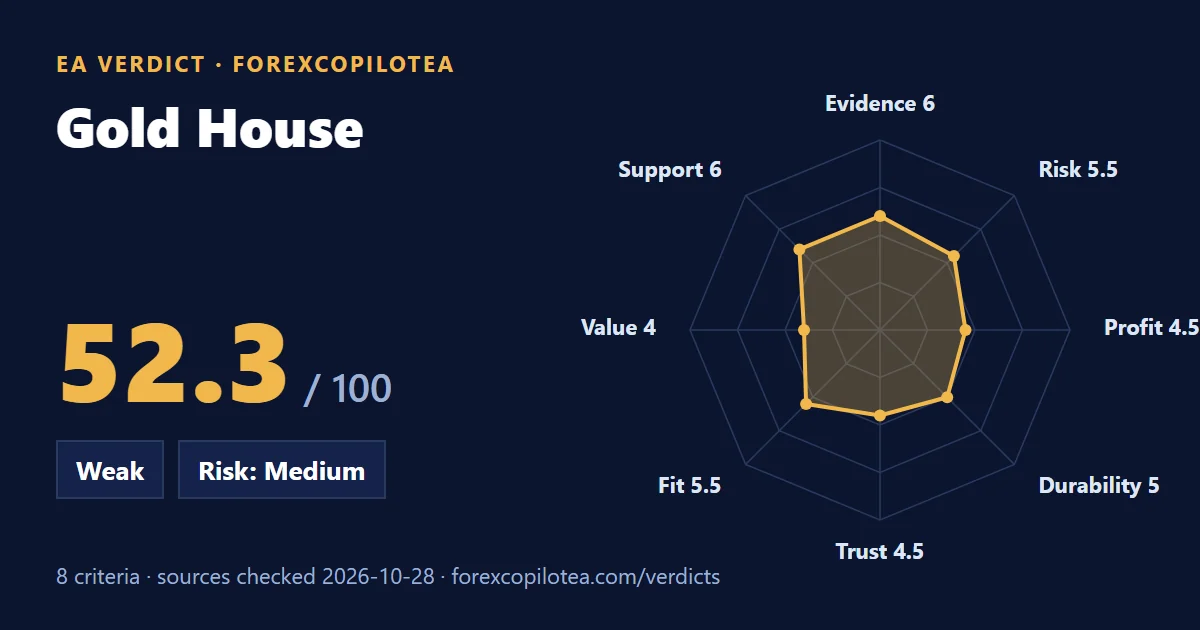
Gold House is a gold breakout Expert Advisor for MetaTrader 5 that tracks swing highs and lows, runs five independent breakout strategies, puts a stop loss on every trade and says it uses no grid and no martingale. Its listing links two live MQL5 signals, shows a 4.4 rating from 68 reviews, and asks $749 with a stated plan to raise the price by $50 after every ten purchases until it reaches $1,999. That is more public proof than most gold EAs give. The signals are also more mixed than the headline growth suggests, and one buyer who has run it since February reports a drawdown of 30% to 40% from the peak. We read the listing and the reviews we could open, checked both signals line by line and scored Gold House on the same eight criteria as every verdict here. The result is 52.3 out of 100 and a Medium risk label: a real, running breakout system with an edge that is modest, lumpy and still short on history.
Key takeaways
- Gold House scores 52.3 out of 100 (band: Weak) with a Medium risk label. It has verified live records, a stop on every trade and no stated grid, but the edge is thin and every record is under 12 months, vendor-run and at one broker.
- The two signals (MQL5 signals 2359124 and 2372604, both at Tickmill) show +48.1% in 37 weeks on 762 trades with a profit factor of 1.27, and +23.5% in 27 weeks on 648 trades with a profit factor of 1.53. Balance drawdowns are 11.9% and 8.5%; equity drawdowns are 1.3% and 1.8%.
- The main signal wins only 41.6% of its trades, with an average win of 14.08 USD against an average loss of 7.87 USD. That is a classic breakout shape: many small losses, fewer large wins. It also produced a 22-trade losing streak worth 180.43 USD, and MQL5 shows a monthly growth of minus 4.28% and an annual forecast of minus 51.93% on it today.
- MQL5 notes that 80% of the main signal's growth came within five days, or 1.92% of its 260 days. The profit came from a few bursts; a buyer should expect long flat or losing stretches, which the listing itself says last one to three months.
- We sell a listing for Gold House, and it shows the same version, 3.0, as the Market. Treat it as a separate purchase with its own price and terms. The same developer also makes Gold Snap, which we scored in an earlier verdict.
- 52.3 / 100
- weighted verdict score on eight published criteria
- PF 1.27 and 1.53
- profit factors of the two live MQL5 signals, over 762 and 648 trades
- $749
- Market price on 28 Oct 2026, rising $50 after every 10 purchases to a planned $1,999
The verdict at a glance: a real breakout edge, a short record and a price that climbs
Gold House earns points for showing its work. Two live accounts with hundreds of trades each, a rating built on 68 reviews, a free demo and a developer who answers are all things many gold EAs lack. It loses points on the size and steadiness of the edge. A profit factor of 1.27 on 762 trades is positive and small, the win rate is below half, and the platform's own forecast for the main signal is negative today. The scorecard and radar show how the total was built.
52.3 / 100
Weighted verdict score
Weak
Verdict band
Medium
Risk label
| Criterion | Weight | Score | Best evidence | Points |
|---|---|---|---|---|
| Verified evidence | 20 | 6/10 | Grade A | 12.0 |
| Risk and drawdown behaviour | 20 | 5.5/10 | Grade A | 11.0 |
| Profitability quality | 15 | 4.5/10 | Grade A | 6.8 |
| Sustainability | 15 | 5/10 | Grade B | 7.5 |
| Transparency and trust | 10 | 4.5/10 | Grade B | 4.5 |
| Practical fit | 10 | 5.5/10 | Grade B | 5.5 |
| Cost and value | 5 | 4/10 | Grade B | 2.0 |
| Support and usability | 5 | 6/10 | Grade B | 3.0 |
| Total | 100 | 52.3 |
What Gold House actually is
Gold House MT5 is an Expert Advisor for MetaTrader 5, sold on the MQL5 Market by Chen Jia Qi of China, whose seller profile shows a 4.1 rating from 286 votes, 5 products and 11 signals, with a website at tradingvisionx.com. It was published on 12 February 2026, showed version 3.0 and was last updated on 16 June 2026, with 10 activations per licence. The listing calls it 'Gold Swing Breakout Trading', 'one EA, three trading modes', and points to two live signals, one for 'Profit Priority Mode' and one for 'BE priority Mode'.
The idea is the oldest one in trend following: the EA tracks swing highs and lows on gold and trades the breakout when price moves through them. The listing says it does not use fixed-time entries or indicator crossovers. It runs five independent breakout strategies that can be switched on or off, filters direction through several layers so that it 'refuses blind counter-trend entries', and manages each position with a trailing stop and partial close. A built-in adaptive risk system scales the stop loss, take profit and trailing parameters in proportion to the gold price, so the settings do not go stale as gold rises. The listing is explicit about two things a buyer should hear: every trade carries a mandatory stop loss, and there is no grid and no martingale.
| Item | What the vendor says |
|---|---|
| Seller | Chen Jia Qi, China. Seller rating 4.1 from 286 votes; 5 products, 11 signals. Website tradingvisionx.com. |
| Price | $749 purchase on 28 Oct 2026, with a free demo and 10 activations. The listing says the price rises $50 after every 10 purchases, with a final planned price of $1,999. |
| Strategy | XAUUSD swing high and low breakout; five independent breakout strategies that can be toggled; multi-layer direction filter; trailing stop with partial close. |
| Risk controls | Mandatory stop loss on every trade; adaptive scaling of stop, target and trail with the gold price; no grid, no martingale; on-chart monitoring panel. |
| Requirements | XAUUSD or GOLD, any timeframe, a VPS recommended, a low-spread ECN broker with gold spread within 25 points. Minimum deposit $100 (0.01 lots), recommended $1,000+, optimal $2,000+. |
| Track record | 'Developed and validated on 7 years of historical data' and 'confirmed through real market performance' on 'our team's internal live account'. Two public signals linked. |
| Reach | 6,410 free demo downloads, rating 4.4 from 68 reviews, 444 comments. |
| After purchase | Buyers are asked to send a private message to receive recommended parameters, instructions and usage tips. |
| Versions | 3.0, updated 16 June 2026. Reviewers mention a 2.1 update that changed behaviour. |
How we judged it, and who has something to sell
Evidence on EAs is never neutral. Here is every party near this product and what each stands to gain, ours included.
- The developer sells the EA, sells signal subscriptions (999 USD a month on both signals, with no subscribers shown) and runs the live accounts. His record is public, which counts for something, and it is also his sales page.
- MQL5 and MetaQuotes host the Market, the reviews and the signals. The signal statistics, the 'too frequent deals' notice and the 80%-in-five-days note are the platform's own.
- Buyers who wrote reviews include satisfied users and at least one who reports a deep drawdown while still calling the edge real. Testimony, not data, and each is unverifiable from outside.
- ForexCopilotEA sells a listing for this EA. We gain if you buy it, which is why this verdict opens with that fact and applies the same rules as every other.
Evidence ladder: what each rung of proof held for Gold House
Grade A: Independent proof
- MQL5 signals 2359124 and 2372604, 'Gold House' and 'Gold House BE priority mode', at Tickmill-Live: platform-built statistics for 37 and 27 weeks and 762 and 648 trades. The vendor runs the accounts, so his interest is noted, but the figures are computed from broker history and the platform's notices are its own.
- MetaQuotes and Myfxbook documentation, used for how testing reports and verified records work.
Grade B: Checkable vendor material
- The Market listing: version, price, requirements, recommended settings, dated reviews and developer replies.
- The free demo, which runs in the Strategy Tester only, and the product's MQL5 channel.
Grade C: Claim only
- 'Developed and validated on 7 years of historical data' and 'from our team's internal live account'. We were given no tester report and no record of that account.
- 'Backtest results are completely genuine and match live settings', from one buyer's review.
- 'Five independent strategies', 'multi-layer directional filter' and 'adaptive risk control': described, but the logic is closed and the inputs are sent by private message after purchase.
Grade D: Conflicted, anonymous or unverifiable
- Positive reviews that praise the developer's responsiveness; they may be genuine and are not independently checkable.
- The price ladder: 'the price will increase by $50 after every 10 purchases' is a sales mechanism, not a measure of quality.
What the two live signals show, number by number
Platform-computed signal statistics are the best public evidence a vendor can show: the platform reads the broker history and does the arithmetic. They still have limits. The vendor runs the account, the broker is one broker, the record is short, and a signal shows what happened at one broker with one set of inputs. With those limits in mind, here is what the two Gold House signals show on 28 October 2026.
| Statistic | Gold House (2359124) | BE priority mode (2372604) |
|---|---|---|
| Broker, leverage | Tickmill-Live, 1:100 | Tickmill-Live, 1:500 |
| Started, age | 12 Feb 2026, 37 weeks | 7 May 2026, 27 weeks |
| Growth, initial deposit | +48.12% on 2,000 USD | +23.49% on 2,000 USD |
| Trades, win rate | 762 trades, 41.60% win rate | 648 trades, 68.20% win rate |
| Profit factor, expected payoff | 1.27, 1.26 USD per trade | 1.53, 0.72 USD per trade |
| Average win, average loss | 14.08 USD, minus 7.87 USD | 3.07 USD, minus 4.30 USD |
| Best, worst trade | 126.89 USD, minus 27.57 USD | 89.13 USD, minus 23.97 USD |
| Longest losing streak | 22 trades, minus 180.43 USD | 11 trades, minus 70.84 USD |
| Maximal drawdown by balance | 398.62 USD, 11.91% | 223.04 USD, 8.61% |
| Relative drawdown by equity | 1.33% | 1.78% |
| Recovery factor, Sharpe ratio | 2.41, 0.09 | 2.11, 0.08 |
| Trades per week, average hold | 30, 50 minutes | 40, 14 minutes |
| Monthly growth, annual forecast | Minus 4.28%, minus 51.93% | 3.90%, 47.33% |
Two different profiles sit side by side. The main signal is the classic breakout profile: a win rate of 41.6%, an average win of 14.08 USD that is nearly twice the average loss of 7.87 USD, and a profit factor of 1.27. The 'BE priority' signal moves stops to break even sooner, which turns many small wins and fewer losses into a 68.2% win rate but an average win of 3.07 USD that is smaller than the average loss of 4.30 USD. Its higher profit factor of 1.53 comes from the high hit rate. This is the same trade-off we saw in Gold Snap: protecting profits early raises the win rate and shrinks the payoff, and the system then depends on keeping the win rate.
Three details need a careful read. First, MQL5 notes that 80% of the main signal's growth came within five days, which is 1.92% of its 260 days. A breakout strategy earns most of its profit in a few large moves, and that matches the pattern, but it also means the +48% headline was built in a handful of sessions and the months around them were flat or negative. The platform's monthly growth for the main signal is minus 4.28% and its annual forecast minus 51.93%. A forecast is an extrapolation of recent months and not a prediction, and it is a fair warning that the account has been giving back ground. Second, both signals carry the platform notice that 'too frequent deals may negatively impact copying results': the trades are short, so a copier's slippage will not match the signal's. Third, the Sharpe ratios are 0.09 and 0.08, which are low; the profit came with a lot of noise.
- Main signal, by balance11.9%
398.62 USD on a 2,000 USD start
- Main signal, by equity1.3%
relative equity drawdown
- BE priority, by balance8.6%
223.04 USD
- BE priority, by equity1.8%
relative equity drawdown
The drawdowns are modest, and they are the drawdowns of two small accounts risked lightly. They are also not the whole picture. A buyer who reviewed the product on 25 August 2026 reports running it since February with 633 trades, a 54.5% win rate and a profit factor of 1.25, and says the account was 'around 30 to 40% from its peak' in a period when 'everyone lost money' on gold, while still ahead by about 6,000 dollars on a 20,000 dollar account. That is one unverifiable testimony, and it fits the verified numbers well: a profit factor of 1.25 against 1.27 on the signal, over a similar number of trades. The lesson is the size of the swings a real account can see at normal risk, which the small signal accounts do not show.
How a swing breakout system makes and loses money
A breakout system enters when price moves beyond a recent high or low, betting that the move will continue. On gold that bet pays off when a session or a week trends and fails when price pokes through a level and falls back. Most attempts fail, which is why the main signal wins only 41.6% of its trades, and the few that work are held with a trailing stop and partial close so that they pay several times the loss. The payoff ratio of 1.79 on the main signal (14.08 against 7.87) is what keeps a sub-50% hit rate profitable. Write it down: win rate times average win must beat loss rate times average loss, and here 0.416 times 14.08 is 5.86 against 0.584 times 7.87 at 4.60, which leaves the 1.26 USD per trade the platform reports.
That arithmetic has two consequences. The edge per trade is small, 1.26 USD on an average risk of about 8 USD, so slippage and spread eat a visible share of it, which is why the listing insists on a low-spread ECN account within 25 points of gold spread. And the result depends on regime. Trending, volatile gold is the system's home: the listing says as much with 'in the current high-volatility environment, breakout strategies are in their element'. The next sentence of the listing matters as much: 'consolidation periods of 1-3 months are normal'. A buyer who starts at the beginning of a three-month range should expect to be flat or negative for the whole quarter.
Interactive: win rate is not edge
- Expected result per trade
- +0.35
- Profit factor
- 1.64
- Break-even win rate
- 33%
At these numbers the system has a positive edge before costs. Add spread, commission and slippage per trade and re-check.
Risk: stops on every trade, but not a free pass
Gold House is a better-behaved design than a grid. Every trade has a stop, no position is added to a loser, and the worst trade on the main signal was minus 27.57 USD on a 2,000 USD account, about 1.4% per trade. That is what keeps the label at Medium and not High. The risks that remain are the ones every breakout EA carries.
- Streaks. The main signal's longest losing run was 22 trades for minus 180.43 USD. With a 41.6% win rate, long losing streaks are normal arithmetic and not an error. A 22-trade streak at 0.5% risk per trade costs about 10%; at 2% per trade it costs more than a third of the account.
- Regime dependence. Gold has trended hard and then ranged hard. A breakout system makes its money in the first and bleeds in the second, and the listing itself says ranges of one to three months are normal.
- Spread and slippage. Short holds of 14 to 50 minutes, 30 to 40 trades a week and an edge of about 1 USD per trade mean the broker's spread and fills decide the result. The platform's notice about copying results says the same thing.
- Version risk. Reviewers describe changes at version 2.1 and later. A signal records what one version did; check which version the signal runs against the version you will buy.
- Size risk. The signals risk lightly on 2,000 USD. A buyer who raises the lot size to chase the headline growth multiplies the streak and drawdown figures above.
Interactive: drawdown recovery
Gain needed to get back to break-even
+42.9%
Blue: equity left. Red: equity lost.
Consecutive losing trades to reach this drawdown: 36
What buyers say
The listing shows a 4.4 rating from 68 reviews. We could read three of them in the page text, and we weigh them as testimony. One, from 31 August 2026, praises the version 2.1 update, says backtest results match live settings, calls the developer responsive, and advises 1% to 2% risk so that 'you'll easily survive the bad weeks'. One, from 5 July 2026, says Gold House 'has been so much better' after an update. The most useful, from 25 August 2026, is the buyer who has run it since February: 633 trades, a 54.5% win rate, a profit factor of 1.25, a drawdown of 30% to 40% from the peak and a profit of about 6,000 dollars on 20,000. It is positive, specific and candid about the drawdown, and it matches the signal.
Two cautions apply. Reviews on a rising-price product come disproportionately from owners who are ahead, and a buyer who is down is less likely to post. And the reviews cannot tell you whether the product will keep its edge. Read them for the range of experiences, not for the average.
Price: $749 and rising, against a short record
The Market price on 28 October 2026 was $749, with a stated plan to add $50 after every ten purchases to a final $1,999. Rising-price ladders are common on the Market, and they do two things. They reward early buyers, and they push buyers to decide before they have run the demo. The price a product can charge ought to follow its record, and Gold House has a positive record of 37 weeks. At 0.72 to 1.26 USD of expected payoff per trade, a licence at $749 is paid back in a few hundred trades at the signals' risk levels, if the edge holds, and the main signal's current monthly growth is negative. We score cost at 4 out of 10 for that reason and credit the free demo, which has 6,410 downloads and costs nothing to run.
Remember the other costs: a VPS, which the listing recommends, and an ECN account with a gold spread within 25 points. If you buy from a source other than the Market, such as our own listing, the price and terms are different, and so is the support. Our listing is a separate purchase with its own terms and shows the same version as the Market, 3.0. Check the terms before you pay.
The score, criterion by criterion: 52.3 out of 100
| Criterion | Score | Points | Why |
|---|---|---|---|
| Verified evidence (weight 20) | 6 / 10 | 12.0 | Two platform-built MQL5 signals on live Tickmill accounts with 762 and 648 trades, 37 and 27 weeks old; but both are vendor-run, at one broker, under 12 months, and the main one now shows a negative monthly growth. |
| Risk and drawdown behaviour (weight 20) | 5.5 / 10 | 11.0 | A stop on every trade and no grid or martingale stated; verified balance drawdowns of 11.9% and 8.5%, but a 22-trade losing streak on the main signal and a buyer reporting a 30% to 40% drawdown from peak on a 633-trade run. |
| Profitability quality (weight 15) | 4.5 / 10 | 6.8 | Verified profit factors of 1.27 and 1.53 and positive expectancy; held back by a 41.6% win rate on the main signal, growth concentrated in five days, and a platform forecast that is negative on the main signal. |
| Sustainability (weight 15) | 5 / 10 | 7.5 | Active development (version 3.0 after 2.1 and earlier), a developer who replies, and a design tied to a simple price-structure idea; but closed logic, a breakout approach that the listing itself says idles for 1 to 3 months, and under nine months of live history. |
| Transparency and trust (weight 10) | 4.5 / 10 | 4.5 | Two public signals, a stated 'internal live account' origin and prompt replies; against that, a price ladder that rises $50 every 10 sales to $1,999, settings sent only after purchase and no way to check the seven-year backtest claim. |
| Practical fit (weight 10) | 5.5 / 10 | 5.5 | A $100 minimum, any timeframe, a VPS and a low-spread ECN account within 25 points of gold spread; the 'one EA, three modes' choice means the buyer must pick the right mode without a long record for each. |
| Cost and value (weight 5) | 4 / 10 | 2.0 | $749 and rising by $50 per 10 buyers against a record that is positive but short; a free demo with 6,410 downloads is the mitigation. |
| Support and usability (weight 5) | 6 / 10 | 3.0 | Free demo, a developer who answers reviews, a private-message channel for settings and an MQL5 channel for updates; the settings are not public beforehand. |
The total is 52.3 out of 100. The grade A on evidence is earned by two platform-built signals; the score stays at 6 because both are vendor-run, at a single broker, and under a year old, and because the main signal's most recent months are negative. Risk, at 5.5, gets credit for a stop on every trade, no grid and modest verified drawdowns, and loses it for a 22-trade losing streak and a buyer-reported 30% to 40% drawdown at larger size. Profitability is the weakest of the three heavy criteria: positive, but a profit factor of 1.27 is a thin margin.
Who Gold House fits, and who it does not
- It fits a trader who understands that a breakout system loses more often than it wins, accepts months of flat or negative returns, runs a VPS on a low-spread ECN account, and sizes the lot to the longest losing streak and not the average.
- It does not fit anyone who needs steady monthly income, who will raise the lot size after a good week, or who cannot sit through 20 losing trades in a row.
- It is risky for prop-firm challenges with tight daily loss limits unless the risk is set very low: the main signal's streak and its clustered profits do not suit a short evaluation window.
- It is a poor choice for a buyer who is paying mostly because the price is about to rise. Run the demo first; a price ladder is not a deadline.
How it compares with other gold EAs we have scored
The same developer's Gold Snap is a faster, shorter-hold gold breakout system with three live signals and a lower price. Gold House holds trades longer and trades a swing structure; its two signals are older and larger in trade count, and its edge per trade is smaller. Next to the grid-based EAs we have scored, such as Wave Rider, Gold House's 52.3 reflects a better risk shape and a thinner profit margin. For how breakout, grid and scalper designs differ, see our strategy comparison and our gold EA category.
Questions to put to the developer before you pay
- Which version is each signal running, and which mode does each use?
- Can you publish the recommended parameters before purchase, or a tester report for the seven years you cite?
- What does the 'internal live account' show, and can it be verified on Myfxbook or through the broker?
- Why is the main signal's monthly growth negative today, and how long is the longest flat period in the live history?
- What risk per trade do the signals use, and what do you advise for a 1,000 USD account?
- How do the three modes differ in expected win rate and payoff, and which do you advise a new buyer to start with?
- What happens to the price ladder if the signals fall behind?
Sources and when they were opened
- MQL5 Market: Gold House MT5 (product 165036), opened 28 October 2026Source of the price, version, requirements, rating, readable reviews and the developer's statements. Written by the vendor and by buyers.
- MQL5 Signals: Gold House (signal 2359124), opened 28 October 2026Source of the main signal's figures, notices and drawdown. The vendor operates the account.
- MQL5 Signals: Gold House BE priority mode (signal 2372604), opened 28 October 2026Source of the break-even signal's figures. The vendor operates the account.
- Myfxbook Help: VerificationHow a trading account's track record is verified on Myfxbook.
- MetaTrader 5 Help: Testing ReportWhat each figure in the tester's report means, including drawdown.
- MetaTrader 5 Help: Strategy TestingThe Strategy Tester: testing modes, settings and forward testing.
- ESMA: ESMA agrees to prohibit binary options and restrict CFDs to protect retail investorsThe EU leverage limits, margin close-out, negative balance protection and risk-warning rules for retail CFD accounts.
- CFTC Customer Advisory: AI Won't Turn Trading Bots into Money MachinesA US regulator's warning about trading-bot claims of unusually high returns.
Frequently asked questions
Is Gold House EA legit?
It is a real, running product with a documented approach, two public signals with 762 and 648 trades, regular updates and a developer who replies to reviews, rated 4.4 from 68 reviews on the MQL5 Market. We do not allege wrongdoing. Its edge is modest and its records are short, which is why it scores 52.3 out of 100 with a Medium risk label.
Does Gold House use a grid or martingale?
The listing says no grid and no martingale, and says every trade carries a mandatory stop loss. The signals are consistent with that: the worst trade on the main signal was minus 27.57 USD, and neither signal shows positions being added to a loser. We cannot read the code, so this rests on the listing and the signals.
How much does Gold House cost?
The MQL5 Market price on 28 October 2026 was $749, with a free demo and 10 activations. The listing says the price rises $50 after every 10 purchases, to a final planned price of $1,999. A VPS and a low-spread ECN account are extra. Sellers differ in price, version and terms, so read the terms of whichever seller you use.
What is the minimum deposit for Gold House?
The listing says $100 at 0.01 lots, with $1,000 or more recommended and $2,000 or more optimal. The vendor's signals both started with 2,000 USD. Treat $1,000 as a floor and remember that the main signal had a 22-trade losing streak.
What drawdown does Gold House have?
On the vendor's signals the maximum drawdown by balance was 11.9% on the main signal and 8.6% on the break-even one, with equity drawdowns under 2%. One buyer reports a drawdown of 30% to 40% from the peak over 633 trades at larger size. Plan around the streak, not the average.
Does Gold House work in a ranging market?
Not well, by the vendor's own description. The listing says consolidation periods of one to three months are normal for gold and that breakout strategies are 'in their element' in volatile conditions. Expect flat or negative stretches in ranges.
How was the score calculated?
Eight weighted criteria (evidence 20, risk 20, profitability 15, sustainability 15, trust 10, fit 10, cost 5, support 5), each scored out of ten against written anchors. Sources are graded A to D and unverified claims cannot count as proof. We sell a listing for this EA, which is disclosed at the top. The total here is 52.3 out of 100.
Gold Expert Advisors in our store
We sell these, so weigh that interest. Put the same eight questions to any of them before you buy: read the manual, run your own backtest, and start on demo.



Keep reading
- EA Verdict #9Gold Snap EA Review: Verdict and Risk (2026)Is Gold Snap worth $399? Independent EA verdict: 56.0/100, Medium risk. Three live signals, 31 reviews and a backtest dispute scored, checked 21 Oct 2026.
- EA Verdict #5Wave Rider EA Review: Verdict and Risk (2026)Is Wave Rider EA worth $249? Independent EA verdict: 43.0/100, High risk. Grid recovery, a three-week signal, reviews and cost scored, 17 Oct 2026.
- Risk managementEA in Drawdown: What to Do (and What Not to Do)What to do when your Expert Advisor is in drawdown: separate normal from broken, check the logs, compare with the backtest, and decide to hold, reduce or stop.
- Strategy comparisonWhich EA Strategy Wins Long Term?Compare MT5 Expert Advisor strategy types, from scalping and grid to hedging and arbitrage: how each earns, how each fails, and which tend to survive long term.