
EA Verdict
AQG (ArtQuant Gold) EA Review (2026): A 20-Module Gold Grid EA With Virtual Stops, a 16-Week Live Signal and a Loss Event on Record
By Benjamin Lee · Updated · 36 min read
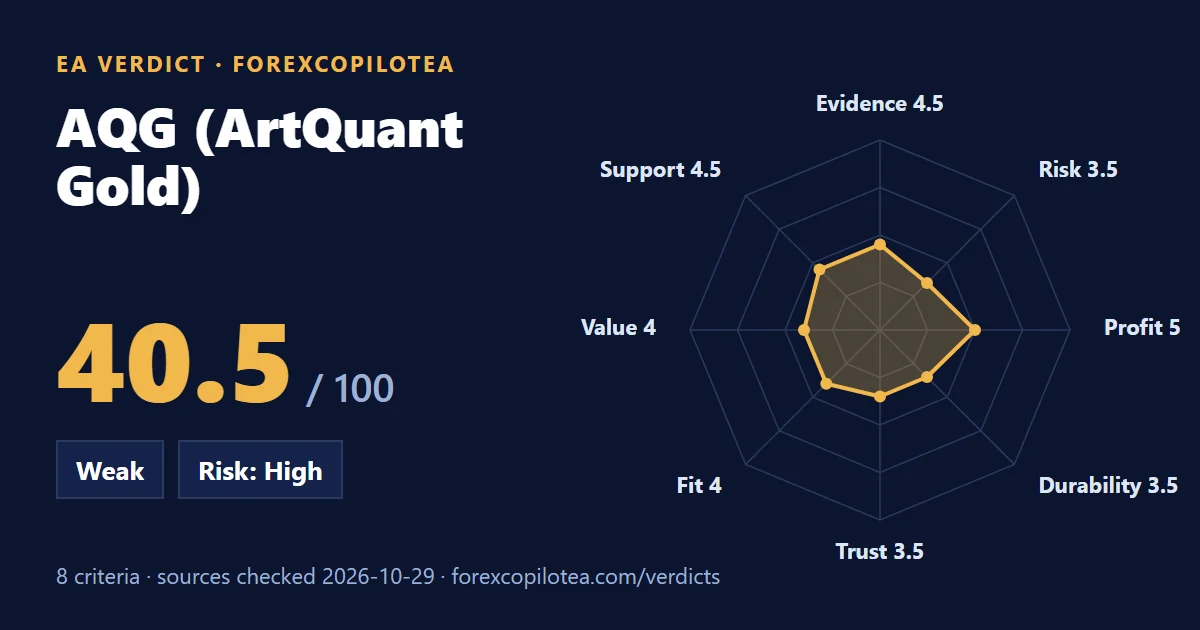
AQG, short for ArtQuant Gold, is a gold-only Expert Advisor for MetaTrader 5 that runs up to 20 internal trading modules under one portfolio manager, opens several positions per cycle in a grid-based structure and manages its take profit, stop loss and trailing virtually inside the terminal rather than at the broker. This AQG EA review covers the product the MQL5 Market sells for 700 USD at version 3.2, its single linked live signal and 175 buyer comments, and it scores the product on the same eight criteria as every verdict here. The result is 40.5 out of 100, a Weak band and a High risk label. The numbers on the live signal are attractive: a profit factor of 2.80 and a 77.6% win rate over 711 trades. But the signal is 16 weeks old, the account is held near 1,000 EUR by withdrawals, the equity drawdown reached 26.72% in that time, and the record before 10 July 2026 is not visible because an earlier signal was deleted after a loss event.
Key takeaways
- AQG scores 40.5 out of 100 (band: Weak) with a High risk label. A grid cannot be rated better than High, and this one has virtual stops, a documented loss event on 1 July 2026 and a verified equity drawdown of 26.72% in 16 weeks.
- The linked signal (MQL5 signal 2381660) shows 711 trades in 16 weeks, 552 wins (77.63%), a profit factor of 2.80, an average win of 2.41 EUR against an average loss of 2.99 EUR and a worst trade of minus 15.62 EUR. It started on 10 July 2026, the day version 3.2 was released.
- The signal's balance drawdown is 6.17% but its relative equity drawdown is 26.72% (295.17 EUR). In a grid the difference is the point: the floating loss in open baskets is where the risk sits, and the seller himself wrote that his first full month returned 27% with a 27% drawdown.
- The Market price is 700 USD, cut from an intended 999 USD after weak sales. The Market page states that copies sold outside the official Market are not authorized and may contain modified, outdated or unsafe files.
- We sell a listing under the name ArtQuan Gold (AQG) at 26.99 USD, version 3.2, as a compiled .ex5 only, with no setfile, manual or source code. Treat it as a separate purchase with its own terms, and read the licence question below before you pay.
- 40.5 / 100
- weighted verdict score on eight published criteria
- PF 2.80, DD 26.7%
- profit factor and relative equity drawdown of the vendor's 16-week signal over 711 trades
- $700 vs $26.99
- Market price against our listing on 29 Oct 2026, both at version 3.2
The AQG verdict at a glance: strong signal statistics on a short, reset and hard-to-reconcile record
AQG earns points for being a real, long-lived, openly described product with a free demo, a detailed list of protections and a signal anyone can open. It loses points on three things. The first is time: the only visible live record is 16 weeks old, and it belongs to an engine that was rebuilt in July 2026. The second is design: a grid with virtual stops depends on the terminal staying connected and on floating losses staying survivable, and the seller's own signal showed a 26.72% equity drawdown inside four months. The third is the surrounding record: a loss event around 1 July 2026, a deleted earlier signal, disputes in the comments and a price cut. The scorecard and radar show how the total was built.
40.5 / 100
Weighted verdict score
Weak
Verdict band
High
Risk label
| Criterion | Weight | Score | Best evidence | Points |
|---|---|---|---|---|
| Verified evidence | 20 | 4.5/10 | Grade A | 9.0 |
| Risk and drawdown behaviour | 20 | 3.5/10 | Grade A | 7.0 |
| Profitability quality | 15 | 5/10 | Grade A | 7.5 |
| Sustainability | 15 | 3.5/10 | Grade B | 5.3 |
| Transparency and trust | 10 | 3.5/10 | Grade B | 3.5 |
| Practical fit | 10 | 4/10 | Grade B | 4.0 |
| Cost and value | 5 | 4/10 | Grade B | 2.0 |
| Support and usability | 5 | 4.5/10 | Grade B | 2.3 |
| Total | 100 | 40.5 |
What AQG (ArtQuant Gold) actually is
AQG is an Expert Advisor for MetaTrader 5, sold on the MQL5 Market as 'ArtQuant Gold, Multi-Module Expert Advisor for XAUUSD' by Miguel Angel Vico Alba of Spain, who describes himself as CEO of ArtQuant Systems Ltd., a software engineer, MQL developer, independent trader and Spanish-language forum moderator. His seller profile shows a rank of 10,842, a 4.5 rating from 66 ratings, one product, one signal and 4 published codes. The product was published on 18 May 2025, shows version 3.2 updated on 10 July 2026, and lists 10 activations per licence. The page rating is 4.23 from 26 ratings, and the page counts 29 reviews and 175 comments. The seller wrote on 28 July 2026 that the product showed 91 purchases and at least 92 users.
The description is about what is inside, not about a signal. The EA trades gold only and will not trade on an unrelated instrument; it is independent of the chart timeframe; and it needs a hedging account. It combines up to twenty independent internal modules with a central portfolio manager. The buyer does not configure indicators or internal strategy parameters; the internal logic is preconfigured, and the buyer chooses which modules run, how large the positions are and which protections are active. The page is explicit that the product 'uses a grid-based multi-position trading structure' that 'can experience significant or prolonged floating drawdown'. We take that sentence at its word and score the design as a grid.
| Item | What the vendor says |
|---|---|
| Seller | Miguel Angel Vico Alba, Spain, 'CEO at ArtQuant Systems Ltd.'. Seller rating 4.5 from 66 ratings; 1 product, 1 signal. Official Discord linked in the comments. |
| Price | 700 USD on every language version of the page, no rental, free demo (2,297 demo downloads). Intended 999 USD, a temporary 699 USD promotion, then 700 USD from June 2026. |
| Strategy | Gold only. Up to 20 internal modules under one portfolio manager; grid-based multi-position cycles; buy, sell or both; independent of the chart timeframe. |
| Sizing | Fixed lot or balance-step scaling (example: base 0.01 lot, step 1,000, so 0.01 lot from 1,000 to 1,999.99 and 0.02 from 2,000). Reference deposit 1,000 USD, leverage up to 1:500. |
| Protections | Daily loss limit, floating loss limit, floating drawdown protection (alert, close own positions, or close and remove the EA), Cycle Guard, margin monitoring, max total exposure, per-module exposure, max orders per cycle. |
| Filters | Maximum entry spread, maximum slippage, Friday filters, first-Friday filter, USD economic calendar filter (live only), Christmas and New Year filter. |
| Stops | Take profit, stop loss and trailing are virtual and not sent to the broker. A stable 24/7 VPS is required. |
| Requirements | MetaTrader 5, hedging account, ECN or raw low-spread broker preferable; official presets validated for IC Markets raw and RoboForex ECN, optimisation required elsewhere. |
| Track record | One linked signal (MQL5 signal 2381660) described as 'a transparent real-account reference' and 'not a recommendation'. |
| Reach | Rating 4.23 from 26 ratings, 29 reviews, 175 comments. |
| Versions | 3.2, updated 10 Jul 2026; version 3.1 on 5 Jul 2026 and 3.0 on 31 May 2026. |
How we judged it, and who has something to sell
Evidence on EAs is never neutral. Here is every party near this product and what each stands to gain, ours included.
- The developer sells the EA at 700 USD, sells a subscription to the signal (499 per month on the signal page, with 1 subscriber shown) and moderates an official Discord. His record is public, which counts for something, and it is also his sales page.
- MQL5 and MetaQuotes host the Market, the reviews, the comments and the signals. The signal statistics and every notice on its page are the platform's own.
- Buyers who wrote reviews and comments include praise and complaints. Several of the most active defenders in the comments are also five-star reviewers, and several critics are one-star reviewers. Some commenters link AQG to the Quantum Queen family of EAs and some accuse each other of working for competitors. We treat all of it as testimony, not data.
- ForexCopilotEA sells a listing for this EA at a fraction of the Market price. We gain if you buy it, which is why this verdict opens with that fact and applies the same rules as every other.
Evidence ladder: what each rung of proof held for AQG
Grade A: Independent proof
- MQL5 signal 2381660: platform-built statistics for 16 weeks and 711 trades, from 10 July 2026. The vendor runs the account, so his interest is noted; the figures are computed from broker history and the platform's notices are its own. We rate it grade A, with the gaps listed below.
- The MQL5 Market version history for product 139041: dated release notes written by the seller and kept by the platform.
- MetaQuotes and Myfxbook documentation, used for how testing reports and verified records work.
Grade B: Checkable vendor material
- The Market listing: version, price, protections, requirements and the risk text, including the sentence about grid drawdown.
- The free demo, which runs in the Strategy Tester only, the seller's replies to comments and his 7-stage optimisation advice.
- Our own store page, used for the version, price and what ships.
Grade C: Claim only
- 'The EA does not and will never open 0.7 lot trades unless the account balance is at least 30,000 USD' and 'the strategy that caused issues on July 1st is no longer present in version 3.1': statements by the seller that we cannot check from outside.
- Buyers' profit claims such as plus 30% in eleven days or plus 4.92% in twelve active days with a 95.7% win rate: short samples with nothing linked.
- 'Reviews are either competitors that want to demote the product or too impatient': an opinion, not a record.
Grade D: Conflicted, anonymous or unverifiable
- A comment that calls the seller a scammer and says he removed the product so that bad reviews are no longer visible: an unproven allegation from an account another user calls freshly created. The seller and several users dispute it.
- A comment that the seller 'deletes signals when he blows them'. The earlier signal 2311351 does return 'trading signal not found', but the reason is not shown on the page.
- Five-star one-liners such as 'BEST gold grid EA in market' from reviewers whose accounts we cannot assess.
What the AQG live signal shows, number by number
A platform-computed signal is the best public evidence a vendor can show. This one has strong headline statistics and several features that limit how far they can be trusted. The signal belongs to Miguel Angel Vico Alba, trades XAUUSD only on an ICMarketsSC-MT5-3 account with 1:500 leverage in euros, and started on 10 July 2026 at 16:19, the day version 3.2 was released. The seller describes it as a reference for transparency, not a recommendation to copy his broker, deposit or leverage. Here is what it shows on 29 October 2026.
| Statistic | Value |
|---|---|
| Started, age | 10 Jul 2026, 16 weeks (reliability shown as 16 weeks) |
| Initial deposit, deposits, withdrawals | 1,000.00 EUR, 2,000.00 EUR, 2,844.28 EUR |
| Growth, profit, balance, equity | +128.19%, 854.98 EUR, 1,010.70 EUR, 1,010.70 EUR |
| Trades, win rate | 711 trades, 552 wins (77.63%), 159 losses (22.36%) |
| Long and short | 338 long (47.54%), 373 short (52.46%), XAUUSD only |
| Profit factor, expected payoff | 2.80, 1.20 EUR per trade |
| Gross profit, gross loss | 1,329.84 EUR, minus 474.86 EUR |
| Average win, average loss | 2.41 EUR, minus 2.99 EUR |
| Best, worst trade | 16.11 EUR, minus 15.62 EUR |
| Longest losing run | 9 trades, minus 67.73 EUR |
| Drawdown by balance, absolute and maximal | 3.33 EUR, 68.24 EUR (6.17%) |
| Relative drawdown by balance, by equity | 3.23% (68.00 EUR), 26.72% (295.17 EUR) |
| Recovery factor, Sharpe ratio | 12.53, 0.35 |
| Trading days, activity | 55 trading days (50.93%), average holding time 34 minutes |
| Maximum deposit load | 14.94% |
| Monthly growth, annual forecast | 26.17%, 317.48% |
| Subscribers, price | 1 subscriber, copy price 499 USD per month (page title shows EUR) |
Read the numbers together. A 77.63% win rate with an average win of 2.41 EUR and an average loss of 2.99 EUR is the profile of a grid or basket system: many small wins and fewer, larger losses. The arithmetic confirms the expected payoff the platform shows: 0.7763 times 2.41 minus 0.2237 times 2.99 is about 1.20 EUR per trade. The payoff ratio is about 0.81, so the system depends on its hit rate staying high. If the win rate fell from 77.6% to 70%, the same payoffs would give about minus 0.0 EUR per trade, a break-even system. That is an illustration of sensitivity, not a forecast: the point is how much of the result sits in one number.
The balance drawdown of 6.17% and the equity drawdown of 26.72% describe two different accounts. Balance counts only closed trades; equity counts the floating loss in open baskets. A grid keeps its losses open until the basket closes, so balance looks calm while equity carries the risk. The platform's 295.17 EUR equity drawdown on an account of about 1,000 EUR is the number to plan around. The seller said as much on 7 August 2026: his first full month produced a 27% return and, 'coincidentally', a 27% drawdown at the default 0.01 lot per 1,000 USD. A drawdown that matches the return is not a strategy with a cushion.
- Relative, by equity26.7%
295.17 EUR
- Maximal, by balance6.2%
68.24 EUR
- Relative, by balance3.2%
68.00 EUR
The money flow is the hard part to read. The platform shows an initial deposit of 1,000 EUR, further deposits of 2,000 EUR and withdrawals of 2,844.28 EUR. The seller has said the account is kept near 1,000 as a reference and that withdrawals round it back down, and he has said that an earlier version of the signal fell to 418.19 before a top-up of 581.81 brought it back to 1,000. But the displayed figures do not add up in a simple way: a balance of 1,010.70 plus withdrawals of 2,844.28 less deposits of 2,000 gives a net result of 1,854.98, not the profit of 854.98 the platform shows. We cannot resolve the difference from public pages and we do not guess. It means a buyer cannot reconstruct the return on capital, and that 'growth 128.19%' is the platform's compounded metric, not a return on 1,000 EUR.
Other details lower the weight we can put on the signal. The platform's consecutive-wins figure appears as 21 in one block and 15 in another, and trades per week is shown as 91 where 711 trades over 16 weeks is about 44. The slippage table lists average slippage by server, and on the signal's own server, ICMarketsSC-MT5-3, it is 21.16 pips over 114 deals. Dated platform notices show 'Too frequent deals may negatively impact copying results' added and removed repeatedly between August and October 2026, most recently added on 23 October after being removed on 22 October, and a notice of no trading activity for six days on 21 October. The signal has no reviews. None of this suggests manipulation. It means the record is a young, withdrawn-from, operator-run account whose labels do not always agree with each other.
How a gold grid with virtual stops makes and loses money
A grid system opens a first position and then adds more at set distances as price moves, closing the whole basket when the combined result reaches a target. That is why the signal shows a 77.6% win rate and a 34-minute average hold: most baskets close in a small profit before price goes far. The cost is in the tail. When gold trends in one direction for long enough, the basket grows, the floating loss grows with it and the account relies on a protection to cut the loss. AQG's description names the sensitivities itself: lot size, capital, leverage, margin, strong directional moves, gaps, spread and swap. It also states it 'does not guarantee profits, a specific drawdown, account survival or protection against stop-out'.
What is different about AQG is the portfolio layer. Up to twenty internal modules each run their own logic, and the buyer either picks a predefined portfolio profile or writes a custom module map such as '1,3,5,11,14,20'. A setting called Max Active Modules caps how many modules trade at once, while one active module may manage several positions. A buyer in the comments posted the mapping of seven predefined presets, for example Preset 06 using modules 5, 16, 17 and 19 and Preset 01 using sixteen of the twenty. A mix of modules is meant to spread the entries across times and conditions. In a grid family the risk is that the modules fail together: when gold makes a large one-way move, several baskets can be on the wrong side at the same time. The seller's earlier statement that entries were 'mostly concentrated around midnight' in the old engine and the fix in version 3.1 show that the module mix has real effects.
The second structural feature is that take profit, stop loss and trailing are virtual. They are held in the EA and not sent to the broker. The listing says so directly: if the terminal, VPS, internet connection or broker server becomes unavailable, virtual protections cannot be executed until communication and EA operation are restored. For a buyer this changes the checklist. With a conventional stop at the broker, a power cut costs you the trade's planned maximum. With a virtual stop, the planned maximum is only a plan while everything is running. A stable VPS is therefore part of the risk model, not an optional extra.
A user's log from 4 September 2026 shows what can go wrong with that design. On version 3.2 across three accounts, one account did not send the 08:01 basket close, logged 'Trade open not confirmed even though the broker had successfully completed the trade with retcode 10009' and 'Grid re-entry failed at virtual grid level', grew to a 13-trade basket and was closed by the floating-loss protection at a large loss during the non-farm payrolls release. That is one user's reading of his own logs, we saw no seller reply on the page, and we cannot reproduce it. We report it because it describes exactly the failure a virtual grid is exposed to: the EA's picture of its positions and the broker's picture drifting apart.
Interactive: drawdown recovery
Gain needed to get back to break-even
+42.9%
Blue: equity left. Red: equity lost.
Consecutive losing trades to reach this drawdown: 36
The protection settings, and why they are inputs rather than guarantees
The listing offers a long list of controls, which counts in its favour. Max Total EA Exposure, per-module exposure and max orders per cycle cap how large the baskets get. A daily EA loss limit and a floating loss limit set a cash or percentage ceiling. Floating drawdown protection can alert you, close the EA's positions, or close them and remove the EA from the chart, with a threshold as a percentage of balance or an amount. Cycle Guard stops certain non-forced cycle closures while the whole cycle's net result is negative after trading costs. Broker margin protection watches the margin level. Each can be set to zero, which disables it.
Three details matter for how much weight to give these. First, the drawdown protection 'evaluates ArtQuant Gold positions only; other trades may still affect the account equity'. If you run other EAs or trade manually on the same account, the protection does not see them. Second, the page says that margin protection cannot guarantee a stop-out is avoided. Third, the seller explained on 28 July 2026 that the drawdown alert exists 'so that they can reassess the situation and, if they personally choose to do so, add additional funds to increase the available margin'. That is consistent with the live signal, which took 2,000 EUR of deposits on top of its 1,000 EUR start. A control whose designed response is to add money is a control you should price in as a cost.
There is also a change-history point. Version 2.44, on 25 May 2026, removed the internal stop-out protection, which the note says caused forced closures under dynamic leverage. The protections in version 3.1 are a new set. We do not judge the decision, which may have been sound. We note that the protections a buyer reads about today did not exist in this form a year ago, and that none has a public track record of containing a severe move.
The July 2026 loss event and the blown-account reports
Between 30 June and 2 July 2026 several comments describe a loss event. One user reported a blown cent account; another wrote that a Tickmill account was blown on a small, high-risk setting of 0.01 lot per 500 USD. The seller wrote on 5 July that 'we are coming from a major loss' and that the signal balance had been reset to 1,000, and later that the strategy or module that caused the problem on 1 July is no longer present in version 3.1. He also replied on 6 July to a user who demanded a refund and threatened a bad review. The user's position was that the issue was not blowing the account but a technical failure: a safety mechanism that did not activate. The seller's position was that the mechanism the user described does not exist in the way he described. The seller then published the chat, which he described as an attempt to force compensation. The user later left one star.
We are not in a position to decide who is right about what that mechanism was, and we do not try. Three points do hold up. The event is on record in the seller's own words. The module said to be responsible was removed, which means the engine buyers get today is not the one that had the event, and also means the live record of the current engine starts afterwards. And earlier, in July 2025, a different user wrote that the robot blew his account; the seller replied that the EA does not open a 0.7 lot trade unless the balance is at least 30,000 USD and that the user had forced the lot size. The seller's general position, repeated across the comments, is that the outcome depends on the user's lot size and settings. That is an accurate description of any grid, and it is also the reason buyers should treat the product's default risk, not its best month, as the planning number. Another buyer wrote on 10 July 2026 that he had lost 30,000 over three months and blamed only himself for using too large a lot; a five-star reviewer runs half the default risk with a 25% drawdown protection.
Version history: how often the engine changed
The Market page lists more than twenty versions since May 2025. The recent ones show how fast the product moves. Version 2.4, on 23 May 2026, changed trade identification and told owners not to update with open trades. Version 2.42 on 24 May made the default direction buy only. Version 2.44 on 25 May removed the internal stop-out protection. Version 3.0 on 31 May was described as a major structural update with 12 modules and virtual-only take profit, stop loss and trailing, and the seller added that the EA no longer sends broker-side levels. Version 3.1 on 5 July moved to up to 20 modules, broker presets, custom portfolios, exposure caps, loss limits, Cycle Guard and a new panel, and warned that old 3.0 set files may need manual adjustment. Version 3.2 on 10 July added a profit-withdrawal simulation to the Strategy Tester, which affects the tester only.
Two things follow. First, the engine whose behaviour you would buy today has been live since 10 July 2026, about 16 weeks, so there is no long record of the 20-module system. Second, the seller's own note on 3.2 admits that in normal long backtests, profits act as extra capital, which can make later drawdowns appear smaller. That is the right correction, and it is also a reason to be careful with any long backtest shown for a balance-scaled lot. A comment from 31 May 2026 asked owners not to re-optimise all 12 modules at once, and another from 5 June said the seller would not keep modifying code because of group pressure, yet 3.1 and 3.2 followed within six weeks. We treat this as the normal churn of an active developer, and as a limit on how much older evidence applies to the current code.
AQG backtest: what the seller tells you to do and what it can show
The listing does not publish a headline backtest. It tells the buyer to test with every tick based on real ticks, warns that a short profitable test is not enough to evaluate a grid-based system, and outlines a 7-stage optimisation workflow with a warning about overfitting and aggressive lot scaling. The USD economic calendar filter is ignored in the Strategy Tester and during optimisation, so a tester run trades through news that a live account would skip. The comments carry comparisons of version 3.0 and 3.1 on IC Markets real ticks from 2020 to the present at 0.01 lot per 1,000 USD, which are the participants' own and not documents we could open.
The honest position is that the buyer is expected to run the backtest. That has an upside: you see the product's behaviour on your own broker's data. It also has a cost: the seller stated on 6 February 2026 that official presets are validated only for IC Markets raw and RoboForex ECN, and that for any other broker optimisation is mandatory. Optimising a grid on a few years of gold history is a recipe for a curve that fits the past; see our guide to optimising an EA in MT5 without overfitting and our guide to backtest versus live results. The signal is the only out-of-sample evidence, and it is 16 weeks long.
AQG reviews: what buyers say
The Market page shows a rating of 4.23 from 26 ratings, which implies 21 five-star and 5 one-star ratings with nothing in between. We could read three review texts, all five stars: 'BEST gold grid EA in market' from 31 August 2026; a 18 July review from someone using it since 7 July who reports a 30% profit and adds that 'some strategies naturally come with higher drawdowns' and that thorough backtesting is needed; and 'Great EA!' from 2 July. The other rated reviewers, twelve five-star and five one-star, are listed but their text did not load. A snippet on the page says the reviews are either from competitors who want to demote a good product or from impatient users, that the EA is extremely picky and that 'when it does it always WINS'. We do not accept 'always' from anyone, including the seller's supporters.
The comments are more informative than the stars. Praise includes a user reporting plus 4.92% in 12 active days with a 95.7% win rate (22 wins, 1 loss), a reviewer comparing AQG favourably with Quantum Queen, whose own account was blown while AQG 'withstood the test of time', and the seller's own first-month report. Criticism includes the blown-account reports above, a 1 July refund dispute, a complaint that the grid was large with tight spacing and a deposit appeared mid-basket, to which the seller declined to respond and said the critic was blocked, and a request to keep the old signal visible. The seller also had a public dispute with the seller of Quantum Queen, whom he accused of creating a false impression that he was the copy; other commenters named AQG's author as the original developer behind that family. We make no finding on that lineage and note only that three buyers raised it.
AQG price: 700 dollars on the Market, 26.99 in our store
The Market price on 29 October 2026 is 700 USD on every language version of the page we opened, with no rental and a free demo downloaded 2,297 times. The seller wrote that he intended 999 USD, ran a temporary 699 USD promotion that he extended, and then set 700 USD on 6 June 2026, joking that buyers at 699 could see the product had appreciated by one dollar. He gave the reasons as weak sales, bad reviews, unconstructive private messages and a drop in Market visibility. A seller who explains his pricing in public deserves credit for it, and a price that moved by 30% in a few weeks shows how little the market was paying for the evidence available.
Set 700 USD against the signal. The profit shown is 854.98 EUR in 16 weeks on a 1,000 EUR account, and the account has taken 2,000 EUR of deposits and paid out 2,844.28 EUR. If the figures are taken at face value, the licence costs about 82% of the profit one account earned in four months, and the 26.72% equity drawdown happened at the same time. The free demo is the mitigation, but it runs in the Strategy Tester and tells you about a backtest, not about a live account. Remember the other costs: a hedging-account broker with low spreads, a VPS that must run around the clock because stops are virtual, and the time to optimise your own settings, since no setfile is sold.
Our listing is 26.99 USD one time, about 3.9% of the Market price, with free updates, a compiled file only, no setfile, no manual and no refunds. A price that low does not change the risk of the strategy; a 26.99 USD licence still runs the same grid on the same account. What it changes is what you are paying for: a file, without the seller's support, presets or any update he ships, since the seller states that distribution outside the Market is not authorized.
Is AQG legit? The licence question about copies sold outside the Market
On the question most searchers ask: AQG is a real product with a named seller, a company behind him, more than a year of version history, a free demo and a public signal, and we have no evidence that it is fraudulent. We report the allegations in the comments as allegations. Where it is not legitimate, in the sense that matters to a buyer, is in how copies reach people. The Market page says the EA is 'officially distributed exclusively through MQL5.com' and that copies, downloads, resales, rental offers or distributions outside the official Market are not authorized and may contain modified, outdated or unsafe files.
Our store sells this EA outside the Market, at version 3.2, for 26.99 USD. We state that plainly because it is the largest fact about our own listing: we cannot show you the seller's authorization, this verdict does not claim that he gave one, and the Market page's warning applies to us. If you want certainty about the file, support from the seller, activation limits that belong to you and the seller's updates, buy from the MQL5 Market at the Market price. If you buy from us anyway, you do so knowing the Market warning, with no setfile or manual and with our no-refund terms. We would rather lose that sale than have you read the verdict after paying. Any rights holder, including ArtQuant Systems Ltd., can write to us through the contact page and we will answer.
Who AQG fits, and what the account needs to look like
AQG is built for a trader who understands grids, accepts that equity can fall by a quarter or more while the balance looks calm, and can run a terminal 24 hours a day. The reference deposit in the listing is 1,000 USD with leverage up to 1:500, and the listing adds that these figures are not guarantees of suitability or account survival. The default sizing, 0.01 lot per 1,000 USD, is what produced the 26.72% equity drawdown on the signal and the 27% drawdown the seller reported for August. A buyer who wants a drawdown around 15% should treat half that lot as a starting point; one five-star commenter runs 0.01 lot per 2,000 USD, a set of custom modules without one of them and a 25% drawdown protection.
- It fits an experienced gold trader who wants a ready-made multi-module grid, will use the demo and a real-tick backtest first, runs it on a hedging account at IC Markets raw or RoboForex ECN or optimises for another broker, and has a stable VPS.
- It does not fit prop-firm challenges. The seller wrote on 24 February 2026 that there is no prop-firm preset and that the EA is not suitable for most challenges, because a grid needs controlled floating drawdown to function.
- It does not fit a small account on a high-leverage broker run at a larger-than-default lot. The reported blown cent and small accounts were all of that kind.
- It does not fit a buyer who cannot keep the terminal online, because the stops are virtual, or a buyer who also trades manually on the same account, because the drawdown protection sees only the EA's positions.
- It is a poor choice for anyone buying on a short winning sample. Several of the profit claims we read are 11 or 12 days long.
If AQG does run on your account, the best preparation is to decide the loss you can accept before you read the signal. Take your balance, multiply it by a drawdown you can tolerate without intervening, and compare it with 26.72% of the lot size you plan to use. For help setting that plan in advance, read our guide on what to do when an EA is in drawdown.
The AQG score, criterion by criterion: 40.5 out of 100
| Criterion | Score | Points | Why |
|---|---|---|---|
| Verified evidence (weight 20) | 4.5 / 10 | 9.0 | A platform-built MQL5 signal on the current engine, but only 16 weeks and 711 trades, run by the vendor, held near 1,000 EUR by withdrawals, with figures that do not reconcile and an earlier signal that was deleted; no longer record exists for this version. |
| Risk and drawdown behaviour (weight 20) | 3.5 / 10 | 7.0 | A grid-based multi-position design with virtual stops only, a verified equity drawdown of 26.72% against a balance drawdown of 6.17%, a documented loss event around 1 July 2026 and user reports of blown accounts; protections exist but are inputs the buyer must set. |
| Profitability quality (weight 15) | 5 / 10 | 7.5 | A verified profit factor of 2.80 and an expected payoff of 1.20 EUR over 711 trades; but only 16 weeks, an average loss larger than the average win, profit withdrawn along the way and a growth figure that does not match the money flow. |
| Sustainability (weight 15) | 3.5 / 10 | 5.3 | Seventeen months on the Market with more than twenty versions, a rebuilt engine in July 2026, a removed safety feature in 2.44, a temporary Market removal and a reset signal; the vendor keeps updating, but the logic is closed and the product keeps changing. |
| Transparency and trust (weight 10) | 3.5 / 10 | 3.5 | Detailed risk text on the page and many specific replies, against open disputes: an unproven allegation of deleted reviews, a seller who published a customer's private chat and blocked a critic, review brigading from both sides and a 'distribution outside the Market is not authorized' notice. |
| Practical fit (weight 10) | 4 / 10 | 4.0 | A hedging account, gold only, a mandatory 24/7 VPS, virtual stops, mandatory optimisation outside two named brokers, a seller who says it is not suited to prop-firm challenges, and a store build that ships no setfile or manual. |
| Cost and value (weight 5) | 4 / 10 | 2.0 | A premium 700 USD on the Market, cut from an intended 999 USD, with a free demo as the mitigation; our listing at 26.99 USD is far lower but carries a licence and provenance question. |
| Support and usability (weight 5) | 4.5 / 10 | 2.3 | A free demo, a long product description, an official Discord and a seller who answers many comments; but no setfile is sold, the manual is the listing text, and the buyer must build and optimise their own settings. |
The total is 40.5 out of 100. Evidence is a grade A source scored at 4.5: the signal is platform-built, but it is under 12 months, vendor-run, shaped by deposits and withdrawals, and it cannot be compared with the record that came before it. Risk, at 3.5, sits in the anchor for a grid with no hard stop that the vendor guarantees: the controls exist, but they are inputs, they are virtual, and the verified equity drawdown is 26.72% in four months. Profitability, at 5, rewards a verified profit factor of 2.80 and is held down by the payoff ratio, the short window and the money flow. Sustainability and trust sit at 3.5 for the product churn and the open disputes, and fit, cost and support at 4 to 4.5 for the broker conditions, the price and the lack of a setfile.
How AQG compares with other EAs we have scored
Next to the gold breakout EAs we have scored, such as Gold House and MoonDog, AQG has a higher live profit factor and a much weaker risk structure: those put a stop on every trade, and this one holds baskets open with virtual levels. Its 40.5 reflects strong signal statistics held back by the design, the record length and the surrounding disputes. For how grids, scalpers and trend systems differ, see our strategy comparison, and browse our grid EAs and gold EAs for similar products.
Questions to put to the seller before you pay
- Can you publish the history of signal 2311351, or explain why it was deleted, so that buyers can see the record before 10 July 2026?
- How do the signal's deposits of 2,000 EUR and withdrawals of 2,844.28 EUR reconcile with its profit of 854.98 EUR?
- What is the longest basket and the largest floating loss the current engine has had, on any account, since version 3.1?
- Is there a published rule for when drawdown protection closes baskets, and has it ever fired on your own account?
- How does the EA recover its position state after a terminal restart or a failed order confirmation, given that stops are virtual?
- Why was internal stop-out protection removed in version 2.44, and what replaces it?
- Which modules do the seven predefined presets use, and which modules were removed after 1 July 2026?
- Do you authorize any reseller to sell AQG outside the Market?
Sources and when they were opened
- MQL5 Market: ArtQuant Gold (product 139041), opened 29 October 2026Source of the price, version, description, risk text, requirements, distribution notice and readable review texts. Written by the vendor and by buyers.
- MQL5 Market: ArtQuant Gold version history, opened 29 October 2026Source of the dated release notes from version 2.4 to 3.2.
- MQL5 Market: ArtQuant Gold comments (175 comments over 9 pages), opened 29 October 2026Source of the seller's replies, the price history, the July 2026 loss event, the allegations and the user log of 4 September 2026. Testimony, not verified records.
- MQL5 Signals: ArtQuant Gold live reference account (signal 2381660), opened 29 October 2026Source of every performance figure, notice and drawdown in this verdict. The vendor operates the account.
- MQL5 Signals: earlier ArtQuant signal (signal 2311351), opened 29 October 2026Returned 'trading signal not found' on this date; cited to show that the earlier record cannot be audited.
- ForexCopilotEA store listing: ArtQuan Gold (AQG), opened 29 October 2026Source of our version, price, delivery and terms. We sell this listing.
- Myfxbook Help: VerificationHow a trading account's track record is verified on Myfxbook.
- MetaTrader 5 Help: Testing ReportWhat each figure in the tester's report means, including drawdown.
- MetaTrader 5 Help: Strategy TestingThe Strategy Tester: testing modes, settings and forward testing.
- ESMA: ESMA agrees to prohibit binary options and restrict CFDs to protect retail investorsThe EU leverage limits, margin close-out, negative balance protection and risk-warning rules for retail CFD accounts.
- CFTC Customer Advisory: AI Won't Turn Trading Bots into Money MachinesA US regulator's warning about trading-bot claims of unusually high returns.
Frequently asked questions
Is AQG (ArtQuant Gold) EA legit?
It is a real product with a named seller, a company behind him, more than a year of version history, a free demo and a public signal, rated 4.23 from 26 ratings on the MQL5 Market. We do not allege wrongdoing and we report the forum allegations as unproven. Its score is 40.5 out of 100 with a High risk label because it is a grid with virtual stops, the signal is 16 weeks old and a loss event is on record from July 2026.
Does AQG use a grid or martingale?
The listing says it uses a grid-based multi-position structure that can experience significant or prolonged floating drawdown. It does not describe a martingale. Take profit, stop loss and trailing are virtual, not placed at the broker, so a stable VPS is part of the risk model. We cannot read the code, so this rests on the listing and the signal.
How much does AQG cost?
The MQL5 Market price on 29 October 2026 is 700 USD with a free demo and no rental, down from an intended 999 USD. Our store lists ArtQuan Gold (AQG) at 26.99 USD one time, version 3.2, as a compiled file with no setfile or manual. The Market states that copies sold outside it are not authorized, so read the licence section before buying from any other seller.
What drawdown does AQG have?
On the vendor's signal the relative equity drawdown is 26.72% (295.17 EUR) and the balance drawdown 6.17%, over 16 weeks. The seller reported a 27% return with a 27% drawdown for his first full month at the default 0.01 lot per 1,000 USD. A grid's open-basket loss can be deeper than anything seen in 16 weeks.
Is AQG profitable on its live signal?
The signal shows a profit of 854.98 EUR, a profit factor of 2.80 and an expected payoff of 1.20 EUR per trade over 711 trades since 10 July 2026. The account received 2,000 EUR of deposits and paid 2,844.28 EUR of withdrawals, and the figures do not reconcile on the page, so the return on capital cannot be worked out from public data.
Can AQG pass a prop firm challenge?
The seller wrote on 24 February 2026 that there is no prop-firm preset and that the EA is not suitable for most prop-firm challenges, because a grid needs controlled floating drawdown to function. The signal's 26.72% equity drawdown is above most challenge limits.
What broker and account does AQG need?
A MetaTrader 5 hedging account trading XAUUSD, with an ECN, raw or low-spread broker preferable and a 24/7 VPS. Official presets were validated only for IC Markets raw and RoboForex ECN; for other brokers the seller says optimisation is mandatory. The listing's reference deposit is 1,000 USD at leverage up to 1:500, which it says is not a guarantee of suitability.
How was the score calculated?
Eight weighted criteria (evidence 20, risk 20, profitability 15, sustainability 15, trust 10, fit 10, cost 5, support 5), each scored out of ten against written anchors. Sources are graded A to D and unverified claims cannot count as proof. We sell a listing for this EA, which is disclosed at the top. The total here is 40.5 out of 100.
Gold Expert Advisors in our store
We sell these, so weigh that interest. Put the same eight questions to any of them before you buy: read the manual, run your own backtest, and start on demo.



Keep reading
- EA Verdict #12Gold House EA Review: Verdict and Risk (2026)Is Gold House worth $749? Independent EA verdict: 52.3/100, Medium risk. Two live MQL5 signals, 68 reviews and a rising price ladder scored, checked 28 Oct 2026.
- EA Verdict #13MoonDog EA Review: Verdict and Risk (2026)Is MoonDog EA worth $299? Independent EA verdict: 51.5/100, Medium risk. Five breakout modules, ONNX filters and two live MQL5 signals scored, 28 Oct 2026.
- Risk managementEA in Drawdown: What to Do (and What Not to Do)What to do when your Expert Advisor is in drawdown: separate normal from broken, check the logs, compare with the backtest, and decide to hold, reduce or stop.
- Strategy comparisonWhich EA Strategy Wins Long Term?Compare MT5 Expert Advisor strategy types, from scalping and grid to hedging and arbitrage: how each earns, how each fails, and which tend to survive long term.
- OptimisationHow to Optimize an EA in MT5 Without OverfittingHow to optimise an EA in MT5 without overfitting: tester modes and criteria, how many inputs to use, plateaus versus spikes, forward testing and a process.