
EA Verdict #17
Ghost Scalper MT5 Review (2026): Three Live Signals, 12% Equity Drawdown and Optional Prop Protection
By Benjamin Lee · Updated · 22 min read
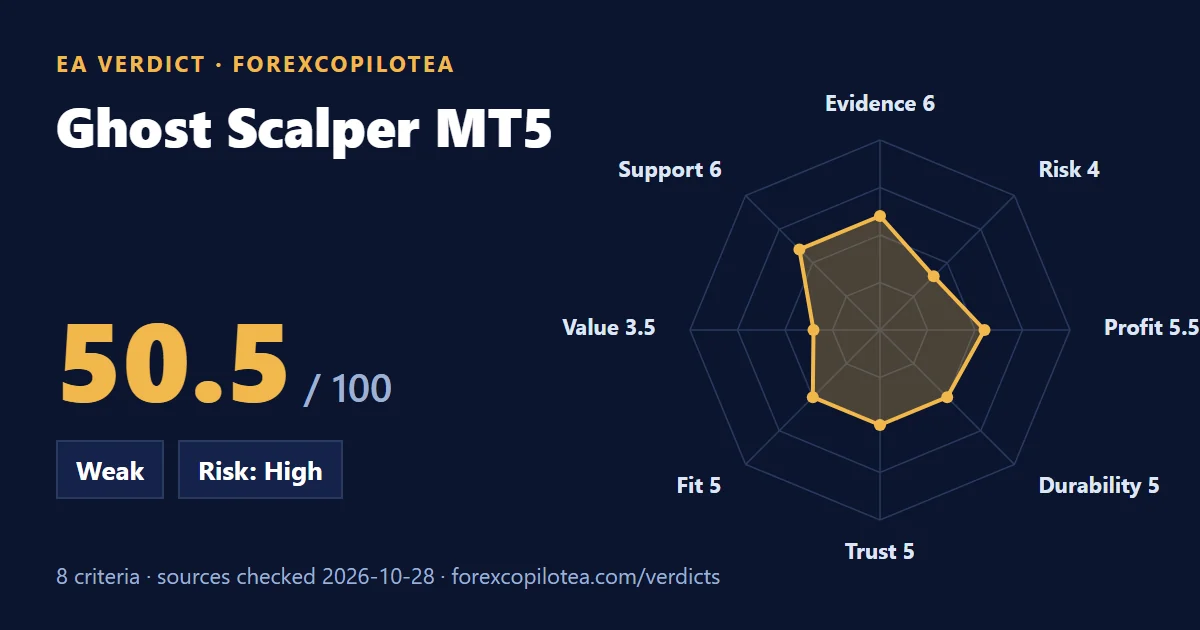
Ghost Scalper MT5 is a gold Expert Advisor with four separately configurable strategies, selectable buy and sell directions, trailing options and an optional prop-firm protection system. Its MQL5 listing links three public live signals, each with roughly 300 trades, which gives buyers more to inspect than a backtest screenshot. Those signals are still operated by the vendor and cover only about eleven weeks. Their platform-reported equity drawdowns range from 8.93% to 12.12%, while peak deposit load ranges from 28.63% to 33.27%. The prop protection is OFF by default and cannot guarantee compliance with a firm's rules. ForexCopilotEA's separate store listing says version 2.90, while the MQL5 product page describes version 5.1. We score the Market listing and disclose that mismatch. Verdict: 50.5/100, Weak band and High risk.
Key takeaways
- Ghost Scalper scores 50.5/100 (Weak) with a High risk label. Three live records help, but they are vendor-run and only around eleven weeks old.
- The linked VT Markets, Vantage and Ultima signals show 291, 311 and 292 trades. Their reported profit factors are 1.92, 2.07 and 1.98, with win rates from 61.98% to 65.59%.
- The same signals show 8.93% to 12.12% equity drawdown and peak deposit load above 28%. Do not read the balance drawdown alone as total exposure.
- The product describes four independent strategy modules and optional prop controls. Those controls are disabled by default; published limits are settings, not a guarantee of prop-firm compliance.
- The current Market page describes Ghost Scalper 5.1; ForexCopilotEA's separate storefront mock listing says v2.90. No evidence establishes that the store file matches the public signal version.
- The Market price is $499 to buy or $299 to rent for one month. A demo is available, but a demo and short positive signal record do not establish future profitability.
- 50.5 / 100
- weighted score; Weak band
- 8.93%–12.12%
- reported equity drawdown across three linked signals
- $499 / $299
- MQL5 purchase price or one-month rental on 28 October 2026
The verdict: a checkable signal set, but the risks are not small
Ghost Scalper offers a meaningful amount of public detail. The MQL5 product page describes four independent strategies, configurable long and short directions, per-strategy money management, standard and custom trailing, a news filter, weekend handling and a dashboard that reports execution-related information. It also links three signals on separate account providers. This makes it possible to examine how one vendor's system has behaved on more than one live account rather than relying solely on a product description.
That evidence has important limits. All three signals are linked from the same product page and operated by the same vendor. They use related versions or settings of the same product family, and they began within a short period. The samples therefore are not independent replications, even though separate broker accounts can reveal some execution differences. At the review date, the signals had only about eleven weeks of history. They cannot establish performance through a full range of market conditions or tell a buyer what a future losing sequence might look like.
The risk figures deserve more attention than the impressive headline growth percentages. Platform signal growth of 106% to 483% is calculated from each account's own history and capital changes; it is not an annualized forecast or a promise to buyers. Peak deposit load was 28.63% to 33.27%, and maximum equity drawdown was 8.93% to 12.12%. Those figures can coexist with lower balance drawdown because balance does not include every open loss. The accounts also traded rapidly, holding positions for only two or three minutes on average. For a short-hold gold strategy, spread and execution conditions can materially change the result.
We give credit for public platform records, meaningful trade counts and an extensive description. We withhold credit for short duration, seller-operated accounts, significant floating exposure, closed entry logic and a premium price. The resulting Weak band reflects mixed but incomplete evidence. The High risk label is a practical warning about the drawdown and configuration risks; it does not mean that every buyer will experience the same loss.
50.5 / 100
Weighted verdict score
Weak
Verdict band
High
Risk label
| Criterion | Weight | Score | Best evidence | Points |
|---|---|---|---|---|
| Verified evidence | 20 | 6/10 | Grade A | 12.0 |
| Risk and drawdown behaviour | 20 | 4/10 | Grade A | 8.0 |
| Profitability quality | 15 | 5.5/10 | Grade A | 8.3 |
| Sustainability | 15 | 5/10 | Grade B | 7.5 |
| Transparency and trust | 10 | 5/10 | Grade B | 5.0 |
| Practical fit | 10 | 5/10 | Grade B | 5.0 |
| Cost and value | 5 | 3.5/10 | Grade B | 1.8 |
| Support and usability | 5 | 6/10 | Grade B | 3.0 |
| Total | 100 | 50.5 |
What is Ghost Scalper MT5?
The reviewed product is an XAUUSD Expert Advisor for MetaTrader 5. The Market description says four independent strategies, named Ghost A through D, can be enabled or disabled, with separate buy and sell direction controls and independent money-management settings. This flexibility can help an experienced user limit a configuration to the modules they understand. It can also increase complexity: simultaneous strategies can create correlated exposure, and a setting that looks conservative per strategy may still allow a larger total risk when several are active.
The product page describes STANDARD trailing as the default and CUSTOM trailing as a way to set stop loss, take profit, trailing start, distance and step separately by direction. It says proprietary entry calculations and optimized parameters are protected. That is a normal commercial choice, but it limits independent review of the entry rules and means buyers cannot reproduce the vendor's exact selection logic from the public description alone. The values displayed for custom trailing are platform points; their practical price distance depends on the broker's symbol digits and contract specification.
The page also describes an adaptive anti-slippage feature that adjusts trailing, stop and target behavior using observed execution slippage. It explicitly says the feature cannot eliminate slippage and that actual broker-side slippage cannot be reliably simulated in the MT5 Strategy Tester. That qualification matters: a strategy may behave differently under news, fast markets, thin liquidity or broker-side requotes. Testing on a single historical feed cannot fully establish real-time execution quality.
| Listing feature | What it says | What remains unknown |
|---|---|---|
| Four independent strategies | A–D can be enabled and configured separately. | Correlation, overlap and maximum combined exposure under the buyer's settings. |
| Adaptive anti-slippage | Trailing and protection behavior can adjust to observed execution. | Whether the method improves outcomes at a specific broker or in extreme volatility. |
| Prop Firm Protection | Optional limits include 4% daily, 6% overall, 0.5% per new trade and 2% total open/pending risk. | That it is enabled, correctly configured or compliant with a particular firm's rulebook. |
| News filter | Major USD events and adjustable restrictions are described. | Feed availability, event timing accuracy and handling of unexpected announcements. |
| Virtual protection | Fallback behavior is described if a broker rejects a stop modification. | That it can protect against gaps, disconnects, execution failure or all broker-side events. |
A feature list is not a performance audit. Buyers should request the full manual and settings file, check whether modules share risk limits, confirm how the EA treats manual trades and other bots, and test that the protection behavior is consistent with the account type. The product page's detailed caveats are helpful, but they do not prove that the configured limits will prevent losses or satisfy an external firm's rules.
Three public live signals: the measured record
The MQL5 Market page links Ghost Scalper MT5 VT (signal 2387162), Ghost Scalper MT5 Vantage (2386083), and Ghost Scalper MT5 Ultima Market (2387100). On 28 October 2026, the pages reported 291, 311 and 292 trades respectively. All three had been operating for about eleven weeks. Their names identify separate provider accounts, but they remain records run by one seller and should not be counted as three independent strategy tests.
| Signal | Trades / win rate | Profit factor | Balance DD | Equity DD / max load |
|---|---|---|---|---|
| VT Markets (2387162) | 291 / 63.57% | 1.92 | 10.62% max | 10.17% / 28.63% |
| Vantage (2386083) | 311 / 65.59% | 2.07 | 11.07% max | 8.93% / 33.27% |
| Ultima Market (2387100) | 292 / 61.98% | 1.98 | 10.62% max | 12.12% / 30.62% |
The profit factors near two and win rates between 62% and 66% are positive historical summaries. They do not say how the next month will look, whether the results survive a different gold regime or how much risk was required to produce them. Expected payoff was about €2.67 to €2.84 per trade in the displayed account currency. The average winning trades were only moderately larger than average losing trades, and the signals recorded six consecutive losses. A seemingly high hit rate does not eliminate the possibility of a damaging streak.
The 2–3 minute average holding time makes execution a central concern. An EA that enters and exits quickly may be affected by spread, commission, latency, fill quality, slippage and symbol suffixes. Subscriber results can diverge from the signal provider, and the signal pages themselves display warnings about copying risk and high growth. One account showed a maximum deposit load above 33%, meaning margin use peaked at a significant share of the account's funds. Deposit load is not identical to drawdown, but it is a useful indicator of how much margin the trading activity consumed.
There is also a material difference between balance and equity drawdown. The Vantage signal's maximal balance drawdown was 11.07%, yet its reported relative equity drawdown was 8.93%; the Ultima signal's was 12.12%. These percentages use platform measures that can be calculated from different periods or bases, so avoid treating them as directly interchangeable. The underlying lesson is to inspect the signal's equity chart, open positions, peak deposit load and broker conditions alongside any single drawdown number.
The signal data is valuable because it is public and includes real trades rather than only a backtest. The limitation is the short observation window and common operator. A longer history would need to show what happened in quieter markets, after a string of losses, after updates and on accounts with comparable fees and execution. If the vendor changes settings or versions, the old and new periods should be clearly identified rather than merged into one headline.
Prop Firm Protection is optional and off by default
The version 5.1 product description presents Prop Firm Protection with default OFF. The displayed limits include 4% maximum daily drawdown, 6% maximum overall drawdown, 0.5% maximum risk per new trade and 2% maximum total open and pending risk. The page also describes an optional daily target, a safety buffer, server-time daily reset, and two actions when a limit is reached: block new trades only or close a position. These controls are configuration options, not independent evidence that a specific prop firm's rule set will be met.
A prop firm's definitions can differ: some measure intraday loss using balance, some equity, some account-specific starting values; rules may include commissions, floating profit, reset times, news restrictions or prohibited trading behavior. A generic 4% or 6% figure cannot automatically implement all of them. The listing itself cautions that compliance cannot be guaranteed. A buyer should obtain the current firm's rules in writing, map each limit to the exact EA setting and test the behavior on a practice account before any evaluation.
The separate strategy risk controls also matter. The product allows Fixed Lot, Risk Percent and Risk per Balance independently for each module. If multiple strategies trade together, per-entry limits may not control aggregate exposure unless total open and pending risk is calculated correctly. Confirm that the feature monitors trades from other EAs and manual entries as advertised, and establish what it does with positions it did not open. Never rely on a software checkbox as a substitute for reading the firm's rules and keeping a manual safety margin.
Version mismatch between the MQL5 product and our store listing
The MQL5 product page checked for this review describes Ghost Scalper 5.1. ForexCopilotEA's separate mock listing identifies Ghost Scalper v2.90. Those are different published version identifiers and different seller contexts. We cannot conclude from the names alone that the files are the same build, that they contain the same protections or that the public signals use either version. This is a material issue for a buyer who expects the reviewed signals or newest features to apply to the file bought from another seller.
Version identity should be treated like evidence identity. Ask each seller for the exact build, release notes, supported platform and settings. Ask the signal vendor which build and module configuration ran on each account and when it changed. If the answer is not publicly documented, do not assume that the signal is a version-matched trial of the store product. The difference does not show wrongdoing; it simply prevents a confident equivalence claim.
Price, rental and total cost
The Market page showed $499 to buy or $299 to rent for one month on the review date, with a free demo. Renting lowers the initial commitment but still costs a substantial amount for a single month and does not guarantee that the strategy will suit a particular broker. Buying costs more up front, and the value depends on how long the product works for the customer, the support terms and whether future updates preserve the behavior that made the buyer choose it.
The price must be considered next to a short live record. Around eleven weeks is not enough to estimate a long-run return, and multiplying the present signal's growth by a year would be misleading. A VPS, commissions, gold spreads and slippage may add material cost. The product's execution features acknowledge that fill quality matters. Before purchasing, test the free demo in the broker's environment, identify symbol specifications and measure the spread at the EA's trading times rather than assuming that a signal at another broker will transfer.
A useful demo protocol starts with one strategy enabled and the default trailing method, then changes one setting at a time. Record the server time, symbol name, spread, commission and any rejected orders. Compare the EA's on-chart or platform history with the broker's statement so that partial closes and pending orders are not missed. If the demo cannot show the expected protection behavior, ask the seller for a reproducible procedure rather than assuming a setting worked because a label appeared in the dashboard.
When several modules are enabled, track aggregate rather than per-module exposure. Four independent entry engines can still react to the same gold move, and strategies that look different in their settings can be correlated in practice. Ask whether the risk percentage applies to each new order, each strategy's whole campaign or the account's total open and pending risk. Verify how the system treats pending orders during a sudden spread widening, whether a module can submit a new order while another is managing a loss, and whether manual positions count toward any account-level limits.
Signal-provider results should be compared carefully with a subscriber account. A provider and buyer may have different symbol suffixes, contract sizes, commissions, leverage, execution delays and stop levels. A short-hold strategy can be especially sensitive to those differences. The MQL5 signal pages display broker-specific slippage observations, but those do not guarantee that all subscribers will receive the same entry and exit price. A buyer should not size an account by multiplying the provider's dollar result by a balance ratio; the lot settings and margin behavior may not scale linearly.
The large growth figures shown beside the signals are not a like-for-like comparison with ordinary account returns. Each page calculates growth from its own history and account changes, and early high percentages can reflect the relationship between starting capital and position sizing. The lower-risk decision is to inspect absolute profit and loss, drawdown, deposits, withdrawals, equity and margin load together. If those details cannot be reconciled, treat the growth number as context rather than a buying argument.
The vendor labels the three linked histories by provider, which gives readers a chance to compare different environments. But all records remain under the same operator and product family, and they began within a similar short period. A genuinely useful future comparison would publish dates, build identifiers, active strategies and risk presets for each one. It would also keep old versions and stopped accounts visible. Without that continuity, updating a product can make it difficult to tell whether later results represent improvement or simply a new sample.
For prop-firm users, test a breach in a practice environment only. Determine what happens at the daily limit, overall limit and total open-risk threshold; check whether blocking new trades differs from closing existing positions; and ensure a server reset cannot restart trading at an unsafe time. Read the firm's rules for news trading, weekend positions and copy trading. A setting that closes positions automatically may itself produce slippage or violate another restriction. The seller's disclaimer that compliance cannot be guaranteed is the correct reminder to keep responsibility with the account holder.
Finally, preserve a baseline before changing anything. Record the version, settings, starting balance, account type and broker. If performance changes after a software update or a profile switch, the baseline helps identify which change coincided with it. Never optimize every module on the same short signal history and then treat that history as independent confirmation. A user who wants to evaluate a strategy needs a forward test that is long enough to include both favorable and unfavorable conditions.
Who Ghost Scalper may suit
- It may suit a gold trader comfortable checking spreads, execution, account margin and open positions rather than relying only on a win rate.
- It may suit a user willing to start with a demo, enable only strategies they understand and independently test any account-level protection.
- It does not suit someone who sees prop protection as a guarantee or assumes its disabled default is already active.
- It does not suit anyone who needs a long verified record or expects the vendor's short signal results to be reproduced on every broker.
- It is a poor fit for someone unable to tolerate equity drawdowns above 10% or a run of consecutive losses.
- It requires caution when multiple strategies or other bots run on the same account; combined margin and correlation can be more important than a module's individual risk setting.
Execution and monitoring checks for a short-hold gold EA
A two- or three-minute average holding period makes execution quality central to any buyer's evaluation. A displayed signal history records the provider's fills, not necessarily the subscriber's. Different spreads, commissions, latency, order routing, requotes and slippage can change a fast strategy's entry and exit prices. A demo test is useful for learning the installation and observing order behavior, but it does not reproduce live liquidity or prove that the copied account will match the signal.
Before a live trial, record the exact product version, broker server, symbol suffix, account type, leverage, commission schedule, spread limits and selected strategy modules. Confirm that the EA's configured symbol and timeframe match the documentation. Track open equity and margin while positions are active, not only closed balance. A terminal disconnection or delayed data feed can also affect management, so ask what the EA does if prices stop updating or an order cannot be modified. The sources available for this review do not independently verify those failure modes.
The optional prop-firm protection deserves a separate test rather than a checkbox assumption. Buyers should ask whether its limits monitor equity or balance, how often they are checked, what timezone defines the trading day, and what happens to existing trades when a threshold is reached. Firm rules can differ and may include consistency, news, lot-size or prohibited-strategy clauses outside an EA's controls. The vendor's setting can help manage selected thresholds, but it cannot certify that an account complies with a third party's full rulebook.
Finally, compare each of the three signal histories on a common basis: time period, deposits, withdrawals, equity drawdown, deposit load and trade size. Their broadly similar headline results are not three independent trials because the accounts share an operator and product family. Variation between brokers is still useful context, but it does not establish that the system will behave consistently in a different market regime. A meaningful update should preserve the current records and explain any material change in version or settings.
The version discrepancy should be resolved before treating any signal as representative of a purchase. Ask the seller to identify the exact build installed on each account, the date it was installed, the strategies enabled and whether the MQL5 signal was migrated between versions. A version number alone is not enough if configuration files or presets differ. Save the response and compare it with the product page and delivered file; if the vendor cannot reconcile the Market's 5.1 label with the separate store's 2.90 label, score performance claims for the purchased build as unverified.
A cautious observation period should have written limits established in advance: a maximum account loss, a maximum open exposure, a minimum free-margin buffer and a rule for stopping the test. Review both balance and equity at regular intervals, and do not increase lot size merely because the account has had a winning streak. These safeguards cannot make the EA safe or prevent a gap, broker outage or slippage event. They make it easier to detect when the actual behavior no longer matches the risk the user agreed to tolerate.
The public evidence is useful precisely because it includes setbacks and account-level metrics, but it still has boundaries. Signal providers select what to publish, buyers may use different broker conditions, and an observed drawdown is a historical maximum rather than a forecast ceiling. The verdict rewards inspectability without equating it with independence. A longer record, transparent version mapping and comparable subscriber results would improve confidence; no one statistic can replace those forms of corroboration.
The score, criterion by criterion
The verdict uses the same eight criteria and weights as our other EA reviews: verified evidence 20, risk 20, profitability 15, sustainability 15, transparency and trust 10, practical fit 10, cost 5 and support 5. Scores are out of ten and combined into a weighted total. A grade A signal source means the platform displays checkable account statistics; it does not mean the vendor is independent, the broker has audited the strategy, or the result will transfer to a buyer.
| Criterion | Score | Points | Reason |
|---|---|---|---|
| Verified evidence (weight 20) | 6 / 10 | 12.0 | Three platform-built vendor-run MQL5 signals show 291 to 311 trades each, but only around 11 weeks of history at one developer and different broker accounts. |
| Risk and drawdown behaviour (weight 20) | 4 / 10 | 8.0 | Signals show 8.93% to 12.12% equity drawdowns and 28.63% to 33.27% peak deposit load; prop protection is optional and OFF by default. |
| Profitability quality (weight 15) | 5.5 / 10 | 8.3 | Three signals report profit factors of 1.92 to 2.07 and 62% to 66% winners, but the live histories are short, vendor-operated and not independently replicated. |
| Sustainability (weight 15) | 5 / 10 | 7.5 | Four configurable strategies, several execution features and active development are documented, but entry logic is closed and the live sample covers a narrow period. |
| Transparency and trust (weight 10) | 5 / 10 | 5.0 | Three linked signals, a free demo and detailed risk disclosures are helpful; the separate store listing is version 2.90 while the Market page is 5.1. |
| Practical fit (weight 10) | 5 / 10 | 5.0 | A gold-only system for H1 with execution and spread sensitivity; overlapping strategies and high peak deposit load matter, and the protection setting must be enabled deliberately. |
| Cost and value (weight 5) | 3.5 / 10 | 1.8 | $499 to buy or $299 for one month of rent is a premium against only about 11 weeks of vendor-operated signal history, despite the free demo. |
| Support and usability (weight 5) | 6 / 10 | 3.0 | A free demo, extensive setup information, dashboard and product-page documentation are public; signal results and product support remain vendor-supplied. |
The signals earn evidence points for real, inspectable trades and more than 290 trades each. Their short history and shared operator cap the score. Risk receives fewer points because the floating drawdown and deposit load matter, and because an optional limit that starts OFF cannot be counted as default protection. The product's documentation and trial are positive for support, but a high purchase price and a version gap reduce cost and trust. The weighted total is 50.5 out of 100, not an endorsement of a future result.
Questions to put to the seller before a live test
Sources and review date
- MQL5 Market: Ghost Scalper MT5, product 189922Vendor description, risk caveats, price, version and links to the three signals; opened 28 October 2026.
- MQL5 Signal: Ghost Scalper MT5 VT, 2387162Platform statistics for the vendor-operated VT Markets account; checked 28 October 2026.
- MQL5 Signal: Ghost Scalper MT5 Vantage, 2386083Platform statistics for the vendor-operated Vantage account; checked 28 October 2026.
- MQL5 Signal: Ghost Scalper MT5 Ultima Market, 2387100Platform statistics for the vendor-operated Ultima account; checked 28 October 2026.
- ForexCopilotEA Ghost Scalper store listingSeparate storefront listing; its mock product record identifies version 2.90 and is not the Market listing reviewed.
- ForexCopilotEA verdict methodologyThe shared weights, score anchors and source grades used in this review.
Frequently asked questions
Is Ghost Scalper EA profitable?
The three linked MQL5 signals reported profit factors from 1.92 to 2.07 across roughly 300 trades each at the 28 October 2026 check. Those are vendor-operated records about eleven weeks long, not an independent trial or a guarantee. Gold execution and future conditions can produce different results.
What does Ghost Scalper trade?
The MQL5 listing describes an MT5 Expert Advisor for XAUUSD gold, with four configurable strategy modules. It recommends H1, but the actual configuration and symbol specifications should be checked for the buyer's broker.
How risky is Ghost Scalper?
We label it High risk. The three signals showed 8.93% to 12.12% equity drawdown and peak deposit load above 28%. A signal's past drawdown does not cap future losses, and the product's optional prop controls are OFF by default.
Does Ghost Scalper guarantee prop-firm compliance?
No. The product describes optional drawdown and exposure settings, but the page says compliance with every firm's rules cannot be guaranteed. Firms can define daily loss, equity, reset time and prohibited behavior differently. Check the current rules and test settings independently.
How much does Ghost Scalper cost?
On 28 October 2026, the MQL5 Market showed $499 to buy or $299 to rent for one month, with a free demo. VPS, broker spread, commission and slippage are additional practical costs. Check the current checkout price before purchase.
Is the ForexCopilotEA Ghost Scalper the same version?
That is not established. The Market page describes Ghost Scalper 5.1, while our separate mock store listing says v2.90. They have different sellers and terms. Confirm the exact build and what the price includes on the listing you intend to buy.
Can I test Ghost Scalper before buying?
The MQL5 product page offers a free demo. Use it to check platform compatibility, broker symbols and spreads, module settings and account protections. A demo helps test setup; it cannot establish that the strategy will earn a profit.
How was this Ghost Scalper verdict scored?
We applied eight published criteria and weights to public listing and signal evidence for a total of 50.5/100. The review gives credit for three inspectable signals and detailed product documentation, while limiting confidence for short duration, vendor operation, equity risk and version uncertainty. The commercial relationship is disclosed at the top.
Gold Expert Advisors in our store
We sell these, so weigh that interest. Put the same eight questions to any of them before you buy: read the manual, run your own backtest, and start on demo.



Keep reading
- EA VerdictScalping Robot Pro EA Review: Risk & ResultsScalping Robot Pro EA review: 45.0/100, live MQL5 signal, 824 trades, drawdown, price and version risk checked 28 Oct 2026.
- EA Verdict #12Gold House EA Review: Verdict and Risk (2026)Is Gold House worth $749? Independent EA verdict: 52.3/100, Medium risk. Two live MQL5 signals, 68 reviews and a rising price ladder scored, checked 28 Oct 2026.
- Strategy comparisonWhich EA Strategy Wins Long Term?Compare MT5 Expert Advisor strategy types, from scalping and grid to hedging and arbitrage: how each earns, how each fails, and which tend to survive long term.