
EA Verdict
Institutional SMC Robot EA Review (2026): A Smart Money Concepts Gold EA With Three Young Signals, a Moving Price and One Disputed Review
By Benjamin Lee · Updated · 39 min read
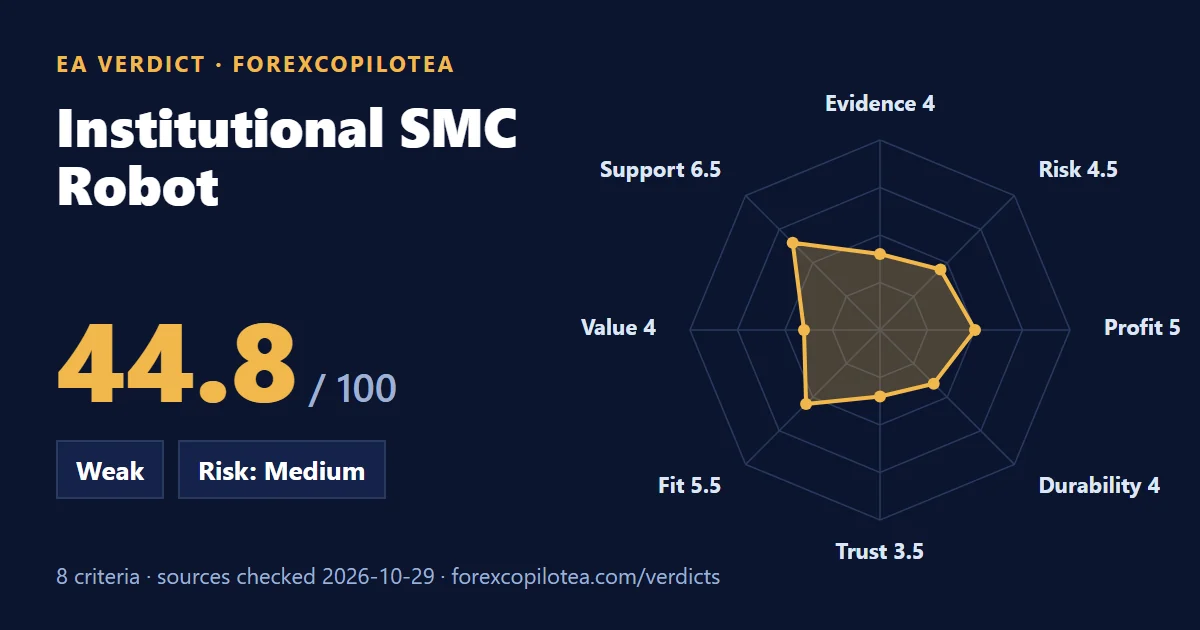
Institutional SMC Robot is a Smart Money Concepts Expert Advisor for MetaTrader 5 that reads swing structure on a chart, waits for a break of structure or a change of character, filters for unmitigated order blocks and fair value gaps, and enters with a stop and a target taken from the swing or from a risk-reward ratio. Its default backtest is gold on H1. It costs $599 on the MQL5 Market, or $199 a month to rent, after a price that its seller's comments show at $299 in August, and it links three live signals. Those signals win 84% to 91% of their trades, show profit factors of 3.49 to 7.94 and are between one and nine weeks old on accounts of 154 to 496 euros. We read the listing, the 19 reviews we could open and the comment thread, checked each signal line by line and scored Institutional SMC Robot on the same eight criteria as every verdict here. The result is 44.8 out of 100 and a Medium risk label: a busy, well-supported product whose public proof is still too young to carry a high score.
Key takeaways
- Institutional SMC Robot scores 44.8 out of 100 (band: Weak) with a Medium risk label. It has three platform-built signals and a developer who answers everyone, but they cover 1, 8 and 9 weeks, 18 to 57 trades each, and MQL5 itself flags them as newly opened and possibly random.
- The gold signal (MQL5 signal 2389159) shows 37 trades in 9 weeks, 83.78% winners, a profit factor of 3.49 and a profit of 152.26 EUR, but an average loss of 10.17 EUR against an average win of 6.88 EUR, a balance drawdown of 27.57% and an equity drawdown of 25.18%. One trade of 91.92 EUR is 60% of its profit.
- The Market price on 29 October 2026 is $599 (rent $199 for one month or $399 for a year). The vendor's own comments show a regular price of $299 in August, a 50% promotion on 30 September and a page that now says 'Only 2 copies left at the current price' with a next price of $999.
- One of 21 ratings is a 1-star review alleging two large losses and 'random execution'. The developer's reply says the Expert Advisor closed no stop loss and that it was a single open trade. The dispute is about open versus closed trades, not about the size of the floating loss, and we report it as an allegation.
- We sell a listing for Institutional SMC Robot at $26.99, version 3.10 against 3.20 on the Market. It ships a compiled file and a PDF manual with no setfile and no source. Treat it as a separate purchase with its own price and terms.
- 44.8 / 100
- weighted verdict score on eight published criteria
- PF 3.49 to 7.94
- profit factors of the vendor's three live signals, aged 9, 8 and 1 weeks, over 37, 57 and 18 trades
- $599
- Market price on 29 Oct 2026 (rent $199 a month), against $26.99 on our listing
The verdict at a glance: a lively product with a very young record
Institutional SMC Robot earns points for what it lets a buyer see and for how the vendor behaves. The strategy is described in specific terms, three signals are linked from the first lines of the page, there is a free demo, the cent-account and prop-firm cases are covered, and the developer replies to every review and to most comments. It loses points on the evidence and on the way it is sold. The oldest signal is nine weeks old, the newest is one week old, no backtest report is published, the set files and manual come privately after a comment, and the price has moved three times in three months. The scorecard and radar show how the total was built.
44.8 / 100
Weighted verdict score
Weak
Verdict band
Medium
Risk label
| Criterion | Weight | Score | Best evidence | Points |
|---|---|---|---|---|
| Verified evidence | 20 | 4/10 | Grade A | 8.0 |
| Risk and drawdown behaviour | 20 | 4.5/10 | Grade A | 9.0 |
| Profitability quality | 15 | 5/10 | Grade A | 7.5 |
| Sustainability | 15 | 4/10 | Grade B | 6.0 |
| Transparency and trust | 10 | 3.5/10 | Grade B | 3.5 |
| Practical fit | 10 | 5.5/10 | Grade B | 5.5 |
| Cost and value | 5 | 4/10 | Grade B | 2.0 |
| Support and usability | 5 | 6.5/10 | Grade B | 3.3 |
| Total | 100 | 44.8 |
What Institutional SMC Robot actually is
Institutional SMC Robot is an Expert Advisor for MetaTrader 5, sold on the MQL5 Market by VUJCIC INVESTMENTS COMPANY of Italy, whose seller profile shows a 4.8 rating from 47 ratings, 6 products and 8 signals. It was published on 23 July 2026, showed version 3.20 and was last updated on 17 October 2026, with 17 activations and a free demo downloaded 1,669 times. The product page rating is 4.81, built from 21 ratings, 20 of them five stars and one of them a single star; the page counts 23 reviews and 126 comments. The page text begins 'INSTITUTIONAL SMC ROBOT VERSION 3.0', a label the vendor has not updated, so the version number in the title block and the one in the text disagree.
Smart Money Concepts, or SMC, is a vocabulary for reading price structure. The listing says the robot tracks 'real institutional footprints': a break of structure (BOS), a change of character (CHoCH), order blocks, fair value gaps (FVG) and Quasimodo levels (QML). In mechanical terms the EA finds swing highs and lows through a fractal sensitivity setting, confirms that structure has broken or flipped, keeps only order blocks and fair value gaps that price has not yet revisited, and then places an entry with a stop and a target taken from the nearest local swing or from a fixed risk-reward ratio. A trailing stop and a spread filter manage the trade. Lot sizing can be fixed, set by a risk level, or set as a percentage of risk.
Around that core sit the protections and extras. News protection pauses trading around FOMC, NFP, CPI and central bank speeches, and the listing says it 'cannot eliminate slippage'. A time-window filter restricts trading hours. A prop-firm module has a maximum daily loss guard that closes everything and pauses, and a maximum total drawdown guard that halts the EA permanently. Version 3.2 added profit-based pyramiding, also called scale-in: the EA adds positions only while the main trade is in profit, at an interval you set in points, with each added volume equal to the main lot times an 'Added Lot Multiplier' and a configurable maximum number of additional trades. The listing says pyramiding requires a hedging account and is disabled on netting accounts. Optional chart visuals and a performance dashboard are switched by two inputs, InpEnableVisuals and InpShowDashboard.
| Item | What the vendor says |
|---|---|
| Seller | VUJCIC INVESTMENTS COMPANY (user dragoljubvujcic), Italy. Seller rating 4.8 from 47 ratings; 6 products, 8 signals. Private Telegram group for buyers. |
| Price | $599 to buy; $199 for one month or $399 for one year to rent. Free demo (1,669 downloads), 17 activations. 'Only 2 copies left at the current price' and 'next price usd 999'. |
| Strategy | Smart Money Concepts: BOS, CHoCH, unmitigated order blocks and fair value gaps, Quasimodo levels, swing detection by fractal sensitivity. Entries with SL and TP from local swing or risk-reward ratio. |
| Risk controls | Trailing stop, spread protection, news filter (FOMC, NFP, CPI, central bank speeches), time windows, Max Daily Loss Guard, Max Total Drawdown Guard, free-margin and stop-out checks on added positions. |
| Markets and timeframes | Default backtest on XAUUSD, H1, 'Every tick based on real ticks'. Also intended for NASDAQ, US30, BTCUSD, other crypto and forex. Vendor comments give XAUUSD on H1, US100 on M30 and BTCUSD on M15. |
| Requirements | MetaTrader 5. Minimum deposit $200, $300 or more recommended. Cent, micro, standard, ECN and raw-spread accounts. Hedging account for pyramiding. Exness cent or three-decimal gold needs point inputs multiplied by ten and a dedicated .set file. |
| Track record | Three live signals linked in the description (gold at Vantage Markets, Nasdaq at FPtrading, forex at Vantage Markets). A Bitcoin signal is marked 'COMING SOON'. No backtest report, win rate, drawdown or return figure appears in the description. |
| Versions | 3.20, updated 17 Oct 2026; about eight versions since a 1.2 in late July. |
Institutional SMC Robot price: our listing against the Market product, difference by difference
Because we sell a listing under this name, here is every difference we could find between what we sell and what the Market vendor sells, as of 29 October 2026. We are not saying one is better than the other; a buyer deserves to see the gap before deciding which, if either, to use.
| Point | ForexCopilotEA listing | MQL5 Market product |
|---|---|---|
| Version | v3.10 in the title; the body text still reads 'Version 3.0' | 3.20, updated 17 Oct 2026 |
| Price and terms | $26.99, one-time, no subscription, lifetime updates promised | $599 to buy, $199 for one month or $399 for one year to rent |
| What ships | A compiled .ex5 and a PDF user manual in one ZIP. 'No setfile with this EA. No source code.' | The EA through the Market, plus set files and a manual sent privately after the buyer comments |
| Set files | None. Buyers who need a cent-account configuration are told to contact the developer, meaning our seller | Set files for XAUUSD, NASDAQ (US100), BTCUSD, EURUSD, EURCAD, AUDUSD, USDJPY and USDCAD are listed, and the vendor sends updated sets after each version |
| Pyramiding | Our description does not mention pyramiding, the live signals, or the set files and support the vendor supplies | Profit-based pyramiding added in 3.2; three linked signals; private Telegram group |
| Support | No original-developer support is described | The developer answers comments and reviews, and says he gives step-by-step installation support |
| Reviews | None on our page ('New listing, no reviews yet'). The 4.2 Trustpilot figure on our site covers the whole store, from 10 reviews, not this product | Rating 4.81 from 21 ratings, 23 reviews, 126 comments |
| Seller | Benjamin Lee, ForexCopilotEA | VUJCIC INVESTMENTS COMPANY |
Two consequences follow. First, the performance evidence in this verdict belongs to the Market product, version 3.20 and the vendor's private set files. Our file is one version behind, and without a setfile a buyer cannot reproduce the signals' settings, so even a perfect signal would not be a promise about our copy. Second, the price gap is large: $599 against $26.99 is a factor of about 22. That gap says nothing about quality in either direction. It is a reason to read our listing's terms carefully and to run the free Market demo, which does run the product's own default settings in the Strategy Tester, before paying anyone.
How we judged it, and who has something to sell
Evidence on EAs is never neutral. Here is every party near this product and what each stands to gain, ours included.
- The developer sells the EA, rents it, sells signal subscriptions (500 USD a month on each of the three signals, with 0 subscribers shown on 29 October) and sells five other products, several of which he promotes in the comment thread. His record is public, which counts for something, and it is also his sales page.
- MQL5 and MetaQuotes host the Market, the reviews, the comments and the signals. The signal statistics and every notice on their pages are the platform's own.
- Buyers who wrote reviews are mostly five-star writers who praise support and the delivery of set files, often within days of buying. Testimony, not data, and none can be checked from outside.
- ForexCopilotEA sells a listing for this EA. We gain if you buy it, which is why this verdict opens with that fact and applies the same rules as every other.
Evidence ladder: what each rung of proof held for Institutional SMC Robot
Grade A: Independent proof
- MQL5 signals 2389159, 2389243 and 2396091: platform-built statistics for 9, 8 and 1 weeks and 37, 57 and 18 trades. The vendor runs the accounts, so his interest is noted, but the figures are computed from broker history and the platform's notices are its own. Their trade lists need a login and we did not check them.
- MetaQuotes and Myfxbook documentation, used for how testing reports and verified records work.
Grade B: Checkable vendor material
- The Market listing: version, price, rental price, the module list, the pyramiding description, the requirements, dated reviews, the comment thread and the developer's replies.
- The free demo, which runs in the Strategy Tester only, and the dated version notes in the vendor's comments.
Grade C: Claim only
- 'High-probability trades', 'real institutional footprints' and 'ideal even for beginners': descriptions, not measurements.
- 'No martingale or grid. Safe to use on propfirms', from one five-star reviewer: an opinion that the signals' drawdowns do not obviously support for every account.
- The vendor's 7 October comment that a gold trade 'was closed at a loss 30 minutes before a high-impact news release' and so the EA 'protected the trading capital from a potentially much larger loss': a claim about a counterfactual.
Grade D: Conflicted, anonymous or unverifiable
- Positive reviews that praise the support and the free gifts; they may be genuine and are not independently checkable. One reviewer asks for set files inside his review.
- Scarcity messages: 'Only 2 copies left at the current price' and, in a review, 'Go buy your copy before it becomes too expensive'.
- A one-star review whose claims we cannot confirm and a developer reply we cannot confirm either.
Institutional SMC Robot live signals: what the three accounts show, number by number
A platform-computed signal is the best public evidence a vendor can show. These three have limits that matter more than usual. The vendor runs every account. The accounts are tiny, from 154 to 496 euros. The ages are 9 weeks, 8 weeks and 1 week. Each page carries platform warnings, and the platform describes the gold account as 'a newly opened account' whose 'trading results may be of random nature'. With those limits in mind, here is what the three signals show on 29 October 2026. All three are priced at 500 USD a month to copy, have no subscribers and no signal reviews, are algorithmic, and run at 1:500 leverage.
| Statistic | SMC Robot XAUUSD (2389159) | SMC Robot US100 (2389243) | SMC Robot Forex (2396091) |
|---|---|---|---|
| Broker | VantageMarkets-Live 14 | FPTrading-Live | VantageMarkets-Live 10 |
| Started, age | 1 Sep 2026, 9 weeks, 25 trading days | 1 Sep 2026, 8 weeks, 23 trading days | 18 Oct 2026, 1 week, 3 trading days |
| Initial deposit, deposits, withdrawals | 100.00, 420.00, 270.00 EUR | 103.16, 0.00, 30.00 EUR | 238.41, 0, 0 EUR |
| Growth, profit, balance | +110.43%, 152.26, 402.26 EUR | +92.54%, 80.93, 154.09 EUR | +107.92%, 257.26, 495.67 EUR |
| Trades, win rate | 37, 83.78% (31 wins, 6 losses) | 57, 91.22% (52 wins, 5 losses) | 18, 88.88% (16 wins, 2 losses) |
| Long, short | 12 long, 25 short | 39 long, 18 short | 2 long, 16 short |
| Profit factor, expected payoff | 3.49, 4.12 EUR | 7.94, 1.42 EUR | 7.80, 14.29 EUR |
| Average win, average loss | 6.88, minus 10.17 EUR | 1.78, minus 2.33 EUR | 18.44, minus 18.93 EUR |
| Best, worst trade | 91.92, minus 47.30 EUR | 7.33, minus 11.14 EUR | 51.15, minus 17.59 EUR |
| Longest winning run, longest losing run | 14 wins (64.31 EUR), 2 losses (minus 4.98 EUR) | 15 wins (40.68 EUR), 2 losses (minus 0.49 EUR) | 12 wins (263.65 EUR), 2 losses (minus 32.48 EUR) |
| Maximal drawdown by balance | 47.45 EUR, 27.57% | 11.14 EUR, 7.56% | 33.49 EUR, 6.73% |
| Relative drawdown by balance, by equity | 14.70% (47.35 EUR), 25.18% (37.61 EUR) | 9.49% (11.14 EUR), 15.26% (16.84 EUR) | 6.62% (32.94 EUR), 2.82% (6.73 EUR) |
| Recovery factor, Sharpe ratio | 3.21, 0.25 | 7.26, 0.58 | 7.68, 0.82 |
| Trades per week, average hold | 4, 4 hours | 20, 2 hours | 19, 10 hours |
| Maximum deposit load | 19.91% | 81.37% | 55.92% |
| Symbols | XAUUSD+ only | US100 only | USDCAD+ (10 deals), EURCAD+ (8) |
Start with the gold signal, because gold is the product's flagship and the only market with a stated default backtest. Its 83.78% win rate, average win of 6.88 EUR and average loss of 10.17 EUR give an expected payoff of 0.8378 times 6.88 minus 0.1622 times 10.17, which is 5.76 minus 1.65, or 4.11 EUR, matching the platform's 4.12 EUR. The edge is the hit rate. The break-even win rate for those averages is about 59.6%, so there is room, but six losses in 37 trades is too few to know how large or how clustered the losses can get. The single worst trade, minus 47.30 EUR, is 4.6 times the average loss and nearly half of the account's balance-drawdown figure.
The gold account's growth figure needs care. It started with 100 EUR, took 420 EUR of deposits and gave back 270 EUR in withdrawals, so the net capital added was 250 EUR and the balance reconciles as 100 plus 420 minus 270 plus 152.26, which is 402.26 EUR. The percentage is platform-adjusted and is large because the base is small. The profit of 152.26 EUR also leans on one trade: the best trade, 91.92 EUR, is 60% of the whole profit, and without it the remaining 36 trades earned about 60 EUR. The platform noted 'Too much growth in the last month indicates a high risk' on 6 and 9 October, removed it on 7 October and 29 October, and had earlier noted that the share of trading days was too low and that the number of deals was too small to evaluate trading, a notice removed on 21 October.
The US100 signal is the most active: 57 trades, 20 a week, and a profit factor of 7.94. It is also the smallest. Its average win is 1.78 EUR and its average loss 2.33 EUR; the break-even win rate is about 56.7%, and it wins 91.2%. The deposit load peaked at 81.37% on an account that never held more than about 154 EUR, which says the lot size was large for the balance, whatever the drawdown. The listing's own minimum is $200 with $300 or more recommended, and this account is below it. The page also shows no swaps charged, which points to a swap-free account type, and records stretches with no trading: a notice of six days without activity appeared on 20 and 27 September and was removed the next trading day. Its newest platform warning, on 27 October, is the growth notice again.
The forex signal is one week old and should be read as the start of a record and not as a result. It has made 18 trades on 3 trading days, 16 of them short, across USDCAD and EURCAD, and reports growth of 107.92% in a week, which MQL5 flags with 'High average monthly growth may indicate high trading risks' on 22 October. A 12-trade winning streak earned 263.65 EUR, more than the entire net profit of 257.26 EUR, because the other six trades lost money overall. Average win and average loss are almost equal at 18.44 and 18.93 EUR, so the whole result rests on 16 wins in 18. It began on 18 October, the day after version 3.20 was released, which is consistent with a new version, and forex set files were first mentioned with version 3.0 on 6 October. Nothing in a week can show whether those rules hold.
- Gold, maximal by balance27.6%
47.45 EUR on a 100 EUR start
- Gold, relative by equity25.2%
37.61 EUR
- US100, relative by equity15.3%
16.84 EUR
- US100, maximal by balance7.6%
11.14 EUR
- Forex, maximal by balance6.7%
33.49 EUR, one week
- Forex, relative by equity2.8%
6.73 EUR, one week
Taken together, the three signals describe one profile: win rates of 84% to 91%, profit factors of 3.5 to 7.9, and an average loss that is equal to or larger than the average win (1.5 times on gold, 1.3 times on US100, about 1.0 on forex). That profile is common for a system that takes profit near the nearest structure and places the stop at the swing beyond it. It is not a bug. It is a shape that works while the hit rate holds and punishes a month when it does not. The earliest signal started on 1 September 2026, ten weeks after the product went on sale on 23 July. The vendor's 3 August comment announces a 'LIVE SIGNAL' and posts results for that day, but that signal is not among the three linked now, so the first six weeks of the product's life have no public record we could open. No Bitcoin signal exists yet, although the listing says BTCUSD is supported and several reviewers say they run it.
How a Smart Money Concepts EA makes and loses money
SMC rests on a story: large participants leave footprints in price, a sweep of obvious highs and lows clears resting orders, and a sharp break of structure in the opposite direction marks where they have taken a position. Whether that story is true is a debate we do not need to settle. What matters for an EA is that the story is converted into rules: a swing is a bar that is higher or lower than a number of bars on each side, a break of structure is a close beyond the last swing, an order block is the last opposing candle before the move, a fair value gap is a three-candle imbalance, and a block counts as unmitigated until price returns to it. Every one of those rules has a threshold, and the thresholds are where the product's results are won or lost.
Two practical consequences follow. First, the fractal sensitivity setting changes what the EA sees as a swing, which changes every downstream signal. A set file for gold on H1 and a set file for US100 on M30 are different configurations of the same engine, which is why the vendor sends them separately and why a buyer without the right set file is not running the signal's strategy. Second, taking profit at the nearest local swing and the stop at the far side produces the signals' shape: frequent small wins and rarer, larger losses. The vendor's own comment on 7 October is a good illustration of how this feels in practice: a trade opened at 16:00 on default settings was closed at a loss shortly before a high-impact release. A buyer who reads that as the protection working is right about the rule and should still expect the loss to appear in the statistics.
- Martingale
- Grid
- Trend
- Scalper
A reviewer on the Market page put the trade-off plainly: the system 'requires patience', trades fewer times, and 'when it hits the SL it can be a big loss but it has a very high win rate'. That is an accurate description of what the signals show, and it is the thing to size against. The expectancy calculator below lets you test how the three signals' win rates and averages hold up if the hit rate slips.
Interactive: win rate is not edge
- Expected result per trade
- +0.35
- Profit factor
- 1.64
- Break-even win rate
- 33%
At these numbers the system has a positive edge before costs. Add spread, commission and slippage per trade and re-check.
Pyramiding in version 3.2: what the scale-in module adds to the risk
Version 3.2 added profit-based pyramiding. When it is switched on, the EA adds a position each time the main trade has moved a set number of points into profit. Each added position is the main lot times an 'Added Lot Multiplier', up to a 'Maximum Additional Trades' limit, and the added trades are linked to the main trade and closed with it. The listing says free-margin and stop-out checks guard each addition, and that the module needs a hedging account. When the vendor was asked on 26 October whether the update changed the EA, he replied that it 'has been greatly improved with additional trading options' and that a buyer who prefers can 'disable additional options and use it as previous versions with old set files'.
This is a different thing from a grid or a martingale, because positions are added only to winners and the vendor describes no averaging down. It is still a way to raise exposure at the moment a trade has moved, and it means total risk on a trade can be a multiple of the main lot. If the main trade later reverses through the shared exit, all the linked positions close together, so a reversal after several adds gives back more than a single position would. We could not see which of the three signals, if any, uses pyramiding, because the set files are private. The listing, our own listing's description and the reviews do not say. A buyer should treat version 3.20 behaviour with pyramiding on as untested in public, and should ask which version and which settings each signal runs.
Institutional SMC Robot drawdown and risk: contained per trade, uncertain in the tail
Institutional SMC Robot is a better-behaved design than a grid. It enters with a stop taken from structure, a reviewer who tested it reports 'clear tp and sl' and 'no martingale or grid', and the listing describes no averaging down. That keeps the label at Medium and not High. The vendor does not state in so many words that every trade carries a stop, so that point rests on the reviewer and on the shape of the signals' worst trades, which are bounded at 47.30, 11.14 and 17.59 EUR. The risks that remain are the ones a high-win-rate, structure-based system carries.
- Negative skew. The average loss is 1.5 times the average win on gold. About two losers erase five winners, and the break-even win rate on the gold signal's averages is around 60%.
- A thin loss sample. Six, five and two losing trades cannot show the tail. Expect real losses to be larger and more clustered than the signals suggest.
- Equity drawdown on the flagship. The gold signal's 25.18% relative equity drawdown and 27.57% balance drawdown sit beside marketing that says the EA suits 'strict Prop Firm evaluation rules'. A typical prop-firm maximum drawdown limit of 10% would have been breached on that account.
- Deposit load. The US100 signal's 81.37% peak deposit load and the forex signal's 55.92% on accounts of 154 and 496 EUR are high. A small account at a minimum lot can be heavily exposed even with a stop.
- Pyramiding. Added positions multiply exposure on a reversal and need a hedging account. See the section above.
- Slippage and news. The listing says news protection 'cannot eliminate slippage'. MQL5 shows slippage as 'No data' on all three signals.
- Version and set-file risk. About eight versions in three months, each with new set files. A signal records what one version and one set did; check the version and the set you will receive against the ones you tested.
Interactive: drawdown recovery
Gain needed to get back to break-even
+42.9%
Blue: equity left. Red: equity lost.
Consecutive losing trades to reach this drawdown: 36
Institutional SMC Robot reviews: what buyers say, and the one-star allegation
The listing shows a rating of 4.81 from 21 ratings, and a tab with 23 reviews. We could read 19 of them in the page text; about four more sit on a second page that did not load for us. The developer replied to every one we read. Of the 19, 18 are five-star and one is a single star, which matches the vendor's rating arithmetic: 20 five-star and one one-star ratings give the page's 4.8095. Most five-star reviews praise support, a fast reply and the delivery of set files. Several are days old. One, from 18 October, says it 'performs exactly as described, and the initial results are highly promising' and that the developer 'fixed some issues in short time'. One, from 16 October, says the EA 'is performing as well as in his signals'. One, from 4 October, reports testing on a small live account for a few days with 'only two' trades so far, one on gold and one on Bitcoin. One, from 25 September, reports running it live on XAUUSD, BTCUSD and US100 and says losses 'have remained well controlled'. One, from 12 September, calls it a 'good SMC strategy for gold' that 'requires patience'.
The review pattern has limits. Few reviews report the writer's own results and most describe the first days after purchase. One reviewer asks for set files inside the review. One, written on 18 September, ends 'Go buy your copy before it becomes too expensive', which is a sales sentence in the reviews section. Another says 'under the test lets see'. We weigh the reviews as evidence of good support, which is real, and not as evidence of performance, which will take months to appear.
Two observations are fair. The reviewer's reversal in one day, from praise to condemnation, suggests the experience was a loss on a live position, not a considered assessment. And the developer's reply, while specific on the facts, is dismissive in tone toward a customer, which counts against the trust score even if the facts are on his side. Anyone who wants to see how the product handles a large floating loss should look for it in the signal data, not in either party's words.
Is Institutional SMC Robot legit? What the price history and the support show
Legitimacy here is a narrower question than performance, and the answer is yes on the first and open on the second. The product is real and regularly updated. It runs on the MQL5 Market, which validates and delivers it. The seller has a profile with 47 ratings, 6 products and 8 signals. The developer answers questions, publishes version notes in comments, and does what he says on set files. There are no fraud allegations in the comment thread beyond the single one-star review. We do not allege wrongdoing.
What we can say is that the pricing and the marketing have features that call for care. In the developer's comment of 16 August, the product carried a 'SPECIAL PROMOTIONAL PRICE' and 'AFTER THAT, THE PRICE GOES BACK TO THE REGULAR $299'. On 30 September a comment said 'Last days to get 50% off' and gave the 'NEXT PRICE USD599'. By 29 October the price is $599 and the description says 'Only 2 copies left at the current price! -next price usd 999'. Between 30 September and 29 October the same thread contains bare comments promoting the seller's other products ('TRY BROKK!!!', 'TRY INSTITUTIONAL AGGRESSIVE!!!', 'TRY INSTITUTIONAL XAUUSD!!!', 'TRY NEURAL SENTINEL!!!'). A price that triples in three months while the live record grows from a few weeks to nine is a reason to slow down, not to hurry.
| Date | What the vendor said or shipped |
|---|---|
| 23 Jul 2026 | Product published on the MQL5 Market. |
| 24 to 25 Jul 2026 | Version 1.2 with new set files; older ones called 'deprecated'. |
| 3 Aug 2026 | A comment announces a 'LIVE SIGNAL' and posts results for that day. |
| 16 Aug 2026 | Promotional price, 'back to the regular $299' afterwards. |
| 19 Sep 2026 | Versions 1.8 and 1.9 discussed; a buyer on 1.8 is told to update to 1.9. |
| 30 Sep 2026 | Version 2.1: news protection, visual backtest mapping, a fix that adds a missing global variable 'to ensure proper variable scoping and compilation for the scale-in logic', AdjustStopsLevel check. Price: 'last days to get 50% off', next price $599. |
| 6 Oct 2026 | Version 3.0: 'Lumina 3D Dashboard' and forex set files. |
| 17 Oct 2026 | Version 3.20: pyramiding engine, per the description. |
| 29 Oct 2026 | Price $599; 'only 2 copies left at the current price', next price $999. |
The version trail shows a developer who works and ships quickly, which is a strength for support and a cost for stability. A fix for a missing variable that the scale-in code needed in order to compile is the kind of change that happens in a fast-moving codebase, and it shows why a signal that started on 1 September, on whatever version was current, does not necessarily describe version 3.20. For how backtest and live results diverge, see our guide to backtest versus live results.
Institutional SMC Robot price: $599, $199 a month, and what you can test first
The Market price on 29 October 2026 was $599 to buy, $199 for one month of rental and $399 for a year, which the page describes as saving 84%. The Japanese and Turkish pages of the listing show the same $599. The free demo has been downloaded 1,669 times and runs in the Strategy Tester only. The rental is the useful mitigation: a month costs about a third of the purchase price, and the year costs two thirds. A month is short for a system that trades gold four times a week, as the gold signal does, but it is enough to learn the set files, check the broker's server time and compare fills against the vendor's.
Set the price against the record. The three signals have earned 152.26, 80.93 and 257.26 EUR in 9, 8 and 1 weeks. At the gold signal's pace, a $599 licence is a large multiple of a 250 EUR net deposit. That is not an argument against the product; it is a reminder that price and evidence should be weighed together, and that the record at $299 in August was shorter still. If you buy from a source other than the Market, such as our own listing at $26.99, the price, the version and what is delivered are different. Our listing is a separate purchase with its own terms and shows version 3.10 against 3.20, so read what is included before you pay. Remember the other costs: a Windows VPS, which the listing recommends, a broker with low gold spreads, and the time to set up the private set files.
Is Institutional SMC Robot safe for prop firm challenges?
The vendor markets the EA for 'strict Prop Firm evaluation rules', and the module is real: a Max Daily Loss Guard that closes all positions and pauses, a Max Total Drawdown Guard that halts the EA permanently, and time-window filters. A guard that stops the EA is not the same as a system that stays inside the limit. On the gold signal, the relative equity drawdown was 25.18% and the maximal balance drawdown 27.57%, and the worst trade was 47.30 EUR on a balance that was at most about 400 EUR. A challenge with a 5% daily limit and a 10% total limit gives the guards very little room, and a reversal after pyramiding could cross a limit in one session. A reviewer's view that it is 'safe to use on propfirms' is an opinion. If you use a prop-firm account, set the guards well inside the firm's limits, set the lot from the worst loss and not the average, test the exact set on a demo of the same size for at least a month, and read the firm's rules on news trading and on copy trading, which differ.
Support, set files and the install: what the buyer actually gets
Support is the product's strongest point, and it has a particular shape. The comment thread is dominated by buyers posting that they have just purchased and asking for set files, and the developer answering that he has sent 'the set files and manual with all the details of the EA'. Delivery is private. The listing promises step-by-step installation support, a comprehensive user guide and a private Telegram group. A buyer who wanted a default for gold would find only 'Backtest with default only for XAUUSD', H1, default settings, every tick based on real ticks, and a vendor comment that US100 should run on M30 and BTCUSD on M15. Another buyer asked on 26 October whether the update makes a new EA and whether it can work like the original; the vendor replied that options can be disabled. On the same date the thread shows a buyer who cannot install ('Install failed on terminal please guide'), with no reply visible when we read it.
Two frictions matter. A manual and set files that arrive only after you comment under a public product page mean you cannot read the full instructions before paying, which the criteria count against transparency. And the vendor's practice of calling older set files deprecated, and 'strongly recommend[ing]' the latest version, means a set file is a perishable item. For a buyer through our listing, the position is different again: our file ships with a PDF manual but no setfile, so the private set files that the Market vendor supplies are not part of it, and the cent-account note tells buyers to contact the developer, which on our listing means our seller.
The score, criterion by criterion: 44.8 out of 100
| Criterion | Score | Points | Why |
|---|---|---|---|
| Verified evidence (weight 20) | 4 / 10 | 8.0 | Three platform-built MQL5 signals, but only 9, 8 and 1 weeks old with 37, 57 and 18 trades on accounts of 154 to 496 EUR; the vendor runs them, MQL5 flags them as newly opened and 'random', and no backtest report is published. |
| Risk and drawdown behaviour (weight 20) | 4.5 / 10 | 9.0 | Stops and targets from swing structure, a prop-firm loss guard and no stated grid or martingale; against that, an equity drawdown of 25.18% and a balance drawdown of 27.57% on the gold signal, a pyramiding module, an 81% peak deposit load on the index signal and an open dispute about floating losses. |
| Profitability quality (weight 15) | 5 / 10 | 7.5 | Verified profit factors of 3.49, 7.94 and 7.80 and positive expectancy on all three signals; but under 12 months, an average loss above the average win on two of them, one trade worth 60% of the gold signal's profit, and deposits and withdrawals on two accounts. |
| Sustainability (weight 15) | 4 / 10 | 6.0 | A seller with 6 products, 8 signals and a 4.8 rating who updates often; but the product is three months old, about eight versions have shipped, set files are 'deprecated' with each, and the logic is closed. |
| Transparency and trust (weight 10) | 3.5 / 10 | 3.5 | A candid risk disclaimer and replies to every review; against that, set files and the manual delivered privately after a comment, a price that moved from $299 to $599 with 'only 2 copies left' and 'next price usd 999', a dismissive reply to a critic, and incentives attached to the purchase. |
| Practical fit (weight 10) | 5.5 / 10 | 5.5 | XAUUSD on H1 with mainstream brokers, a stated $200 minimum, cent and prop-firm modes; but pyramiding needs a hedging account, cent gold needs hand-adjusted inputs, and the index signal ran at an 81% deposit load on 154 EUR. |
| Cost and value (weight 5) | 4 / 10 | 2.0 | $599 to buy or $199 a month to rent against signals that are 1 to 9 weeks old; a free demo with 1,669 downloads and the rental are the only mitigation, and the page still says the next price is $999. |
| Support and usability (weight 5) | 6.5 / 10 | 3.3 | A free demo, a manual, per-symbol set files, a private Telegram group and a developer who answers every comment; friction from set files that arrive only after a comment and from set files that go stale with each update. |
The total is 44.8 out of 100. The grade A on evidence is earned by three platform-built signals; the score stays at 4 because the oldest is nine weeks old, all three are tiny and vendor-run, the platform flags them as new and possibly random, and no backtest report is published. Risk, at 4.5, gets credit for structure-based stops and a prop-firm guard and loses it for a 25% equity drawdown on the flagship, high deposit loads, pyramiding and a dispute about floating losses. Profitability is positive on all three signals and is held back by short records, a payoff below one and a profit concentrated in a few trades. Trust, at 3.5, is the lowest criterion: closed logic with the manual and sets delivered after payment, a moving scarcity price and incentives attached to the purchase outweigh a candid disclaimer and a developer who replies.
Who Institutional SMC Robot fits, and who it does not
- It fits a trader who wants a rules-based Smart Money Concepts EA on gold, is happy to run the free demo and a rental month first, starts with the default XAUUSD H1 setup and sizes the lot to the worst loss.
- It does not fit anyone who needs a long verified record before paying, who wants every instruction before purchase, or who cannot tolerate a loss that wipes out several winners.
- It is risky for prop-firm challenges with a 10% limit unless the lot is small and the guards are set inside the limit: the gold signal's equity drawdown was above 25%.
- It is a poor choice for a buyer who is paying mainly because two copies remain at the current price, or because a signal grew 100% in a week. Run the demo first.
How it compares with other EAs we have scored
Next to Gold Beaver, another very high-win-rate gold system with a payoff below one, Institutional SMC Robot has three signals instead of one but each is younger, and a lower trust score because its logic, manual and sets are private. Next to Pulse Engine, which has a signal of 2,271 trades and a thin edge, it is the opposite case: a handful of trades with a large apparent edge that a larger sample would have to confirm. Its 44.8 reflects young records, a moving price and closed delivery, set against real support. For how these system types differ, see our strategy comparison and our gold EA category.
Questions to put to the developer before you pay
- Which version, symbol, timeframe and set file does each of the three signals run, and is pyramiding on?
- Can you publish a real-tick backtest report for XAUUSD H1 at default settings, with drawdown and trade count?
- Does every trade carry a hard stop loss, and what is the largest loss at 0.01 lot you have seen on any account?
- How is the prop-firm module meant to be used given a 25% equity drawdown on the gold signal?
- Can the manual and the default set files be read before purchase?
- How will the price move from here, and do owners get every update?
- Does the 1-star review's open-trade loss reflect the strategy's normal floating range, and what is that range?
Sources and when they were opened
- MQL5 Market: Institutional SMC Robot (product 187011), opened 29 October 2026Source of the price, rental prices, version, strategy description, pyramiding module, requirements, readable reviews, comments and the developer's statements. Written by the vendor and by buyers.
- MQL5 Market: Institutional SMC Robot comments (product 187011), opened 29 October 2026Source of the version trail, price statements, set-file delivery and the one-star dispute. Written by the vendor and by buyers.
- MQL5 Signals: SMC Robot XAUUSD (signal 2389159), opened 29 October 2026Source of the gold signal's figures and notices. The vendor operates the account.
- MQL5 Signals: SMC Robot US100 (signal 2389243), opened 29 October 2026Source of the index signal's figures and notices. The vendor operates the account.
- MQL5 Signals: SMC Robot Forex (signal 2396091), opened 29 October 2026Source of the forex signal's figures and notices. The vendor operates the account.
- MQL5 seller profile: dragoljubvujcic, opened 29 October 2026Source of the seller rating, product count and signal count.
- ForexCopilotEA listing: Institutional SMC Robot v3.10, opened 29 October 2026Source of our version, price, delivery and description. We are the seller.
- Myfxbook Help: VerificationHow a trading account's track record is verified on Myfxbook.
- MetaTrader 5 Help: Testing ReportWhat each figure in the tester's report means, including drawdown.
- MetaTrader 5 Help: Strategy TestingThe Strategy Tester: testing modes, settings and forward testing.
- ESMA: ESMA agrees to prohibit binary options and restrict CFDs to protect retail investorsThe EU leverage limits, margin close-out, negative balance protection and risk-warning rules for retail CFD accounts.
- CFTC Customer Advisory: AI Won't Turn Trading Bots into Money MachinesA US regulator's warning about trading-bot claims of unusually high returns.
Frequently asked questions
Is Institutional SMC Robot EA legit?
It is a real, actively updated product with a documented strategy, three public signals, a private community and a developer who replies to every review, rated 4.81 from 21 ratings on the MQL5 Market. We do not allege wrongdoing. Its signals are one to nine weeks old on tiny accounts, which is why it scores 44.8 out of 100 with a Medium risk label.
Does Institutional SMC Robot use martingale or a grid?
The vendor does not state it either way, and one reviewer writes 'No martingale or grid'. Version 3.2 adds optional pyramiding, which adds positions only while the main trade is in profit and needs a hedging account. The signals' worst trades were 47.30, 11.14 and 17.59 EUR. We cannot read the code, so this rests on the listing, a review and the signals.
How much does Institutional SMC Robot cost?
The MQL5 Market price on 29 October 2026 was $599 to buy, $199 for one month or $399 for one year to rent, with a free demo. The page says only 2 copies remain at that price and gives a next price of $999. A Windows VPS and a low-spread broker are extra. Our own listing is a separate sale at $26.99 for version 3.10 with no setfile, so read the terms of whichever seller you use.
What drawdown does Institutional SMC Robot have?
On the vendor's gold signal the maximal drawdown by balance was 27.57% and the relative drawdown by equity 25.18%. The US100 signal shows 7.56% and 15.26%, the one-week forex signal 6.73% and 2.82%. All three are small accounts, 1 to 9 weeks old, so use the worst trade and your own lot size to plan.
Which timeframe and symbol does Institutional SMC Robot use?
The only public default is XAUUSD on H1, with every tick based on real ticks. The vendor's comments say US100 should run on M30 and BTCUSD on M15, and the listing names Nasdaq, US30, Bitcoin, crypto and forex as supported. Set files for each are sent privately after purchase.
What is the minimum deposit for Institutional SMC Robot?
The listing states $200 as the minimum with $300 or more recommended, and supports cent, micro, standard, ECN and raw-spread accounts. The US100 signal ran at an 81% peak deposit load on 154 EUR, so a small balance can be heavily exposed. Pyramiding needs a hedging account.
Is Institutional SMC Robot good for prop firms?
It has a daily loss guard and a total drawdown guard, and the vendor markets it for prop-firm rules. The gold signal's equity drawdown of 25.18% is more than a typical 10% limit allows, so set the guards well inside the firm's limits and test the exact set on demo first.
How was the score calculated?
Eight weighted criteria (evidence 20, risk 20, profitability 15, sustainability 15, trust 10, fit 10, cost 5, support 5), each scored out of ten against written anchors. Sources are graded A to D and unverified claims cannot count as proof. We sell a listing for this EA, which is disclosed at the top. The total here is 44.8 out of 100.
Gold Expert Advisors in our store
We sell these, so weigh that interest. Put the same eight questions to any of them before you buy: read the manual, run your own backtest, and start on demo.



Keep reading
- EA VerdictGold Beaver EA Review: Verdict and Risk (2026)Is Gold Beaver worth $449? Independent EA verdict: 48.8/100, Medium risk. A 23-week MQL5 signal, 13 presets and a 94% win rate scored, checked 29 Oct 2026.
- EA VerdictPulse Engine EA Review: Verdict and Risk (2026)Is Pulse Engine worth $599? Independent EA verdict: 52.8/100, Medium risk. A 36-week MQL5 signal, 2,271 trades and a 1.06 profit factor scored, checked 29 Oct 2026.
- BacktestingWhy EA Live Results Differ From Backtests (and What to Do)Why EA live results differ from backtests: spread, slippage, delay, data, overfitting and more. Eleven causes, how to check each and how to close the gap.
- Risk managementEA in Drawdown: What to Do (and What Not to Do)What to do when your Expert Advisor is in drawdown: separate normal from broken, check the logs, compare with the backtest, and decide to hold, reduce or stop.