
EA Verdict
Pulse Engine EA Review (2026): A Time-of-Day Pattern EA With a 20-Year Backtest and a Live Signal at a 1.06 Profit Factor
By Benjamin Lee · Updated · 21 min read
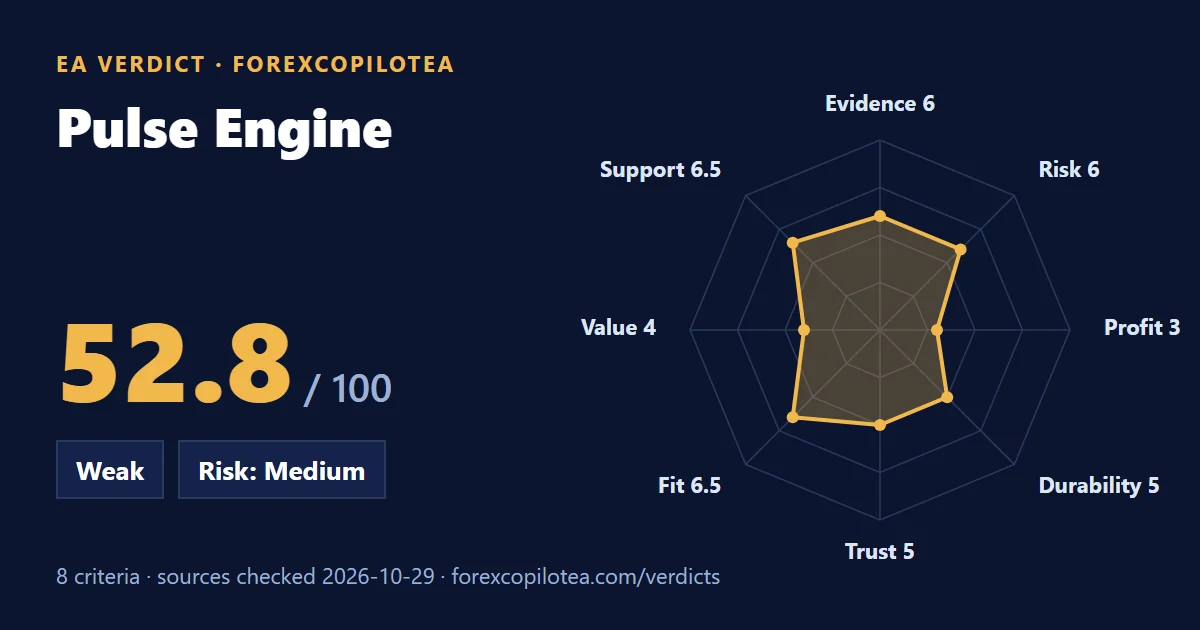
Pulse Engine is a multi-market Expert Advisor for MetaTrader 5 that trades 70 intraday directional patterns across gold, three forex pairs, the Nasdaq index and Bitcoin from one chart. It uses no indicators and no fixed timeframes, puts a stop loss on every trade, says it uses no martingale and no grid, and shows a 20-year backtest of more than 50,000 trades. It costs $599 with a stated final price of $1,499. Its live signal is the interesting part: 2,271 trades over 36 weeks, which is a large sample, at a profit factor of 1.06. The page opens with an unusually blunt warning about overhyped EAs, and we took it at its word. We read the listing and the reviews we could open, checked the signal line by line and scored Pulse Engine on the same eight criteria as every verdict here. The result is 52.8 out of 100 and a Medium risk label: a carefully built, well-controlled system whose live record has not yet shown the edge its backtest describes.
Key takeaways
- Pulse Engine scores 52.8 out of 100 (band: Weak) with a Medium risk label. Its risk controls and its large live sample are strengths; its profitability on that sample is the weakest of the three heavy criteria.
- The vendor's signal (MQL5 signal 2370727) shows 2,271 trades in 36 weeks, a 50.55% win rate, a profit factor of 1.06 and an expected payoff of 0.36 USD per trade. Balance is 5,819.20 USD on 3,000 USD of start plus 2,000 USD of deposits, so the trading profit is 819.20 USD.
- MQL5 reports a monthly growth of minus 4.48% and an annual forecast of minus 54.37% on the signal, a recovery factor of 0.72 and a note that 80% of the growth came within three days. A forecast is an extrapolation of recent months, not a prediction, and it is a fair warning.
- The listing's claim of 'over 70 patterns across 6 markets' and a '20 year backtest' cannot be checked from public data. The live signal is the evidence we can check, and so far it shows a small edge at best.
- We sell a listing for Pulse Engine. It shows version 1.8 against 1.90 on the Market, and ships a compiled file. Treat it as a separate purchase with its own price and terms.
- 52.8 / 100
- weighted verdict score on eight published criteria
- PF 1.06
- profit factor of the vendor's 36-week signal over 2,271 trades, with a monthly growth of minus 4.48%
- $599
- Market price on 29 Oct 2026, with a stated final price of $1,499 and a free demo
The verdict at a glance: a large live sample that shows a very small edge
Pulse Engine earns points for how it behaves. A stop on every trade, a deposit load under 2%, a worst trade of 76 USD and an equity drawdown of 2.5% describe a system that is hard to hurt. It loses points on whether it makes money. A profit factor of 1.06 over 2,271 trades means the gross profit is only 6% larger than the gross loss, and costs, slippage or a slightly worse broker can erase that. The scorecard and radar show how the total was built.
52.8 / 100
Weighted verdict score
Weak
Verdict band
Medium
Risk label
| Criterion | Weight | Score | Best evidence | Points |
|---|---|---|---|---|
| Verified evidence | 20 | 6/10 | Grade A | 12.0 |
| Risk and drawdown behaviour | 20 | 6/10 | Grade A | 12.0 |
| Profitability quality | 15 | 3/10 | Grade A | 4.5 |
| Sustainability | 15 | 5/10 | Grade B | 7.5 |
| Transparency and trust | 10 | 5/10 | Grade B | 5.0 |
| Practical fit | 10 | 6.5/10 | Grade B | 6.5 |
| Cost and value | 5 | 4/10 | Grade B | 2.0 |
| Support and usability | 5 | 6.5/10 | Grade B | 3.3 |
| Total | 100 | 52.8 |
What Pulse Engine actually is
Pulse Engine is an Expert Advisor for MetaTrader 5, sold on the MQL5 Market by Jimmy Peter Eriksson of Croatia, whose seller profile shows a 4.5 rating from 158 votes, 7 products and 15 signals, with a website at erikssonsystems.com. It was published on 1 May 2026, showed version 1.90 and was last updated on 18 July 2026, with 10 activations per licence and a rating of 4.14 from 40 reviews. It trades XAUUSD, USDJPY, EURUSD, GBPUSD, USTEC and BTCUSD from a single EURUSD chart, with a symbol-mapping section for each broker's names.
The idea is not a technical indicator. The developer says he built pattern-recognition software that finds times of day when a market has historically moved in one direction, for each market and each day of the week, and that Pulse Engine trades 70 such patterns. He argues the approach does not depend on whether the market is trending or reverting. Each market was tested as far back as data allows: about 20 years for forex pairs, 15 for indices and 10 for crypto, for more than 50,000 backtested trades. Every trade has a stop loss. Other features: a randomisation function so that trades differ between users, an advanced news filter, a daily loss protection and an input for the maximum drawdown you accept, around 9% recommended for prop firms. The system expects a broker on US-style server time, GMT+2 or GMT+3.
| Item | What the vendor says |
|---|---|
| Seller | Jimmy Peter Eriksson, Croatia. Seller rating 4.5 from 158 votes; 7 products, 15 signals. Private community for buyers. |
| Price | $599 on 29 Oct 2026, with a free demo (3,443 downloads) and 10 activations. 'Price increase soon'; final price $1,499. Other language versions of the page show other figures. |
| Strategy | Intraday directional patterns by time of day and weekday; 70+ patterns across XAUUSD, USDJPY, EURUSD, GBPUSD, USTEC and BTCUSD; no indicators, no fixed timeframes. |
| Risk controls | Stop loss on every trade; no martingale or grid; daily loss protection; maximum-drawdown input (about 9% for prop firms); randomisation of entries; news filter. |
| Requirements | One EURUSD chart; correct broker symbol mapping; broker time GMT+2 or GMT+3 with US daylight saving; a VPS is sensible. |
| Track record | A live signal, a backtest results page, a setup guide and prop-firm (FTMO) results, all linked from the description. |
| Reach | Rating 4.14 from 40 reviews, 67 comments. |
| Versions | 1.90, updated 18 Jul 2026. |
How we judged it, and who has something to sell
Evidence on EAs is never neutral. Here is every party near this product and what each stands to gain, ours included.
- The developer sells the EA and six other products, sells signal subscriptions (49 USD a month on this signal, with no subscribers shown) and runs the buyer community. His record is public, which counts for something, and it is also his sales page.
- MQL5 and MetaQuotes host the Market, the reviews and the signals. The signal statistics and every notice on its page are the platform's own.
- Buyers who wrote reviews include three satisfied users in the part of the page we could read, one of whom runs it on a prop-firm account. Testimony, not data, and none can be checked from outside.
- ForexCopilotEA sells a listing for this EA. We gain if you buy it, which is why this verdict opens with that fact and applies the same rules as every other.
Evidence ladder: what each rung of proof held for Pulse Engine
Grade A: Independent proof
- MQL5 signal 2370727, 'Pulse Engine Live Signals': platform-built statistics for 36 weeks and 2,271 trades. The vendor runs the account, so his interest is noted, but the figures are computed from broker history and the platform's notices are its own.
- MetaQuotes and Myfxbook documentation, used for how testing reports and verified records work.
Grade B: Checkable vendor material
- The Market listing: version, price, markets, inputs, requirements, dated reviews and replies.
- The free demo, which runs in the Strategy Tester only, the setup guide and the public community.
Grade C: Claim only
- 'Over 70 patterns across 6 markets' and a 'combined historical backtest of more than 50,000 trades' over about 20, 15 and 10 years: described, with a results page, and we could not reproduce them.
- 'Completely independent of market regime': an assertion about the patterns; the signal's flat result is the only live test.
- FTMO results, linked from the page; we did not have access to an audited record.
Grade D: Conflicted, anonymous or unverifiable
- Positive reviews that praise the support and the strategy; they may be genuine and are not independently checkable.
- 'You will not find a more unique system than this': a sales claim.
What the live signal shows, number by number
A platform-computed signal is the best public evidence a vendor can show, and this one is bigger than most. Trades at 68 a week for 36 weeks produce a sample from which a real estimate can be made. It still has limits: the vendor runs the account, the broker is one broker, and the account received 2,000 USD of deposits during the run. With those limits in mind, here is what the Pulse Engine signal shows on 29 October 2026.
| Statistic | Value |
|---|---|
| Started, age | 25 Apr 2026, 36 weeks |
| Initial deposit, deposits, withdrawals | 3,000 USD, 2,000 USD, 0 USD |
| Growth, profit, balance, equity | +25.62%, 819.20 USD, 5,819.20 USD, 5,826.86 USD |
| Trades, win rate | 2,271 trades, 50.55% (1,148 wins, 1,123 losses) |
| Profit factor, expected payoff | 1.06, 0.36 USD per trade |
| Average win, average loss | 11.76 USD, minus 11.29 USD |
| Best, worst trade | 131.77 USD, minus 75.83 USD |
| Longest winning, losing run | 16 wins (86.93 USD), 12 losses (minus 238.80 USD) |
| Maximal drawdown by balance | 1,142.08 USD, 24.34% |
| Relative drawdown by balance, by equity | 17.06% (1,141.94 USD), 2.53% (144.55 USD) |
| Recovery factor, Sharpe ratio | 0.72, 0.03 |
| Trades per week, average hold | 68, 7 hours |
| Trading activity, maximum deposit load | 97.53%, 1.89% |
| Monthly growth, annual forecast | Minus 4.48%, minus 54.37% |
Read the numbers together. A 50.55% win rate with an average winner of 11.76 USD and an average loser of 11.29 USD is a coin toss with a tiny tilt: 0.5055 times 11.76 minus 0.4945 times 11.29 equals 0.36 USD per trade, which is the platform's figure. The tilt is 3% of the average trade. At 68 trades a week the account earned 819 USD in 36 weeks, a return of about 16% on the 5,000 USD that was deposited. The Sharpe ratio is 0.03 and the recovery factor 0.72, which means the largest drawdown, 1,142 USD, was larger than the whole net profit.
The platform's note that 80% of the growth came within three days is the second warning. A system with a steady 3% edge per trade would show growth spread across the weeks; this one made most of its money in a few sessions and was flat or negative otherwise, and the platform now projects minus 4.48% a month. None of that proves the edge is absent. Thirty-six weeks is a short window for a system built on seasonal and time-of-day effects, which can cluster, and the developer's pattern edge could be real and small. It does mean a buyer should not expect the 20-year backtest's smooth curve from the live account.
- Maximal, by balance24.3%
1,142.08 USD
- Relative, by balance17.1%
1,141.94 USD
- Relative, by equity2.5%
144.55 USD
How a time-of-day pattern system makes and loses money
Many markets have hours when buyers or sellers dominate: the London open, the US cash open, the fix, the roll. A time-of-day system enters at the start of such a window, holds for a set period and exits, betting that the historical bias persists. It is attractive because it needs no indicator and trades often, which produces large samples. It is fragile because a bias is a statistical tendency of a few tenths of a percent, easily changed by a policy shift, a change in market structure, or a broker's clock being an hour off.
Pulse Engine adds two things to the idea. It spreads 70 patterns across six uncorrelated markets, which cuts the swings, and it randomises entries slightly so that thousands of copies do not all trade at the same instant. The cost of that smoothness is a smaller edge per trade. The signal's 68 trades a week at an expected payoff of 0.36 USD make spread, commission and slippage the central question: a broker whose costs are 0.20 USD a trade higher than the signal's would remove more than half the profit. This is why the listing's insistence on correct broker time and symbol mapping is not a detail.
Interactive: win rate is not edge
- Expected result per trade
- +0.35
- Profit factor
- 1.64
- Break-even win rate
- 33%
At these numbers the system has a positive edge before costs. Add spread, commission and slippage per trade and re-check.
The backtest claim: 50,000 trades and what they can show
The listing's backtest is its main evidence, and it is a large one. Twenty years of forex data and fifty thousand trades give a statistical sample that small-sample products cannot match. Two cautions apply. First, 70 patterns were found by software searching history for times of day with a directional bias, which is a search over thousands of candidate windows. Some of what it finds will be real, and some will be chance that looks like a bias in the data it was found in. The developer states that each pattern was validated, but the page does not show out-of-sample results per pattern. Second, the backtest cannot include what a live account pays: real spreads and slippage at those exact minutes, which are typically wider at opens and fixes than at other times.
The live signal is the first out-of-sample test that exists, and it is a modest one: a profit factor of 1.06. A fair reading is that the edge is smaller live than the backtest suggests, as is usual, and that it is too early to say whether it is zero. For how backtests and live results differ, see our guide to backtest versus live results and our guide to reading an MT5 backtest report.
Risk: well controlled, with a thin margin for costs
Pulse Engine is a well-behaved design. Every trade has a stop, nothing is averaged, the peak deposit load was 1.89% and the worst trade was minus 75.83 USD on a 5,000 USD account, about 1.5%. Equity drawdown, at 2.5%, is tiny. That keeps the label at Medium. The risks that remain are different from the usual ones.
- Cost sensitivity. An expected payoff of 0.36 USD per trade means a broker's spread and slippage decide whether the edge survives.
- Clock risk. The system needs a broker on US-style server time. A wrong offset moves every pattern to the wrong hour.
- Pattern decay. A time-of-day bias can fade when other traders find it or when market structure changes. Thirty-six weeks cannot show decay.
- Six symbols, six mappings. A wrongly mapped symbol, or a broker without USTEC or BTCUSD, changes what the account trades.
- Balance drawdown. The balance drawdown was 24.3% at the peak. Plan around it, even though equity drawdown was small, because it measures realised losses.
Interactive: drawdown recovery
Gain needed to get back to break-even
+42.9%
Blue: equity left. Red: equity lost.
Consecutive losing trades to reach this drawdown: 36
What buyers say
The listing shows a rating of 4.14 from 40 reviews. We could read three, from July and August 2026, and we weigh them as testimony. One, from 17 August, combines Pulse Engine with two other products from the same seller for 'risk diversification', says spreading risk over markets 'takes off a lot of psychological pressure' and that it 'actually makes profits'. One, from 4 August, bought it for a 100,000 dollar prop-firm account after asking the developer's advice and calls the results 'promising'. One, from 18 July, calls it 'one of the most unique EAs' with stop losses on every trade and adjustable drawdown settings, and says it feels 'like a genuine long-term trading system rather than an overhyped product'.
Two cautions apply. Reviews of a product at three months describe first impressions. And two of the three describe combining it with other products from the same seller, which is a reasonable approach and also a sign that the reviewer sees the product as one part of a portfolio. The reviews agree with the signal on one point: the system is built for control, not for fast growth.
Price: $599 and rising, against a record that has earned 819 dollars
The Market price on 29 October 2026 was $599, with the page saying a price increase is coming and the final price will be $1,499. Other language versions of the listing show other end prices, which suggests the figure has changed more than once. Set the price against the signal: 819.20 USD of trading profit in 36 weeks on 5,000 USD of capital. At that rate a licence at $599 is paid back in about 26 weeks on a 5,000 dollar account, if the edge is real and the account's costs match the vendor's, and not at all if the platform's current forecast is right.
The free demo, with 3,443 downloads, is the sensible first step, though it runs only in the Strategy Tester and so shows you the backtest and not the live behaviour. Remember the other costs: a VPS, an account with low costs on six symbols, and the time to map them. If you buy from a source other than the Market, such as our own listing, the price, version and support are different. Our listing is a separate purchase with its own terms and shows version 1.8 against 1.90 on the Market, so check the version and what is included.
Choosing a broker for a cost-sensitive system
For a system whose edge is a few cents a trade, the broker is part of the strategy. Look for a raw-spread account with a fixed, small commission, because a wide marked-up spread costs the same at every minute while a commission is predictable. Check that the server clock is GMT+2 in winter and GMT+3 in summer, which is the New York close convention; many brokers use other offsets. Confirm that all six symbols exist with the same contract size, and test a month on demo while comparing fills with the vendor's published signal. If your costs per trade are clearly higher, the honest conclusion is that the system is not for that account.
The score, criterion by criterion: 52.8 out of 100
| Criterion | Score | Points | Why |
|---|---|---|---|
| Verified evidence (weight 20) | 6 / 10 | 12.0 | A platform-built MQL5 signal 36 weeks long with 2,271 trades, a large sample; but the vendor runs it, 2,000 USD of deposits shaped the curve and it shows one broker and one set. |
| Risk and drawdown behaviour (weight 20) | 6 / 10 | 12.0 | A stop on every trade, no martingale or grid, a daily loss protection and an input for maximum drawdown; verified balance drawdown of 17% to 24%, equity drawdown of 2.5%, a deposit load under 2% and a worst trade of 76 USD. |
| Profitability quality (weight 15) | 3 / 10 | 4.5 | A verified profit factor of only 1.06 and an expected payoff of 0.36 USD per trade over 2,271 trades; a recovery factor of 0.72, and the platform shows minus 4.48% monthly growth and a negative annual forecast. |
| Sustainability (weight 15) | 5 / 10 | 7.5 | A seller with 15 signals, 7 products and regular updates (1.90 in July); a design based on time-of-day patterns that can decay, and a live record that does not yet show the edge the long backtest implies. |
| Transparency and trust (weight 10) | 5 / 10 | 5.0 | A candid warning about AI and ICT marketing on the page, a public signal and prop-firm results; against that, a 20-year backtest claim beside a flat live record and a 'price increase soon' message. |
| Practical fit (weight 10) | 6.5 / 10 | 6.5 | One chart for six markets, a symbol-mapping setup, broker time of GMT+2 or GMT+3, a drawdown input and a prop-firm mode; the six markets mean six sets of broker symbols to map correctly. |
| Cost and value (weight 5) | 4 / 10 | 2.0 | $599 and rising towards a stated final price of $1,499 against a live record that has earned 819 USD in 36 weeks; a free demo with 3,443 downloads is the mitigation. |
| Support and usability (weight 5) | 6.5 / 10 | 3.3 | A private community for buyers, replies to reviews, a setup guide and a vendor who answers messages; reviewers praise the support. |
The total is 52.8 out of 100. The grade A on evidence is earned by a platform-built signal with a large sample; the score stays at 6 because the vendor runs it, the account had deposits and it shows a single broker. Risk, at 6, is the strongest criterion: a stop on every trade, a low deposit load and a tiny equity drawdown. Profitability, at 3, reflects a profit factor of 1.06 and a negative current forecast, which the large sample makes more meaningful, not less.
Who Pulse Engine fits, and who it does not
- It fits a trader who wants a low-risk, diversified, rule-based system, has a low-cost broker on the right server time, is happy with slow growth and will judge it over a year.
- It does not fit anyone who needs strong monthly returns now, whose broker charges wide spreads, or who cannot map six symbols correctly.
- It is suitable for prop-firm accounts that value tiny equity drawdowns, with the drawdown input set to the firm's limit, if the cost check passes.
- It is a poor choice for a buyer who is paying mainly because the price is about to rise. Run the demo, and watch the signal for another quarter, first.
How it compares with other EAs we have scored
Next to the gold breakout EAs we have scored, such as Gold House, Pulse Engine is safer and slower: a similar profit factor on a much larger number of trades, with a far smaller drawdown. Next to One Man Army, which wins often and loses big, it wins half the time and loses the same as it wins. Its 52.8 reflects excellent risk behaviour and a thin live edge. For how these system types differ, see our strategy comparison and our EA categories.
Questions to put to the developer before you pay
- Which version and drawdown setting does the signal run, and is its broker the one a buyer should copy?
- Can you publish out-of-sample results per pattern and a real-tick tester report?
- Why is the signal's monthly growth negative, and how long was the longest flat period in the backtest?
- How do the patterns behave when the broker's clock is an hour off?
- What are the broker costs on the signal, and at what cost level does the edge disappear?
- How many of the 70 patterns have been added or removed since launch?
- How does the price schedule work for existing owners?
Sources and when they were opened
- MQL5 Market: Pulse Engine (product 165801), opened 29 October 2026Source of the price, version, markets, inputs, requirements, readable reviews and the developer's statements. Written by the vendor and by buyers.
- MQL5 Signals: Pulse Engine Live Signals (signal 2370727), opened 29 October 2026Source of every performance figure, notice and drawdown in this verdict. The vendor operates the account.
- Myfxbook Help: VerificationHow a trading account's track record is verified on Myfxbook.
- MetaTrader 5 Help: Testing ReportWhat each figure in the tester's report means, including drawdown.
- MetaTrader 5 Help: Strategy TestingThe Strategy Tester: testing modes, settings and forward testing.
- ESMA: ESMA agrees to prohibit binary options and restrict CFDs to protect retail investorsThe EU leverage limits, margin close-out, negative balance protection and risk-warning rules for retail CFD accounts.
- CFTC Customer Advisory: AI Won't Turn Trading Bots into Money MachinesA US regulator's warning about trading-bot claims of unusually high returns.
Frequently asked questions
Is Pulse Engine EA legit?
It is a real, regularly updated product with a documented approach, a public signal with 2,271 trades over 36 weeks, a private community and a developer who replies to messages, rated 4.14 from 40 reviews on the MQL5 Market. We do not allege wrongdoing. Its live profit factor is 1.06, which is why it scores 52.8 out of 100 with a Medium risk label.
Does Pulse Engine use martingale or a grid?
The listing says no martingale and no grid, and that every trade has a stop loss. The signal is consistent with that: its worst trade was minus 75.83 USD on a 5,000 USD account, and its peak deposit load was 1.89%. We cannot read the code, so this rests on the listing and the signal.
How much does Pulse Engine cost?
The MQL5 Market price on 29 October 2026 was $599, with a free demo, and the page says the price will rise towards a final $1,499. A VPS and an account with low costs on six symbols are extra. Sellers differ in price, version and terms, so read the terms of whichever seller you use.
What markets does Pulse Engine trade?
XAUUSD, USDJPY, EURUSD, GBPUSD, USTEC and BTCUSD, from a single EURUSD chart, using a symbol-mapping section to match your broker's names. Check that your broker offers all six and that its server time is GMT+2 or GMT+3 with US daylight saving.
What drawdown does Pulse Engine have?
On the vendor's signal the maximal drawdown by balance was 24.3% and the relative drawdown 17.1%, while the relative equity drawdown was only 2.5%. The listing recommends a maximum-drawdown input of about 9% for prop-firm accounts.
Has Pulse Engine been profitable live?
Slightly, so far. The signal shows 819.20 USD of trading profit in 36 weeks, a profit factor of 1.06 and an expected payoff of 0.36 USD per trade, and MQL5 currently shows a negative monthly growth and annual forecast. The sample is large but the margin is thin.
How was the score calculated?
Eight weighted criteria (evidence 20, risk 20, profitability 15, sustainability 15, trust 10, fit 10, cost 5, support 5), each scored out of ten against written anchors. Sources are graded A to D and unverified claims cannot count as proof. We sell a listing for this EA, which is disclosed at the top. The total here is 52.8 out of 100.
Gold Expert Advisors in our store
We sell these, so weigh that interest. Put the same eight questions to any of them before you buy: read the manual, run your own backtest, and start on demo.



Keep reading
- EA Verdict #12Gold House EA Review: Verdict and Risk (2026)Is Gold House worth $749? Independent EA verdict: 52.3/100, Medium risk. Two live MQL5 signals, 68 reviews and a rising price ladder scored, checked 28 Oct 2026.
- EA Verdict #14One Man Army EA Review: Verdict and Risk (2026)Is One Man Army EA worth $599? Independent EA verdict: 56.0/100, Medium risk. A 55-week MQL5 signal, 546 trades and a 0.41 payoff ratio scored, checked 28 Oct 2026.
- Risk managementEA in Drawdown: What to Do (and What Not to Do)What to do when your Expert Advisor is in drawdown: separate normal from broken, check the logs, compare with the backtest, and decide to hold, reduce or stop.
- Strategy comparisonWhich EA Strategy Wins Long Term?Compare MT5 Expert Advisor strategy types, from scalping and grid to hedging and arbitrage: how each earns, how each fails, and which tend to survive long term.