
EA Verdict
Pac Man BTC EA Review (2026): A Bitcoin Breakout and Runner EA, a 17-Day-Old Live Signal and a Price Gap Between Two Sellers
By Benjamin Lee · Updated · 32 min read
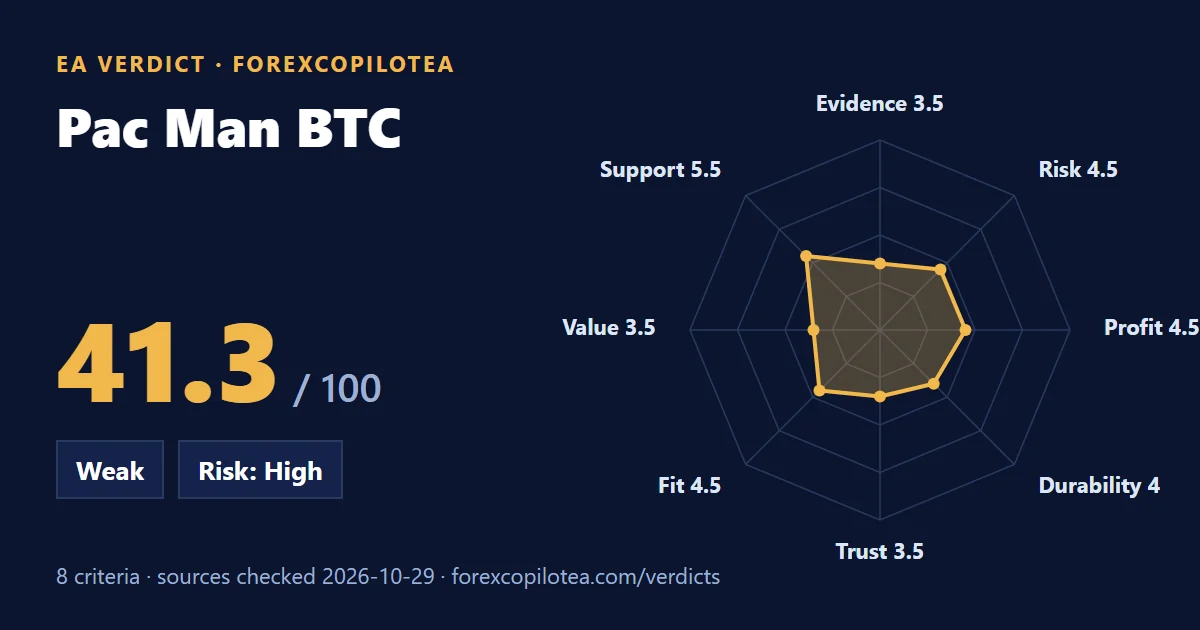
Pac Man BTC is a Bitcoin Expert Advisor for MetaTrader 5 that runs two systems in one file, a Breakout system and a Runner system, on the BTCUSD H1 chart, with up to twelve internal confirmation signals and an optional multiplier that triples the lot on its strongest setups. It costs 499 USD on the MQL5 Market, or 299 USD a month to rent, and it was published on 2 October 2026, so everything about it is new. This Pac Man BTC EA review read the listing, all nine reviews, all four comments and the one live signal the listing links, and scored the product on the same eight criteria as every verdict here. The result is 41.3 out of 100, in the Weak band, with a High risk label: a real, actively supported product whose only public record is 17 days long, run by the author on a broker he recommends with an affiliate link.
Key takeaways
- Pac Man BTC scores 41.3 out of 100 (band: Weak) with a High risk label. The design is plausible and the author is responsive, but the track record is 17 days, the entry logic is closed and the evidence score is capped well below the middle of the scale.
- The only live record is MQL5 signal 2395235, started on 12 October 2026: 113 trades, 80.53% winners, a profit factor of 1.98, an expected payoff of 3.82 EUR per trade, a balance drawdown of 15.27% and growth of 43.20% on a 1,000 EUR start. The platform itself says the results of a newly opened account may be of a random nature.
- The average winner is 9.57 EUR and the average loser is 19.96 EUR, so the loss is about 2.1 times the win. With those sizes the system needs roughly 67.6% winners to break even; it has delivered 80.5%. The margin is real and also the first thing a worse broker would erase.
- The Market price is 499 USD (299 USD a month to rent) and the signal's own subscription is 999 per month with no subscribers, more than the 446.29 EUR the account has earned. A free demo is available and runs in the Strategy Tester.
- We sell a listing for Pac Man BTC at 26.99 USD for the compiled file, 59.99 USD for source code only, or 76.99 USD for both. It is version 1.5 against 1.6 on the Market. Read the disclosure below before comparing prices.
- 41.3 / 100
- weighted verdict score on eight published criteria
- PF 1.98, 17 days
- profit factor of the only live signal, over 113 trades from a 1,000 EUR start
- $499 or $299/mo
- Market price to buy or rent for a month on 29 Oct 2026, with a free demo
The verdict at a glance: a promising first three weeks and almost no history
Pac Man BTC earns points for being specific about what it is: a breakout product with a trend-following runner, a stated list of protections, a free demo and an author who answers every review. It loses points on time. A system that trades Bitcoin on a one-hour chart, holds each trade for about half an hour and has been public for 27 days has not yet met a quiet month, a violent weekend or a change in broker costs. The signal is a good start, a platform-built one, and it is also the vendor's own account with a notice that it may be random. The scorecard and radar show how the total was built.
41.3 / 100
Weighted verdict score
Weak
Verdict band
High
Risk label
| Criterion | Weight | Score | Best evidence | Points |
|---|---|---|---|---|
| Verified evidence | 20 | 3.5/10 | Grade A | 7.0 |
| Risk and drawdown behaviour | 20 | 4.5/10 | Grade A | 9.0 |
| Profitability quality | 15 | 4.5/10 | Grade A | 6.8 |
| Sustainability | 15 | 4/10 | Grade B | 6.0 |
| Transparency and trust | 10 | 3.5/10 | Grade B | 3.5 |
| Practical fit | 10 | 4.5/10 | Grade B | 4.5 |
| Cost and value | 5 | 3.5/10 | Grade B | 1.8 |
| Support and usability | 5 | 5.5/10 | Grade B | 2.8 |
| Total | 100 | 41.3 |
What Pac Man BTC actually is
Pac Man BTC is an Expert Advisor for MetaTrader 5, sold on the MQL5 Market by Thomas Christoph Lipka of Germany, known on the platform as Thommy. His seller profile shows a rating of 4.3 from 43 votes, 6 products and 11 signals. The product was published on 2 October 2026, showed version 1.6 and was updated on 23 October 2026. The page shows 57 purchases per month, 898 downloads of the free demo and 12 activations, a figure the page does not define and which we read as the number of installs a licence allows. It trades BTCUSD only, from one H1 chart.
The description says the EA combines two different trading systems in one file, which can run separately or together. The Breakout system uses several internal strategies designed for different market conditions and places pending orders only when one of them identifies a valid setup, so the EA does not trade continuously; it waits. Each strategy has its own entry, stop loss, take profit, break-even and trailing settings. The Runner system is described as built to identify stronger moves and to follow ongoing price movement, using multi-timeframe analysis and up to twelve internal confirmation signals. The stronger the confirmation, the higher the setup's signal class.
That classification feeds the feature that matters most for risk. A Signal Strength Multiplier can scale the Runner's position by class: Standard at x1.00, Strong at x2.00 and Premium at x3.00. With a fixed lot of 0.01 the three classes trade 0.01, 0.02 and 0.03, and the same principle applies to the Risk Percent and Balance Based money-management modes. The multiplier can be turned off, which sets every class to x1.00. You choose between three modes: Breakout only, Runner only, or both, and each system has its own money management with Fixed Lot, Risk Percent or Balance Based sizing. The page recommends a minimum balance of USD 500 and, for smaller accounts or first tests, a conservative fixed lot.
The rest of the feature list is the usual set for a modern product: automatic entry and pending-order management, stop loss and take profit, break-even, dynamic trailing, spread-adaptive trading, a maximum-spread protection, weekend trading control and a real-time dashboard on the chart. The page states that the internal strategy settings are preconfigured and that, under normal conditions, the core parameters do not need to be changed. The setup is four steps: open BTCUSD on H1, enable Algo Trading, choose a mode and set a lot or risk. One chart only.
| Item | What the vendor says |
|---|---|
| Seller | Thomas Christoph Lipka, Germany. Seller rating 4.3 from 43 votes; 6 products, 11 signals. |
| Price | 499 USD to buy or 299 USD to rent for one month on 29 Oct 2026, with a free demo (898 downloads). The same prices appear on the German, Russian, Chinese and Japanese versions of the page. |
| Strategy | BTCUSD only. A Breakout system with several internal strategies that place pending orders only on a valid setup, and a Runner system with up to 12 confirmation signals and an optional x1, x2, x3 size multiplier. |
| Risk controls | Stop loss, take profit, break-even and dynamic trailing; spread-adaptive trading with a maximum-spread protection; weekend trading control. The page does not state stop sizes, a maximum drawdown or whether any averaging or grid is used. |
| Money management | Separate for each system: Fixed Lot, Risk Percent or Balance Based. Recommended minimum balance USD 500. |
| Requirements | MT5 desktop, BTCUSD on H1, one chart, Algo Trading on, an ECN account recommended by the author in a comment, a stable VPS recommended. |
| Track record | One live signal linked as 'Live Account 1', a backtest shown as a screenshot and a video. No backtest figures in the text. |
| Reach | 9 reviews, all five stars; 4 comments; 57 purchases per month. |
| Versions | 1.6, updated 23 Oct 2026. |
How we judged it, and who has something to sell
Evidence on EAs is never neutral. Here is every party near this product and what each stands to gain, ours included.
- The author sells the EA, rents it, sells subscriptions to the signal (999 per month, with no subscribers shown) and answers the reviews. In a public comment he recommends a broker as his first choice and attaches an affiliate link for it, and his own signal runs on that broker. That is a disclosed-by-the-link incentive, not a hidden one, and it means broker advice from him should be weighed.
- MQL5 and MetaQuotes host the Market, the reviews, the comments and the signals. The signal statistics and every notice on its page are the platform's own.
- Buyers who wrote reviews are, in the part of the page we could read, all five-star and all written between 7 and 21 October 2026. Several are existing customers of the same author. Testimony, not data, and none can be checked from outside.
- ForexCopilotEA sells a listing for this EA at a far lower price. We gain if you buy it, which is why this verdict opens with that fact and applies the same rules as every other.
Evidence ladder: what each rung of proof held for Pac Man BTC
Grade A: Independent proof
- MQL5 signal 2395235, 'Pac Man BTC Ultima Ultra High Risk': platform-built statistics for 113 trades over 17 days. The author runs the account, so his interest is noted; the figures are computed from broker history and the platform's notices are its own.
- MetaQuotes and Myfxbook documentation, used for how testing reports and verified records work.
Grade B: Checkable vendor material
- The Market listing: version, price, modes, the multiplier, money-management options, requirements and the author's replies.
- The free demo, which runs in the Strategy Tester only, and the author's public comments on broker choice.
Grade C: Claim only
- 'Up to twelve internal confirmation signals', 'several internal strategies' and 'preconfigured settings': described, and not open to inspection because the logic is closed.
- The backtest on the page: a screenshot and a video with no figures in the text and no stated period or data quality.
- Reviewer statistics pasted into a review: 16 trades, a profit of 707.91 USD and a drawdown of 1,279.85 USD, which no one can check.
Grade D: Conflicted, anonymous or unverifiable
- Five-star reviews posted within two weeks of launch, answered by the author within hours, some by existing customers. They may be genuine; they are not independent proof.
- A review the author says called the product a scam, which is no longer visible: known only through the author's reply and not scored.
- 'The Bitcoin killer' and 'Best Expert Advisor (EA)': sales-style praise.
Pac Man BTC live results: what the signal shows, number by number
The listing links one live record under the label 'Live Account 1', which implies there may be others; only this one is linked. It is the best public evidence available, and it is a platform-computed signal, so it counts as grade A. It also has hard limits. The account is the author's, it runs on the broker he recommends, it started on 12 October 2026 although the product was published on 2 October (the first ten days are not shown) and the platform carries the notice 'This is a newly opened account, and the trading results may be of random nature'. Here is what the page showed on 29 October 2026.
| Statistic | Value |
|---|---|
| Started, age | 12 Oct 2026, 3 weeks (17 days at our visit); 18 trading days |
| Broker, leverage, currency | UltimaMarkets-Live 1, 1:500, EUR; BTCUSD+ only |
| Initial deposit, deposits, withdrawals | 1,000.00 EUR, 0.00, 0.00 |
| Growth, profit, balance, equity | +43.20%, 446.29 EUR, 1,446.29 EUR, 1,446.29 EUR |
| Trades, win rate | 113 trades, 80.53% (91 wins, 22 losses) |
| Long, short | 46 (40.71%), 67 (59.29%) |
| Profit factor, expected payoff | 1.98, 3.82 EUR per trade |
| Average win, average loss | 9.57 EUR, minus 19.96 EUR |
| Best, worst trade | 57.01 EUR, minus 106.60 EUR |
| Gross profit, gross loss | 871.02 EUR, minus 439.04 EUR |
| Longest winning, losing run | 16 wins (163.25 EUR), 3 losses (minus 218.18 EUR) |
| Maximal drawdown by balance | 218.18 EUR, 15.27% |
| Relative drawdown by equity | 12.35% (176.47 EUR) |
| Recovery factor, Sharpe ratio | 1.98, 0.20 |
| Trades per week, average hold | 40, 32 minutes |
| Trading activity, maximum deposit load | 9.21%, 13.07% |
| Subscription | 999 per month (the page title says EUR, the button says USD), 0 subscribers, 0 funds, 0 reviews |
Read the numbers together. A win rate of 80.53% sounds like a system that is nearly always right, but the average loser is 19.96 EUR against an average winner of 9.57 EUR, a ratio of about 2.1 to 1. Multiply it out: 0.8053 times 9.57 minus 0.1947 times 19.96 gives 3.82 EUR a trade, which is the platform's figure. The break-even win rate at those sizes is 19.96 divided by 29.53, or 67.6%. The system has to win about two trades in three just to stand still, and it has won four in five so far. The cushion is 12.9 percentage points, and it was measured over 113 trades. A run of 22 losses in the sample, not the 91 wins, is what defines the shape of the risk.
The strings of results matter too. The longest winning run was 16 trades worth 163.25 EUR and the longest losing run was 3 trades worth minus 218.18 EUR. The maximal balance drawdown is also 218.18 EUR, so the entire drawdown so far was that one run of three losses. That is how a high win rate with large losers behaves: long quiet gains, then a short sharp loss that gives back more than a dozen wins. The worst single trade, minus 106.60 EUR, is about 10.7% of the starting deposit, and the page's maximum deposit load of 13.07% tells you that at times about a seventh of the account was committed to margin.
Two details do not add up and are worth stating. The gross profit and gross loss on the page net to 431.98 EUR, while the headline profit is 446.29 EUR; the page does not explain the 14.31 EUR difference, which may be swaps, commissions or rounding. And the Sharpe ratio is only 0.20, which for a record with 80% winners suggests the equity line is uneven when measured against its volatility. With 113 trades the Sharpe ratio is not statistically meaningful, but it is a reason not to read the 43% growth figure as a monthly run rate. MQL5 labels 43.20% as monthly growth only because the account is under one month old.
- Relative, by balance15.3%
218.18 EUR
- Relative, by equity12.4%
176.47 EUR
- Worst single trade, as share of start10.7%
106.60 EUR on 1,000 EUR
How a breakout and runner system makes and loses money on Bitcoin
A breakout system waits for price to leave a range and places a pending order beyond the edge, betting that the move continues. It wins when a real break follows through and loses when the break fails and price returns to the range. Bitcoin suits the idea because it trades around the clock, moves in bursts and is full of ranges that end suddenly. It punishes the idea for the same reasons: false breaks are common, spreads widen in bursts and weekend liquidity is thin. A reviewer who has run Pac Man BTC for a week described it the same way: it places breakout orders at key levels, and 'if the breakout isn't valid, it basically exits at break-even'.
That description fits the numbers. A system that exits failed breakouts at or near break-even, takes many small gains with a fast trailing stop and occasionally takes a full stop loss will show a high win rate, small winners and larger occasional losers. The signal's average hold of 32 minutes confirms the trailing approach. It trades 40 times a week, 59% of them on the short side, so the early weeks of the record may also reflect a market that was falling at times; with 113 trades we cannot separate the system from the regime.
The Runner adds a second logic. It looks for stronger moves across timeframes and, when its internal confirmation count is high, it can scale the position. In plain terms it adds size when it is most confident. That is not a martingale: it does not add after a loss and it does not average a losing position. It is still a confidence-based sizing rule, and confidence in a closed algorithm is not something a buyer can audit. One reviewer who uses almost all of the author's products reports that the multiplier's losses 'quickly eat up' the profits and that he turned it off and runs fixed lots on the Runner. The author's reply says the multiplier is optional. That is the single most useful piece of user testimony on the page, because it is a criticism, it is specific and the author did not dispute it.
Interactive: win rate is not edge
- Expected result per trade
- +0.35
- Profit factor
- 1.64
- Break-even win rate
- 33%
At these numbers the system has a positive edge before costs. Add spread, commission and slippage per trade and re-check.
The backtest claim: a screenshot, a video and no numbers
The Market page shows the backtest as a single image and a YouTube video. The page text contains no profit factor, no drawdown, no trade count, no test period and no statement of the data quality used. It does say, honestly, that the Strategy Tester results on the page are historical backtests and may differ from live trading. We cannot score a backtest we cannot read, so the product's evidence rests on the signal alone. If you want your own backtest, the free demo runs in the Strategy Tester, and our guide on how to read an MT5 backtest report explains which lines to check first: the quality of the history, the number of trades, the drawdown and the largest loss.
Two reviewers raise the backtest themselves. One, who had used the EA for a week, called drawdown control excellent and the backtest 'perfect', then added: 'with BTC, especially scalper-type EAs, you can't fully trust the backtest'. The author replied that he agrees backtests on Bitcoin can mislead. Another, after a full week, said results 'aren't that far from what you'd see on the backtesting'. Both are one-week impressions. Bitcoin backtests are hard to trust for specific reasons: the history of tick data differs by broker, spreads and commissions on the exact minutes of a fast breakout are rarely modelled, and a trailing stop that follows price in seconds depends on tick order that a tester only approximates. For the general case, see our guide on backtest versus live results.
Pac Man BTC risk and drawdown: why we label it High
A stop loss is described for every strategy, the worst trade so far was 106.60 EUR and the account never lost more than 15.27% from a balance peak. Those facts argue against an Extreme label. We still land on High because the sample is 17 days, the design has features that can enlarge a loss in one move and several risks cannot be measured from public data. A High label means the design can take large losses in a single adverse move; it is not an accusation.
- The multiplier. On a Premium signal the Runner trades three times the base size. If a setup rated as the most confident fails, the loss is three times the standard loss. At the signal's average loss of 19.96 EUR that would be about 60 EUR; the worst trade so far was 106.60 EUR. The page does not say which trades were multiplied.
- Unpublished stops. The page never states a stop size in points or as a share of the account, so you cannot compute a worst case from the listing. You can only read it from the record, which is short.
- Weekend and gap risk. The listing advertises weekend trading control, and a reviewer notes the EA trades on weekends. Bitcoin can gap on thin weekend liquidity, and a stop is a request, not a guarantee of the exit price.
- Cost sensitivity. An expected payoff of 3.82 EUR on an average win of 9.57 EUR means a few euros of extra spread or commission per trade would remove most of the edge.
- Regime dependence. 59% of the signal's trades were short. In a one-way market a breakout-and-trail system does well; in a choppy range it is exposed to repeated small stop-outs. The record has not been tested by a long range.
- Size against balance. A reviewer who pasted statistics shows 16 trades with a 1,279.85 USD maximum drawdown and an average lot of about 1.16, which tells you that some users run it at sizes where one or two losses cost hundreds or more than a thousand dollars.
The pasted statistics are worth a closer look because they come from a different account at a different size. The reviewer reports 14 wins and 2 losses, a gross profit of 1,987.76 USD, a gross loss of 1,279.85 USD, a best trade of 643.92 USD and a worst of minus 675.16 USD. The winners average 141.98 USD and the two losers average 639.93 USD, a ratio of 4.5 to 1. The break-even win rate at those sizes is 81.8%; the reviewer's win rate is 87.5%. The shape is the same as the signal's: a high win rate carrying much larger losses, and a worst loss larger than the best win. The numbers are a reviewer's screenshot, grade C, and we use them only to show that the pattern is not unique to one account.
Interactive: drawdown recovery
Gain needed to get back to break-even
+42.9%
Blue: equity left. Red: equity lost.
Consecutive losing trades to reach this drawdown: 36
Broker, commissions and the FTMO dispute
Two of the author's public comments are about brokers, and both are useful. On 19 October 2026 he wrote that the product should be run on an ECN account, named Ultima Markets as his first choice, listed VT Markets, Vantage Markets and PU Prime as alternatives, attached an affiliate link for Ultima Markets and added: 'use an ECN account and stick with the recommended default EA settings'. The advice is sound as a statement about costs, since a trade that lasts half an hour cannot carry a wide spread. It also comes from someone who is paid when you open the account, and whose signal runs there. You are free to use another broker; just compare its raw spread and commission with those of the signal's broker.
The second comment is a dispute. On 15 October 2026 the author wrote that a buyer named Stefano Trimarchi had posted a review labelling the product 'SCAM'. According to the author, that buyer later explained that FTMO's BTCUSD commissions were much higher than he expected ('my bad i didnt check before'), asked if the EA could trade another instrument and asked for a refund. The author published screenshots of the conversation. That review is not visible on the product page today: all nine listed reviews are five stars, and the page's structured data counts six ratings. We cannot see the review, so we cannot say what it claimed, and we do not treat it as a finding. We report it as an allegation made by a buyer, known only through the author's reply, which is the author's side of it. The right reading is limited: a prop-firm account with high commissions will change this system's results, which is consistent with the cost sensitivity visible in the signal.
Two things follow. First, the public display of a private conversation, with the buyer named, is a way of answering criticism that some readers will find fair and others heavy-handed. We note it and do not score it as misconduct. Second, if you plan to use a prop-firm account, check the firm's BTCUSD commission before you pay for anything. The product page itself says live results may differ between brokers, and lists spread, slippage, liquidity, execution speed and account type as factors.
Pac Man BTC reviews: what buyers say
The listing shows a five-star rating with nine reviews, written between 7 and 21 October 2026, all five stars, and the page's structured data lists six ratings. Four of the nine carry no text. The text we could read is short: one reviewer says it is hard to find an excellent Bitcoin EA and that after a week 'it feels outstanding', trading very frequently and even on weekends; another calls it the 'Bitcoin killer' with clear stops, targets and fast trailing; a third calls it a two-in-one strategy that is 'very good and stable'; a fourth says it is the 'Best Expert Advisor'. The author replied to every review within hours, in several cases thanking the reviewer and mentioning his Telegram community, and in one case saying that the product 'has already paid for itself after just one day'.
We weigh these reviews as testimony and discount them for three reasons. They come from a 15-day window after launch, so none describes a drawdown or a bad month. At least some come from buyers of the author's other products, one of whom says he uses almost all of them. And the replies are promotional in tone, which is the author's right, and which makes the thread read like a sales page. The two valuable reviews are the ones that disagree with the mood: the warning about the multiplier and the note that backtests on Bitcoin cannot be fully trusted. A third comment, from a user who is 'very satisfied so far', received a one-line reply about the user's profit factor, in a screenshot we could not read.
The seller's overall rating is 4.3 from 43 votes across all products, against 5.0 on this product. That gap is normal for a new product with few reviews and says nothing about quality either way. Read the reviews again in six months.
Pac Man BTC price: 499 dollars from the author, 26.99 from us
The Market price on 29 October 2026 is 499 USD to buy, or 299 USD to rent for one month; a purchase costs about 1.7 months of rent. A free demo is available, and the German, Russian, Chinese and Japanese versions of the page show the same prices. Set the price against the evidence: the only live account has earned 446.29 EUR in 17 days from a 1,000 EUR start, and its own subscription costs 999 per month. If a copier paid that subscription for a month, the whole profit of the signal to date would not cover it. We do not suggest anyone should subscribe; the price shows how the author values the signal and how little the 0 subscribers agree.
Our listing is priced at 26.99 USD for the compiled file, which is about 5.4% of the Market price, 59.99 USD for source code only and 76.99 USD for both. It is a one-time payment with all sales final and no refund. The difference is not a discount on the same product. Our listing is version 1.5, one version behind the Market's 1.6; it ships the EA file without a setfile or manual; it comes without the author's support or Telegram community; and the origin of the file is the open question we describe in the disclosure. The compiled file we ship may not match version 1.6's behaviour, so the signal's results may not describe it. Before you weigh the price gap, ask us for the provenance of the file through the contact page. If the answer does not satisfy you, the Market, with its free demo, is the safer route.
Remember the other costs: a VPS (Windows is recommended), an ECN account at a broker with competitive Bitcoin spreads and commissions, and enough capital to survive the drawdown. The page recommends at least USD 500. A 15% drawdown in three weeks on 500 USD is 75 USD; in the signal's terms it took three losing trades. Whether that is acceptable is your decision, and trading leveraged products can lose more than you can afford.
Is Pac Man BTC legit?
It is a real product from an identifiable seller with a public profile, six products, eleven signals and a rating of 4.3, sold on the MQL5 Market, which tests every submission before listing. It has a free demo, a live signal, a responsive author and a described method. We found no evidence of fabricated results: the signal statistics are computed by the platform from the broker's history. We do not allege wrongdoing.
The honest answer to 'is it legit' is therefore yes, with a qualifier that is about time and not about intent. Legit does not mean proven. A product 27 days old with a 17-day record, a closed method and a fast-moving review thread has shown only that it works for three weeks on its author's account. The disputed review, the affiliate link and the high-priced signal subscription are things to be aware of, and none is evidence of dishonesty on its own. The right posture is to test on a demo, then trade at a very small size, and let the record grow before trusting it.
The score, criterion by criterion: 41.3 out of 100
| Criterion | Score | Points | Why |
|---|---|---|---|
| Verified evidence (weight 20) | 3.5 / 10 | 7.0 | One platform-built MQL5 signal, but only 17 days and 113 trades old, vendor-run on the vendor's promoted broker, with the first ten days since launch missing and a platform notice that the results may be random; no tester numbers in text and no third-party record. |
| Risk and drawdown behaviour (weight 20) | 4.5 / 10 | 9.0 | Stops, break-even and trailing are described and the worst trade was 106.60 EUR on 1,000 EUR; but the stop sizes are not published, a Runner multiplier can triple size, the signal's balance drawdown was 15.27% in three weeks and the logic is closed. |
| Profitability quality (weight 15) | 4.5 / 10 | 6.8 | A verified profit factor of 1.98 and a positive expected payoff of 3.82 EUR per trade; but only 113 trades in 17 days, an average loss twice the average win, a Sharpe ratio of 0.20 and no spread across months. |
| Sustainability (weight 15) | 4 / 10 | 6.0 | A seller with 6 products and 11 signals and a fast update (1.6 within 21 days); but closed logic, a record that covers one BTC regime for under three weeks and a style the reviewers themselves say backtests overstate. |
| Transparency and trust (weight 10) | 3.5 / 10 | 3.5 | A free demo and replies to every review; against that, unpublished entry logic, a disputed review the author answered with screenshots of a private conversation, an affiliate link for the broker his signal runs on, and promotional replies to five-star reviews. |
| Practical fit (weight 10) | 4.5 / 10 | 4.5 | BTCUSD on H1 only, one chart, an ECN account needed because commissions and spread matter to a trade that lasts 32 minutes, a USD 500 stated minimum against a 15% drawdown in three weeks, and a VPS; weekends are traded. |
| Cost and value (weight 5) | 3.5 / 10 | 1.8 | 499 USD to buy or 299 USD a month to rent, with a free demo, against a signal whose whole profit so far is 446 EUR and whose own subscription costs 999 a month; the demo is the mitigation. |
| Support and usability (weight 5) | 5.5 / 10 | 2.8 | A free demo, a quick-start section, preconfigured settings, an active author who answers reviews and a community channel; but no manual or setfile is described on the page and the one critical review is no longer visible. |
The total is 41.3 out of 100. The grade A on evidence is earned by a platform-built signal; the score stays at 3.5 because the record is 17 days long, the author runs it on his promoted broker, the first ten days since launch are not shown and the platform warns that the results may be random. Under the written anchors, a verified record of under 12 months sits at 5 to 6.5 only if it is otherwise clean; a window this short, with a missing start, belongs lower. Risk and profitability sit at 4.5: the numbers are better than the anchors for an unverified claim, and the sample is too small for more. Trust, at 3.5, reflects closed logic, a disputed review and an incentive attached to the broker advice. Cost, at 3.5, is a premium price with only a demo and a rental as mitigation.
Who Pac Man BTC fits, and who it does not
- It fits a trader who wants a rule-based Bitcoin breakout tool, has an ECN account with low BTCUSD costs, can run a VPS, will start on a demo with the multiplier off and will judge it over months, not days.
- It does not fit a trader on a prop-firm account with high BTCUSD commissions, one who needs steady monthly returns now, or one who cannot sit through a 15% balance drawdown within a few weeks.
- It is a poor choice for a buyer whose main reason is that nine reviews say five stars. They are real posts from a two-week window, and they are not a record.
- It is a risky choice for anyone buying our listing mainly for the low price without asking about the file's provenance, the version and the absence of author support.
How it compares with other EAs we have scored
Next to Pulse Engine, which spreads 70 time-of-day patterns over six markets and shows 36 weeks of signal history, Pac Man BTC is concentrated in one volatile asset and a fraction as old, with a higher profit factor and a much shorter record. Next to MoonDog, another breakout EA with a short record, it shares the pattern of a high win rate on small gains; MoonDog publishes its stop and target sizes and Pac Man BTC does not. Its 41.3 reflects a plausible design and an immature record. For how these system types differ, see our strategy comparison and our scalper EAs.
Questions to put to the author before you pay
- Which version and settings does the signal run, and what happened between the 2 October launch and the 12 October start of the signal?
- What are the stop loss sizes of the Breakout strategies and of the Runner, as points or a share of the account?
- How often does a Premium signal occur, and what were the results of the x2 and x3 trades on their own?
- Can you publish a tester report with the period, the data quality, the spread model and the commission used?
- What is the largest drawdown in the backtest, and how long did recovery take?
- Why is the signal subscription 999 per month, in which currency, and what does the price include?
- Is a manual or a setfile available before purchase, and what happened to the review you replied to on 15 October?
Sources and when they were opened
- MQL5 Market: Pac Man BTC (product 198495), opened 29 October 2026Source of the price, version, modes, the multiplier, money-management options, requirements, the nine reviews and the author's replies. Written by the vendor and by buyers.
- MQL5 Market: Pac Man BTC comments, opened 29 October 2026Source of the author's comments on a disputed review, his broker recommendation with an affiliate link and one buyer's comment.
- MQL5 Signals: Pac Man BTC Ultima Ultra High Risk (signal 2395235), opened 29 October 2026Source of every performance figure, notice and drawdown in this verdict. The author operates the account.
- ForexCopilotEA store listing: Pac Man BTC v1.5, opened 29 October 2026Source of our own version, price, editions and what the download includes. We sell this listing.
- Myfxbook Help: VerificationHow a trading account's track record is verified on Myfxbook.
- MetaTrader 5 Help: Testing ReportWhat each figure in the tester's report means, including drawdown.
- MetaTrader 5 Help: Strategy TestingThe Strategy Tester: testing modes, settings and forward testing.
- ESMA: ESMA agrees to prohibit binary options and restrict CFDs to protect retail investorsThe EU leverage limits, margin close-out, negative balance protection and risk-warning rules for retail CFD accounts.
- CFTC Customer Advisory: AI Won't Turn Trading Bots into Money MachinesA US regulator's warning about trading-bot claims of unusually high returns.
Frequently asked questions
Is Pac Man BTC EA legit?
It is a real product from an identifiable MQL5 seller, with a free demo, a live signal of 113 trades and a described method, and we found no evidence of fabricated results. We do not allege wrongdoing. It is also only 27 days old with a 17-day record, which is why it scores 41.3 out of 100 with a High risk label.
How much does Pac Man BTC cost?
The MQL5 Market price on 29 October 2026 is 499 USD to buy or 299 USD to rent for a month, with a free demo. ForexCopilotEA sells a separate listing at 26.99 USD for the compiled file, 59.99 USD for source code only or 76.99 USD for both, in version 1.5 against 1.6 on the Market and without the author's support. A VPS and an ECN account are extra.
What drawdown does Pac Man BTC have?
On the author's only live signal the maximal drawdown by balance was 15.27% (218.18 EUR) and by equity 12.35%, after just 17 days, and it came from one run of three losing trades. The page states no expected drawdown. A short record cannot show the worst case.
Does Pac Man BTC use martingale or a grid?
The listing does not say either way. It describes stop loss, take profit, break-even and trailing, and a Runner size multiplier of x1, x2 or x3 by signal strength, which raises size on confident setups and not after losses. The logic is closed and we cannot read it, so we do not rate it as a grid or martingale, and we cannot rule one out.
What is the Pac Man BTC Signal Strength Multiplier?
An optional setting on the Runner system. Setups are ranked Standard, Strong or Premium by up to twelve internal confirmation signals and traded at x1, x2 or x3 of the base size. It can be turned off. One reviewer reports that its losses ate his profits and that he runs fixed lots instead.
Which broker and account should I use for Pac Man BTC?
The author advises an ECN account and recommends Ultima Markets first, with an affiliate link, then VT Markets, Vantage Markets and PU Prime. Because a trade lasts about 32 minutes, compare spread and commission on BTCUSD yourself, especially on prop-firm accounts, where one dispute arose over commissions. Use H1 on a single BTCUSD chart.
How was the score calculated?
Eight weighted criteria (evidence 20, risk 20, profitability 15, sustainability 15, trust 10, fit 10, cost 5, support 5), each scored out of ten against written anchors. Sources are graded A to D and unverified claims cannot count as proof. We sell a listing for this EA, which is disclosed at the top. The total here is 41.3 out of 100.
Gold Expert Advisors in our store
We sell these, so weigh that interest. Put the same eight questions to any of them before you buy: read the manual, run your own backtest, and start on demo.



Keep reading
- EA VerdictPulse Engine EA Review: Verdict and Risk (2026)Is Pulse Engine worth $599? Independent EA verdict: 52.8/100, Medium risk. A 36-week MQL5 signal, 2,271 trades and a 1.06 profit factor scored, checked 29 Oct 2026.
- EA Verdict #13MoonDog EA Review: Verdict and Risk (2026)Is MoonDog EA worth $299? Independent EA verdict: 51.5/100, Medium risk. Five breakout modules, ONNX filters and two live MQL5 signals scored, 28 Oct 2026.
- BacktestingWhy EA Live Results Differ From Backtests (and What to Do)Why EA live results differ from backtests: spread, slippage, delay, data, overfitting and more. Eleven causes, how to check each and how to close the gap.
- Risk managementEA in Drawdown: What to Do (and What Not to Do)What to do when your Expert Advisor is in drawdown: separate normal from broken, check the logs, compare with the backtest, and decide to hold, reduce or stop.