
EA Verdict #11
Perceptrader AI EA Review (2026): What a 'Neural Network Grid' Is, and What Its Own Signals Show
By Benjamin Lee · Updated · 22 min read
Perceptrader AI is a $2,800 grid Expert Advisor for six currency pairs that adds an artificial-neural-network filter to a grid. Its listing talks about deep learning, perceptrons and optional ChatGPT and Gemini forecasts, and claims 80 consecutive months in profit. Its seller, who also makes Waka Waka, publishes several live MQL5 signals for the product, which is more than most AI-branded EAs offer, and the numbers on them do not all agree with each other. We read the listing, the reviews and the developer's reply, opened the main signals and scored Perceptrader AI on the same eight criteria as every verdict here. The result is 44.0 out of 100 and a High risk label: a real, long-running grid with an AI filter whose benefit the record does not isolate, at a price that assumes it does.
Key takeaways
- Perceptrader AI scores 44.0 out of 100 (band: Weak) with a High risk label. A grid with lot multipliers cannot be rated better than High; the signals give it a mid-tier evidence score, not a high one.
- The vendor's main PAI signal (MQL5 signal 1919885, MT4, IC Markets) shows +347% over 6,755 trades, a 65.6% win rate, a profit factor of 1.51, and an average win of 9.55 USD against an average loss of 12.12 USD. Its drawdown is 17% to 18%. The platform forecasts about 0.55% a month.
- The same vendor's other AI-filter signals look very different: 'PAI Unique Mode 5 Pairs' shows a 73% drawdown, and 'PAI Standard Mode 5 Pairs' shows a profit factor of 33.25 and a best trade of 56,646 USD on a 1,612 USD balance, which cannot be right. We do not use those numbers, and we say why.
- The 'AI' is, per the listing, a perceptron-based minimum-profit-probability filter on top of a grid. The ChatGPT and Gemini filters are described as live-only, which means they cannot be backtested, and the record does not show whether they are on.
- We sell a listing for Perceptrader AI, and it shows the same version, 2.43, as the Market. Treat it as a separate purchase with its own price and terms.
- 44.0 / 100
- weighted verdict score on eight published criteria
- 1.51
- profit factor of the vendor's main PAI signal over 6,755 trades, with an average loss larger than the average win
- $2,800
- Market price on 21 Oct 2026, purchase only, last updated 8 Feb 2026
The verdict at a glance: a grid with an AI label, and signals that do not isolate the AI
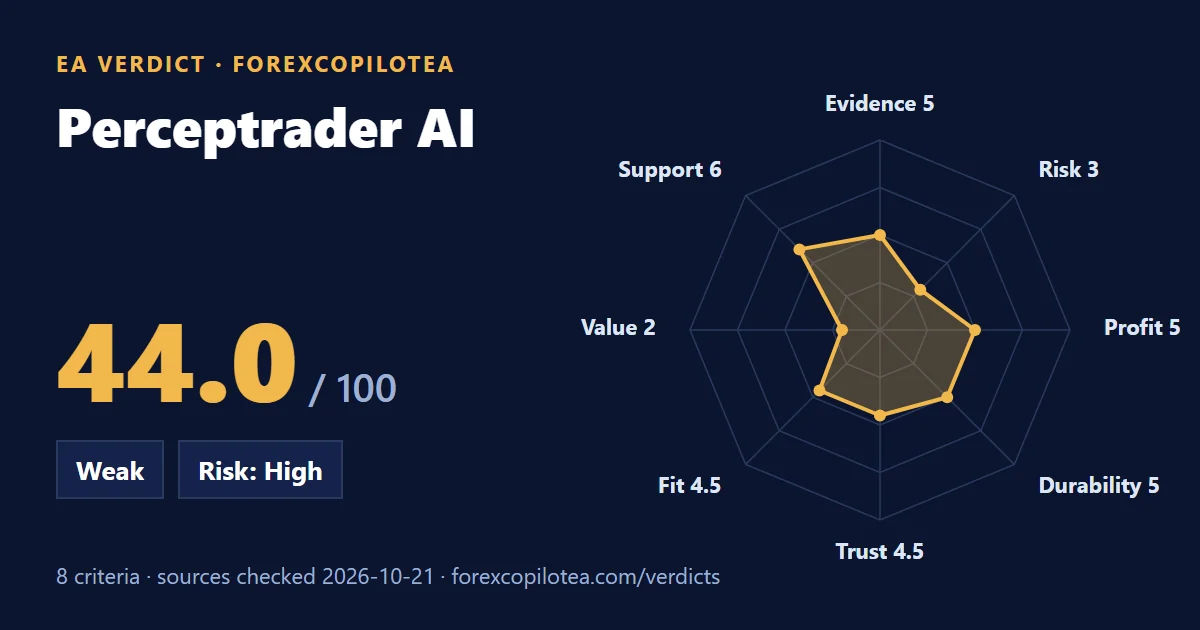
Perceptrader AI earns points for showing live accounts and for a documented, configurable design. It loses them on the central question for a product with 'AI' in its name: does the AI do anything the grid underneath would not? The signals do not answer that, the risk controls are those of a grid, and the price is the highest on the Market. The scorecard and radar show how the total was built.
44.0 / 100
Weighted verdict score
Weak
Verdict band
High
Risk label
| Criterion | Weight | Score | Best evidence | Points |
|---|---|---|---|---|
| Verified evidence | 20 | 5/10 | Grade A | 10.0 |
| Risk and drawdown behaviour | 20 | 3/10 | Grade A | 6.0 |
| Profitability quality | 15 | 5/10 | Grade A | 7.5 |
| Sustainability | 15 | 5/10 | Grade B | 7.5 |
| Transparency and trust | 10 | 4.5/10 | Grade B | 4.5 |
| Practical fit | 10 | 4.5/10 | Grade B | 4.5 |
| Cost and value | 5 | 2/10 | Grade B | 1.0 |
| Support and usability | 5 | 6/10 | Grade B | 3.0 |
| Total | 100 | 44.0 |
What Perceptrader AI actually is
Perceptrader AI MT5 is an Expert Advisor for MetaTrader 5, sold on the MQL5 Market by Valeriia Mishchenko of Russia, whose seller profile shows a 4.2 rating from 277 votes, 14 products and 11 signals. It was published on 24 July 2023, showed version 2.43 and was last updated on 8 February 2026. It trades NZDUSD, USDCAD, AUDNZD, AUDCAD, NZDCAD and GBPCHF from one M5 chart. The listing calls it a grid system 'using deep learning and artificial neural networks'.
Read closely, the design has three layers. The foundation is a grid, with a configurable distance, a 'smart distance' that adapts to volatility, custom lot multipliers, a weighted take profit, break-even after a chosen grid level and a trailing stop. The second layer is a set of trend, momentum and volatility filters 'based on deep learning'. The third is a 'Perceptron-based minimum profit probability' setting: the EA estimates the probability that a trade will profit and skips it below a threshold. There are two trading modes, 'Standard' and 'Unique', and optional forecast filters that call ChatGPT and Gemini, which the listing says work 'in live trading only'.
| Item | What the vendor says |
|---|---|
| Seller | Valeriia Mishchenko, Russia. Seller rating 4.2 from 277 votes; 14 products, 11 signals. |
| Price | $2,800, purchase only, with a free demo. 10 activations. No rental option. |
| Strategy | Six pairs on M5 from one chart. A grid with smart distance and multipliers, filtered by deep-learning trend, momentum and volatility models and a perceptron profit-probability threshold; standard and unique trade modes. |
| Risk controls | Maximum floating drawdown (percent or money) with close-and-pause actions; daily drawdown limits with a reset hour; minimum free margin; maximum lots, spread and symbols; a news and bank-holiday filter; a stock-market-crash filter; default 500-pip stop if left at zero. |
| Requirements | Hedging account, a VPS, three external websites for the news and time data, backtests with Tick Data Suite. At 1:30 leverage low-risk settings only below $6,000; at 1:100 up to significant risk on $1,000. |
| Track record | '80 consecutive months in profit with low drawdown', linked to signal 1919885. |
| Reach | 6,929 free demo downloads, rating 4.67 from 7 reviews, 30 comments. |
| Versions | 2.43, published 24 Jul 2023, last updated 8 Feb 2026. |
How we judged it, and who has something to sell
Evidence on EAs is never neutral. Here is every party near this product and what each stands to gain, ours included.
- The developer sells the EA, sells signal subscriptions (999 USD a month each) and runs the live accounts. Her records are public, which counts for something, and they are also her sales page.
- MQL5 and MetaQuotes host the Market, the reviews and the signals. The statistics and warnings on each signal are computed by the platform.
- Buyers who wrote reviews are few: seven reviews in three years. Testimony, not data, and each is unverifiable from outside.
- Reseller and affiliate sites sell or review the product with figures that conflict with each other. We use none of them as evidence.
- ForexCopilotEA sells a listing for this EA. We gain if you buy it, which is why this verdict opens with that fact and applies the same rules as every other.
Evidence ladder: what each rung of proof held for Perceptrader AI
Grade A: Independent proof
- MQL5 signal 1919885, 'PAI Unique Mode No Limits with AI Filter' (MT4, ICEMarkets-Server): platform-built statistics for 6,755 trades. The vendor runs the account, so her interest is noted.
- MQL5 signal 2020263, 'PAI Standard Mode 5 Pairs with AI Filter', whose statistics are internally inconsistent and are used only as a caution, not as evidence.
- MetaQuotes and Myfxbook documentation, used for how testing reports and verified records work.
Grade B: Checkable vendor material
- The Market listing: version, price, inputs, requirements, dated reviews and a developer reply.
- The free demo, which runs in the Strategy Tester only, an installation video and a setup guide archive.
Grade C: Claim only
- '80 consecutive months in profit with low drawdown': a headline for a product listed in July 2023 that must include history before the product existed.
- 'Stable safe grid', 'solid track record' and 'AI filter works well': reviewer opinions without a record.
Grade D: Conflicted or anonymous
- Affiliate and reseller reviews that disagree about whether the EA is a grid, what chart it runs on and what it costs. Nothing on them is used as proof.
The vendor's PAI signals: what they show, and what they cannot
The main signal is 'PAI Unique Mode No Limits with AI Filter' (signal 1919885): an MT4 account at IC Markets with 1:300 leverage, 5,000 USD initial deposit, 8,000 USD withdrawn and no deposits. It showed a balance and equity of 11,216.13 USD and growth of 347.44% on 21 October. The platform lists its start as 8 April 2023 and its length as 377 weeks, which would be about seven years; the author's label reads 'growth since 2019'. The week count, the start date and the label cannot all describe the same history, so we treat the record as covering the product's logic, not as 377 weeks of this exact version.
| Measure | Value | What it means |
|---|---|---|
| Age | 377 weeks listed; start date 8 Apr 2023 | The two do not match. The week count and 'since 2019' suggest earlier history is counted. |
| Trades | 6,755 (4,434 winners, 2,321 losers) | A large sample, about 15 a week, average hold about 19 hours. |
| Win rate | 65.64% | Typical for a grid with a filter. |
| Average win / loss | +9.55 USD / -12.12 USD | Payoff ratio of 0.79. |
| Profit factor | 1.51 (1.50 in the summary) | Gross profit 42,337.30 USD against gross loss 28,121.17 USD. |
| Expected payoff | +2.10 USD per trade | Positive, and small next to a worst trade of -264.93 USD. |
| Drawdown | 17.06% by balance, 17.94% by equity | Moderate and consistent across the two bases. |
| Deposit load | 21.16% maximum | Margin use is moderate at this setting. |
| Cash flow | 5,000 start, 8,000 withdrawn | Withdrawals exceed the start, so the account has returned its capital and more. |
| Monthly growth | 0.55% (forecast 6.64% a year) | The platform's own forecast is modest. |
| Platform warnings | 'No trading activity' spells; leverage changes | No drawdown warning on the page. |
- PAI Unique Mode No Limits (signal 1919885), by equity17.9%
- PAI Standard Mode 5 Pairs (signal 2020263), by equity32.4%
- PAI Unique Mode 5 Pairs (signal 2020261), maximum per seller list73%
When a signal's own numbers cannot all be right
The second signal, 'PAI Standard Mode 5 Pairs with AI Filter' (2020263), shows a balance of 1,611.67 USD from a 400 USD start, yet a growth figure of 0.61%. It shows a profit factor of 33.25, a best trade of 56,646.03 USD on that 1,612 USD balance and a recovery factor of 683. Its own page says 'Trading style has changed. Part of history is not included in statistics.' Those figures describe an account whose history is partly excluded and whose units cannot all be in the same currency. We cannot tell which numbers are right, so we do not use any of them as evidence of profitability, and we advise buyers to ignore a profit factor above 10 on any signal, here or elsewhere. A figure that good is a data problem before it is a strategy.
The seller's own list adds a third AI-filter signal, 'PAI Unique Mode 5 Pairs' (2020261), which shows +291% over 178 weeks with a 73% drawdown and 1,320 trades. A fourth, 'Waka Clone', shows 0% growth with a 90% drawdown, and a fifth, 'WakaSmart', shows a profit factor of 73.76 with 57% drawdown. They are different settings of related systems, not independent confirmations, and the spread of results (17% to 73% drawdown, profit factors from 1.5 to 275) is the honest picture of what 'Perceptrader AI' can look like depending on the mode and risk used.
A note on the figures. MQL5 pages are generated from the account, but one page can show the same measure two ways: the main signal prints both 1.51 and 1.50 for profit factor and gives two readings of its longest winning streak. We quote the main statistics block and name the basis, and where a page disagrees with itself we say so.
What 'AI' means here, and what it does not
The listing's AI claims fall into three groups. The first is a set of machine-learning filters, described as deep-learning models for trend, momentum and volatility, and a perceptron that estimates a minimum probability of profit. A perceptron is a very small neural network, and a threshold on its output is a legitimate filter. It reduces the number of trades; it does not change what a grid does when price keeps moving against it. The second is a note that the neural network 'has been retrained using the latest historical data', which means the model is periodically refit, a real maintenance burden and a risk, because refitting on recent history is how an over-fitted model is produced. The third is the optional ChatGPT and Gemini forecast filters, which work 'in live trading only'.
The honest test of an AI filter is a controlled comparison: the same grid, same pairs, same period, with the filter on and off, over a long window and out of sample. The signals names ('with AI Filter') imply the comparison exists somewhere. It is not on the listing, and the vendor's signals do not carry an 'off' twin. Without it, a buyer is paying $2,800 for a grid and trusting that the AI adds value. Our walk-forward guide and backtest versus live guide show how to test it yourself.
A grid with multipliers: what that means for risk
Underneath the filters, Perceptrader AI is a grid. If price moves against a first position by a set distance, the EA opens a second, then a third and more, each with a lot multiplier, and the basket closes at a weighted take profit. The listing's risk controls are the right ones for that structure: a maximum floating drawdown that closes everything and pauses trading, daily drawdown limits like a prop firm's, a minimum free margin and a cap on open lots. The default 500-pip stop, used only if the setting is left at zero, is wide, and the controls are only as good as the values you choose.
A filter that skips low-probability entries makes a bad first trade less likely. It cannot stop a good-looking first trade from going wrong, and the grid's exposure when that happens is the same with or without AI. That is why we cap the risk score by design family and why the 17% to 73% drawdown range matters more than any single signal. See our grid, martingale and scalper comparison.
What buyers say, and what reviews cannot tell you
The listing shows a rating of 4.67 from just seven reviews over three years, with 30 comments. Six are positive and short: one reports consistent profit for over a year and praises the number of adjustable parameters (April 2026), one calls it a 'stable safe grid' (February 2024), one cites a solid track record (January 2024), one says it works well, especially the AI filter, after two months (October 2023), and two are a bare rating and a vote of faith in the author from launch week. One review, in August 2023, calls support slow and the price poor value; the developer replied that she found no message from the buyer, that she usually answers within a day and gave a support address.
Seven reviews is a thin base, and the rating says little. The same seller's older product, Waka Waka MT5, has 44 reviews and a lower rating, with several detailed negative accounts of deep drawdowns; see our Waka Waka verdict. Perceptrader AI inherits the grid's character, and its small review count is a gap, not a clean bill.
The real price of Perceptrader AI
$2,800, purchase only, is the same price as the vendor's other EAs, from a decade-old grid to this AI version, and the listing was last updated in February 2026. That uniform price says the price is set by the seller's brand, not by the evidence for each product. The only mitigation is a free demo with 6,929 downloads that runs in the tester. Add a VPS and the capital a grid needs, which at the vendor's own guidance is thousands of dollars.
| Cost | Typical figure | Note |
|---|---|---|
| Licence | $2,800 listed | One-off, no rental. Ours is a separate sale at its own price. |
| VPS | $10 to $30 a month | Required: the EA must run continuously. See our VPS setup guide. |
| Capital | $1,000 at 1:100, $6,000+ at 1:30 | Per the vendor's own leverage guidance; a deep basket can need far more. |
| Data and tools | Tick Data Suite for testing | Recommended for backtests; a separate purchase. |
| Your time | 12 weeks of demo | The test plan below. |
Can your account actually run it?
The setup is demanding. It needs a hedging account, a VPS, six pairs from a single M5 chart, correct broker suffixes, and access to three external websites for news and time data. Backtests are to be run with Tick Data Suite using GMT+2 with US daylight saving. The leverage guidance is the key sentence: at 1:30, low-risk settings only on accounts under $6,000. See our ESMA guide, our hedging versus netting guide and how much money to run an EA.
On prop firms: the listing includes FTMO-style daily drawdown limits, which is thoughtful. A grid that adds positions into a losing basket is still a poor fit for most prop-firm rules, and an EA that depends on web access to three third-party sites needs the firm's permission. See our FTMO guide.
Will it last?
The vendor is long-standing, with a family of grid EAs running since 2021 or earlier, a website and a support address. Against that, the listing was last updated in February 2026, eight months before our check, which is a long gap for a product that describes a continually retrained neural network. The grid underneath depends on currency pairs that tend to range, and trends in AUDCAD or NZDCAD are where reviewers of the sister product report their worst losses. The AI filter may help or may be an overfit to the training window; the data does not say.
What we could not see
Criterion by criterion: how the 44.0 was built
Each score below is out of 10, multiplied by the criterion's weight, and sits inside the tier described by the written scoring anchors. The reasoning is short on purpose; the sections above carry the evidence.
| Criterion | Score | Points | Why |
|---|---|---|---|
| Verified evidence (weight 20) | 5 / 10 | 10.0 | Live platform-built signals with thousands of trades are real evidence. Material gaps hold it at 5: MT4 accounts, an inconsistent second signal, history that predates the product and a vendor-run record. |
| Risk and drawdown behaviour (weight 20) | 3 / 10 | 6.0 | A grid with multipliers cannot score above the 3 to 4.5 tier. The vendor's AI-filter signals show 17.9%, 32.4% and 73% drawdowns. Label High. |
| Profitability quality (weight 15) | 5 / 10 | 7.5 | A profit factor of 1.51 and positive expectancy on the main signal, offset by an average win below the average loss and a forecast of 0.55% a month. The second signal's numbers are unusable. |
| Sustainability (weight 15) | 5 / 10 | 7.5 | A long-standing vendor and stated retraining, offset by no update since February 2026, a closed model and a regime-dependent grid. |
| Transparency and trust (weight 10) | 4.5 / 10 | 4.5 | A detailed input list, a guide and a reply to a critic, offset by an '80 months' headline that predates the product, AI branding on a perceptron and filters that cannot be backtested. |
| Practical fit (weight 10) | 4.5 / 10 | 4.5 | Hedging, a VPS, six pairs, three external websites and tick data; the leverage guidance means $6,000 or more at 1:30. |
| Cost and value (weight 5) | 2 / 10 | 1.0 | $2,800 with no rental, in line with the seller's other products, against a platform-forecast growth of 0.55% a month; the free demo is the mitigation. |
| Support and usability (weight 5) | 6 / 10 | 3.0 | Free demo, setup archive, video, a public input list and a stated one-day reply; one buyer calls support slow. |
Who it might suit, and who should walk away
- It might suit an experienced trader with several thousand dollars of risk capital and a hedging ECN account, who will test the filter on and off before trusting it, and who sets the maximum-drawdown input before the first trade.
- It might suit someone who wants a configurable grid with prop-style risk limits and accepts that the AI label is unproven.
- Walk away if you are buying because of 'AI' or '80 consecutive months'. Neither is something the record isolates.
- Walk away if your account is under $1,000, or under $6,000 on 1:30 leverage and you want more than the lowest risk setting.
- Walk away if you cannot sit through a 30% to 70% drawdown, or cannot afford to lose the account.
If you want to test it: a 12-week plan
Step 1: Weeks 1 to 2: read the signals
Open signals 1919885, 2020263 and 2020261. Note which mode each uses, the drawdown, and anything on the pages that disagrees with itself.
Step 2: Weeks 2 to 4: run the filter on and off in the tester
Use Tick Data Suite, the same six pairs and the same period, with the profit-probability filter on and off. Record the profit factor, drawdown and trade count for each.
Step 3: Weeks 4 to 10: forward-test on a demo
Same version, lowest risk preset, the maximum-drawdown input set. Record every basket's depth and whether the filter skipped trades.
Step 4: Weeks 10 to 12: decide with numbers
Continue only if the filter-on results beat filter-off with a margin, and the deepest basket is one your account survives.
Step 5: Start small, and only if it passed
Fund an amount you can lose completely and treat the first live month as part of the test.
Ten questions to put to the developer before you pay
A developer with a real edge can answer these in a paragraph. Vague or missing answers are information too, and they are the fastest way to close the gaps this verdict could not.
- Is there a controlled comparison of the same grid with the AI filter on and off, and can I see it?
- Which version and settings does each PAI signal run, and are the ChatGPT and Gemini filters on?
- How can the 377-week count, the 8 April 2023 start and 'growth since 2019' all be true for signal 1919885?
- What explains the profit factor of 33.25 and the best trade of 56,646 USD on signal 2020263?
- How is the '80 consecutive months in profit' counted, and for which account and product?
- What is the deepest basket in the history of the main signal, and when?
- When was the neural network last retrained, and on what data window?
- Why has the listing not been updated since February 2026?
- What are the default multipliers and the default maximum-drawdown setting?
- What is the refund policy, and what happens to a buyer whose account is stopped out?
What would move this score
- A published filter-on versus filter-off comparison over several years. This lifts trust and profitability together.
- An MT5 signal on the current version, of at least 12 months, with consistent statistics. This lifts evidence.
- A resolution of the signal inconsistencies. This lifts trust and evidence.
- An update and a stress test of each risk preset. This lifts sustainability and risk, though a grid will not leave the High label.
- Downward risks: a deeper drawdown, a reset record, or a retraining that changes behaviour without notice.
The developer, or any reader with the signals open, can send corrections through the contact page. We will recalculate and log the change with the date at the top of this page.
How it compares with the other verdicts
Next to its sister product Waka Waka, Perceptrader AI shares the pair family and the grid, adds a filter and a six-pair set, and has a shorter, less consistent record. Next to Quantum Queen X at 36.5 and Wave Rider at 43.0, it has more evidence than either, with a deeper and more variable drawdown. Its 44.0 lands where a long vendor-run grid record with unresolved data issues tends to land. For how these system types differ, see our strategy comparison and our grid category.
Sources and when they were opened
- MQL5 Market: Perceptrader AI MT5 (product 102615), opened 21 October 2026Source of the price, version, inputs, requirements, rating, reviews and the developer's reply. Written by the vendor and by buyers.
- MQL5 Signals: PAI Unique Mode No Limits with AI Filter (signal 1919885, MT4), opened 21 October 2026Source of the main performance figures and platform warnings. The vendor operates the account.
- MQL5 Signals: PAI Standard Mode 5 Pairs with AI Filter (signal 2020263, MT4), opened 21 October 2026Source of the inconsistent figures discussed above. Used as a caution, not as evidence.
- MQL5 Market: seller page for Valeriia Mishchenko, opened 21 October 2026Source of the seller rating, product list and the signal list with its drawdowns.
- Myfxbook Help: VerificationHow a trading account's track record is verified on Myfxbook.
- MetaTrader 5 Help: Testing ReportWhat each figure in the tester's report means, including drawdown.
- MetaTrader 5 Help: Strategy TestingThe Strategy Tester: testing modes, settings and forward testing.
- ESMA: ESMA agrees to prohibit binary options and restrict CFDs to protect retail investorsThe EU leverage limits, margin close-out, negative balance protection and risk-warning rules for retail CFD accounts.
- CFTC Customer Advisory: AI Won't Turn Trading Bots into Money MachinesA US regulator's warning about trading-bot claims of unusually high returns, including claims about artificial intelligence.
Frequently asked questions
Is Perceptrader AI legit?
It is a real, long-running product with a documented design, public signals and a developer who replies to critics, rated 4.67 from seven reviews on the MQL5 Market. We do not allege wrongdoing. The evidence is mixed and does not isolate the AI, which is why it scores 44.0 out of 100 with a High risk label.
Does Perceptrader AI use a grid or martingale?
It is a grid. The listing describes a grid with configurable distance, a volatility-adjusted smart distance and custom lot multipliers, filtered by neural-network models. Increasing lots on losing positions is the mechanism a martingale uses, so assume basket size can grow quickly and set the maximum-drawdown input yourself.
What drawdown does Perceptrader AI have?
On the vendor's main PAI signal the drawdown is about 17% to 18%. Her other AI-filter signals show 32% and 73%. The difference comes from mode and risk settings, so the drawdown you get depends on what you choose. The listing's own guidance is low risk only below $6,000 at 1:30 leverage.
How much does Perceptrader AI cost?
The MQL5 Market price on 21 October 2026 was $2,800 with no rental, and the listing was last updated on 8 February 2026. A VPS, a hedging account and the capital a grid needs are extra. A free demo is available and runs in the Strategy Tester. Sellers differ in price, version and terms, so read the terms of whichever seller you use.
Is the AI in Perceptrader AI real?
It is real in the narrow sense: the listing describes neural-network filters and a perceptron that estimates profit probability. What the record does not show is whether the filter improves results, because there is no filter-on versus filter-off comparison. The ChatGPT and Gemini filters work in live trading only and cannot be backtested.
Is the 80 consecutive months in profit claim true?
We could not verify it. The product was published in July 2023, so the claim must count history from before the product existed. The vendor's main signal lists 377 weeks but a start date of April 2023, which do not match. Ask the developer which account and period the claim covers.
How was the score calculated?
Eight weighted criteria (evidence 20, risk 20, profitability 15, sustainability 15, trust 10, fit 10, cost 5, support 5), each scored out of ten against written anchors. Sources are graded A to D and unverified claims cannot count as proof. We sell a listing for this EA, which is disclosed at the top, and a grid cannot be rated better than High risk. The total here is 44.0 out of 100.
Gold Expert Advisors in our store
We sell these, so weigh that interest. Put the same eight questions to any of them before you buy: read the manual, run your own backtest, and start on demo.



Keep reading
- BacktestingWhy EA Live Results Differ From Backtests (and What to Do)Why EA live results differ from backtests: spread, slippage, delay, data, overfitting and more. Eleven causes, how to check each and how to close the gap.
- BacktestingWalk-Forward Analysis in MT5: A Practical GuideWalk-forward analysis for MT5 Expert Advisors: in-sample and out-of-sample periods, the tester's Forward setting, a manual rolling process and how to read results.
- Strategy comparisonWhich EA Strategy Wins Long Term?Compare MT5 Expert Advisor strategy types, from scalping and grid to hedging and arbitrage: how each earns, how each fails, and which tend to survive long term.
- VerificationHow to Verify an EA Track Record: Myfxbook and MQL5How to read an EA track record on Myfxbook or MQL5 Signals: what verification proves, the numbers to check, fake-record tricks, and a 12-point checklist.