
EA Verdict
Range Breakout EA Review (2026): An Asian-Range, London-Breakout EA on Five Markets With a 1.16 Profit Factor and a 649 USD Price
By Benjamin Lee · Updated · 34 min read
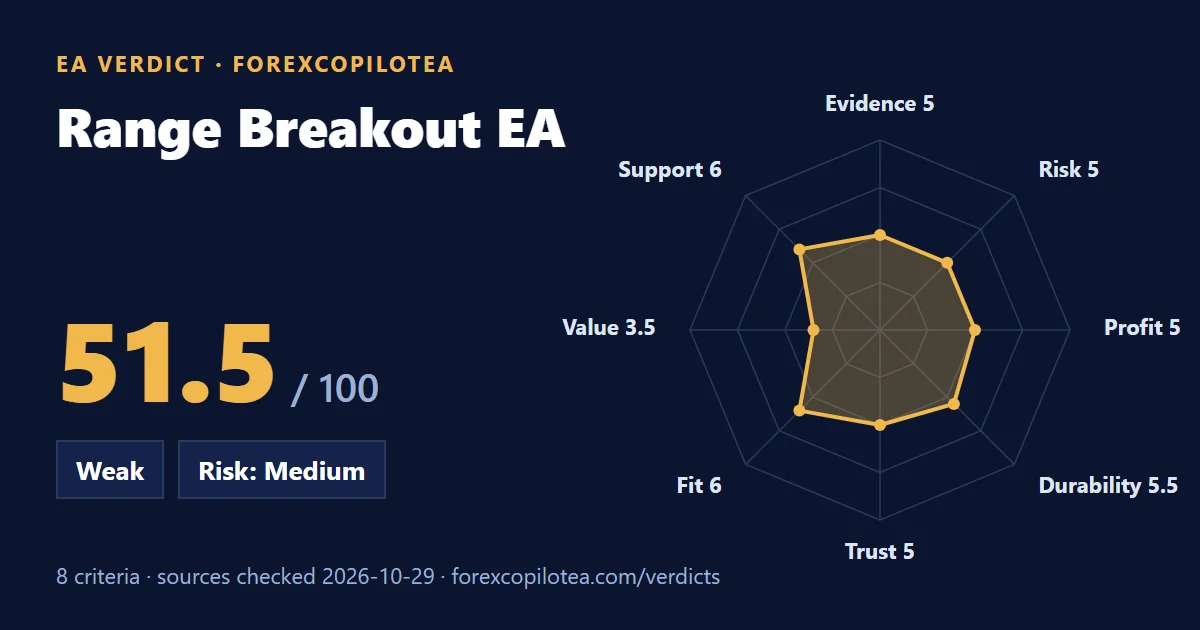
Range Breakout EA is a session breakout Expert Advisor for MetaTrader 5 that marks the quiet Asian range and trades the break of it when London opens, on gold, USDJPY, Bitcoin, the Dow (US30) and the DAX (DE40). It is sold on the MQL5 Market as Range Breakout EA with Range Filters for 649 USD, with a stated next price of 749 USD and a final price of 999 USD, and it says it uses no martingale and no grid. Its live signal is large enough to take seriously: 2,079 trades over about two years, a 41.41% win rate and a profit factor of 1.16. This Range Breakout EA review read the listing, all 37 comments, the three reviews we could open and the signal line by line, and scored the product on the same eight criteria as every verdict here. The result is 51.5 out of 100 and a Medium risk label: a clearly described, actively supported breakout system whose public record shows a thin, uneven edge rather than the steady curve its marketing implies.
Key takeaways
- Range Breakout EA scores 51.5 out of 100 (band: Weak) with a Medium risk label. A two-year, 2,079-trade signal is a real strength; a profit factor of 1.16 and a maximal balance drawdown of 25.53% keep every other criterion modest.
- The vendor's signal (MQL5 signal 2271995) shows 347.83% growth, 2,079 trades, 861 winners (41.41%), a profit factor of 1.16 and an expected payoff of 1.37 USD per trade. The 1,000 USD account also took 1,578.52 USD of deposits and paid out 1,502.43 USD, so the trading profit is 2,838.40 USD and the headline percentage mostly reflects a small starting base.
- On the same signal MQL5 shows a monthly growth of minus 2.20% and an annual forecast of minus 26.66%, 17 consecutive losing trades at the longest, and a notice that 80% of the growth came within 10 days, 1.41% of the signal's days. US30 and DE40 together made 801 of the 2,079 trades and a net loss of about 235 USD.
- The price is 649 USD on the MQL5 Market on 29 October 2026, with a free demo that has 4,264 downloads and 10 activations per licence. Our own store sells a listing under this name for $26.99, as a compiled file only; the author is Jimmy Peter Eriksson, our listing is sold by a reseller, and the licence terms for that resale are not stated.
- We sell a listing for Range Breakout EA. It shows version 5.2, the same as the Market's 5.20, but it is a separate purchase with no setfile, manual or source code, and no refunds.
- 51.5 / 100
- weighted verdict score on eight published criteria
- PF 1.16, 41% wins
- profit factor and win rate of the vendor's two-year signal over 2,079 trades, with a monthly growth of minus 2.20%
- 649 USD
- Market price on 29 Oct 2026, next price 749 USD, stated final price 999 USD, free demo
The Range Breakout EA verdict at a glance: a solid sample with a thin edge
Range Breakout EA earns points for being checkable. The strategy is explained in plain terms, the demo is free, the seller answers questions in public, and a signal with more than two thousand trades is open for anyone to read. It loses points on what that signal contains. A profit factor of 1.16 means gross profit exceeds gross loss by 16%, a win rate of 41.41% means long losing runs are normal, and the account's own growth figure is flattered by a 1,000 USD starting balance and by deposits and withdrawals along the way. The scorecard and radar show how the total was built.
51.5 / 100
Weighted verdict score
Weak
Verdict band
Medium
Risk label
| Criterion | Weight | Score | Best evidence | Points |
|---|---|---|---|---|
| Verified evidence | 20 | 5/10 | Grade A | 10.0 |
| Risk and drawdown behaviour | 20 | 5/10 | Grade A | 10.0 |
| Profitability quality | 15 | 5/10 | Grade A | 7.5 |
| Sustainability | 15 | 5.5/10 | Grade B | 8.3 |
| Transparency and trust | 10 | 5/10 | Grade B | 5.0 |
| Practical fit | 10 | 6/10 | Grade B | 6.0 |
| Cost and value | 5 | 3.5/10 | Grade B | 1.8 |
| Support and usability | 5 | 6/10 | Grade B | 3.0 |
| Total | 100 | 51.5 |
What Range Breakout EA actually is
Range Breakout EA is an Expert Advisor for MetaTrader 5, sold on the MQL5 Market by Jimmy Peter Eriksson of Croatia, whose seller profile shows a 4.5 rating from 158 votes, 7 products and 15 signals, and a website at erikssonsystems.com. The page was published on 25 August 2024, shows version 5.20 updated on 23 August 2026, 10 activations per licence, a rating of 4.68 from 34 reviews and 37 comments. The seller's bio says he has more than five years of experience and builds strategies with 'no martingale, no grid systems, and no hidden risk mechanics'. The listing's headline calls it prop-firm ready and shows '23 Months Live Signal' and '+300% Live Growth'.
The idea is a classic one. Volatility is usually low during the Asian session, so price tends to form a tight range. When the London session opens, participation rises and price often breaks out of that range and keeps going. The EA trades the breakout and closes positions later in the day when volatility slows. It says it uses no indicators and no fixed timeframe, which the author argues reduces overfitting, and it adds an internal breakout filter meant to reject lower-quality breaks. It covers five markets with built-in settings: XAUUSD, USDJPY, BTCUSD, US30 and DE40.
There are two ways to run it. In One Chart mode, the default and the mode the page recommends for backtesting, you attach it to any chart and it trades every enabled market from there. In Individual Chart mode, which the page recommends for live trading, you switch One Chart off, attach the EA to each market's chart and choose the matching Preset Market. Risk comes in three automatic levels (low, medium, high), a manual percentage or a fixed lot. There is a daily drawdown protector aimed at prop-firm rules (FTMO, The5ers and FundedNext are named), a spread filter, a trade randomiser, and screen displays for daily profit and drawdown. The EA expects a broker on US-style server time, GMT+2 in winter and GMT+3 in summer.
| Item | What the vendor says |
|---|---|
| Seller | Jimmy Peter Eriksson, Croatia. Seller rating 4.5 from 158 votes; 7 products, 15 signals. Public and private (proof-of-purchase) communities. |
| Price | 649 USD on 29 Oct 2026. The description says 'Next Price: $749, Final Price: $999 (Limited Copies At Current Price)'. Free demo with 4,264 downloads; 10 activations. A rental option is mentioned by commenters but no rental price is visible on the page. |
| Strategy | Asian-session range, London breakout, positions closed later in the day. XAUUSD, USDJPY, BTCUSD, US30, DE40. No indicators, any timeframe, internal breakout filter. |
| Risk controls | Low, medium and high automatic risk, manual risk percent or fixed lot; daily drawdown protector; spread filter; trade randomiser. 'No Martingale / No Grid'. |
| Requirements | MetaTrader 5, broker on GMT+2 / GMT+3 server time, a reliable VPS recommended. No setfiles required: settings are built in. |
| Track record | A live signal (2271995), a 'main portfolio' signal, FTMO result screenshots posted in comments and a backtest guide blog post. |
| Reach | Rating 4.68 from 34 reviews, 37 comments, '25 purchases per month' shown on the page. |
| Versions | 5.20, updated 23 Aug 2026; 5.1 (21 Aug 2026) fixed the daily drawdown protector not resetting in One Chart mode. |
How we judged it, and who has something to sell
Evidence on EAs is never neutral. Here is every party near this product and what each stands to gain, ours included.
- The developer sells this EA and six other products, sells signal subscriptions (49 USD a month on this signal, with no subscribers shown) and runs the buyer community. His record is public, which counts for something, and it is also his sales page.
- MQL5 and MetaQuotes host the Market, the reviews, the comments and the signals. The signal statistics and every notice on its page are the platform's own.
- Buyers who wrote reviews include three satisfied users in the part of the page we could read, all in September and October 2026, and one critical commenter in January 2026. Testimony, not data; none can be checked from outside.
- ForexCopilotEA sells a listing for this EA. We gain if you buy it, which is why this verdict opens with that fact and applies the same rules as every other.
Evidence ladder: what each rung of proof held for Range Breakout EA
Grade A: Independent proof
- MQL5 signal 2271995, 'Range Breakout EA Live': platform-built statistics for about two years and 2,079 trades. The vendor runs the account, so his interest is noted, but the figures are computed from broker history and the platform's notices are its own.
- MetaQuotes and Myfxbook documentation, used for how testing reports and verified records work.
Grade B: Checkable vendor material
- The Market listing: version, price, markets, setup modes, requirements, dated reviews and 37 comments with the seller's replies.
- The free demo, which runs in the Strategy Tester only, and the public community.
- The seller's two other linked signals, read as context only: the 'main portfolio' signal combines several of his EAs and is not evidence for this one.
Grade C: Claim only
- '+300% Live Growth' and 'Why Range Breakout EA is so Stable': marketing wording, which the signal's profit factor and current monthly growth do not support in the same tone.
- FTMO result screenshots and 'verified FTMO payouts' posted as images in comments; we could not open an audited record behind them.
- The Monte Carlo forward projection posted in December 2025, made by the vendor from his own inputs. We cannot reproduce it.
- The seller's January 2026 statement of 'a total of 121%, with an average of around 10% profit per month'. The signal's own figures do not show that.
Grade D: Conflicted, anonymous or unverifiable
- Positive reviews that praise the seller and the strategy; they may be genuine and are not independently checkable.
- The critical comment from January 2026, machine-translated from Chinese, which describes a near 10,000 USD loss; it links no statement or record.
Range Breakout EA live results: the signal, number by number
A platform-computed signal is the best public evidence a vendor can show, and this one is large and long. Roughly 24 trades a week for about two years gives a sample from which a real estimate can be made. It has limits: the vendor runs the account, it uses one broker (ICMarketsSC-MT5-2, leverage 1:500), and the account was topped up and drawn down. The page also contradicts itself on dates: the Started field reads 1 January 2026, while the page shows 102 weeks and 709 days of lifetime and a 'growth since 2024' label. We therefore do not state a precise start date, and rely on the 102 weeks and 2,079 trades. Here is what the Range Breakout EA signal shows on 29 October 2026.
| Statistic | Value |
|---|---|
| Age, broker | 102 weeks (709 days of lifetime on the notice), ICMarketsSC-MT5-2, leverage 1:500 |
| Initial deposit, deposits, withdrawals | 1,000.00 USD, 1,578.52 USD, 1,502.43 USD |
| Growth, profit, balance, equity | +347.83%, 2,838.40 USD, 3,914.49 USD, 3,952.55 USD |
| Trades, win rate | 2,079 trades; 861 wins (41.41%), 1,218 losses (58.59%) |
| Long, short | 1,092 (52.53%), 987 (47.47%) |
| Gross profit, gross loss | 20,741.52 USD, minus 17,902.81 USD |
| Profit factor, expected payoff | 1.16 (the signals table shows 1.15), 1.37 USD per trade |
| Average win, average loss | 24.09 USD, minus 14.70 USD |
| Best, worst trade | 238.95 USD, minus 141.93 USD |
| Longest losing run | 17 trades (minus 169.89 USD) by count; the largest consecutive loss in money is minus 249.62 USD over 12 trades |
| Drawdown, maximal by balance | 512.56 USD, 25.53% |
| Drawdown, relative by balance, by equity | 28.29% (512.14 USD), 8.96% (187.04 USD) |
| Recovery factor, Sharpe ratio | 5.54, 0.05 |
| Trades per week, average hold | 24, 7 hours |
| Trading days, activity, maximum deposit load | 504 days (71.09%), 58.64%, 10.55% |
| Monthly growth, annual forecast | Minus 2.20%, minus 26.66% |
Read the numbers together. A win rate of 41.41% with an average winner of 24.09 USD and an average loser of 14.70 USD is a trend-following shape: it loses more often than it wins and relies on winners about 1.64 times the size of losers. The arithmetic checks out: 0.4141 times 24.09 minus 0.5859 times 14.70 is about 1.37 USD per trade, the platform's figure. That is 1.37 USD on an average trade size where the average loss is 14.70 USD, so the edge is about 9% of an average loss. It is positive, and it is small enough that spread, slippage and commission on a different broker could remove a large part of it.
The money flow needs care. The account began with 1,000 USD, took 1,578.52 USD of deposits and paid out 1,502.43 USD of withdrawals. Balance is 3,914.49 USD, which equals 1,000 plus 1,578.52 plus the 2,838.40 USD of trading profit minus the withdrawals. A reader who sees 347.83% growth should translate it: the trading profit is about 110% of the 2,578.52 USD that was put into the account, spread over two years, and the percentage is computed in a way that rewards small early balances. The growth figure is a platform calculation and is not false; it just cannot be read as the return of a fixed pot of capital.
Three more features of the page deserve a flat description. First, the platform notice says 80% of the growth was achieved within 10 days, which is 1.41% of the signal's 709 days. The notice history on the page in early 2025 alternated between 'share of days for 80% of growth is too low' and '80% of growth achieved within 1 days'. Profits are concentrated in a small number of large days, so a buyer who starts at a bad time can see a long flat or negative stretch. Second, the platform's own current monthly growth is minus 2.20% and its annual forecast minus 26.66%. A forecast is an extrapolation of recent months, not a prediction, and it differs sharply from the page's '+300% Live Growth' headline. Third, the longest run of consecutive losses is 17 trades, which a 41% win rate makes normal; a buyer should expect something like it.
- Relative, by balance28.3%
512.14 USD
- Maximal, by balance25.5%
512.56 USD
- Relative, by equity9.0%
187.04 USD
The gap between the balance and equity measures is large and deserves explanation. Equity drawdown, at 8.96%, is measured on the account's marked-to-market value, and with the withdrawals and deposits in play it can look small; balance drawdown, at 25.53% to 28.29%, measures realised losses against the balance peak and is the more realistic figure for planning, because it is the one that reflects what a run of closed losing trades does. We use the balance figures for the risk score.
Which markets make the money: USDJPY and gold carry it
The signal page splits trades and net profit by symbol, and the split is the most useful table on it. The sizes shown are rounded by the platform, so treat them as approximate.
| Symbol | Deals | Share of deals | Net profit (USD) |
|---|---|---|---|
| USDJPY | 592 | about 28% | about +1,200 |
| US30 | 409 | about 20% | about minus 37 |
| DE40 | 392 | about 19% | about minus 198 |
| BTCUSD | 374 | about 18% | about +374 |
| XAUUSD | 312 | about 15% | about +1,500 |
Gold produced about 1,500 USD from only 312 deals, roughly 4.80 USD a deal on the rounded figures, and USDJPY about 1,200 USD from 592 deals, about 2.00 USD a deal. Bitcoin returned about 1 USD a deal. US30 and DE40 together took 801 of the 2,079 deals, 38.5% of the activity, and netted a loss of about 235 USD. In other words, two of the five advertised markets used a great deal of the signal's trading and added nothing, while the profit came from a smaller number of trades on gold and the yen.
That matches the one clearly critical comment on the page. In late January 2026 a buyer wrote that he almost lost 10,000 USD, that win rates on US30, DE40 and USDJPY were 'shockingly low' and that he had bought three EAs from the same place. The seller replied that the signal was up 121% in total, around 10% a month on average, that the screenshots covered about two weeks, that win rate has nothing to do with overall performance, and that the system is designed with a lower win rate and a higher reward-to-risk on US30 and DE40. The seller's point about win rate is correct in principle, and the signal bears it out for the system as a whole. The signal does not, however, show US30 and DE40 earning that higher reward. Their net result is negative over about 800 deals. We report both statements as made, treat the buyer's loss as an unverified allegation, and note that the seller invited him to make contact before judging.
How an Asian-range breakout system makes and loses money
A range breakout is a bet on a regime change inside the day. The Asian session is quiet for most pairs, so a tight band forms. The London open brings volume, and a move out of the band can extend. The system wins when the break continues and loses when price breaks one way, reverses back through the range and stops the position out. It tends to lose often with small losses and win less often with larger ones, which matches the 41.41% win rate and the 1.64 payoff ratio on the signal.
Three structural weaknesses follow from the design. The first is false breakouts, which cluster in choppy, range-bound weeks and are the source of the long losing runs; a loss streak of 17 is arithmetic, not a malfunction. The second is time dependence: the setup needs the broker's clock, the session boundaries and the daylight-saving shifts to line up, and it misbehaves when they do not. The third is crowding. Asian-range breakouts are among the best-known retail strategies, so a measured edge can narrow as more capital trades the same level at the same time. The listing's internal breakout filter and randomiser address part of this, and the seller does not publish how the filter works.
The seller describes avoiding indicators as a way to reduce overfitting. The listing is more careful than that elsewhere and says, in its own words, that avoiding indicators does not automatically eliminate overfitting or guarantee long-term stability. We agree with the careful version. A session range has few free parameters, which helps, but each market has its own preset, and the presets were optimised on history. The seller's own advice to a buyer who asked for US30 and US100 setfiles in 2025 was to do some testing and optimisation but to 'be careful to not overoptimise too much', which is the right instinct and also an admission that optimisation is part of using this product.
Interactive: win rate is not edge
- Expected result per trade
- +0.35
- Profit factor
- 1.64
- Break-even win rate
- 33%
At these numbers the system has a positive edge before costs. Add spread, commission and slippage per trade and re-check.
Backtests, the demo and what we could not run
The listing recommends One Chart mode for backtesting and points to a backtest guide on the MQL5 blog. We did not run the demo and we did not open the guide, so we have no independent backtest figures to quote, and the page gives no backtest profit factor or drawdown in text. The free demo, downloaded 4,264 times, runs only in the Strategy Tester, so it tests the logic against history on your broker's data and does not show live behaviour.
There is a notable contrast between the 4,264 demo downloads and the 10 activations shown on the page. They measure different things: the demo count is cumulative downloads, while the Market's activations figure is the number of activations a licence permits, so we do not read it as a sales count. The page does say it sells about 25 copies a month, and that is the figure to use when judging reach. For how tester results differ from live trading, see our guide to backtest versus live results and our guide to reading an MT5 backtest report. A buyer who optimises the presets should read our guide to optimising an EA without overfitting first.
The vendor also posted a Monte Carlo forward projection in December 2025 that randomises the order of trades and skips some to model real-world uncertainty, and states that the strategy keeps a positive long-term expectancy even under unfavourable randomisation. A Monte Carlo test reshuffles the trades the system has already made; it cannot create information about market regimes it has not seen, and it is only as good as the sample behind it. The live signal's positive expectancy supports the statement, and the vendor-made projection is a claim, not proof.
Range Breakout EA drawdown and risk: bounded per trade, but a real 25% to 28%
The listing says no martingale and no grid. The signal is consistent with that: the worst trade was minus 141.93 USD against an average loss of 14.70 USD, about ten average losses, and the maximum deposit load was 10.55%. There is no sign of a basket that grows into a loss. We cannot read the code, so this rests on the listing and the signal. The page does not say in so many words that every trade has a stop loss, and that is why the risk score is not higher. Risk has three layers here.
- Trade risk. The automatic low, medium and high levels, a manual percentage and a fixed lot decide how large each loss is. The signal's account used its own setting; a buyer who picks a higher level than the vendor will see larger swings and a deeper drawdown, because a drawdown scales with risk per trade.
- Streak risk. With a 41.41% win rate, 17 losing trades in a row happened, costing 169.89 USD. At a risk setting that costs 2% a trade, a streak like that is a 30% drawdown. The setting matters more than the strategy here.
- Rule risk. The daily drawdown protector is meant for prop-firm limits. In the version note of 21 August 2026 the seller says an earlier bug stopped the protector from resetting at the start of a new day in One Chart mode, and asks prop-firm users to update to 5.1. That was fixed in a public update, and it is also a reminder that the protector is software, and prop-firm users should check it behaves on a demo before trusting it with a challenge.
- Duplicate-trade risk. In June 2025 a demo user reported a buy and a sell opened together on USDJPY. The seller replied that the EA should not do that, that it has not happened to him, and that changing inputs or restarting the terminal while the range is being created can leave the range wrong and open incorrect positions. The reply tells us the range state is fragile to restarts and input changes during the build window, so a buyer should avoid restarting a terminal during the Asian session and use a VPS.
- Concentration risk. With 80% of the growth in 10 days, a start date is a matter of luck. A buyer who begins in a flat spell will watch a flat account, and one who raises risk to compensate will deepen the next drawdown.
Interactive: drawdown recovery
Gain needed to get back to break-even
+42.9%
Blue: equity left. Red: equity lost.
Consecutive losing trades to reach this drawdown: 36
What buyers say about Range Breakout EA
The listing shows a rating of 4.68 from 34 reviews. We could read three, from 18 September, 21 September and 8 October 2026, and we weigh them as testimony. One calls range breakout strategies patient and difficult and says this EA has 'mastered the strategy beautifully so far', calls it a solid option for portfolio diversification in a market dominated by grid and breakout EAs and praises a friendly, supportive seller. One says the last few months have been great, that it 'does have its drawdown periods, but that's a good thing: it shows the system isn't overfitted', and that the seller is always available. One has used it with other products from the same seller for three months, reports steady profits and recommends it with proper risk settings.
Two cautions apply. A rating of 4.68 over 34 reviews means some reviews are below five stars, and we could not read them, so the sample we saw is not the whole picture. And the claim that drawdowns prove the system is not overfitted is a reviewer's reasoning, not a fact: a drawdown is evidence the system loses money sometimes, and says nothing either way about overfitting. Two of the three also run the product in combination with other products from the same seller, which is sensible and means their results are not Range Breakout EA's alone. The comments section is the better read: 37 comments, almost all questions about setfiles and settings, mostly answered within a day or two, and one clearly critical post.
Setfiles, settings and support: the page says 'plug and play', the comments say otherwise
The listing says 'Plug & Play Setup - No Set-files Required' and that market-specific settings are built into the EA through the Preset Market input. The comment record shows a different journey. In late 2024 and early 2025 buyers asked for Bitcoin, US30 and US100 setfiles and the seller handled some by private message. A comment in 2025 posted 'Latest Optimized Setfiles' for XAUUSD, USDJPY and BTCUSD. In November 2025 the seller wrote that the EA is plug and play and that older setfiles applied to a previous version, that he would ask MQL5 to remove the old comment, and that US30 and DE40 were still in testing. On 29 October 2026, the day we read the page, a commenter asked for the latest setfiles and had not been answered.
None of that shows bad faith. Software evolves, setfiles go out of date and a seller who answers by private message cannot always be seen answering. It does show a gap between the marketing line and the buyer's experience, and it matters for what you buy. If you buy the EA elsewhere without the community, you will not have the seller's private channel. Our own listing ships no setfile or manual, and the Market description says none are needed. Whether that is enough is a judgement for the buyer, and it is worth testing on the free demo before paying anyone.
Response quality is a point in the seller's favour. He replied to the January 2026 criticism in public with figures and an offer to help, he explained the duplicate-trade report in terms of how the range is built, he gave a direct answer on the GMT+2 offset and he told a buyer plainly that he does not recommend the trailing stop on these markets after testing it and finding no stable results. The November 2025 time-zone thread, however, ended with a buyer still confused and the conversation moved to private message, so the public record does not show whether it was resolved.
Range Breakout EA price: 649 USD and rising, against a 2,838 USD record
The Market price on 29 October 2026 was 649 USD. The description says the next price is 749 USD and the final price 999 USD, under the words 'Limited Copies At Current Price'. The same 649 USD appeared on the Russian, German, Spanish, Chinese, Japanese and Portuguese versions of the page, so there is no language-based difference. A rising price with a limited-copies message is urgency marketing, and we mark it down on trust and on value rather than treating it as dishonest: staged pricing is common on the Market. Commenters in 2025 mention renting the EA, so a rental option exists or existed, but no rental price is shown on the page we read.
Set the price against the signal. The account made 2,838.40 USD of trading profit in about two years. A licence at 649 USD is about 23% of that profit, and the purchase would need to be run at a larger account and risk setting than the signal's to matter, which brings a larger drawdown with it. Nobody should buy on a price-rise message; the free demo is the sensible first step, with the caveat that it shows backtest behaviour only. Add the other costs: a VPS (the listing recommends one), a broker with a GMT+2 server and low costs on gold, USDJPY, Bitcoin and two indices, and the time to test.
Our $26.99 listing against the 649 USD Market price
Our store lists a Range Breakout EA at $26.99 one-time, about 4% of the Market price. Comparing the two is not like for like. Ours is version 5.2, matching the Market's 5.20; it ships the compiled .ex5 in one ZIP, with no setfile, user manual or source code; it states lifetime updates; and it does not offer refunds, as all sales are final. It also lacks the things the Market purchase includes: the author's name on the page, the seller's private buyer community, and, as far as we can tell, the author's direct support. The seller shown on our page is a reseller. Our page does not say whether the author licenses that resale or whether the file carries the activation limits of a Market copy, and we will not guess. If those questions matter to you, ask us through the contact page before buying, and weigh them against the price difference.
Will the edge last? Seller track record and version history
The seller has 15 signals and 7 products, a 4.5 rating from 158 votes, and a habit of posting updates and results in the comments. The product itself was published in August 2024 and has been updated in 2026 (5.1 on 21 August, 5.20 by 23 August). In November 2025 the Preset Market input replaced per-market setfiles and US30 and DE40 were still described as in testing. That means the two markets which lost money on the signal were added or reworked late, and the long record mixes versions. We cannot tell from public data which version produced which trades, so a verified record for the exact version on sale is not available; this is one of the material gaps in the evidence score.
A neighbouring product from the same seller, Pulse Engine, is a time-of-day pattern system with its own signal and a lower profit factor. Reading the two together suggests a developer who builds rule-based, low-complexity systems and publishes the results honestly enough that weak figures are visible, which is a point in his favour on trust and durability. It does not change the fact that Range Breakout EA's own numbers are modest.
The score, criterion by criterion: 51.5 out of 100
| Criterion | Score | Points | Why |
|---|---|---|---|
| Verified evidence (weight 20) | 5 / 10 | 10.0 | A platform-built MQL5 signal of about two years with 2,079 trades, well above 12 months; but the vendor runs it, 1,578.52 USD of deposits and 1,502.43 USD of withdrawals shape the curve, 80% of the growth came in 10 days and the platform's start date and week count disagree. |
| Risk and drawdown behaviour (weight 20) | 5 / 10 | 10.0 | No martingale or grid is stated and the worst trade was 141.93 USD, but a verified balance drawdown of 25.53% (28.29% relative), 17 consecutive losses, two markets that lose money live and no stop-loss statement on the page leave the controls only partly verified. |
| Profitability quality (weight 15) | 5 / 10 | 7.5 | A verified profit factor of 1.16 and an expected payoff of 1.37 USD per trade over 2,079 trades with a payoff ratio near 1.64; but a 41.41% win rate, growth concentrated in 1.41% of days and a platform monthly growth of minus 2.20%. |
| Sustainability (weight 15) | 5.5 / 10 | 8.3 | Two years of live data, a seller with 15 signals and 7 products, version 5.20 updated in August 2026 and a breakout logic that is documented in outline; against that, a session-based edge that can decay, two of five markets net negative and a changed setup (preset input, new markets) over the life of the record. |
| Transparency and trust (weight 10) | 5 / 10 | 5.0 | A candid page, a public signal, specific replies to critics and a free demo; against that, a ramping price (649 USD, next 749 USD, final 999 USD), 'so stable' and '+300%' wording beside a negative current monthly figure and a 'no set files' message that still ends in private setfiles. |
| Practical fit (weight 10) | 6 / 10 | 6.0 | One chart or per-market charts, five markets with built-in presets, a prop-firm drawdown protector and no timeframe choice; but it needs a broker on GMT+2 or GMT+3 server time, five symbols mapped correctly and capital that tolerates a 25% to 28% balance drawdown. |
| Cost and value (weight 5) | 3.5 / 10 | 1.8 | 649 USD and rising towards 999 USD against a verified record with a profit factor of 1.16 and 2,838.40 USD of trading profit in two years; a free demo and a rental option mitigate it, but the price is premium for the proof. |
| Support and usability (weight 5) | 6 / 10 | 3.0 | A free demo, a seller who replies in comments, a private buyer community and a plug-and-play setup; but the setfile message is inconsistent and a time-zone question from November 2025 stayed open in public. |
The total is 51.5 out of 100. The grade A on evidence is earned by a platform-built signal of two years and 2,079 trades; it scores 5 and not higher because the vendor runs it, deposits and withdrawals shape the curve, growth is concentrated in 10 days, the start date is inconsistent and the record spans several versions. Risk, at 5, reflects a bounded loss per trade and a 25.53% to 28.29% balance drawdown that is only partly explained by documented controls. Profitability, at 5, reflects a real, positive expectancy of 1.37 USD per trade with several weaknesses. Value, at 3.5, is the lowest score: a premium and rising price against a modest verified edge, partly offset by a free demo.
Who Range Breakout EA fits, and who it does not
- It fits a trader who understands that a 41% win rate means long losing streaks, has a low-cost broker on GMT+2 server time, will run a VPS and will judge the system over a year or more at a modest risk setting.
- It fits a prop-firm trader who tests the daily drawdown protector on a demo first and keeps the risk level low enough that a 17-trade losing streak cannot breach the firm's limit.
- It does not fit anyone who needs steady monthly returns, who expects '+300%' to repeat, or who cannot tolerate a balance drawdown of about 25% to 28%.
- It is a poor choice for a buyer who is paying mainly because the price is about to rise, or who cannot test on a demo first.
How it compares with other EAs we have scored
Next to Pulse Engine, the other session-based system from the same seller, Range Breakout EA has a higher profit factor and a much deeper balance drawdown, and a similar story of a verified signal with a thin edge. Next to Gold Beaver, which wins 94 trades in 100 and loses larger on the others, it is the opposite shape: it loses more often than it wins and relies on larger winners. Its 51.5 reflects a real sample, a well-explained approach and an honest seller, held back by modest profitability and a premium price. For how these system types differ, see our strategy comparison and our EA categories for gold.
Questions to put to the developer before you pay
- Which version and risk level does the live signal run, and has the setup changed since August 2024?
- Why does the Started field read 1 January 2026 when the page shows 102 weeks?
- Does every position carry a stop loss, and what is the maximum loss per trade at each automatic risk level?
- Why do US30 and DE40 show a net loss on the signal, and are they still recommended?
- Can you publish a real-tick backtest report for version 5.20 and the inputs behind the presets?
- What happens to the range if the terminal restarts during the Asian session?
- How does the price schedule work for existing owners, and what is the licence position for copies sold outside the Market?
Sources and when they were opened
- MQL5 Market: Range Breakout EA with Range Filters (product 122237), opened 29 October 2026Source of the price, version, markets, setup modes, requirements, readable reviews, all 37 comments and the developer's statements. Written by the vendor and by buyers.
- MQL5 Signals: Range Breakout EA Live (signal 2271995), opened 29 October 2026Source of every performance figure, notice, drawdown and symbol split in this verdict. The vendor operates the account.
- MQL5 Signals: Eriksson Systems Complete Portfolio (signal 2340542), opened 29 October 2026A multi-EA portfolio signal that includes Range Breakout EA among other products. Read for context only and not used as evidence for this product.
- ForexCopilotEA store listing: Range Breakout EA, opened 29 October 2026Source of our version, price, what the download includes and the sale terms. This is the seller's own page.
- Myfxbook Help: VerificationHow a trading account's track record is verified on Myfxbook.
- MetaTrader 5 Help: Testing ReportWhat each figure in the tester's report means, including drawdown.
- MetaTrader 5 Help: Strategy TestingThe Strategy Tester: testing modes, settings and forward testing.
- ESMA: ESMA agrees to prohibit binary options and restrict CFDs to protect retail investorsThe EU leverage limits, margin close-out, negative balance protection and risk-warning rules for retail CFD accounts.
- CFTC Customer Advisory: AI Won't Turn Trading Bots into Money MachinesA US regulator's warning about trading-bot claims of unusually high returns.
Frequently asked questions
Is Range Breakout EA legit?
It is a real, regularly updated product with a documented approach, a public signal with 2,079 trades over about two years, a private buyer community and a seller who answers questions in public, rated 4.68 from 34 reviews on the MQL5 Market. We allege nothing against the developer. The signal's profit factor is 1.16 and its current monthly growth is negative, which is why it scores 51.5 out of 100 with a Medium risk label.
Does Range Breakout EA use martingale or a grid?
The listing says no martingale and no grid, and the signal is consistent with that: its worst trade was minus 141.93 USD against an average loss of 14.70 USD, and its maximum deposit load was 10.55%. We cannot read the code, and the page does not state that every trade has a stop loss, so this rests on the listing and the signal.
How much does Range Breakout EA cost?
The MQL5 Market price on 29 October 2026 was 649 USD, with a free demo, a stated next price of 749 USD and a final price of 999 USD. A rental option appears to exist but no price was shown. A VPS and a broker on GMT+2 server time are extra. Our store sells a separate listing for $26.99 with a compiled file only and no refunds, so read the terms of whichever seller you use.
What markets does Range Breakout EA trade?
XAUUSD, USDJPY, BTCUSD, US30 and DE40, with built-in presets chosen through the Preset Market input. You can run all five from one chart (the default, recommended for backtesting) or attach it to separate charts, which the page recommends for live trading. On the vendor's signal gold and USDJPY made the profit, while US30 and DE40 were net negative.
What drawdown does Range Breakout EA have?
On the vendor's signal the maximal drawdown by balance was 25.53% and the relative balance drawdown 28.29%, while the relative equity drawdown was 8.96%. The longest losing run was 17 trades. Plan around the balance figures, and set the risk level so that a streak like that cannot breach your own limit.
Has Range Breakout EA been profitable live?
Modestly. The signal shows 2,838.40 USD of trading profit over about two years, a profit factor of 1.16 and an expected payoff of 1.37 USD per trade, on an account that also took deposits and made withdrawals. MQL5 currently shows a monthly growth of minus 2.20%, and it notes that 80% of the growth came within 10 days.
Does Range Breakout EA work with prop firms?
The listing calls it prop-firm ready and includes a daily drawdown protector aimed at firms such as FTMO, The5ers and FundedNext. A bug that stopped the protector resetting in One Chart mode was fixed in version 5.1 in August 2026. Our listing warns that firms may flag identical trading across accounts, so read your firm's rules and test the protector on a demo first.
How was the score calculated?
Eight weighted criteria (evidence 20, risk 20, profitability 15, sustainability 15, trust 10, fit 10, cost 5, support 5), each scored out of ten against written anchors. Sources are graded A to D and unverified claims cannot count as proof. We sell a listing for this EA, which is disclosed at the top. The total here is 51.5 out of 100.
Gold Expert Advisors in our store
We sell these, so weigh that interest. Put the same eight questions to any of them before you buy: read the manual, run your own backtest, and start on demo.



Keep reading
- EA VerdictPulse Engine EA Review: Verdict and Risk (2026)Is Pulse Engine worth $599? Independent EA verdict: 52.8/100, Medium risk. A 36-week MQL5 signal, 2,271 trades and a 1.06 profit factor scored, checked 29 Oct 2026.
- EA VerdictGold Beaver EA Review: Verdict and Risk (2026)Is Gold Beaver worth $449? Independent EA verdict: 48.8/100, Medium risk. A 23-week MQL5 signal, 13 presets and a 94% win rate scored, checked 29 Oct 2026.
- BacktestingWhy EA Live Results Differ From Backtests (and What to Do)Why EA live results differ from backtests: spread, slippage, delay, data, overfitting and more. Eleven causes, how to check each and how to close the gap.
- Risk managementEA in Drawdown: What to Do (and What Not to Do)What to do when your Expert Advisor is in drawdown: separate normal from broken, check the logs, compare with the backtest, and decide to hold, reduce or stop.
- OptimisationHow to Optimize an EA in MT5 Without OverfittingHow to optimise an EA in MT5 without overfitting: tester modes and criteria, how many inputs to use, plateaus versus spikes, forward testing and a process.