
EA Verdict
Swing Forge Gold EA Review (2026): A Multi-Zone Gold Breakout EA, Four Young Live Signals and a Slippage Problem
By Benjamin Lee · Updated · 37 min read
Swing Forge Gold is a gold breakout Expert Advisor for MetaTrader 5 that places pending buy-stop and sell-stop orders at swing highs and lows, protects every trade with a hard stop loss and says it uses no grid and no martingale. This Swing Forge Gold EA review covers the product sold on the MQL5 Market at $299, with a stated rise to $399 after "3 copies left". Its seller links four live signals, each between 10 and 12 weeks old, which hold trades for about 45 seconds on average and show profit factors from 1.66 to 2.42. Win rates on the same strategy run from 44% to 68%, balance drawdowns from 21% to 30%, and a buyer on the listing measured slippage of up to 170 points against a default stop of 225. One reviewer called the backtest fake; the seller has not replied in public. We read the listing, its changelog, the comments and the three reviews we could open, checked all four signals line by line and scored Swing Forge Gold on the same eight criteria as every verdict here. The result is 43.8 out of 100 and a Medium risk label: a tightly controlled, execution-sensitive system with a young record, a fast-changing design and a price that asks for more trust than the evidence yet supports.
Key takeaways
- Swing Forge Gold scores 43.8 out of 100 (band: Weak) with a Medium risk label. Equity drawdowns of 2.4% to 3.6% are a strength; balance drawdowns of 21% to 30%, a 10-to-12-week record and heavy design changes hold the score down.
- Four MQL5 signals run the same strategy on four accounts. Profit factor is 2.42, 2.10, 1.84 and 1.66; win rate is 67.80%, 65.25%, 57.44% and 44.21%. The spread between them is consistent with broker execution deciding the result, which is what a buyer in the comments reported.
- Average holding time is 43 to 49 seconds. A system that lives for under a minute depends on spread, fill speed and slippage far more than on the idea. One commenter measured an average slippage of 55 points and a maximum of 170 on a default 225-point stop, and the author agreed the stop is small relative to gold's short-interval range.
- The author's marketing figures do not match the platform's. '400% growth in two months' is profit relative to a 100 USD deposit; MQL5 shows 71.77% growth on that signal after 341 USD of withdrawals. The platform also logged 'too much growth in the last month' warnings on the signals.
- We sell a listing for Swing Forge Gold at $26.99, version 1.13, as a compiled file with no setfile, manual or source. The Market product costs $299 and is at version 1.14. Treat ours as a separate purchase; we cannot verify the licence terms under which it is sold.
- 43.8 / 100
- weighted verdict score on eight published criteria
- PF 1.66 to 2.42
- profit factor across four vendor-run signals of 94 to 146 trades each, 10 to 12 weeks old
- $299
- Market price on 29 Oct 2026, with a stated rise to $399 and a free demo; our listing is $26.99
The verdict at a glance: tight control, a young record and an execution problem
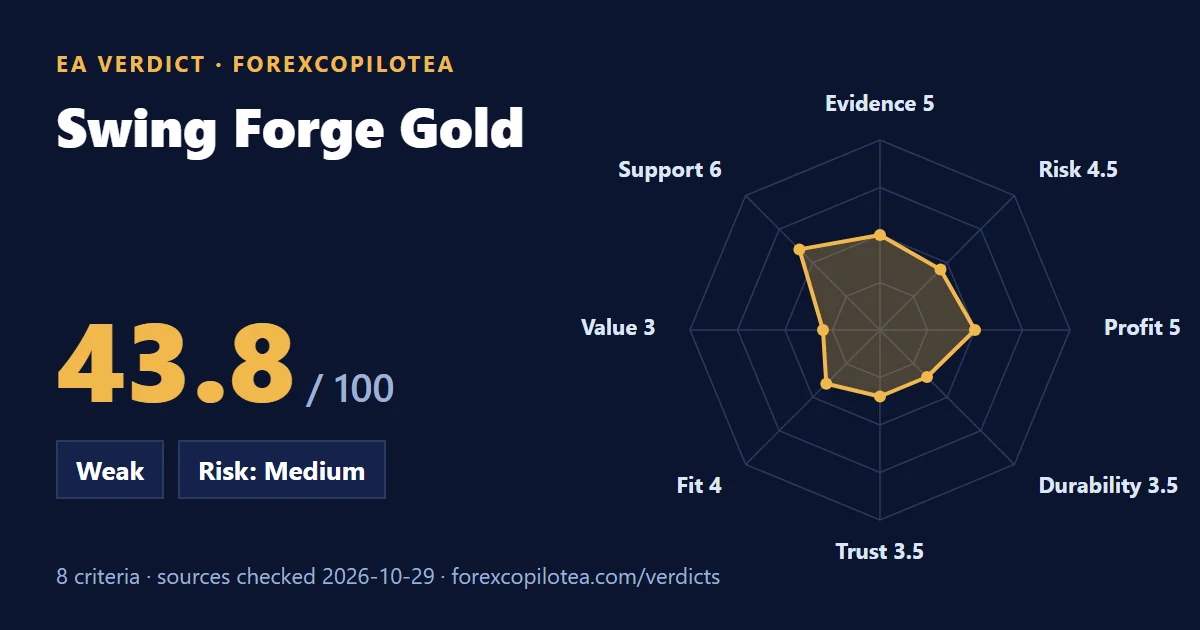
Swing Forge Gold earns points for the way it is built to be small and bounded. Every trade has a hard stop from the moment it opens, positions last well under a minute so almost nothing floats on the equity curve, and the four signals show equity drawdowns between 2.4% and 3.6%. It loses points on three things. The record is short: the oldest signal is 12 weeks old and the youngest 10. The result is sensitive to the broker: the same strategy returned a 44% win rate on one account and a 68% win rate on another. And the product changed fast: five versions in about seven weeks, one trading zone removed and another added, while the signals were running. The scorecard and radar show how the total was built.
43.8 / 100
Weighted verdict score
Weak
Verdict band
Medium
Risk label
| Criterion | Weight | Score | Best evidence | Points |
|---|---|---|---|---|
| Verified evidence | 20 | 5/10 | Grade A | 10.0 |
| Risk and drawdown behaviour | 20 | 4.5/10 | Grade A | 9.0 |
| Profitability quality | 15 | 5/10 | Grade A | 7.5 |
| Sustainability | 15 | 3.5/10 | Grade B | 5.3 |
| Transparency and trust | 10 | 3.5/10 | Grade B | 3.5 |
| Practical fit | 10 | 4/10 | Grade B | 4.0 |
| Cost and value | 5 | 3/10 | Grade B | 1.5 |
| Support and usability | 5 | 6/10 | Grade B | 3.0 |
| Total | 100 | 43.8 |
What Swing Forge Gold actually is
Swing Forge Gold is an Expert Advisor for MetaTrader 5, sold on the MQL5 Market under the name SwingForge Gold by Hanzla Khalil of Pakistan, whose seller profile (user mike12434) shows that he registered in the MQL5 community on 24 February 2026, has one product and four signals, a rating of 4.2 from 9 votes and a reputation of 733. His own bio describes a developer with four years of coding experience who builds 'a small number of comprehensive systems that combine multiple, independently-tuned strategies into a single product'. The product was published on 23 August 2026, showed version 1.14 and was last updated on 12 October 2026, with 10 activations, a rating of 4.22 from 9 reviews and 31 comments. The page reports 6 purchases per month and 557 demo downloads.
The strategy is a confirmed swing breakout on XAUUSD. The EA places pending Buy Stop and Sell Stop orders at swing highs and lows during session windows, and each trade carries a hard stop loss from the moment it fills. The listing contrasts this with 'dangerous grids, martingale, or cost-averaging' and says Swing Forge Gold was built 'on the opposite philosophy: strict risk management and pure price action'. Instead of a single rule set it runs separate 'zones', each with its own swing-depth parameters, session schedule and volatility offsets. Management is dynamic: break-even, trailing stops and a fakeout filter that cuts a trade early if the breakout fails quickly. The EA also offers equity and drawdown guards that close all trades when a daily loss or total drawdown limit is hit, and a news filter with Off, Low, Medium and High settings that pauses trading and clears pending orders.
| Item | What the vendor says |
|---|---|
| Seller | Hanzla Khalil (mike12434), Pakistan. Registered 24 Feb 2026. Rating 4.2 from 9 votes; 1 product, 4 signals. Says he deliberately limits how widely each EA is sold. |
| Price | $299 ('3 copies left, then $399'), free demo (557 downloads), 10 activations. No rental seen. |
| Strategy | XAUUSD swing breakouts with pending stop orders; separate zones with their own sessions and offsets; fakeout filter; dynamic break-even and trailing stops. |
| Risk controls | Hard stop loss on every trade; no grid, no martingale; equity and drawdown guards; news filter (Off, Low, Medium, High); minimum hold-time setting for prop firms. |
| Presets | Low Risk (recommended), Balanced and Custom (lot size, risk percent per trade, trailing points). |
| Requirements | XAUUSD or GOLD, hedging account, ECN or raw spread, leverage 1:30 to 1:500, a Windows VPS under 20 ms; minimum balance $100 at 0.01 lot, $500 or more recommended. |
| Track record | Four live signals linked from the description: Vantage, Vantage 2nd, StarTrader Live and UltimaMarkets Live. |
| Reach | Rating 4.22 from 9 reviews, 31 comments. Comments are visible to purchasers. |
| Versions | 1.14, updated 12 Oct 2026. Earlier: 1.13 (30 Aug), 1.12 (27 Aug), 1.1 and 1.01 (24 Aug). |
How we judged it, and who has something to sell
Evidence on EAs is never neutral. Here is every party near this product and what each stands to gain, ours included.
- The developer sells the EA at $299, sells copy subscriptions to each of the four signals at 99 USD a month (with no subscribers shown on any of them) and posts growth screenshots and a chat-group link in the comments. His record is public, which counts for something, and it is also his sales page.
- MQL5 and MetaQuotes host the Market, the reviews and the signals. The statistics, drawdown figures and the notices on each signal page are the platform's own.
- Buyers who wrote reviews and comments include one who alleges a fake backtest, two positive reviewers and several technical commenters. One reviewer is on the seller's friends list. Testimony, not data, and none can be checked from outside.
- ForexCopilotEA sells a listing for this EA at a different price and version. We gain if you buy it, which is why this verdict opens with that fact and applies the same rules as every other.
Evidence ladder: what each rung of proof held for Swing Forge Gold
Grade A: Independent proof
- MQL5 signals 2384955, 2387616, 2388394 and 2388396: platform-built statistics for 10 to 12 weeks and 94 to 146 trades each. The vendor runs every account, so his interest is noted, but the figures are computed from broker history and the platform's notices are its own.
- MetaQuotes and Myfxbook documentation, used for how testing reports and verified records work.
Grade B: Checkable vendor material
- The Market listing, the changelog with dates, the free demo and the manuals the author attaches to comments for versions 1.0, 1.12 and 1.13.
- The author's replies to technical comments, which are dated and specific.
Grade C: Claim only
- '217% growth in one month' and 'over 400% growth in just two months': screenshots and phrases in comments, not platform figures.
- 'With fixed lots, you will observe losses never surpassing wins': a stated design aim; two of four signals show a lower profit factor and one has more losing trades than winning ones.
- The backtest on the listing: described by the vendor, alleged to be fake by one buyer, and not readable in the page text we could open.
Grade D: Conflicted, anonymous or unverifiable
- Positive reviews that say 'performing well' without figures, and a demo test that reports a 100 USD balance reaching 476.76 USD in six days; they may be genuine and are not independently checkable.
- '3 copies left, then $399': a sales message, not a measure of quality.
Is Swing Forge Gold legit? The fake-backtest allegation and the replies
The short answer is that it is a real, working product with real broker-based signals, and that one reviewer alleges something serious. On 10 September 2026 a reviewer named Radu Bot wrote on the listing: 'Fake backtest, scam. Looks like i was wrong.' That is an allegation, it is short, it gives no figures and it does not say which backtest or which settings the reviewer used. We report it as an allegation and do not treat it as established. We did not find a public reply from the seller to that review on the page. Two other things belong in the same paragraph. The reviewer appears on the seller's friends list on MQL5, which means the two know each other; it does not tell us what the dispute is about. And in a comment on the same page, a different buyer wrote on 11 September that he did not believe the backtest results were fabricated, and attributed his poor results to execution conditions instead.
What can be tested is the live evidence, and the live evidence is not fake in the sense that matters. Four signals built by MQL5 from broker trade history show real trades with real profits and losses. The disagreement over the backtest is therefore a question about the listing's marketing material, which we could not read as text, and not about whether the EA trades. Our view is that an unanswered public allegation costs a vendor trust points even when the allegation is thin, because silence leaves a buyer unable to judge it. We do not allege wrongdoing. We list the open question under 'What we could not verify' and ask the seller in the questions below to publish tester settings so that anyone can reproduce the backtest.
Swing Forge Gold live signals: all four, number by number
A platform-computed signal is the best public evidence a vendor can show, and here there are four of them, which is more than most products offer. They still share limits: the vendor runs all four, each uses one broker, the accounts are small, and every one of them started before the current version. The table shows what each signal page displayed on 29 October 2026.
| Statistic | A: Vantage (2384955) | B: Vantage 2nd (2387616) | C: StarTrader (2388394) | D: Ultima Markets (2388396) |
|---|---|---|---|---|
| Started, age | 3 Aug 2026, 12 weeks | 21 Aug 2026, 11 weeks | 26 Aug 2026, 10 weeks | 26 Aug 2026, 10 weeks |
| Initial deposit, withdrawals | 100 USD, 341 USD | 903 USD, 1,358 USD | 100 USD, 0 USD | 100 USD, 0 USD |
| Growth, profit | +71.77%, 442.94 USD | +166.77%, 1,464.38 USD | +118.57%, 118.57 USD | +95.12%, 95.12 USD |
| Balance | 201.94 USD | 1,009.38 USD | 218.57 USD | 195.12 USD |
| Trades, win rate | 146, 67.80% | 118, 65.25% | 94, 57.44% | 95, 44.21% |
| Profit factor, expected payoff | 2.42, 3.03 USD | 2.10, 12.41 USD | 1.84, 1.26 USD | 1.66, 1.00 USD |
| Average win, average loss | 7.63, minus 6.64 USD | 36.28, minus 32.41 USD | 4.82, minus 3.54 USD | 5.72, minus 2.74 USD |
| Best, worst trade | 33.35, minus 26.40 USD | 124.45, minus 110.75 USD | 21.03, minus 13.20 USD | 12.93, minus 13.40 USD |
| Max drawdown by balance | 23.01% (78.71 USD) | 20.78% (336.03 USD) | 28.47% (41.74 USD) | 29.71% (42.06 USD) |
| Drawdown by equity (relative) | 2.38% (4.98 USD) | 3.59% (38.18 USD) | 3.48% (4.06 USD) | 3.52% (4.10 USD) |
| Leverage, algo-trading share | 1:500, 100% | 1:2000, 97% | 1:500, 100% | 1:500, 100% |
| Long and short trades | 78 and 68 | 51 and 67 | 31 and 63 | 31 and 64 |
| Profit factor basis: gross profit and loss | 755.24 and minus 312.30 USD | 2,793.18 and minus 1,328.80 USD | 260.07 and minus 141.50 USD | 240.29 and minus 145.17 USD |
| Sharpe ratio, recovery factor | 0.42, 5.63 | 0.35, 4.36 | 0.28, 2.84 | 0.22, 2.26 |
Common to all four: the signals hold a trade for 43 to 49 seconds on average, make about nine trades a week, show trading activity between 0.02% and 0.35%, trade only gold and list a monthly price of 99 USD to copy with zero subscribers. The maximum deposit load stays between 41% and 49%, which is large for a system that is mostly flat: it reflects the margin used while a trade is open on a small account.
Read the table in three ways. First, every signal is profitable and every signal has a profit factor above 1.6, which is a real and verified result. Second, the numbers are small: the four accounts together made about 2,121 USD of profit in 10 to 12 weeks, 1,464 USD of it on the one account that started with 903 USD and ran at about 2.25% risk per trade according to its description. Third, the same strategy on four brokers produced a 44% win rate in one place and 68% in another. The edge, in other words, is not just in the strategy; it is in how and where the orders are filled.
The signal pages also contain inconsistencies that deserve a plain mention. On each signal the maximum consecutive wins and losses in the statistics table differ from the figures in the chart text beside it: signal A lists 7 consecutive losses in one place and 3 in another, and signals B, C and D do the same. We do not know why, and we treated the platform's statistics table as the primary figure. It is a small flaw in the presentation, not evidence of manipulation, but it is the sort of detail you would want explained before paying for an unseen backtest.
- B: Vantage 2nd20.8%
336.03 USD on a 903 USD start
- A: Vantage23.0%
78.71 USD on a 100 USD start
- C: StarTrader28.5%
41.74 USD
- D: Ultima Markets29.7%
42.06 USD
Swing Forge Gold results: the marketing figures against the platform figures
The seller posts often. On 29 August 2026 he wrote '217% Growth in one month' with a screenshot; on 7 October he wrote 'We have achieved over 400% growth in just two months. More to go'. Those figures are not invented from nothing, but they are computed differently from MQL5's, and the difference matters. Signal A started with 100 USD, has made 442.94 USD of profit and has had 341 USD withdrawn. Profit of 442.94 USD on a 100 USD deposit is 443% of the deposit, which is where '400% growth' comes from. MQL5's own Growth figure for the same signal is 71.77%, because the platform compounds growth over the changing balance and the withdrawals reduce the base. Both numbers are arithmetically honest. Only one of them tells a buyer how an account that was left alone would have grown.
The platform itself has commented on the pace. Signal A carried the warning 'Too much growth in the last month indicates a high risk' from 7 October until 28 October, a note on high average monthly growth earlier in its life, and the notice 'Trading style has changed. Part of history is not included in statistics.' Signals C and D carry notes that 80% of their growth came within one to three days: signal C's note, dated 22 September, said 80% of the growth was achieved within 1 day, 3.45% of 29 days; signal D's said 80% came within 3 days, 4.62% of 65 days. A system that makes most of its money on a handful of days is a breakout system behaving as designed. It also means that a buyer who starts during a quiet stretch will see a very different curve from the one on the screenshot.
One more set of numbers belongs here. Monthly growth is shown at 44.14%, 38.26%, 38.76% and 43.58% across the four signals. MQL5 offers these as descriptive, and no sensible buyer should read them as a rate to expect: a 100 USD base makes any percentage easy to produce, and the platform's own warnings say the pace indicates risk. The right comparison is not the percentage but the profit factor and the expected payoff per trade after your own costs.
Swing Forge Gold slippage and spread: the problem a 45-second trade cannot hide
The most useful single piece of evidence on the listing is a technical comment, not a review. On 11 September 2026 a buyer wrote that he did not think the EA was at fault and did not think the backtest was fabricated, but that execution conditions had become hard for breakout-style scalpers. With the default stop of 225 points, he reported a maximum slippage of 170 points and an average of 55 points on his broker, which also kept a 9-point spread. A trade that slips 170 points leaves 55 points before the stop. He observed the same on highly rated ECN brokers such as IC Markets. The author replied that the stop is anchored to the fill or the signal price, so that if it is the fill, the 225 points move with the slippage, and added: 'Your wider point stands though - the stop is small relative to gold's short-interval range. I'm working on trailing logic / wider stop with adjusted sizing.'
Put the numbers together. A 225-point stop on gold is about 2.25 dollars of price movement when a point is one cent, which is a short distance for an instrument that routinely moves several dollars in minutes around news and session opens. A pending buy-stop order is filled at the next available price once price crosses its level; in a fast move that price can be well beyond the level. The average slippage of 55 points the buyer reports is 24% of the stop distance before any spread is counted. Add a 9-point spread and a trade starts with roughly a third of its risk budget gone. That is the mechanism behind a win rate of 44% on one broker and 68% on another: the strategy's entries are identical, but the fill, the spread and the break-even trigger are not.
The author's version history points the same way. Version 1.13 on 30 August made break-even and trailing stops adjust to the spread, 'fixing early BE on wide-spread brokers'. Version 1.14 on 12 October added an on-by-default option to add the average spread to break-even and trailing. Another commenter, Jun Ito, wrote on 25 August that he kept being stopped out by his broker and asked whether the stop could be hidden, and later said it worked on a variable-spread broker if he subtracted the spread from the trailing-stop start. These are real fixes to a real sensitivity. They are also admissions that the first builds did not fit every broker, and that a buyer on an unlucky broker may meet the same behaviour. Three of the four signals carry the platform notice 'High risk of negative slippage when copying deals'.
How a pending-order breakout system makes and loses money
A breakout system waits for price to leave a recent range and tries to ride the first move. Swing Forge Gold defines the range by swing highs and lows, places a stop order a little beyond each, and lets the market trigger whichever side moves first. If the order fills and price keeps going, break-even and the trailing stop lock in a small gain; if price returns, the fakeout filter cuts the trade early, and the hard stop caps the loss. Because gold is volatile at session opens, the zones are tied to session schedules so that the orders are live when moves are likely and off when they are not.
The signals show the shape this produces. A win rate of 44% to 68%, an average win of 7.63 USD against an average loss of 6.64 USD on signal A, and 36.28 USD against 32.41 USD on signal B, give a payoff ratio close to one. This is not the high-win-rate, big-loss profile of an averaging system and it is not the low-win-rate, big-win profile of a pure trend follower. It is a middle path: the edge is a modest tilt in the win rate, which is why one broker's slippage can erase it. On signal D, a win rate of 44.21% with an average win of 5.72 USD and an average loss of 2.74 USD gives an expected payoff of 1.00 USD per trade; if the average loss grew to 4.50 USD with the same win rate, the payoff would drop to about minus 0.04, and the edge would be gone.
Pending breakout orders also have a well-known hazard that the commenters touched on: orders that are placed and cancelled repeatedly. Buyer Shahid Saghir reported on 16 September that on two XAUUSD charts with different magic numbers the EA kept placing and cancelling stop orders, and that break-even moved the stop to 30 points below the buy price, so that break-even produced a small loss. He also noted an initial stop of 500 points plus 30, which differs from the 225-point default another buyer quoted, so settings differ between presets and versions. The author answered that no input existed for that purpose, that he would add one on returning home, and that he would examine running on multiple charts. Version 1.13 reduced the number of orders and 1.14 lets the panel show why a zone is not armed, which are the kind of changes you would expect in response, though we could not confirm that this specific issue was closed.
Interactive: win rate is not edge
- Expected result per trade
- +0.35
- Profit factor
- 1.64
- Break-even win rate
- 33%
At these numbers the system has a positive edge before costs. Add spread, commission and slippage per trade and re-check.
Update history: five versions in seven weeks
The changelog is a useful, honest document, and it also tells you how settled the product is. Version 1.01 and 1.1 on 24 August fixed brokers that name gold 'GOLD' and removed false 'trading disabled' alerts. Version 1.12 on 27 August changed the news filter timings from stopping new trades 100 minutes before news to 30, resuming after 20 minutes instead of 60, and closing open trades 10 minutes before news instead of 100. It also added a 'no re-entry on used levels' option, which the author says reduces the number of trades while increasing the win ratio, and adjusted the entry levels of the Flint zone. A comment from the author on 27 August said that after losses caused by a bug fixed in 1.12, all losses were recovered with a profit in one day.
Version 1.13 on 30 August added a new zone, Ember, as the eighth, cut the number of orders, made break-even and trailing stops adjust to the spread, made closing more reliable, added settings for broker GMT winter and summer time, introduced a new panel showing spread, slippage and execution time, and removed a 'max slippage' input because it had no effect on pending orders. Version 1.14 on 12 October removed Flint, added Zenith, turned the news filter on by default at high impact only, added a trade-comment input with the default 'SFG', and removed false pop-ups about AutoTrading and the investor password. The notes tell users to remove the EA from the chart and attach it again, and to make sure no pending Flint order remains.
Two readings of this are fair. The first is positive: the author ships fixes quickly, writes specific notes and removes inputs that do not work. The second is cautious: in seven weeks the core logic changed twice, a trading zone was swapped out, and the default news behaviour flipped from off to on. The signals run across those changes; signal A even carries a platform note that the trading style has changed and part of its history is excluded. Signals A and B were described as running with the news filter off, around 2.25% risk per trade and some manual trades; signals C and D ran the default low-risk preset at 0.01 lots per 100 USD. A buyer on version 1.14 therefore runs a different configuration from every signal, and none of the four records belongs to the exact product on sale. That is the largest single gap in the evidence.
The seven zones, or eight: what the listing says and what the changelog says
The listing is internally inconsistent about the product's central feature. A heading says 'The 7 Forge Zones', the text beneath says '8 independent, specialized trading zones', and it names eight: Crest, Anvil, Ridge, Spark, Forge, Crown, Flint and Ember. The changelog explains part of this: Ember became the eighth zone in 1.13, and 1.14 removed Flint and added Zenith, which keeps the count at eight but changes the list. The description still names Flint and does not mention Zenith. One signal description says 'All 7-zone Enabled', which dates from before Ember.
This is a small point with a practical consequence. A buyer reading the description will think the product contains Flint, a zone that the current version has removed, and will not know what Zenith does. Because each zone has its own sessions, swing depth and offsets, the zone list is the strategy; a stale description means the one document that should explain the strategy is out of date. The author's manuals for each version, attached to comments, are the more reliable source, but comments are visible to purchasers only, so a prospective buyer cannot read them before paying. The free demo, which runs in the strategy tester, is the one way to see the current zones in action first.
Swing Forge Gold drawdown and risk: a small equity swing, a larger balance one
The design is bounded. Every trade has a stop, nothing is averaged, positions live for under a minute and the worst single trade across the four signals was minus 110.75 USD on the 903 USD account, a little over 12% of its starting balance but about 11% of its peak balance, set by its larger lot size. On the 100 USD accounts the worst trade was 26.40, 13.20 and 13.40 USD. The equity drawdown figures are tiny, 2.4% to 3.6%, precisely because trades are too short to float for long. That is why the label is Medium and not High.
The balance drawdown tells the other half of the story. Balance counts only closed trades, so a 29.7% balance drawdown on signal D means that losing trades, one after another, took nearly a third off the realised balance at one point. Signal D's longest losing run in the statistics table is 12 trades, signal C's 8 and signals A and B's 7, though the chart text beside them says 3, which we flagged above. A system that fills at 44% win rate on a bad broker can string losses together, and the stop sizes mean each loss is small but the count is high. With tiny stops, the cost of a bad stretch comes from frequency and spread, not from one large loss.
- Execution risk. Slippage and spread decide whether the edge exists on your account. The same strategy shows 44% to 68% win rates on four brokers.
- Balance drawdown. Expect 20% to 30% of realised balance to be lost at some point; the signals have done it within 10 to 12 weeks.
- Version risk. Five versions in seven weeks, with core logic changes. The record you read belongs to earlier builds.
- Settings risk. Signals A and B ran at about 2.25% risk per trade with news off; the default Low Risk preset is much milder. Pick lots from the preset you test, not from the screenshot.
- Broker and leverage risk. The listing's range is 1:30 to 1:500; signal B ran at 1:2000, which MQL5 does not allow subscribers to copy. Leverage above your jurisdiction's limit is a regulatory matter as well as a risk one.
- Support risk. On 16 September the author said he was on a family trip with no internet for one to two weeks. A system that needs fast fixes needs a vendor who is reachable; plan for gaps.
Interactive: drawdown recovery
Gain needed to get back to break-even
+42.9%
Blue: equity left. Red: equity lost.
Consecutive losing trades to reach this drawdown: 36
What buyers say: three readable reviews and the comments
The listing shows a rating of 4.22 from 9 reviews. We could read three, and star ratings were not exposed in the page text. The first, from 10 September, is the allegation discussed above. The second, from 25 September, by Mahnoor28, says she is 'really happy' so far, that the EA has been 'performing well on my account, with good trade management and encouraging results', and that Mr Khalil's support was helpful and responsive; it gives no figures. The third, from 7 October, by Anganie sarabjit, says the buyer bought on 1 October, ran it on a demo account starting at 100 USD, and had 476.76 USD six days later, noting that it does not trade every hour 'but when it takes a trade so far it is a good one', and promising an update at the end of October. That is a demo, over six days, and a rise of 376%, which is a number about a demo account and not evidence of what live money does.
The comments are more informative than the reviews. Comment 22 on slippage is the most careful piece of analysis on the page. Comment 17 reports repeated 'This account does not allow trading (investor password?)' messages, which the author's 1.14 notes describe as false pop-ups now removed. Comment 29, on 7 October, says it was a 'beautiful lovely breakout' day with good profits on a live account, with a screenshot. Comment 3 asks whether the stop can be hidden because the broker keeps stopping the buyer out; the author's reply was 'Dm me please'. We saw no refund demands in the comments. The six reviews we could not open could change this picture in either direction.
Swing Forge Gold price: $299 on the Market, $26.99 in our store
The Market price on 29 October 2026 was $299, with the listing saying '3 copies left, then the price will be increased to $399' and describing $299 as a discount. The page shows 10 activations and about 6 purchases a month, so 'three copies left' is a scarcity message and cannot be tested from outside. The seller's profile says he deliberately limits distribution and that this is 'not a marketing gimmick'; we have no way to confirm either the limit or the motive, and we note that scarcity wording is a standard sales device that rewards quick decisions, the opposite of what a 10-to-12-week record calls for. The free demo has 557 downloads and costs nothing.
Set the price against the evidence. The four signals together earned about 2,121 USD in 10 to 12 weeks, mostly on one account of 903 USD that ran at higher risk and later had 1,358 USD withdrawn. A buyer at $299 plus a VPS needs a broker with fills as good as the best signal's to approach those figures, and the signals do not prove they would. The price is not outrageous for a gold EA with a manual and a responsive author, and it is high against a record this short.
| Item | MQL5 Market | ForexCopilotEA listing |
|---|---|---|
| Version | 1.14, updated 12 Oct 2026 | 1.13 |
| Price and terms | $299 (stated rise to $399); free demo; 10 activations | $26.99 one-time with lifetime updates; all sales final, no refunds; no demo |
| What ships | Compiled EA, manual for each version (attached to comments), support from the author | Compiled .ex5 file only: no setfile, no user manual, no source |
| Description | Zones, presets, requirements and a changelog | Generic template text with no zones or strategy detail; risk bullets on false breakouts, spread, slippage and wide stops |
| Reviews | 4.22 from 9 reviews, 31 comments | New listing, no product reviews yet; the Trustpilot widget (4.2 from 10 reviews) is store-wide, not about this product |
Our listing is a different purchase. It is at an earlier version than the one the Market sells, so it lacks the changes in 1.14, including the news filter default and the Zenith zone; it comes without a manual that the author publishes for each version; and the licence and provenance under which it is sold cannot be verified by us from public information. We do not allege piracy, and we are not stating that there is a problem; we are stating that we cannot verify. A buyer should weigh that, together with the missing author support that comes with a Market licence, before choosing our price over the Market's. Read our listing and the gold EA category with that in mind.
Setup and broker: what Swing Forge Gold needs to run as designed
The requirements are specific. The EA runs on XAUUSD or GOLD, on a hedging account, with leverage between 1:30 and 1:500, ECN or raw spread, and a Windows VPS with latency under 20 ms. The minimum balance is stated as $100 at 0.01 lot with $500 or more recommended. The author says it was optimised on Vantage and also tested on StarTrader, Ultima Markets and TMGM, 'results vary with spread, so always backtest on your own broker first'. The listing also says the zones are not optimised for prop firms and advises a minimum hold-time setting of two minutes or more for them; with an average holding time of 43 to 49 seconds, that setting would change the strategy's behaviour, so we would not treat a prop-firm challenge as a good fit.
Choose a broker for fills. A raw-spread account with predictable commission, a low-latency VPS close to the broker's server and a broker with a proven record of filling stop orders near their level are worth more than a bigger welcome offer. Set the broker's GMT offset in the EA correctly, since 1.13 added winter and summer settings and sessions depend on it, and decide on news filter strength before the first trade. Run the demo for at least a month across several session opens and record your own average slippage and win rate; those two numbers will tell you more than any of the four signals. For background on how to read a tester report when you do, see our guide to reading an MT5 backtest report.
The score, criterion by criterion: 43.8 out of 100
| Criterion | Score | Points | Why |
|---|---|---|---|
| Verified evidence (weight 20) | 5 / 10 | 10.0 | Four platform-built MQL5 signals, 10 to 12 weeks old, with 94 to 146 trades each; but all four are run by the vendor on accounts of 100 to 903 USD, two have withdrawals or manual trades, the histories span a changed trading style and a version that is no longer the one on sale, and no backtest figures are published in the text. |
| Risk and drawdown behaviour (weight 20) | 4.5 / 10 | 9.0 | A hard stop on every trade, no grid or martingale stated and equity drawdowns of only 2.4% to 3.6%; but balance drawdowns of 21% to 30% on all four signals, a buyer-measured slippage of up to 170 points against a 225-point default stop, and three signals flagged for negative-slippage risk. |
| Profitability quality (weight 15) | 5 / 10 | 7.5 | Verified profit factors of 1.66 to 2.42 and positive expectancy on all four signals; but win rates range from 44% to 68% on the same strategy, growth is concentrated in a few days on two signals, and withdrawals and deposits distort the headline growth figures. |
| Sustainability (weight 15) | 3.5 / 10 | 5.3 | Closed zone logic, a seller who joined MQL5 in February 2026 with one product, five versions in seven weeks that swapped a trading zone and flipped the news-filter default, and a record that does not cover one full market regime. |
| Transparency and trust (weight 10) | 3.5 / 10 | 3.5 | A manual for each version and candid author replies on slippage; against that, the manuals sit in purchaser-only comments, an unanswered fake-backtest allegation, a '3 copies left' price message, growth claims above the platform figures and a description that still names a removed zone. |
| Practical fit (weight 10) | 4 / 10 | 4.0 | Gold only, a hedging account with raw or ECN spread, a low-latency VPS under 20 ms and a broker whose slippage on gold stops is tolerable; the author states the zones are not optimised for prop firms, and one signal ran at a leverage the platform does not allow subscribers to copy. |
| Cost and value (weight 5) | 3 / 10 | 1.5 | $299, with a stated rise to $399, against four signals totalling about 2,121 USD of profit on small accounts in 10 to 12 weeks; a free demo with 557 downloads is the mitigation. |
| Support and usability (weight 5) | 6 / 10 | 3.0 | A free demo, a manual for each version, a changelog that explains fixes and an author who replies to technical comments; against that, a one-to-two-week absence in September and a multi-chart issue that was acknowledged but not yet resolved. |
The total is 43.8 out of 100. The grade A on evidence is earned by four platform-built signals; the score stays at 5 because each is under 12 months, all are run by the vendor, two show growth concentrated in a few days, withdrawals distort the first two, and none belongs to the version on sale. Risk, at 4.5, gives credit for a hard stop on every trade and equity drawdowns near 3%, and loses it for balance drawdowns of 21% to 30% and a stop that real slippage can swallow. Profitability, at 5, rests on profit factors from 1.66 to 2.42 that vary too much between brokers to be called repeatable. Sustainability and trust sit at 3.5 because the logic is closed, the design changed in seven weeks, the manuals are behind a purchase and an allegation is unanswered.
Who Swing Forge Gold fits, and who it does not
- It fits a trader who can run a low-latency VPS on a raw-spread gold account, will test fills on a demo for a month, starts on the Low Risk preset and treats the vendor's signals as a sample of one broker each.
- It does not fit a trader whose broker has wide or variable gold spreads and heavy slippage on stop orders, or someone who needs a long verified record before paying.
- It is a poor fit for prop-firm challenges: the author says the zones are not optimised for them, and a 45-second holding time clashes with the minimum-hold rules some firms apply.
- It is a poor choice for a buyer who is paying mainly because three copies are said to remain at $299. Run the free demo first, and watch the signals for another quarter.
How it compares with other gold EAs we have scored
Next to Gold House and Gold Snap, Swing Forge Gold is a younger record with several signals instead of one deeper one; its advantage is breadth across four brokers, and its weakness is that the breadth shows how much the result depends on the broker. Its 43.8 reflects strong trade-level controls and thin evidence of durability. For how these system types differ, see our strategy comparison, and for how to treat a short live record against a backtest, see our guide to backtest versus live results.
Questions to put to the developer before you pay
- Can you publish the backtest settings, the broker, the tick model and the tester report so anyone can reproduce it, and reply publicly to the fake-backtest review?
- Which version, preset, lot size and news setting does each of the four signals run, and which one matches the current Low Risk preset?
- How do the default stop of 225 points and the break-even trigger behave when slippage averages 55 points, and when will the wider stop and adjusted sizing you mentioned be released?
- Was the multi-chart order placement and cancellation issue reported in September fixed, and in which version?
- Why do the maximum consecutive wins and losses in the statistics tables differ from the chart text on the signal pages?
- What does Zenith do, why was Flint removed, and will the description be updated to match?
- Will manuals be available before purchase, and what is the policy for the price after the stated 3 copies?
Sources and when they were opened
- MQL5 Market: SwingForge Gold (product 192062), opened 29 October 2026Source of the price, version, zones, presets, requirements, readable reviews and the comments quoted. Written by the vendor and by buyers.
- MQL5 Market: SwingForge Gold, version history, opened 29 October 2026Source of every dated change from version 1.01 to 1.14.
- MQL5 Signals: SwingForge Gold (signal 2384955), opened 29 October 2026Vantage account. Source of the figures in column A and the platform notices quoted. The vendor operates the account.
- MQL5 Signals: SwingForge Gold 2nd Signal (signal 2387616), opened 29 October 2026Vantage account at 1:2000 leverage. Source of column B. The vendor operates the account.
- MQL5 Signals: SFG StarTrader (signal 2388394), opened 29 October 2026StarTrader account. Source of column C and the 80%-of-growth notes. The vendor operates the account.
- MQL5 Signals: SFG UltimaMarkets (signal 2388396), opened 29 October 2026Ultima Markets account. Source of column D and the 80%-of-growth notes. The vendor operates the account.
- MQL5 community: seller profile mike12434, opened 29 October 2026Source of the registration date, product and signal counts, rating and the seller's statements about his method and distribution.
- ForexCopilotEA store listing: Swing Forge Gold EA v1.13 MT5, opened 29 October 2026Source of our version, price, what ships and the description. We are the seller of this listing.
- Myfxbook Help: VerificationHow a trading account's track record is verified on Myfxbook.
- MetaTrader 5 Help: Testing ReportWhat each figure in the tester's report means, including drawdown.
- MetaTrader 5 Help: Strategy TestingThe Strategy Tester: testing modes, settings and forward testing.
- ESMA: ESMA agrees to prohibit binary options and restrict CFDs to protect retail investorsThe EU leverage limits, margin close-out, negative balance protection and risk-warning rules for retail CFD accounts.
- CFTC Customer Advisory: AI Won't Turn Trading Bots into Money MachinesA US regulator's warning about trading-bot claims of unusually high returns.
Frequently asked questions
Is Swing Forge Gold EA legit?
It is a real, working product with a manual for each version, four public MQL5 signals of 94 to 146 trades and an author who answers technical questions, rated 4.22 from 9 reviews on the MQL5 Market. One reviewer alleges a fake backtest and we found no public reply; we report that as an allegation and do not treat it as established. The records are 10 to 12 weeks old, which is why it scores 43.8 out of 100 with a Medium risk label.
Does Swing Forge Gold use martingale or a grid?
The listing says no grid, no martingale and no cost-averaging, and that every trade has a hard stop loss from the moment it opens. The signals are consistent with that: the worst trade on any of them was minus 110.75 USD on a 903 USD account, and the average loss is close to the average win. We cannot read the code, so this rests on the listing and the signals.
How much does Swing Forge Gold cost?
The MQL5 Market price on 29 October 2026 was $299, with a stated rise to $399 after three more copies and a free demo. A Windows VPS and a raw-spread gold account are extra. Our own store lists a Swing Forge Gold EA v1.13 at $26.99 as a compiled file with no setfile, manual or source; it is a separate purchase and we cannot verify its licence terms.
What is the Swing Forge Gold drawdown?
On the four vendor-run signals the maximal drawdown by balance was 23.01%, 20.78%, 28.47% and 29.71%, while the relative drawdown by equity was only 2.38% to 3.59%, because trades last about 45 seconds. Expect realised-balance drawdowns of 20% to 30% to be possible.
Does Swing Forge Gold work on prop firm accounts?
The author says the zones are not optimised for prop firms and suggests a minimum hold-time setting of two minutes or more, while the signals average 43 to 49 seconds per trade. The Low Risk preset is described as suitable for challenges, but we would not rely on that without a long demo.
What broker does Swing Forge Gold need?
XAUUSD or GOLD on a hedging account with ECN or raw spread, leverage from 1:30 to 1:500 and a Windows VPS under 20 ms. It was optimised on Vantage and tested on StarTrader, Ultima Markets and TMGM. The same strategy showed win rates from 44% to 68% across those brokers, so test your own broker's fills first.
Is Swing Forge Gold profitable live?
All four vendor-run signals are in profit after 10 to 12 weeks, with profit factors from 1.66 to 2.42 and about 2,121 USD of combined profit on small accounts. The sample is short, the vendor runs every account, and the signals pre-date the current version 1.14.
How was the score calculated?
Eight weighted criteria (evidence 20, risk 20, profitability 15, sustainability 15, trust 10, fit 10, cost 5, support 5), each scored out of ten against written anchors. Sources are graded A to D and unverified claims cannot count as proof. We sell a listing for this EA, which is disclosed at the top. The total here is 43.8 out of 100.
Gold Expert Advisors in our store
We sell these, so weigh that interest. Put the same eight questions to any of them before you buy: read the manual, run your own backtest, and start on demo.



Keep reading
- EA Verdict #12Gold House EA Review: Verdict and Risk (2026)Is Gold House worth $749? Independent EA verdict: 52.3/100, Medium risk. Two live MQL5 signals, 68 reviews and a rising price ladder scored, checked 28 Oct 2026.
- EA Verdict #9Gold Snap EA Review: Verdict and Risk (2026)Is Gold Snap worth $399? Independent EA verdict: 56.0/100, Medium risk. Three live signals, 31 reviews and a backtest dispute scored, checked 21 Oct 2026.
- Risk managementEA in Drawdown: What to Do (and What Not to Do)What to do when your Expert Advisor is in drawdown: separate normal from broken, check the logs, compare with the backtest, and decide to hold, reduce or stop.
- BacktestingWhy EA Live Results Differ From Backtests (and What to Do)Why EA live results differ from backtests: spread, slippage, delay, data, overfitting and more. Eleven causes, how to check each and how to close the gap.
- Strategy comparisonWhich EA Strategy Wins Long Term?Compare MT5 Expert Advisor strategy types, from scalping and grid to hedging and arbitrage: how each earns, how each fails, and which tend to survive long term.