
EA Verdict
Lizard EA Review (2026): A Six-Strategy Gold Breakout EA With 25 Releases in 21 Weeks and No Live Record Left to Check
By Benjamin Lee · Updated · 40 min read
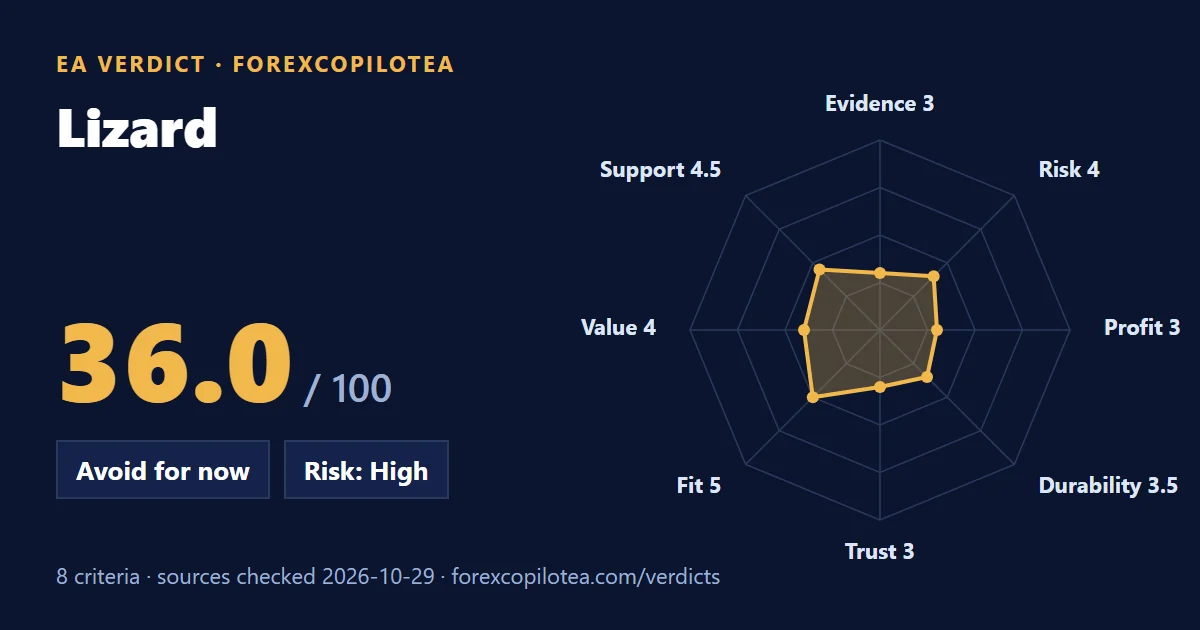
Lizard EA is a gold Expert Advisor for MetaTrader 5 that looks for swing highs and swing lows on the H1 chart of XAUUSD and places buy stop and sell stop orders beyond them, running six independent breakout strategies at once. It says it uses no martingale, no grid and no averaging, puts a stop loss and take profit on every trade and costs 99 USD on the MQL5 Market. The trouble with this Lizard EA review is what is missing: the live signal that helped sell the product was stopped on the seller's own account of events and has since been deleted, the description publishes no performance figure, and the reviews split between buyers who report steady weeks and buyers who report a 30% loss in one day. We read the listing, the 30-plus version changelog, the 20 reviews that load and the comments, and scored Lizard on the same eight criteria as every verdict here. The result is 36.0 out of 100, the band Avoid for now, and a High risk label: a real, actively changed product with a very wide parameter surface and no record an outsider can verify.
Key takeaways
- Lizard EA scores 36.0 out of 100 (band: Avoid for now) with a High risk label. Evidence is capped at 3 out of 10: there is no verified live record, so nothing it earns can be treated as proof.
- The signal that sold the product is gone. The seller cited MQL5 signal 2372821 in September 2026, and on 29 October 2026 MQL5 answered 'trading signal not found'. On 5 October 2026 the seller wrote that he stopped the signal because he is 'no longer actively pushing the EA sales'.
- The Market listing shows version 2.1 (4 October 2026), a rating of 4.07 and a price of 99 USD. Of the 20 reviews we could read, 12 gave five stars and 6 gave one or two; every low review cites live losses, stop-outs or the missing signal.
- Buyers allege that version 1.86 did not block trades at the 12 August 2026 CPI release even with the news filter switched on, and that losses of 25% or more followed under default settings. The developer disputes this and attributes losses to settings; version 1.87 was released the same day with a 'fixed news calendar filter'.
- We sell a listing for Lizard. Ours is version 1.85 at 26.99 USD with the compiled file only, against 2.1 at 99 USD on the Market, eight named releases behind. Treat it as a separate purchase with its own price and terms.
- 36.0 / 100
- weighted verdict score on eight published criteria
- 0 signals
- seller profile on 29 Oct 2026: the cited signal 2372821 returns 'not found'
- 25+ versions
- released between 14 May and 4 Oct 2026, from 1.20 to 2.1
The Lizard EA verdict at a glance: an active product with no record to check
Lizard earns points for being a transparent kind of machine. A breakout EA that waits for a swing level to be crossed, with a defined stop loss and take profit on each trade, is a design a trader can reason about, and the developer answers technical questions in public. It loses points on nearly everything that can be tested. There is no verified signal, no Myfxbook record, no performance figure in the description, and a changelog that shows the strategy set, the defaults and the news logic being rebuilt every week. A buyer in October 2026 is therefore buying version 2.1 on the strength of reviews, most of which describe weeks, not seasons. The scorecard and radar show how the total was built.
36.0 / 100
Weighted verdict score
Avoid for now
Verdict band
High
Risk label
| Criterion | Weight | Score | Best evidence | Points |
|---|---|---|---|---|
| Verified evidence | 20 | 3/10 | Grade B | 6.0 |
| Risk and drawdown behaviour | 20 | 4/10 | Grade C | 8.0 |
| Profitability quality | 15 | 3/10 | Grade C | 4.5 |
| Sustainability | 15 | 3.5/10 | Grade B | 5.3 |
| Transparency and trust | 10 | 3/10 | Grade B | 3.0 |
| Practical fit | 10 | 5/10 | Grade B | 5.0 |
| Cost and value | 5 | 4/10 | Grade B | 2.0 |
| Support and usability | 5 | 4.5/10 | Grade B | 2.3 |
| Total | 100 | 36.0 |
What Lizard EA actually is
Lizard is an Expert Advisor for MetaTrader 5, sold on the MQL5 Market by Marco Scherer of Switzerland, trading under the name Masthetics. His seller profile shows a 4.2 rating from 91 votes, three products, zero signals, zero subscribers, 2,687 demo versions across the range and an experience label of 'no experience'. Lizard was published on 9 May 2026, showed version 2.1 and was last updated on 4 October 2026. The page lists 15 activations (a limit set by the seller, not a count of users), 6,621 demo downloads, a rating of 4.07, 71 reviews and 323 comments, and reports 34 purchases per month. Support runs through a moderator called Zolia, whom the seller described on 20 July 2026 as based in Taiwan, with responsibilities divided inside the team. A regular and well-informed defender in the comments, Mercier Guillaume Patrick, answers many questions; the page does not say how he relates to the seller, so we treat his posts as those of an interested community member.
The strategy statement is specific. The EA identifies key swing highs and swing lows on the H1 chart and places pending buy stop and sell stop orders at calculated entry points. An order is triggered only by an actual breakout; simply touching the price is not enough. Six independent strategies run at once on H1, each with its own stop loss and take profit, its own trailing system, its own magic number and its own risk weighting, from short intraday breakouts to multi-day swing setups. Strategy activation depends on the balance: up to 1,000 USD, zone A is active, and from 1,001 USD zones A and B both trade. The exit system combines break-even, trailing stop loss, trailing take profit and a step-based trail. A virtual stop loss closes positions in software, independently of the broker. Per-strategy time filters block hours where the strategy's historical profit factor was below 1.0, a news filter pauses around US Non-Farm Payrolls, pending orders are cleaned up before the daily close, and an input caps the maximum daily loss in 'prop firm' style.
| Item | What the vendor says |
|---|---|
| Seller | Marco Scherer (Masthetics), Switzerland. Seller rating 4.2 from 91 votes; 3 products, 0 signals. Support moderator Zolia; community on Telegram and Discord. |
| Price | 99 USD to buy on 29 Oct 2026, with a free demo (6,621 downloads) and a rental option whose price was not visible in the page text. 15 activations. |
| Strategy | XAUUSD, H1 only. Swing-high and swing-low breakouts through buy stop and sell stop orders; six independent strategies; balance-based zones. |
| Risk controls | Defined stop loss and take profit on every trade; no martingale, grid or averaging; break-even and three trailing layers; virtual stop loss; maximum daily loss input; time, session, fakeout and news filters. |
| Requirements | MetaTrader 5, one XAUUSD H1 chart, minimum balance 250 USD, hedging account, ECN or RAW recommended, leverage 1:100 or more, VPS strongly recommended. |
| Track record | None in the description: no backtest figure, no signal link, no default risk or stop size stated. |
| Reach | Rating 4.07, 71 reviews (the page data counts 60 ratings), 323 comments. |
| Versions | 2.1, updated 4 Oct 2026; 25 or more releases since 1.20 on 14 May 2026. |
How we judged it, and who has something to sell
Evidence on EAs is never neutral. Here is every party near this product and what each stands to gain, ours included.
- The developer sells Lizard (and two other products), runs the Telegram and Discord communities, and wrote on 5 October 2026 that he is no longer actively pushing sales. His profile also carries a promotion for a third-party offer. His comments are testimony from the party who earns from the sale.
- MQL5 and MetaQuotes host the Market, the reviews, the comments and the signals. The 'not found' page for the cited signal is the platform's own statement.
- Support and community helpers answer most technical questions. One of them, Mercier Guillaume Patrick, also quoted backtests and results; his relationship to the seller is not stated, so we report his posts as community testimony.
- Buyers who wrote reviews split in two. Some say they are profitable; others report losses. We could read 20 of 71. All are testimony, and some reviewers have their own products to sell.
- ForexCopilotEA sells a listing for this EA. We gain if you buy it, which is why this verdict opens with that fact and applies the same rules as every other.
Evidence ladder: what each rung of proof held for Lizard
Grade A: Independent proof
- Nothing for Lizard itself. MQL5 signal 2372821, the signal the seller cited on 10 September 2026, returned 'trading signal not found' when we opened it on 29 October 2026, and the seller profile shows zero signals.
- MetaQuotes and Myfxbook documentation, used for how testing reports and verified records work.
Grade B: Checkable vendor material
- The Market listing and its changelog: version, price, requirements, the strategy description, 30-plus dated release notes.
- The free demo, which runs in the Strategy Tester, a manual and a set file (both handed out in the comments or by private message), and the dated reviews and replies.
Grade C: Claim only
- Monthly results quoted by the seller on 31 July 2026: 'May 2026: +25%, June 2026: +32%, July 2026: 0.13%'. The signal behind them cannot be opened.
- A community member's statement that an account 'began with a $2,000 balance and has already generated $1,198 in profit', and a backtest of 'VTMarket - 1k start - default setting - January 2025 to today'.
- A May 2026 backtest claim for what was called 'Strategy 8' of 'a win rate of approximately 70% with a drawdown of just 2.8%', which also conflicts with the six-strategy description.
- 'No martingale, no grid, no averaging into losses': a design claim we have no evidence against and cannot read in the code.
Grade D: Conflicted, anonymous or unverifiable
- Five-star reviews with no detail ('Too Good :)', 'It's going ok'), and the developer's standard thank-you reply posted to a batch of them within two minutes on 10 September 2026.
- Allegations by one reviewer that prices rise 'until the EA disappears', that users post from the same IP address and that some accounts are fake; none is documented and the seller denies them.
- Reviewers who say they lost money and give no account record; they are also unverifiable, and we weigh them on the same footing.
Does Lizard have a live signal? The one that existed is deleted
A live record is the only thing that separates an EA that works from one that merely tests well. The Lizard page does not link one, and the seller's profile shows zero signals. In the comments the seller and his helpers referred to one repeatedly, and several of the early sales arguments were made with it: on 20 May 2026 the seller wrote that the signal 'has been running on default settings since v1.3'; on 31 July 2026 he quoted its monthly returns; and on 10 September 2026 he answered a one-star review by linking signal 2372821 under the name 'Signal Normal'. A 'High Risk' signal was also mentioned on 12 August 2026 without an identifier.
On 29 October 2026 the platform returned 'trading signal not found' for 2372821. On 5 October 2026 a user asked whether it had stopped and the seller replied: 'Yeah, I stopped the signal a while ago because I'm no longer actively pushing the EA sales, and some users always seem to know everything better anyway. So I'd rather save myself the effort of running a separate terminal just for the signal.' A reviewer wrote on 2 October 2026: 'One of the main reasons I bought it was the seller's live signal, and that signal has now been deleted.' Stopping a signal is the seller's right and costs a seller a terminal and some effort. It also removes the only independent test that existed for this product, at the moment the version changed again.
Three further points about the signal history are worth knowing, because they are the reasons we do not treat the quoted monthly figures as even soft evidence. First, the seller named the signal broker as TMGM Edge (RAW) on 11 August 2026, while a community helper named VTMarket on 23 May 2026 and wrote on 5 June 2026 that the symbol suffix changed from XAUUSD.ECN to XAUUSD.STD because the broker had switched the account type 'as part of the partnership'. A user had alleged that trades were being copied from two accounts; the answer did not establish what was run. Second, the signal ran on the product's default settings, but the defaults changed through the versions (the 1.75 notes list a default risk of 5%, a stop of 3000 points and a high trail mode, while a helper wrote on 29 August 2026 that the default was risk 1%). Third, the quoted July figure of 0.13% was blamed on 'summer seasonality', which is possible and also not testable now.
- May 2026+25%
quoted 31 Jul
- June 2026+32%
quoted 31 Jul
- July 2026+0.13%
quoted 31 Jul
How a swing breakout EA makes and loses money
A swing breakout system bets that when gold closes beyond a recent high or low, the move continues long enough to pay for the ones that fail. It wins in clean trends and loses to false breaks: price pokes through a level, fills the stop order, then reverses to the stop loss. The payoff profile is the opposite of a scalper's. Expect a modest win rate, a stop that is large relative to many individual wins, and a profit that depends on a few big runners. The edge is real in many markets and also unstable, because it needs trending behaviour and decent execution.
Lizard's own filters tell you where the fragility sits. A 'fakeout' filter, with settings from off to high that changed meaning through versions 1.30, 1.50, 1.76, 1.80 and 1.93, exists because a stop-order system fills on spikes. A helper wrote on 21 July 2026 that being 'stopped out immediately' is usually the fake-breakout filter working as intended, and a buyer wrote on 22 July 2026 that since the latest update he had 'only losses with fakeout low filter'. The time filter blocks hours whose historical profit factor was below 1.0, which is a classic optimisation step: it improves the backtest by construction and has to survive out-of-sample hours to be real. The version 2.1 note says the new time profile 'opens more trading hours based on fresh data analysis', which is a re-fit. For how to tell a robust parameter from an overfitted one, see our guide to optimising an EA without overfitting.
Gold adds its own difficulty. Spreads widen at the US data releases that move gold most, stop orders slip, and a trailing stop that sits close to price can be flicked out by a spike. Lizard's changelog shows the developer fighting exactly this: a virtual trailing fallback in 1.86 when the broker's freeze or stop level blocks a modification, a hard stop that reads the broker freeze level in 1.92, and a three-way virtual stop switch in 2.0. Those are sensible responses to real problems. They also mean the exit logic a buyer runs today is not the exit logic that produced any earlier result.
Interactive: win rate is not edge
- Expected result per trade
- +0.35
- Profit factor
- 1.64
- Break-even win rate
- 33%
At these numbers the system has a positive edge before costs. Add spread, commission and slippage per trade and re-check.
Lizard version history: 25 releases in 21 weeks
The update list is the richest evidence we have, and it cuts both ways. A vendor who fixes margin errors for 1:500 leverage (1.21), a day-switch bug (1.67), a per-EA daily drawdown bug (1.72) and a case where 'zones could place too many pending orders' (1.71) is looking after the product. A strategy whose basic structure moves every few weeks is hard to judge, and impossible to match with a record. Here is the sequence that matters.
| Version, date | Change | Why it matters |
|---|---|---|
| 1.20, 14 May 2026 | Two modules: 'Standard (High Risk / High Reward)' and 'Safe Exit' (stop capped at 50 USD at 0.01 lot, break-even at 2 USD, 2 USD trail). | The product launched with a high-risk mode in its first release. |
| 1.30, 19 May | ABC zone system: level A three zones from 0 USD, level B two more from 1,000 USD, level C three more from 2,000 USD; fakeout filter, risk profile High or Low. | Which strategies trade depends on balance, so results do not scale in a straight line. |
| 1.65, 2 Jun; 1.70, 21 Jun | Zone C removed and risk split over five active zones; new zone B3 added. | The strategy set changed twice in three weeks. |
| 1.75, 17 Jul | Defaults set to risk 5%, stop 3000 points and a high trail mode; nine USD news events toggleable; 'trail jitter for prop firm exit diversity'; all zones active from 500 USD. | Larger defaults and a lower balance threshold for the full zone set. |
| 1.85, 27 Jul | Preset system (Conservative, Normal, High, Armageddon, Custom) and a new panel. | This is the version we sell. |
| 1.86 to 1.87, 4 to 12 Aug | Virtual trailing fallback when the broker blocks modification; High preset stop raised from 500 to 1000 points; on 12 Aug a 'fixed news calendar filter'. | The 12 August CPI losses reported by buyers fall between the two. |
| 1.88, 18 Aug; 1.90, 28 Aug | Session filter rework and 'Conservative' preset removed; news calendar moved to a ForexFactory feed that needs a WebRequest address. | A safer preset disappeared; news protection now needs a manual setting. |
| 1.92, 3 Sep; 1.93, 9 Sep | Hard stop reads the broker freeze level; the virtual stop runs full-time ('two stop losses running side by side'); NFP filter default off; fakeout timer 5 to 8 minutes. | The NFP filter named in the description is off by default. |
| 2.0, 17 Sep; 2.1, 4 Oct | Virtual stop switch (On, Off, Trigger by freeze zone); Time Filter 'Old' or 'New' profile. | Trading hours widened on a re-fit. |
Two statements in the comments sit awkwardly beside this table. On 23 July 2026 a helper wrote: 'We have not changed the core of Lizard EA since v1... add-ons.' The changelog records zones removed, zones added, defaults changed, presets introduced and presets deleted. On 6 October 2026 a buyer asked whether the presets had disappeared and was told to 'keep default and change SL as based on the preset before', which means the reader is expected to rebuild an earlier preset by hand. A buyer wrote on 9 October 2026 that version 1.85 was generating a profit on his account while version 2.1 produced a loss. One comparison proves little, but it is the version-drift problem in a sentence: reviews of one release do not describe the next.
Lizard EA reviews: 4.07 stars, and what the readable ones say
The page headline is 4.07, from a rating count that the page data puts at 60 while the tab says 71 reviews. We could read 20 of them, because the pagination for the rest returned an error. Those 20 average 3.95 stars: twelve gave five, two gave four, two gave two and four gave one. That is a polarised distribution, and the split follows a pattern. Every low review cites live losses, early stop-outs, a failed news filter or the disappearance of the signal and the support group. The favourable ones typically cover weeks.
- Positive, with detail. A reviewer on 30 September 2026 had used it for about two months, one on demo and one live, and found both profitable. Another on 29 August 2026 reported about 5% in the first month on a funded account with strict risk. A reviewer on 22 August 2026 lost about 60 USD in July, cut risk and reported +75% in August 'with own settings'. A reviewer on 14 August 2026 wrote of 'Realistic, Solid EA with Proper Risk Control' while seeing '12 days of drawdowns'. A reviewer on 4 September 2026 said version 1.92 'has changed a lot; EA has become much more profitable'.
- Positive, without detail. 'Authentic and reliable products', 'Too Good :)', 'It's going ok', and a five-star rating with no comment from a seller of another EA who is active in the comments.
- Negative on losses. 'I lost 30% of my account in just one day' (5 October 2026). 'I have been using it for 2 months and no profit at all' (6 October 2026). On 31 July 2026 a buyer reported losing 486 USD twice at 0.16 lot and, on version 1.86, losses where the news filter 'didn't work under default settings'. He added that 'multiple users lost 25%+ of their accounts under DEFAULT settings during CPI news'. Another on 12 August 2026 wrote that the 'entry are good but it hit SL to early'.
- Negative on live against test. A German review of 10 September 2026 said tests and demo were great and live results 'very mixed'. A buyer in the comments on 24 July 2026 wrote that in the backtest 'the robot earns really well. However, the reality is quite different'.
- Negative on the signal and support. The 2 October 2026 review (four stars, but a negative text that still contains unfilled template placeholders such as '[version]' and '[X% / $X]') calls the results 'very disappointing', says 'many trades got stopped out quickly after a breakout entry' and asks buyers to 'demand a verifiable live signal first'.
The developer replies to the critical reviews, and the tone is part of the evidence. To the 30%-in-a-day review he replied that the reviewer was 'the only one in the whole community who manages to end up with losses like that. Maybe you messed around with the settings too much?' To another he wrote that the reviewer should 'stay far away from my community'. To a third he wrote, on 14 August 2026, that he was not 'your psychologist for your mental problems'. A helper added that 30% in a day 'is not possible, only if you trade with 100$ balance OR Risk 30% per trade'. The seller's reply may be right on the facts; the point for a buyer is that disputes are treated as flaming, not investigated, and that support for the people who report losses is thin. The developer's single thank-you message to a batch of five-star reviews within two minutes on 10 September 2026 reads as a routine, not as a conversation.
Be careful with our own sample. We read 20 of 71. The missing 51 may be warmer or colder than these. What we can say is that the verifiable reports of loss are specific (amounts, dates, versions), and the verifiable reports of profit are general, with a few exceptions. For how backtest and live results diverge, see our guide to backtest versus live results.
The CPI losses and the news filter, as reported
The most serious complaint is specific and dated, so we set it out as an allegation with the vendor's reply. On 12 August 2026 a buyer, Jung Hoon, wrote in the comments under the heading 'CRITICAL: News Filter Failure caused $2,400 Loss (CPI release)'. He said the news filter was on with 30 minutes before and after, yet the EA opened a buy trade exactly at the CPI release time, with about 800 USD lost across three accounts. A second user on TMGM wrote that he had a full stop loss at CPI with the filter on, and a third wrote that four trades all closed at their stops. A community helper wrote 'I also get the lost from CPI News'. The reviewer later wrote that the developer 'pushed v1.87 overnight to fix this' and 'even called victims liars'. The developer's reply was that critics are 'either fake users or just waiting for the EA to make a single loss', and later, on 14 August 2026, a denial.
The facts we can confirm from the public page are narrower. Version 1.87 was released on 12 August 2026 with the note 'Fixed news calendar filter'. On 29 August 2026 the seller's reply relayed in the comments said there was no fallback to the MQL5 calendar, that in a backtest 'you trade through all news anyway', that only NFP is blocked because he hard-coded the NFP dates, and that 'my own preference would be to remove the news filter completely'. Version 1.90 then moved the feed to ForexFactory, version 1.92 set the NFP filter to off by default, and the description today still lists only the US NFP pause. The reviewer of 2 October 2026 said the news filter stays off until the WebRequest address is added. Whether any buyer lost money because of a defective filter we cannot verify; that the filter has been a moving target is documented.
Lizard drawdown and risk: no verified figure, wide stops, large defaults
There is no verified maximum drawdown for Lizard, because there is no verified record. We therefore score the risk on the design and on the reported behaviour, and we do not infer a number. The design carries a stop loss on every trade, which in the documented versions is large. The 1.20 notes cap the 'Safe Exit' module at 50 USD at 0.01 lot; version 1.72 set the manual stop default at 5000 points, which the notes equate with 50 USD at 0.01 lot; version 1.75 set the default stop at 3000 points; version 1.86 raised the High preset's stop from 500 to 1000 points. On a gold contract, a stop in the thousands of points is a wide stop. A first-day buyer on 12 May 2026 described one strategy with 'TP 20$ SL 38$' and another with 'TP 10$ SL 200$' and called it 'big risk 1:20'.
- Risk per trade is configurable and the defaults moved. The 1.75 note lists a default risk of 5%; a helper wrote on 29 August 2026 that the default is 1%. A 1,000 USD account was reported trading 0.01 lot. If you do not know which default your build uses, you do not know your risk per trade. Check it on demo before anything else.
- Several trades can fire together. Six strategies, and up to eight zones in the 8-zone basket the comments describe, share a risk budget, but the same breakout can trigger several at once. The 1.51 'Risk Scope' option chooses per zone or per basket; the 1.71 fix concerned too many pending orders.
- Reports of large single-day losses exist. The 30% in a day, the 2,400 USD across accounts at CPI and the '25%+ under default settings' are reports by buyers. They are not verified, and the developer and a helper dispute them. They are also specific enough to be taken as a warning.
- The virtual stop depends on your terminal. The listing itself says the virtual stop 'requires the terminal or VPS to remain operational and cannot provide the same protection as a server side stop when the software is disconnected'. Version 1.92 added a hard stop alongside it. Check which is active.
- Prop-firm use is possible and constrained. There is a maximum daily loss input and a trailing 'jitter' for exit diversity, but a news failure or a stop-out cluster inside a firm's daily limit is not prevented by either.
Interactive: drawdown recovery
Gain needed to get back to break-even
+42.9%
Blue: equity left. Red: equity lost.
Consecutive losing trades to reach this drawdown: 36
A comment from the seller on 29 August 2026 deserves to be read as a design principle, not a joke: 'If you don't want to see any stop losses, then you should probably move on to a Grid EA, the only difference is that the stop loss there is usually your margin call.' That is a fair statement of the trade-off. A breakout EA with hard stops will take losses, in runs, by design, and many of the complaints are about the runs: a helper wrote that a critic left a one-star review after '3 stop losses', and the seller wrote that many one-star reviews 'came after the EA hit 12 stop losses'. Twelve stops in a row at a wide stop size can cost 10% or more of a small account, which is why the risk setting matters more than any filter.
Lizard EA price: 99 USD now, and a history we could not verify
The Market price on 29 October 2026 was 99 USD, the same on the German page, with a free demo and a rental option. We could not see the rental price in the page text. The price history exists only in comments and we could not confirm any of it. On 10 August 2026 a reviewer wrote that he paid 999 one day after the price was 199 and that 'now its 699'; on 28 August 2026 another wrote that he 'couldn't find anyone to buy at $699'; on 29 August 2026 a third referred to 'the 70% price cut this week'. If those figures are right, the price went from 199 to 999 to 699 and then to 99 within about eleven weeks. A critic argued on 13 August 2026 that 'the price goes up until the EA disappears'. The seller denies the allegations, and with the signal gone and sales no longer pushed, the price at least is now lower than the early claims.
At 99 USD the question is not whether the price is high but whether it buys anything you can check. It buys a version-2.1 licence, a demo, a manual and a set file that are mostly handed out privately, and a community that has moved between platforms. It does not buy a track record, because none exists. Count the other costs as well: a Windows VPS (which the listing says to strongly consider), an ECN or RAW account, and the time to test the presets. A rental, if you want to test live before paying in full, is the cheaper way to find out.
| Item | ForexCopilotEA listing | MQL5 Market (Marco Scherer) |
|---|---|---|
| Version | 1.85 (the MQL5 update dated 27 July 2026) | 2.1 (4 October 2026) |
| Price | $26.99 EA only; $52.99 source only; $76.99 EA plus source; one-time payment, lifetime updates | 99 USD to buy; a rental option |
| What ships | The compiled .ex5 file only. No setfile, no user manual, no source code in the EA-only edition | The EA, with a manual and a set file given in private by the seller, and access to his communities |
| Missing from our version | Eight named releases: 1.86, 1.87, 1.88, 1.90, 1.92, 1.93, 2.0, 2.1 | Includes the news fix (1.87), the freeze-level stop rework (1.92), the virtual stop switch (2.0) and the new time-filter profile (2.1) |
| Terms | All sales final, no refunds. The page says there are no reviews yet | MQL5 Market terms; 71 reviews; free demo |
| Documentation | The description is near-identical to the MQL5 text and does not mention the WebRequest requirement | The WebRequest address is covered in the comments and the changelog |
The gap in the last row matters. Our description copies the strategy text and has no performance figures, no signal link and no mention of the WebRequest setting that later versions need. Because our listing is version 1.85, it is the build that predates the news fix and the freeze-level work. If you are weighing it against the Market product, weigh the missing releases and the missing manual as costs, and remember that the Market seller's own demo lets you test version 2.1 first.
Support, the manual and the community
Documentation exists but arrives by hand. The manual was posted in the comments on 17 September 2026 as a zip file called Lizard_EA_Manual__EN-CN, and a signal set file (signal_setfile.set) on 9 May 2026. Many replies in the comments are 'I will come to you in private' (for set files, manuals, community access). Official support is Zolia, and many threads are answered by Mercier Guillaume Patrick. That works for a buyer who is willing to message, and not for one who wants to read the instructions before paying.
The community has moved. The seller's profile says that on 30 June 2026 the Discord was closed to verified buyers only because of 'too many scam attempts and cases of identity theft', with a public Telegram group as an alternative. On 23 September 2026 a comment said the Telegram group was reporting 'this user does not exist', a new Discord link was posted on 24 September, and on 28 and 30 September users asked what happened to the Discord and were pointed to the profile. A one-star reviewer on 6 October 2026 wrote that the developer 'had deleted EA and support group and disappeared'; the developer replied that a new group had been opened. We cannot reconcile those accounts. What is verifiable is that a buyer has to follow the seller's channels as they change.
Finally, a gap that affects a version-2.1 buyer directly: on 15 October 2026 a user asked, 'Where can I find the function that select only buy of sell? Did author remove this function?', and the question had no answer in the page text. Parameter lists that change with each release, and a manual dated 17 September that predates 2.1, mean the documentation is likely to lag the product.
Allegations, replies and what we make of them
The Lizard comment section contains a long argument, mostly between one critic, Ryan Woodward, and the seller and his helpers. We record it as allegation and reply, because a verdict that ignored it would be incomplete, and one that repeated it as fact would be unfair. Nothing here is proven.
- Allegation: the price rises until the EA disappears. The critic wrote on 13 August 2026 that 'the price goes up until the EA disappears'. Reply: the seller denies it. What we can observe: user-reported prices fell from 999 and 699 to 99, and the seller says he is no longer pushing sales.
- Allegation: backtests were edited after a large loss. On 12 August 2026 the critic's review said 'there's now an update with edited backtest results' and that the big loss 'doesn't show up on signal either'. Reply, the same day: 'The backtests are not edited. The only thing you can change is the Fakeout settings... If you test with 1ms latency, you'll never get realistic results.' The critic also argued that each new version hides earlier large losses and asked for past versions to be posted. What we can observe: defaults, presets and filters changed in nearly every release and the older builds are not published. We cannot say whether any change was made to flatter a test.
- Allegation: fake accounts and a purchase-for-review scheme. The critic claimed users were commenting from the same IP address and that the EA is 'a free EA if you post a 5 star review'. The seller and a helper answered that critics are fake or hoping for one loss, and a helper alleged on 5 August 2026 that some one-star reviewers demand a crypto refund. No evidence for either side was posted. We note only that the developer's thank-you reply went to a batch of five-star reviews within two minutes, and that some five-star reviews give no detail.
- Allegation: zero new activations since an update. Rebutted in the comments by a user who explained that the activation figure is a limit set by the seller, not usage. We discarded it.
Our reading is deliberately modest. The Lizard page shows a product that was changed often and defended hard, with a signal that existed and has gone, and buyers on both sides. It does not show fraud, and we do not claim it. It shows the absence of the one thing that would settle the argument. A seller who wants disputes to end can republish a signal on a verified broker account and keep it running for twelve months.
Setting Lizard up on a broker: what the listing asks for
The listing asks for MetaTrader 5, a hedging account, ECN or RAW pricing, leverage of 1:100 or more, a minimum balance of 250 USD and a VPS. The EA runs on a single XAUUSD H1 chart. Several of those items matter more than they seem. A hedging account is needed because six strategies hold their own positions. Leverage matters because the 1.21 note records a margin fix for 1:500 and higher leverage. Spread matters because the EA places stop orders and a user asked on 20 July 2026 whether the spread filter removes pending orders when the spread exceeds the limit; the question was not answered in the page text. A cent account matters because the 1.72 note records a virtual stop fix 'on brokers with a freeze level (Cent Account)'.
Balance decides what trades. Up to 1,000 USD only zone A runs; the 1.75 note says all zones are active from 500 USD, while the description says the second zone becomes active at 1,001 USD. A user wrote on 20 July 2026 that a small balance does not unlock all zones. The practical reading is that a 250 USD account trades fewer strategies at the broker's minimum lot, which raises the risk per trade relative to the balance, exactly as other EAs on gold warn. A stop of 50 USD at 0.01 lot is 20% of a 250 USD account, which explains the 'big risk' comment from the first day. The minimum balance is a floor for the software, not a safe starting capital.
Gold session behaviour matters as well. The EA's time filters exclude the hours with historical profit factors below 1.0 per strategy, and the 2.1 'New' profile widens them. A buyer in a broker time zone different from the vendor's should check that the filters use server time and confirm by logging a few orders. For the broader picture of how breakout and scalper designs compare, see our strategy comparison and our gold EA category.
The score, criterion by criterion: 36.0 out of 100
| Criterion | Score | Points | Why |
|---|---|---|---|
| Verified evidence (weight 20) | 3 / 10 | 6.0 | No verified record exists: the signal the seller used to sell the product was stopped and deleted, the monthly figures quoted in comments cannot be checked, and the description carries no backtest or live numbers. What remains is checkable vendor material: the listing, a changelog and dated reviews. |
| Risk and drawdown behaviour (weight 20) | 4 / 10 | 8.0 | The listing says a stop on every trade, no martingale and no grid, and we have no evidence against that; but stops are wide (3000 to 5000 points in documented defaults), buyers report 30% in a day and 2,400 USD across accounts at one CPI release, and no drawdown figure is verified. |
| Profitability quality (weight 15) | 3 / 10 | 4.5 | No profit factor, expectancy or return can be verified. A plausible edge is shown only by backtest statements in comments and by mixed reviews: 12 five-star and 6 one- or two-star reviews of the 20 we could read, several describing live losses against profitable tests. |
| Sustainability (weight 15) | 3.5 / 10 | 5.3 | More than 25 releases in 21 weeks show an active developer, but the core logic changed repeatedly (zones added and removed, presets removed, defaults changed), the seller says he is no longer actively pushing sales, and the record is five months old with no regime coverage. |
| Transparency and trust (weight 10) | 3 / 10 | 3.0 | Open integrity disputes (news filter failure, edited-backtest allegation, price history), a deleted signal and a closed Discord, combative replies to critics and a manual sent in private; against that, specific answers to many technical questions and a public Telegram. |
| Practical fit (weight 10) | 5 / 10 | 5.0 | XAUUSD on one H1 chart, a hedging account, ECN or RAW pricing, 1:100 leverage or more, 250 USD minimum and a VPS; version 1.90 and later need a current MT5 build and an allowed WebRequest URL for the news calendar. Balance thresholds decide which zones trade. |
| Cost and value (weight 5) | 4 / 10 | 2.0 | 99 USD on the Market with a free demo (6,621 downloads) and a rental option, against no verifiable record; users report earlier prices of 199, 999 and 699 USD that we could not confirm. |
| Support and usability (weight 5) | 4.5 / 10 | 2.3 | A demo, a manual and a set file exist, but they are mostly handed out by private message; many comments are answered with 'I will come to you in private', the Discord was closed and reopened, and tester behaviour changes between presets and versions. |
The total is 36.0 out of 100. Evidence is 3 because the only independent record was deleted, so what remains is checkable vendor material, which the anchors place in the 3 to 4.5 tier, and no grade A source supports it. Risk is 4, not 5 or more, because the controls are documented but not verified and the reported single-day losses are specific. Profitability is 3 because the only edge on offer is unverified and mixed. Trust is 3 for open integrity disputes and a deleted signal, offset by detailed technical replies. Fit is the highest score at 5, because the requirements are plain and workable for a motivated buyer. Because the two heaviest criteria are weak, the product lands in the band Avoid for now: demo only, until a verified record exists.
Who Lizard EA fits, and who it does not
- It fits an experienced gold trader who understands breakout systems, accepts runs of consecutive stop losses, will test on a demo through a major news release, and will size the risk down himself.
- It does not fit anyone who is buying on the strength of past monthly returns, because the signal that produced them has been removed.
- It does not fit a trader with a small account who wants all six strategies: the lower balance zones and the minimum lot make the risk per trade larger than it looks.
- It is a poor choice for prop-firm accounts with tight daily limits unless the news handling has been tested by you, since the filter has changed in nearly every version.
- Be cautious with our own v1.85 listing if you need the news fix, the freeze-level stop or any documentation. It has none of them.
How it compares with other EAs we have scored
Next to the other gold EAs we have scored, Lizard is the one with the least to check. Gold House and Pulse Engine each have a platform-built signal we could read line by line, even where the numbers were modest; Lizard's was deleted. Gold Beaver also carries a stop on every position and many presets, but its signal is live. What Lizard shares with them is a preset-heavy design, and what it adds is a changelog that moved faster than any of them. Its 36.0 reflects an inspectable idea and a missing record. For how the designs differ, see our EA category pages for gold and scalpers.
Questions to put to the developer before you pay
- Will you publish a new signal on a verified broker account, on a named version and preset, and keep it running for twelve months?
- What was the broker, account type and symbol of signal 2372821, and why was its symbol changed from XAUUSD.ECN to XAUUSD.STD in June 2026?
- What are the default risk per trade, the stop size and the preset of version 2.1, and what is the maximum drawdown in a tick-based test with your own settings?
- Which versions had the news filter failure reported at the 12 August 2026 CPI release, and what exactly was fixed in 1.87?
- Why is the NFP filter off by default in 1.92, and why does the description still advertise it?
- Will you post earlier versions or a full changelog of default settings, so that buyers can reproduce an older result?
- How many of the six strategies are active at each balance level, and is the 'eight-zone' basket described in the comments the same as the six strategies in the description?
- How does your answer to a reported loss differ from a support process, and where do buyers get help now that the Discord and the Telegram group have changed?
Sources and when they were opened
- MQL5 Market: Lizard (product 172541), opened 29 October 2026Source of the price, version, rating, requirements, strategy description, activations and demo downloads. Written by the vendor; the review count and rating are the platform's.
- MQL5 Market: Lizard comments (pages 1 to 17), opened 29 October 2026Source of the 323 comments quoted: seller and helper replies, CPI reports, price history, signal statements and support exchanges. Testimony, not data.
- MQL5 Market: Lizard updates tab, opened 29 October 2026Source of every version note and date from 1.20 (14 May 2026) to 2.1 (4 October 2026).
- MQL5 Market: Lizard, German page, opened 29 October 2026Used to check the price and the German-language review of 10 September 2026.
- MQL5 seller profile: Masthetics (Marco Scherer), opened 29 October 2026Source of the seller's rating, product count, zero signals, community posts and the 5 October 2026 and 30 June 2026 statements.
- MQL5 Signals: signal 2372821, opened 29 October 2026The signal the seller cited on 10 September 2026. The platform returned 'trading signal not found'.
- ForexCopilotEA listing: Lizard, opened 29 October 2026Source of our version, price, editions and what the download includes. We sell this listing.
- Myfxbook Help: VerificationHow a trading account's track record is verified on Myfxbook.
- MetaTrader 5 Help: Testing ReportWhat each figure in the tester's report means, including drawdown.
- MetaTrader 5 Help: Strategy TestingThe Strategy Tester: testing modes, settings and forward testing.
- ESMA: ESMA agrees to prohibit binary options and restrict CFDs to protect retail investorsThe EU leverage limits, margin close-out, negative balance protection and risk-warning rules for retail CFD accounts.
- CFTC Customer Advisory: AI Won't Turn Trading Bots into Money MachinesA US regulator's warning about trading-bot claims of unusually high returns.
Frequently asked questions
Is Lizard EA legit?
It is a real, actively updated product on the MQL5 Market with a documented approach, a demo, a manual and a seller who answers questions, rated 4.07 from 71 reviews. We do not allege wrongdoing. What we cannot do is verify its results: the live signal the seller cited has been deleted. That gap is why it scores 36.0 out of 100 with a High risk label.
Does Lizard EA have a live signal or verified results?
Not any more. The seller cited MQL5 signal 2372821 on 10 September 2026, and on 29 October 2026 MQL5 reported 'trading signal not found'. The seller's profile shows zero signals, and on 5 October 2026 he wrote that he stopped it because he was no longer actively pushing sales. The monthly figures quoted earlier cannot be checked.
Does Lizard EA use martingale or a grid?
The listing says no martingale, no grid and no averaging into losses, with a stop loss and take profit on every trade. We found nothing in the public material that contradicts this, but we cannot read the code. The stops are wide in documented defaults (3000 to 5000 points), so the risk comes from stop size and risk per trade, not from a basket.
How much does Lizard EA cost?
The MQL5 Market price on 29 October 2026 was 99 USD, with a free demo and a rental option. Buyers say earlier prices were 199, 999 and 699 USD, which we could not verify. A VPS and an ECN or RAW account are extra. Our own listing sells version 1.85 for $26.99 as a compiled file only, a separate purchase with its own terms and no refunds.
What drawdown does Lizard EA have?
No verified drawdown figure exists, because there is no verified record. Buyers report a 30% loss in one day (5 October 2026) and losses of 25% or more at the 12 August 2026 CPI release; the developer disputes both and attributes them to settings. Treat any quoted figure as unverified and size the risk yourself on a demo first.
Does Lizard EA work for prop firm challenges?
The listing says it is prop-firm ready, with an input for the maximum daily loss, and version 1.75 added a trail jitter for exit diversity. The news filter has changed in most releases and the NFP pause is off by default since 1.92, so test the news handling yourself. A cluster of stop losses inside a firm's daily limit is not prevented by the inputs.
What is the difference between your Lizard listing and the MQL5 version?
Ours is version 1.85 at $26.99 for the compiled file, with no setfile or manual; the Market shows 2.1 at 99 USD. We are eight named releases behind (1.86, 1.87, 1.88, 1.90, 1.92, 1.93, 2.0 and 2.1), including the news fix, the freeze-level stop rework and the virtual stop switch. We sell our listing and say so at the top.
How was the score calculated?
Eight weighted criteria (evidence 20, risk 20, profitability 15, sustainability 15, trust 10, fit 10, cost 5, support 5), each scored out of ten against written anchors. Sources are graded A to D and unverified claims cannot count as proof; evidence is capped at 4 without a grade A source. We sell a listing for this EA, which is disclosed at the top. The total here is 36.0 out of 100.
Gold Expert Advisors in our store
We sell these, so weigh that interest. Put the same eight questions to any of them before you buy: read the manual, run your own backtest, and start on demo.



Keep reading
- EA Verdict #12Gold House EA Review: Verdict and Risk (2026)Is Gold House worth $749? Independent EA verdict: 52.3/100, Medium risk. Two live MQL5 signals, 68 reviews and a rising price ladder scored, checked 28 Oct 2026.
- EA VerdictGold Beaver EA Review: Verdict and Risk (2026)Is Gold Beaver worth $449? Independent EA verdict: 48.8/100, Medium risk. A 23-week MQL5 signal, 13 presets and a 94% win rate scored, checked 29 Oct 2026.
- EA VerdictPulse Engine EA Review: Verdict and Risk (2026)Is Pulse Engine worth $599? Independent EA verdict: 52.8/100, Medium risk. A 36-week MQL5 signal, 2,271 trades and a 1.06 profit factor scored, checked 29 Oct 2026.
- Risk managementEA in Drawdown: What to Do (and What Not to Do)What to do when your Expert Advisor is in drawdown: separate normal from broken, check the logs, compare with the backtest, and decide to hold, reduce or stop.
- BacktestingWhy EA Live Results Differ From Backtests (and What to Do)Why EA live results differ from backtests: spread, slippage, delay, data, overfitting and more. Eleven causes, how to check each and how to close the gap.
- OptimisationHow to Optimize an EA in MT5 Without OverfittingHow to optimise an EA in MT5 without overfitting: tester modes and criteria, how many inputs to use, plateaus versus spikes, forward testing and a process.