
EA Verdict
Mon Scalper EA Review (2026): A Gold M15 Trendline-Breakout Scalper With an 84% Win Rate and a 3.6-to-1 Loss Size
By Benjamin Lee · Updated · 32 min read
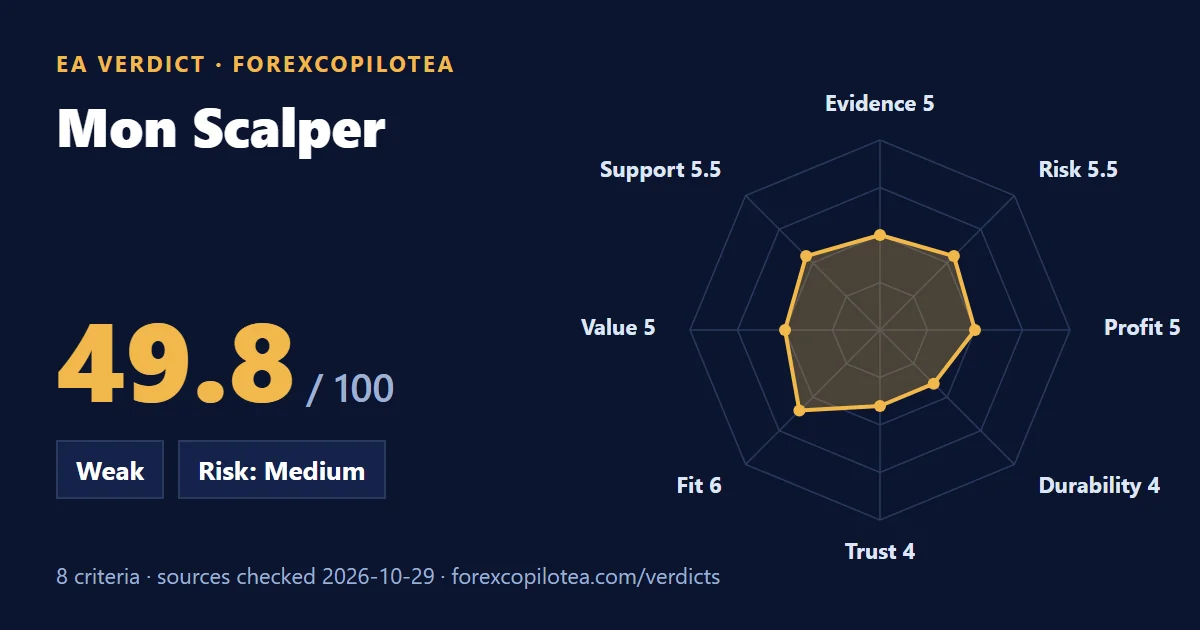
This Mon Scalper EA review covers an MetaTrader 5 Expert Advisor that trades only gold (XAUUSD) on the 15-minute chart, entering when a long-term and a short-term trendline align and price breaks out. It is sold on the MQL5 Market for 399 USD by Xuan Bach Nguyen of Viet Nam, was published on 7 March 2025 and was last updated to version 4.2 on 2 April 2026. The seller says it uses no grid and no martingale, puts a stop loss on every trade and does not read history or filter trades to flatter a backtest. Its live signal is the evidence we can check: 561 trades, an 83.95% win rate, a profit factor of 1.47 and an average loss of 26.63 USD against an average win of 7.46 USD. That is a high-hit-rate system that lives or dies on how rarely the large losers arrive. The signal also carries an unexplained mismatch between its start date and its stated age. We read the listing, its comments and version history, the signal line by line and our own store page, and scored the EA on the same eight criteria as every verdict here. The result is 49.8 out of 100, in the Weak band, with a Medium risk label.
Key takeaways
- Mon Scalper scores 49.8 out of 100 (band: Weak) with a Medium risk label. Bounded losses and a free demo are its strengths; a record with an unexplained age, closed logic and a thin payoff ratio hold it back.
- The vendor's signal (MQL5 signal 2361936) shows 561 trades, 471 wins (83.95%), a profit factor of 1.47, an expected payoff of 1.99 USD and an average loss 3.6 times the average win. To break even at those sizes the system needs to win about 78% of the time, and it wins 84%.
- The signal says it started on 2 March 2026 yet reports 94 weeks and 321 trading days; by the start date the age is about 34 weeks. We could not find an explanation, so we treat the record as an under-12-month record with a gap.
- MQL5 shows monthly growth of minus 6.79% and an annual forecast of minus 82.33% on the signal, a recovery factor of 7.54 and a maximal balance drawdown of 12.07%. A forecast extrapolates recent months and is not a prediction, but it is the platform's own number.
- We sell a listing for Mon Scalper at 26.99 USD, shown as version 4.2, against 399 USD on the Market. Our page has errors, listed below, and the licence behind a cheaper copy of a Market product is a question we cannot answer.
- 49.8 / 100
- weighted verdict score on eight published criteria
- PF 1.47
- profit factor of the vendor's signal over 561 trades, with an 83.95% win rate
- $399
- Market price on 29 Oct 2026, with a free demo; our listing is $26.99
The verdict at a glance: a high win rate bought with large losers
Mon Scalper earns points for what it limits. Every trade is said to carry a stop, the worst trade on the signal was minus 56.22 USD, the maximum deposit load was 2.12% and the maximal balance drawdown was 12.07%. It loses points on how much it can show. The logic is closed, the record has an age we cannot reconcile, the edge per trade is small and the structure of the trades, many small wins paid for by occasional losses about 3.6 times larger, means a short run of bad luck matters more than the win rate suggests. The scorecard and radar below show how the total was built.
49.8 / 100
Weighted verdict score
Weak
Verdict band
Medium
Risk label
| Criterion | Weight | Score | Best evidence | Points |
|---|---|---|---|---|
| Verified evidence | 20 | 5/10 | Grade A | 10.0 |
| Risk and drawdown behaviour | 20 | 5.5/10 | Grade A | 11.0 |
| Profitability quality | 15 | 5/10 | Grade A | 7.5 |
| Sustainability | 15 | 4/10 | Grade B | 6.0 |
| Transparency and trust | 10 | 4/10 | Grade B | 4.0 |
| Practical fit | 10 | 6/10 | Grade B | 6.0 |
| Cost and value | 5 | 5/10 | Grade B | 2.5 |
| Support and usability | 5 | 5.5/10 | Grade B | 2.8 |
| Total | 100 | 49.8 |
What Mon Scalper actually is
Mon Scalper is an Expert Advisor for MetaTrader 5 listed on the MQL5 Market under the title 'Mon Scalper - Dual-Trendline Breakout Scalping Expert'. The seller is Xuan Bach Nguyen (login scalperpot) of Viet Nam, whose profile shows a seller rating of 4.5 stars from 12 votes, 5 products and 2 signals. The product page shows a rating of 4.14, 998 demo downloads, 15 activations, 10 reviews and 8 comments. It was published on 7 March 2025. A separate MT4 version, product 153935, carries the same description, the same price of 399 USD and the same signal link; it was published on 1 November 2025 and had 210 demo downloads and one review when we looked. Everything below concerns the MT5 product, version 4.2.
The strategy, in the seller's words, uses 'two trendlines, a long-term and a short-term trendline' to analyse and confirm the trend, and it trades 'when both trendlines align and a breakout occurs'. It is designed exclusively for XAUUSD and the recommended timeframe is M15. The listing gives these recommendations: any leverage, any account type, a minimum deposit of 450 USD with 600 USD recommended 'per 0.01 lot', and a VPS. It says the default settings are optimised for most brokers and that the EA is compatible with any broker. It does not publish an inputs list, a backtest report, the exit logic or the size of the stop loss, and that matters for the score on transparency.
| Item | What the vendor says |
|---|---|
| Seller | Xuan Bach Nguyen (scalperpot), Viet Nam. Seller rating 4.5 from 12 votes; 5 products, 2 signals. |
| Price | 399 USD on 29 Oct 2026 with a free demo. The description also says 'Launch Price: $199', a rise of $100 after every 10 purchases and a 'Final Price: $999'. |
| Strategy | Dual-trendline breakout scalping on XAUUSD; trades when a long-term and a short-term trendline align and price breaks out. |
| Risk controls | Stop loss on every trade; 'does not use grid, martingale, or other high-risk strategies'; a risk-percentage lot mode and additional risk-control parameters were added in version 4.0. |
| Requirements | XAUUSD, M15, any leverage, any account type, minimum 450 USD and 600 USD recommended per 0.01 lot, VPS recommended. |
| Honesty claims | 'No history reading, trade filtering, or overfitting techniques that create unrealistic backtests.' |
| Track record | A live signal linked from the description (signal 2361936), the seller's comments with screenshots, and buyer testimony. |
| Reach | Rating 4.14, 10 reviews, 8 comments, 998 demo downloads, 15 activations. |
| Versions | 4.2, updated 2 Apr 2026; first published 7 Mar 2025. |
How we judged it, and who has something to sell
Evidence on EAs is never neutral. Here is every party near this product and what each stands to gain, ours included.
- The developer sells two EAs of this family (Mon Scalper and Tom Scalper, both advertised in his comments), sells a signal subscription at 299 USD a month on this signal (0 subscribers shown) and runs a MQL5 channel. His record is public, which counts for something, and it is also his sales page.
- MQL5 and MetaQuotes host the Market, the comments and the signals. The signal statistics and the platform notices on its page are the platform's own.
- Buyers who wrote reviews and comments include three satisfied reviewers in the part of the page we could read, and a user who says he has run it for more than nine months. Testimony, not data, and none can be checked from outside.
- ForexCopilotEA sells a listing for this EA at a fraction of the Market price. We gain if you buy it, which is why this verdict opens with that fact and applies the same rules as every other.
Evidence ladder: what each rung of proof held for Mon Scalper
Grade A: Independent proof
- MQL5 signal 2361936, 'Mon Scalper MT5': platform-built statistics for 561 trades on one ICMarketsSC-MT5-6 account, with the platform's notices and slippage table. The vendor runs the account, so his interest is noted, and the signal's age is internally inconsistent.
- MetaQuotes and Myfxbook documentation, used for how testing reports and verified records work.
Grade B: Checkable vendor material
- The Market listing: version, price, symbol, timeframe, recommended deposit, dated version history, comments and reviews.
- The free demo, which runs in the Strategy Tester only. A seller's manual and set file are offered in comments but we have not seen them.
Grade C: Claim only
- 'Every trade is protected with a stop loss' and 'does not use grid, martingale': stated, consistent with the signal's worst trade, and not provable without the code.
- 'No history reading, trade filtering, or overfitting': a claim, set beside version 4.1's 're-optimized' parameters and version 4.0's 'improved order filtering'.
- 'Mon Scalper continues to reach new ATHs' (seller comment, 4 February 2026) and the screenshots of results on an account using Mon Scalper and Tom Scalper: a seller's own claim with a screenshot we could not read.
Grade D: Conflicted, anonymous or unverifiable
- Positive reviews and comments praising the EA and the seller; they may be genuine and are not independently checkable. Seven of the ten reviews could not be read.
- Our own store page, which sells a listing under this name and contains errors we describe below.
Mon Scalper live signal: number by number
A platform-computed signal is the best public evidence a vendor can show. This one has a decent number of trades, 561, and a single symbol, which makes it clean to read. It has three limits. The vendor runs the account. The account is tiny, with an initial deposit of 150 USD, so percentages are inflated. And the signal's own age data disagree, which we address in the next section. With those limits in mind, here is what the Mon Scalper signal showed on 29 October 2026.
| Statistic | Value |
|---|---|
| Broker and server, leverage | ICMarketsSC-MT5-6, 1:500 |
| Started, stated age | 2 Mar 2026; the page says 94 weeks and 321 trading days (48.78%) |
| Initial deposit, deposits, withdrawals | 150.00 USD, 339.54 USD, 539.54 USD |
| Growth, profit, balance, equity | +1,059.59%, 1,116.63 USD, 1,066.63 USD, 1,066.63 USD |
| Trades, symbol | 561 trades, all XAUUSD |
| Win rate | 471 winners (83.95%), 90 losers (16.04%) |
| Long, short | 328 (58.47%), 233 (41.53%) |
| Profit factor, expected payoff | 1.47 (the table shows 1.46), 1.99 USD per trade |
| Average win, average loss | 7.46 USD, minus 26.63 USD |
| Best, worst trade | 45.66 USD, minus 56.22 USD |
| Gross profit, gross loss | 3,513.13 USD, minus 2,396.50 USD |
| Maximal drawdown by balance | 148.14 USD, 12.07% |
| Relative drawdown by balance, by equity | 28.71% (60.44 USD), 5.12% (51.18 USD) |
| Recovery factor, Sharpe ratio | 7.54, 0.17 |
| Trades per week, average hold | 11, about 2 hours |
| Trading activity, maximum deposit load | 7.16%, 2.12% |
| Monthly growth, annual forecast | Minus 6.79%, minus 82.33% |
| Signal price, subscribers, funds | 299 USD a month, 0 subscribers, 0 USD |
| Signal reviews | None |
Read the numbers together. A win rate of 83.95% with an average win of 7.46 USD and an average loss of 26.63 USD gives 0.8395 times 7.46 minus 0.1604 times 26.63, which is 1.99 USD per trade: the platform's figure. The average winner is 28% of the size of the average loser, so the system needs about 78 wins in every 100 trades just to break even. It wins about 84, a margin of about six points. That margin is the whole edge. If the win rate fell from 84% to 78%, for example in a run of choppy gold sessions where breakouts fail, the expected payoff would drop to zero. The gross profit of 3,513.13 USD over a gross loss of 2,396.50 USD gives the profit factor of 1.47.
The worst trade, minus 56.22 USD, is about 7.5 times the average win, and the best trade, 45.66 USD, is about 6 times it. So one worst-case loser erases about seven and a half average wins, and the average loser erases about 3.6. A sequence of three or four losers in a row is a drawdown of 80 to 100 USD on an account of about 1,000 USD, which is why the maximal drawdown by balance, 148.14 USD or 12.07%, is a plausible figure rather than a surprising one. The platform shows a longest run of three losses at minus 71.53 USD and a maximal consecutive loss of minus 103.52 USD over two trades; the platform's labels for the consecutive-win and consecutive-loss figures are mixed between counts and money, so we quote them only as indications.
- Relative, by balance28.7%
60.44 USD, early on a small balance
- Maximal, by balance12.1%
148.14 USD
- Relative, by equity5.1%
51.18 USD
The relative drawdown by balance of 28.71% looks alarming and needs a note. It is only 60.44 USD, and it happened when the balance was small, early in the record. It is not a larger event than the 148.14 USD maximal drawdown; it is a smaller loss measured against a smaller balance. We report it because the anchor for risk asks about verified drawdown up to about 25% and this one is above it. We weigh it, with the maximal drawdown of 12.07% and the 5.12% equity drawdown, and settle on a risk score of 5.5.
Is the Mon Scalper signal record what it seems? The 94-week question
The signal page gives a start date of 2 March 2026, 04:05:49. On 29 October 2026 that is about 34 weeks. The same page reports an age of 94 weeks, and its 321 trading days are 48.78% of the account's life, which implies about 658 days, or about 94 weeks, and so a starting point around early January 2025. That is before the Market product was published on 7 March 2025. The platform's weekly trade rate of 11 would give about 1,000 trades over 94 weeks, and we see 561; at 561 trades over 94 weeks the rate would be about 6 a week, and over 34 weeks about 16. None of the three combinations fits neatly.
We do not know the reason. A plausible explanation is that the signal was moved, re-created or re-linked to an account with older history, but that is a guess and we do not present it as a finding. Two other facts are relevant. A reviewer says he has used the EA 'since May' (2025) and another commenter has run it for more than nine months by February 2026, so the EA existed and was in use well before March 2026. And the platform's notice history includes a warning on 2 March 2026 that 'too much growth in the last month indicates a high risk', removed on 5 March, which fits a signal that was already showing results at the start date. We cannot tell which of the dates describes the account whose trades we are reading.
For scoring this matters because the evidence criterion asks for a verified record of 12 months or more for the exact version on sale, and the version on sale, 4.2, was released on 2 April 2026. On any reading, at most 29 weeks of the record can belong to version 4.2, and the platform does not say which version traded which trades. Version 4.1 re-optimised the parameters on 1 April 2026, and version 4.0, on 7 March 2026, changed the trendline detection and order filtering. We therefore score the evidence at 5, in the band for a verified record with two or more material gaps or under 12 months, and we list the gaps: the vendor runs it, the age is unexplained, deposits and withdrawals distort the curve, and the record does not belong to the current version in full.
Deposits, withdrawals and the 1,059.59% growth figure
The headline growth of 1,059.59% is not a return on money at risk. The account began with 150.00 USD, received a further 339.54 USD in deposits and paid out 539.54 USD in withdrawals, so withdrawals exceeded deposits by 200 USD. The balance on 29 October 2026 was 1,066.63 USD. The trading profit is the balance plus withdrawals minus deposits: 1,066.63 plus 539.54 minus 489.54 equals 1,116.63 USD, which is the platform's profit figure. Against the 489.54 USD that went in, that is about 228%, over a period the platform calls 94 weeks and the start date calls 34.
Three things follow. First, a tiny base amplifies percentages: the first few winners were large relative to the balance. Second, because the owner withdrew money, the curve is not a clean compounding record, and the platform's growth line has to be read with the deposit and withdrawal markers. Third, 1,116.63 USD of profit on 561 trades is an average of 1.99 USD a trade, a very small sum per trade that costs, slippage and a worse broker can erase. The slippage table on the signal page shows subscribers on other brokers with average slippage between 1.63 and 13.18 for the broker's own units, with 357 samples on ICMarketsSC-MT5-3 at 13.18, 162 on ICMarketsEU-MT5-5 at 7.42 and 114 on ICMarketsSC-MT5-4 at 9.96. We do not translate those into dollars. The point is that a scalper with a 1.99 USD expectancy is sensitive to the execution it gets, and the figures differ by broker.
Interactive: win rate is not edge
- Expected result per trade
- +0.35
- Profit factor
- 1.64
- Break-even win rate
- 33%
At these numbers the system has a positive edge before costs. Add spread, commission and slippage per trade and re-check.
How a dual-trendline breakout scalper makes and loses money
A trendline breakout system draws a line through recent swing points and trades when price crosses it with momentum. Mon Scalper uses two lines: a long-term one to define direction and a short-term one to time the entry, and trades only when both agree and a breakout occurs. In principle that is a trend-continuation filter, and on gold, which tends to run in bursts, it should catch the start of a move. The listing does not say where profits are taken or how the stop is set. Version 2.0 added an 'automatic dynamic stop loss and trailing' feature, and version 4.0 fixed a trailing-stop issue on 'some low-liquidity brokers', so a trailing stop exists, and the signal's two-hour average hold fits a system that exits on a trail or a short target.
The signal's profile is not what a classic trend-follower looks like. Trend systems usually win 30% to 45% of the time and make their money from a few large winners. Mon Scalper wins 84% of the time with small winners and has few large losers. That inverted shape is typical of a system that takes profit early and gives the trade a wide stop, or one that trails tightly after a breakout and is stopped out at a larger distance when the breakout fails. We cannot say which from public information. We can say what the shape means for the buyer: the risk is concentrated in the 16% of trades that lose, and the average one costs 3.6 times the average winner. A sudden change in gold's behaviour, such as a long period in which breakouts fail and reverse, would show up first as a falling win rate. Watch the win rate, not the profit.
Does Mon Scalper use martingale or a grid?
The listing says it 'does not use grid, martingale, or other high-risk strategies', and that every trade is protected by a stop loss. The signal is consistent with it. There are 561 trades of one symbol, the worst loss is 56.22 USD, the deposit load never exceeded 2.12% and the longest losing run is three trades. A grid or martingale that is not stopped normally leaves a different signature: a long series of small wins followed by a single loss many times larger than anything before it. The worst loss here is about 7.5 times the average win, and about 2.1 times the average loss, which is within the range of a stop-loss scalper.
There is one detail that deserves attention. Version 1.2, released on 4 April 2025, added a 'Volume Multiplier Input' to 'scale trade volumes based on probability, optimizing for a better profit factor and improved risk-reward ratio'. That is variable position sizing, and it sits beside the statement that the EA does not rely on 'progressively increasing position sizes'. A probability-based multiplier is not a martingale in itself, since a martingale raises size after a loss and a probability multiplier scales size by signal quality, but we cannot see how the multiplier is set, its default, or what happens to size after a loss. The risk-percentage lot mode, added to or fixed in versions 4.0, 4.1 and 4.2, also scales size with equity. We rate the design as bounded risk per trade with partly verified controls, and we ask the developer for the multiplier's rule in the questions below.
Interactive: drawdown recovery
Gain needed to get back to break-even
+42.9%
Blue: equity left. Red: equity lost.
Consecutive losing trades to reach this drawdown: 36
Mon Scalper version history and updates
The Market page lists seven versions in 13 months, which is a visible record of work. We list them with the gaps between them because the gaps matter for how a buyer should read 'lifetime updates'.
| Version | Date | What the seller says changed |
|---|---|---|
| 1.2 | 4 Apr 2025 | Added a Volume Multiplier input to scale trade volumes by probability. |
| 2.0 | 11 Apr 2025 | Added automatic dynamic stop loss and trailing features. |
| 3.0 | 6 Aug 2025 | Improved order filtering around support and resistance levels. |
| 3.1 | 19 Oct 2025 | Improved performance. |
| 4.0 | 7 Mar 2026 | Fixed a trailing-stop issue on some low-liquidity brokers and an occasional order placement error; improved order filtering; added more risk-control parameters; enhanced trendline detection. |
| 4.1 | 1 Apr 2026 | Fixed a volume calculation issue; parameters re-optimised. |
| 4.2 | 2 Apr 2026 | Fixed a bug in volume calculation when using risk-percentage mode. |
The pace is uneven: two releases in April 2025, gaps of 117, 74 and 139 days, three releases in March and April 2026, then nothing for 210 days. Versions 4.1 and 4.2 came on consecutive days and both fixed volume calculation, so the lot logic changed twice in 48 hours. The 're-optimized' parameters of 1 April 2026 sit beside a listing that says there is no overfitting; re-optimising is normal practice, but it means the signal cannot be called an out-of-sample test of them. See our guide to optimising an EA without overfitting.
Mon Scalper reviews and comments: what buyers say
The Market page shows a rating of 4.14 and 10 reviews, while the seller's profile shows the figure as 4.14 from 7 votes, so not every review carries a rating. Only three reviews were readable in the page text we could open; the other seven load dynamically and we could not read them. We weigh the three as testimony. Hassanien Saleh, on 4 February 2026, wrote 'Thanks mate for such a great EA, working very well.' Mohammad Taghizadeh Ghahderijan, on 20 January 2026, said he was satisfied and that the seller 'was very helpful in explaining how to set up the expert'. Eddie Eng, on 20 October 2025, wrote that he had been using the EA since May, that it was 'profitable so far' and that an issue he met was 'resolved within hours with a new update'.
All three are positive, yet the average of 4.14 implies that lower ratings exist among the unseen reviews. We cannot say what they contain and we do not claim there are none that are negative. The eight comments add a user named Donny Muri Eddy (10 January 2026) who calls it a good EA and a good seller; Lee Wai Chong (5 February 2026) who says he has run it for more than nine months with consistent profits and asks about new EAs; and an unnamed buyer on 12 September 2026 who wrote that he had just bought the EA and asked for the user manual and a set, to which the seller replied 'Sure, I will support you.' The seller's own comments include a 4 February 2026 post saying 'Mon Scalper continues to reach new ATHs', with a screenshot, and posts of results on an account running Mon Scalper and Tom Scalper on 4 February and 24 June 2026. We could not read the screenshots and treat them as claims.
We found no allegation of fraud, refusal of support or a refund dispute in the text we could read. That is a statement about what we could read, and no more. One reasonable inference from the last exchange is that the manual and the set file are supplied by the seller on request and are not part of the Market download. That is relevant to the support score and to how our own listing compares, since ours delivers the manual but not a setfile.
Mon Scalper price: 399 dollars, or 26.99 on our listing
The Market price on 29 October 2026 was 399 USD, with a free demo, and the language versions of the page we opened show the same price. The description still contains a launch schedule: a launch price of 199 USD, a rise of 100 USD after every 10 purchases and a final price of 999 USD. The page shows 15 activations and a price of 399 USD. Activations are not the same as purchases, since one purchase can be activated on more than one account, so we do not infer the number of sales, but the text and the current price do not line up cleanly. A buyer should treat the ladder as stale and not as a reason to hurry. Our scoring treats urgency pricing as a minor concern only when the message is live, and here it looks out of date rather than active.
Our listing sells a file for 26.99 USD, one time, about 6.8% of the Market price, with lifetime updates promised on the page and all sales final. We cannot explain from public information how a copy of a Market product comes to be sold at that price, whether the seller licensed it, or whether an activation limit on the Market licence applies to it. Market products are normally bound to licence activations. We say plainly that the provenance and licence of our copy are unverified by this review, and that the safest purchase is the one on the MQL5 Market from the seller, which gives you the seller's support, the update channel and a licence that is his to give. Whatever the price, the review's score does not change with what we charge.
Mon Scalper drawdown and risk: bounded per trade, sensitive to a bad run
On the evidence, Mon Scalper is a bounded-loss system with a thin edge. Every trade is said to have a stop, the worst trade was 56.22 USD and the peak deposit load was 2.12%. We rate it Medium rather than High because nothing in the record shows open-ended exposure. We do not rate it lower because its profit comes from a narrow margin between a win rate of 84% and a break-even rate of 78%, because the loss size is about 3.6 times the win size, and because the only complete sample is small. The risks that remain are these.
- Win-rate sensitivity. A fall of six points in the win rate wipes out the expected payoff. A run of failed breakouts on gold is the scenario to fear.
- Payoff ratio. An average loss of 26.63 USD against an average win of 7.46 USD means one losing trade needs about 3.6 winners to repair. Three losers in a row, the longest run on the signal, need about eleven.
- Lot rule and account size. The seller's own recommendation is 600 USD per 0.01 lot. A risk-percentage mode scales the position with equity, and its volume calculation was fixed twice in April 2026. Test it with your actual lot rule.
- Execution. The signal's slippage table shows large differences between brokers. A system whose expected payoff is 1.99 USD per trade is sensitive to spread and fills at the minute of a breakout.
- Single instrument and timeframe. Everything depends on gold on M15. There is no diversification inside the EA.
- Record age. If the signal's real history is longer than its start date implies, the drawdown picture may be better than stated; if it is shorter, worse. We cannot tell.
Backtest versus live: what Mon Scalper does not show
The listing publishes no backtest figures at all: no profit factor, no drawdown, no number of years and no tick model. The only quantitative record is the live signal, so a buyer has nothing to compare it with. The free demo allows the Strategy Tester, and the most useful check is to run version 4.2 on real ticks across at least two years of gold and see whether the win rate and the average win and loss land near the signal's 84%, 7.46 USD and 26.63 USD.
See our guides to backtest versus live results and to reading an MT5 backtest report for the checks to run.
The score, criterion by criterion: 49.8 out of 100
| Criterion | Score | Points | Why |
|---|---|---|---|
| Verified evidence (weight 20) | 5 / 10 | 10.0 | A platform-built MQL5 signal with 561 trades, a record under 12 months by its start date and with an unexplained 94-week age; the vendor runs it, deposits and withdrawals shape the curve, and it shows one broker. |
| Risk and drawdown behaviour (weight 20) | 5.5 / 10 | 11.0 | A stop on every trade is claimed and the worst trade was minus 56.22 USD; no grid or martingale is claimed, but a probability-based volume multiplier exists. Verified drawdown is 12.07% maximal and 28.71% relative by balance, and the average loss is 3.6 times the average win. |
| Profitability quality (weight 15) | 5 / 10 | 7.5 | A verified profit factor of 1.47 and an expected payoff of 1.99 USD per trade, with a payoff ratio of 0.28, a negative current month of minus 6.79%, withdrawals that exceed deposits and a very small account that inflates the 1,059.59% growth figure. |
| Sustainability (weight 15) | 4 / 10 | 6.0 | Closed logic for a single instrument; seven dated versions in 13 months and a re-optimisation on 1 April 2026, but no update for 210 days and no regime coverage beyond a short gold record. |
| Transparency and trust (weight 10) | 4 / 10 | 4.0 | The listing explains the idea in general terms and a seller who replies to comments; against that, no inputs or backtest figures are shown, a price ladder on the page no longer matches the price, 'no overfitting' is a claim beside a re-optimisation, and only 3 of 10 reviews were readable. |
| Practical fit (weight 10) | 6 / 10 | 6.0 | One instrument (XAUUSD) on M15, any broker, any account type, and a stated minimum of 450 USD with 600 USD recommended per 0.01 lot; a VPS is recommended, and the signal's own slippage table shows large differences between brokers. |
| Cost and value (weight 5) | 5 / 10 | 2.5 | 399 USD on the Market with a free demo, against a record that has earned 1,116.63 USD on a small account; the listed price ladder is stale. Our own listing is far cheaper, but its licence and provenance are unverified. |
| Support and usability (weight 5) | 5.5 / 10 | 2.8 | A free demo, a seller who answers comments and buyers who praise the setup help; against that, the manual and set file appear to come on request rather than in the Market download, and our listing ships no setfile. |
The total is 49.8 out of 100. Evidence, at 5, is a platform-built signal of 561 trades held back by an unexplained age, a vendor-run account and deposits and withdrawals that shape the curve. Risk, at 5.5, is the strongest of the heavy criteria: a modest verified drawdown and a worst loss of 56.22 USD, offset by the 3.6-to-1 loss size and a volume multiplier we cannot see. Profitability, at 5, rests on a profit factor of 1.47 that falls just below the 1.5 anchor and a negative latest month. Trust and sustainability, at 4, reflect closed logic, a stale price ladder, no backtest and a 210-day gap in updates. Fit, at 6, is the best score: one instrument, any broker, a stated deposit.
Who Mon Scalper fits, and who it does not
- It fits a trader who wants a single-instrument gold scalper with bounded per-trade losses, is comfortable with a high win rate and an occasional larger loser, and will test it on a demo at the intended lot size first.
- It does not fit anyone who wants steady monthly returns on a fixed schedule, a trader whose broker has wide gold spreads, or a buyer who expects a multi-year verified record.
- It is suitable for a small test allocation while the signal's history is clarified and its next quarter is watched.
- It is a poor choice for a buyer who is paying mainly because a price ladder says the price will rise, or because a seller's screenshot shows new highs. Run the demo, and compare the tester's win rate and average loss with the signal's.
How Mon Scalper compares with other EAs we have scored
Next to Gold House and Gold Snap, the other gold systems in this series, Mon Scalper is less documented: it publishes no backtest and no inputs. Next to Pulse Engine, which trades six markets at a profit factor of 1.06 over thousands of trades, it has a higher profit factor on far fewer trades and a much less equal win-loss shape. Its 49.8 reflects bounded risk, a modest verified drawdown and a thin, partly explained record. For the wider category, browse our gold EAs and scalpers.
Questions to put to the developer before you pay
- Why does signal 2361936 show 94 weeks and 321 trading days against a start date of 2 March 2026, and was the history moved from an earlier account?
- Which EA version and which lot rule produced the signal's trades, and was the volume multiplier on?
- What is the stop-loss distance, and how are profits taken? Can you publish a real-tick tester report with years and settings?
- How does the volume multiplier work, what is its default, and does size change after a loss?
- Why were the parameters re-optimised on 1 April 2026, and how many of the signal's trades came after that version?
- Is the price schedule in the description still active, and what does an existing owner pay for updates?
- Which parameters limit daily loss, and is the EA suitable for a prop-firm account?
- Do you supply the manual and a set file with every purchase, or only on request?
Sources and when they were opened
- MQL5 Market: Mon Scalper MT5 (product 128708), opened 29 October 2026, with its comments and updates tabsSource of the price, version history, description, requirements, readable reviews and comments. Written by the vendor and by buyers.
- MQL5 Market: Mon Scalper MT4 (product 153935), opened 29 October 2026The MT4 sibling; used to confirm the description, price and signal link are the same.
- MQL5 Signals: Mon Scalper MT5 (signal 2361936), opened 29 October 2026Source of every performance figure, notice and drawdown in this verdict. The vendor operates the account.
- MQL5 seller profile: Xuan Bach Nguyen (scalperpot), opened 29 October 2026Source of the seller rating, product and signal counts.
- ForexCopilotEA store listing: Mon Scalper, opened 29 October 2026Our own page; source of our version, price, what ships and the errors we describe.
- Myfxbook Help: VerificationHow a trading account's track record is verified on Myfxbook.
- MetaTrader 5 Help: Testing ReportWhat each figure in the tester's report means, including drawdown.
- MetaTrader 5 Help: Strategy TestingThe Strategy Tester: testing modes, settings and forward testing.
- ESMA: ESMA agrees to prohibit binary options and restrict CFDs to protect retail investorsThe EU leverage limits, margin close-out, negative balance protection and risk-warning rules for retail CFD accounts.
- CFTC Customer Advisory: AI Won't Turn Trading Bots into Money MachinesA US regulator's warning about trading-bot claims of unusually high returns.
Frequently asked questions
Is Mon Scalper EA legit?
It is a real, updated product with a described approach, a live signal of 561 trades, seven dated versions since April 2025 and a seller who answers comments, rated 4.14 from 10 reviews on the MQL5 Market. We do not allege wrongdoing. The signal's age is unexplained, the logic is closed and the profit factor is 1.47, which is why it scores 49.8 out of 100 with a Medium risk label.
How much does Mon Scalper cost?
The MQL5 Market price on 29 October 2026 was 399 USD, with a free demo; the description still mentions a 199 USD launch price rising to 999 USD, which no longer matches. A VPS and a gold account with tight spreads are extra. Our own store sells a listing at 26.99 USD one time with its own terms and no refunds, and we cannot verify the licence behind it, so read the terms of whichever seller you use.
Does Mon Scalper use martingale or a grid?
The listing says no grid, no martingale and a stop loss on every trade. The signal is consistent with that: its worst trade was minus 56.22 USD and its peak deposit load 2.12%. The listing also describes a probability-based volume multiplier added in version 1.2, and we cannot read the code, so this rests on the listing and the signal.
What drawdown does Mon Scalper have?
On the vendor's signal the maximal drawdown by balance was 12.07% (148.14 USD), the relative drawdown by balance 28.71% (60.44 USD, on a small early balance) and the relative equity drawdown 5.12%. The sample is small and the account was tiny, so the percentages move a lot with account size.
What is Mon Scalper's win rate and profit factor?
On the signal, 471 of 561 trades won (83.95%), the profit factor is 1.47 and the expected payoff is 1.99 USD per trade. The average win is 7.46 USD and the average loss 26.63 USD, so the system needs a win rate of about 78% to break even.
What symbol and timeframe does Mon Scalper trade?
Gold (XAUUSD) on the M15 chart only. The seller recommends a minimum deposit of 450 USD, 600 USD recommended per 0.01 lot, any leverage and account type, and a VPS.
Is the Mon Scalper signal record reliable?
It is platform-built, which counts, but it is run by the vendor and shows a start date of 2 March 2026 beside a stated age of 94 weeks. Deposits of 339.54 USD and withdrawals of 539.54 USD also shape the curve. We treat it as a real but incomplete record, and the explanation is for the seller to give.
How was the score calculated?
Eight weighted criteria (evidence 20, risk 20, profitability 15, sustainability 15, trust 10, fit 10, cost 5, support 5), each scored out of ten against written anchors. Sources are graded A to D and unverified claims cannot count as proof. We sell a listing for this EA, which is disclosed at the top. The total here is 49.8 out of 100.
Gold Expert Advisors in our store
We sell these, so weigh that interest. Put the same eight questions to any of them before you buy: read the manual, run your own backtest, and start on demo.



Keep reading
- EA Verdict #12Gold House EA Review: Verdict and Risk (2026)Is Gold House worth $749? Independent EA verdict: 52.3/100, Medium risk. Two live MQL5 signals, 68 reviews and a rising price ladder scored, checked 28 Oct 2026.
- EA Verdict #9Gold Snap EA Review: Verdict and Risk (2026)Is Gold Snap worth $399? Independent EA verdict: 56.0/100, Medium risk. Three live signals, 31 reviews and a backtest dispute scored, checked 21 Oct 2026.
- EA VerdictPulse Engine EA Review: Verdict and Risk (2026)Is Pulse Engine worth $599? Independent EA verdict: 52.8/100, Medium risk. A 36-week MQL5 signal, 2,271 trades and a 1.06 profit factor scored, checked 29 Oct 2026.
- Risk managementEA in Drawdown: What to Do (and What Not to Do)What to do when your Expert Advisor is in drawdown: separate normal from broken, check the logs, compare with the backtest, and decide to hold, reduce or stop.
- BacktestingWhy EA Live Results Differ From Backtests (and What to Do)Why EA live results differ from backtests: spread, slippage, delay, data, overfitting and more. Eleven causes, how to check each and how to close the gap.
- Strategy comparisonWhich EA Strategy Wins Long Term?Compare MT5 Expert Advisor strategy types, from scalping and grid to hedging and arbitrage: how each earns, how each fails, and which tend to survive long term.