
EA Verdict
My AI Gold EA Review (2026): A '+1000%' Gold EA Whose Headline Is a 300 Dollar Account and Whose Calmer Signal Has 28 Trades
By Benjamin Lee · Updated · 37 min read
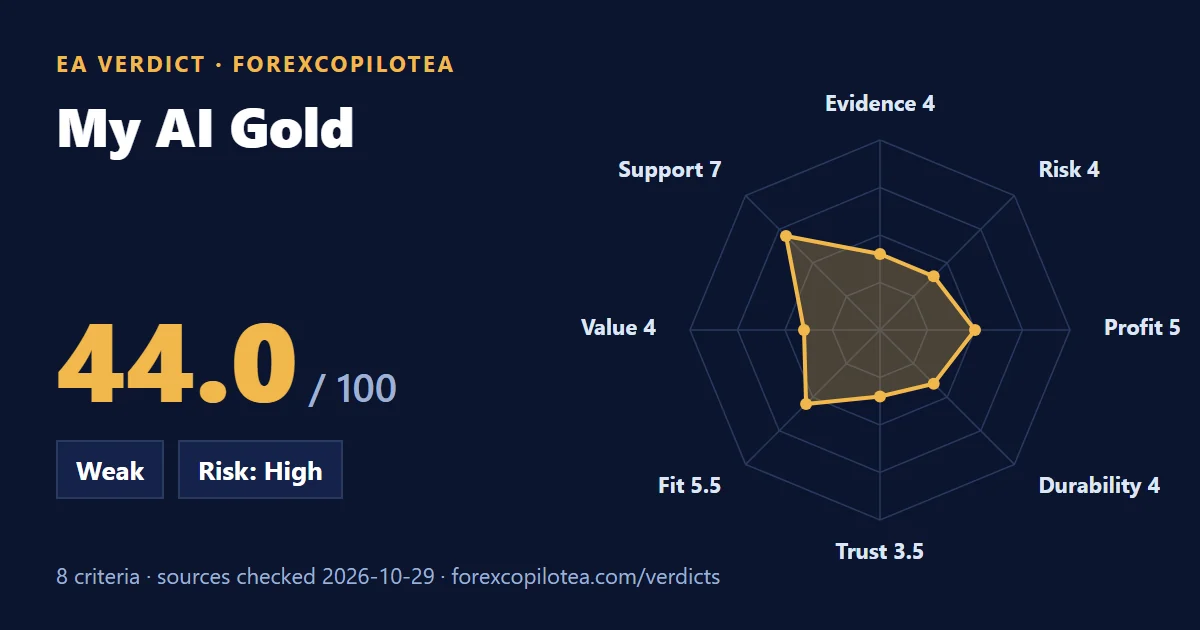
My AI Gold is an Expert Advisor for MetaTrader 5 that trades XAUUSD on the H1 chart, puts a stop loss and a take profit on every trade, says it uses no martingale, no grid and no averaging, and is sold on the MQL5 Market for $899.95 or $499.95 for a year's rental. Its description opens with a '+1000% live track record'. We read that claim against the two signals it links. The +1000% is a 300 USD MetaTrader 4 account labelled High Risk that shows +1,828% on 116 trades. The calmer MetaTrader 5 signal on a 10,000 USD account shows +14.66% on 28 trades in seven weeks. Both have profit factors near 2 or better. Both lose about twice as much on a loser as they win on a winner. We scored My AI Gold on the same eight criteria as every verdict here. The result is 44.0 out of 100 and a High risk label: a real, actively updated product with good early statistics, a young record and a default setting its own seller calls high risk.
Key takeaways
- My AI Gold scores 44.0 out of 100 (band: Weak) with a High risk label. Its early signals are profitable and its support is good; its record is under 12 months, and the product's default risk level is high.
- The '+1000% live track record' in the listing links MQL5 signal 2389616, a 300 USD MetaTrader 4 account named 'High Risk' that shows +1,828.09% (profit 5,484.26 USD) on 116 trades, a 79.31% win rate, a profit factor of 1.97 and a relative balance drawdown of 43.59%.
- The calmer record, MQL5 signal 2390451 on a 10,000 USD IC Markets MT5 account, shows +14.66% on 28 trades in seven weeks, a profit factor of 2.79 and a 3.41% maximal drawdown by balance. MQL5 itself says the number of deals is too small to evaluate trading quality.
- The listing promises a 'solid 1:2 risk-to-reward ratio'. On both signals the average loss is 1.94 to 2.15 times the average win, so the edge depends on winning roughly four trades in five, and a third-party test of the fixed levels put the risk at about $40 for $25.
- We sell a listing for My AI Gold. It shows version 1.82 like the Market, but costs $26.99 as an EA-only edition against $899.95 there, carries one setfile and no manual, and its source option is an older version. Treat it as a separate purchase with its own terms.
- 44.0 / 100
- weighted verdict score on eight published criteria
- PF 1.97 and 2.79
- profit factor of the two linked signals, on 116 and 28 trades, with an average loss near twice the average win
- $899.95
- Market price on 29 Oct 2026, or $499.95 for a year's rental, with a free demo; the price rose from $799.95 in about two weeks
Is My AI Gold legit? The verdict at a glance
My AI Gold is a real product, not a hollow listing. It has a long description, six set files, a user guide in many languages, a seller who answers comments, seven updates in eight weeks, 14 five-star ratings and two public signals. We found no allegation of non-payment, no deleted criticism and no loss complaint aimed at the vendor. It scores low for three reasons. The record is short: 24 weeks on one signal and seven on the other, against the 12 months our anchors ask for. The marketing claims several things the numbers do not show, from the size of the live track record to the risk-to-reward ratio. And the default setting is, in the seller's own words, high risk. The scorecard and radar show how the total was built.
44.0 / 100
Weighted verdict score
Weak
Verdict band
High
Risk label
| Criterion | Weight | Score | Best evidence | Points |
|---|---|---|---|---|
| Verified evidence | 20 | 4/10 | Grade A | 8.0 |
| Risk and drawdown behaviour | 20 | 4/10 | Grade A | 8.0 |
| Profitability quality | 15 | 5/10 | Grade A | 7.5 |
| Sustainability | 15 | 4/10 | Grade B | 6.0 |
| Transparency and trust | 10 | 3.5/10 | Grade B | 3.5 |
| Practical fit | 10 | 5.5/10 | Grade B | 5.5 |
| Cost and value | 5 | 4/10 | Grade B | 2.0 |
| Support and usability | 5 | 7/10 | Grade B | 3.5 |
| Total | 100 | 44.0 |
What My AI Gold actually is
My AI Gold is an Expert Advisor for MetaTrader 5, sold on the MQL5 Market by Vitalii Kosov of Russia, who describes himself as CEO at 'Beast FX' AI Trading Experts. His seller profile shows one product and three signals. The profile also shows a rating figure of '3 (139)' that we could not interpret with confidence, so we did not use it. The product was published on 4 September 2026, showed version 1.82 last updated on 21 October 2026, and carries 15 activations, 5,685 free-demo downloads, 40 comments and a rating of 5.0 from 14 reviews. The page says '155 purchases per month'.
The pitch is an 'AI-driven gold trading revolution'. The description says it is built on 'custom neural networks' using 'advanced machine learning models aggregated from elite open-source GitHub frameworks', and that it is 'optimized specifically for high-precision gold pattern recognition'. It then lists what it is not: not a fragile scalper, and 'absolutely NO Martingale, NO Grid, and NO Averaging', with strict stop loss and take profit on every trade. It claims a 'healthy' 1:2 risk-to-reward ratio, says it is 'prop firm ready' and 'broker independent', and tells you to attach it to 'any timeframe' on XAUUSD, although a later section says it is designed for H1. It also warns that not every month will be green and that the EA should be judged over at least three to four months.
What the page does not contain matters as much. It describes no architecture, no inputs, no training data and no retraining schedule, and shows no backtest figures. The only performance evidence is the pair of signals linked in the first line. Everything below tests the claims against those signals, against an independent Strategy Tester write-up of version 1.82, and against what buyers said in the comments.
| Item | What the vendor says |
|---|---|
| Seller | Vitalii Kosov, Russia, 'CEO at Beast FX AI Trading Experts'. One product, three signals. Support by private message and an MQL5 discussion group. |
| Price | $899.95 to buy, or $499.95 to rent for one year, on 29 Oct 2026. 'Next 10 copies' at this price, then a permanent rise to $999. Free demo. |
| Strategy | XAUUSD only, designed for H1. Neural-network pattern recognition built from open-source frameworks; no further detail. |
| Risk controls | A stop loss and take profit on every trade; no martingale, grid or averaging; six risk presets from conservative to aggressive, and a prop-firm preset. |
| Requirements | MT5 desktop, algo trading on, raw or ECN account recommended, a Windows VPS recommended. Minimum about $1,000 for normal risk, $2,000 for low risk. |
| Track record | Two live signals linked at the top: 'High Risk' (MT4, 300 USD start) and 'ICmarkets 10k Low Risk' (MT5). |
| Reach | Rating 5.0 from 14 reviews, 40 comments, 15 activations, 5,685 demo downloads. |
| Versions | 1.82, updated 21 Oct 2026. Earlier: 1.51 on 24 Sep and 1.71 on 9 Oct, with seven updates since release. |
Our listing against the Market product: the exact differences
Because we sell a listing under this name, the differences are part of the verdict. A buyer comparing the two should see them side by side. Everything in the left column was read on the Market page and everything in the right column on our own listing, both on 29 October 2026.
| Item | MQL5 Market (Vitalii Kosov) | ForexCopilotEA listing |
|---|---|---|
| Version | 1.82, updated 21 Oct 2026 | 1.82 for the compiled file; the source is version 1.75 |
| Price | $899.95 to buy, $499.95 to rent for a year | $26.99 EA only; $60.00 source only; $75.00 EA plus source |
| Terms | Market licence, 15 activations seen, free demo | One-time payment, lifetime updates, instant ZIP download, all sales final, no refunds |
| Set files | Six: aggressive, conservative, high risk, low risk, normal risk and a prop-firm set | One setfile with recommended settings |
| Manual | A user guide in all MQL-supported languages, posted by the seller | 'No user manual with this EA' |
| Source | Not offered | The .mq5 file in two editions |
| Seller | The author, who answers comments and replies to reviews | Benjamin Lee / ForexCopilotEA, a reseller and not the author |
| Reviews | 14 ratings, all five stars | Two five-star reviews on our page, tagged 'new listing, no reviews yet' |
How we judged it, and who has something to sell
Evidence on EAs is never neutral. Here is every party near this product and what each stands to gain, ours included.
- The developer sells the EA, sells a signal subscription (777 USD a month on each of the two signals, with no subscribers shown on either) and runs the discussion group. His record is public, which counts for something, and it is also his sales page.
- MQL5 and MetaQuotes host the Market, the reviews and the signals. The signal statistics and every platform notice quoted below are the platform's own.
- AlgoToolbox, whose tester ran version 1.82 in the Strategy Tester, discloses a broker affiliate link on its page. We use its mechanical findings and its numbers, and treat its opinions as opinions.
- Buyers who wrote reviews include three readable ones, all positive. Testimony, not data, and none can be checked from outside.
- ForexCopilotEA sells a listing for this EA. We gain if you buy it, which is why this verdict opens with that fact and applies the same rules as every other.
Evidence ladder: what each rung of proof held for My AI Gold
Grade A: Independent proof
- MQL5 signal 2389616, 'My AI Gold EA High Risk': platform-built statistics for 116 trades on a MetaTrader 4 account. The vendor runs it, so his interest is noted, but the figures are computed from broker history and the platform's notices are its own.
- MQL5 signal 2390451, 'My AI Gold ICmarkets 10k Low Risk': platform-built statistics for 28 trades on a MetaTrader 5 account, with the platform's own warning that the sample is too small.
- MetaQuotes and Myfxbook documentation, used for how testing reports and verified records work.
Grade B: Checkable vendor material
- The Market listing: version, price, recommendations, the seller's changelog and set-file posts, and dated comments and replies.
- A third-party Strategy Tester write-up of version 1.82 on AlgoToolbox, run from the free demo with its settings listed. It is checkable, though it uses mostly generated tick data and its author carries an affiliate link.
- The free demo, which runs in the Strategy Tester only.
Grade C: Claim only
- 'Custom neural networks' built from open-source GitHub frameworks: no architecture, data or output is published, so we can neither confirm nor refute it.
- 'Healthy 1:2 risk-to-reward', 'broker independent' and 'prop firm ready': claims the signals and the tester do not support in full.
- 'Engineered to pass and scale FTMO challenges': no audited challenge record is linked.
Grade D: Conflicted, anonymous or unverifiable
- 'Distribution is strictly limited' and 'the next 10 copies only': a sales message that sits beside a page showing 155 purchases a month.
- A blog post on MQL5 that calls itself generated by Google AI and quotes a trade frequency its own table contradicts.
- Five-star reviews that say 'perfect' or 'responsive' and show no result; they may be genuine and are not independently checkable.
My AI Gold live track record: the +1000% claim, number by number
The first line of the description reads 'LIVE TRACK RECORD +1000%' and links MQL5 signal 2389616. That signal is named 'My AI Gold EA High Risk', runs on the Weltrade-Live server at 1:500 leverage, and is a MetaTrader 4 account, although the product it advertises is for MetaTrader 5. It started with 300 USD, with no deposits and no withdrawals. A platform-computed signal is the best public evidence a vendor can show. It still has limits: the vendor runs the account, the broker is one broker, the base is tiny and the history has oddities we list below. Here is what it shows on 29 October 2026.
| Statistic | Value |
|---|---|
| Platform, broker, leverage | MetaTrader 4, Weltrade-Live, 1:500 |
| Started, age shown | 3 Sep 2026; 'Weeks: 24' |
| Initial deposit, deposits, withdrawals | 300.00 USD, 0.00 USD, 0.00 USD |
| Growth, profit, balance | +1,828.09%, 5,484.26 USD, 5,784.26 USD |
| Trades, win rate | 116 trades, 79.31% (92 wins, 24 losses) |
| Long, short | 60 (51.72%), 56 (48.28%) |
| Profit factor, expected payoff | 1.97, 47.28 USD per trade |
| Average win, average loss | 120.87 USD, minus 234.82 USD |
| Best, worst trade | 335.86 USD, minus 522.91 USD |
| Longest winning, losing run | 9 wins (1,885.69 USD), 3 losses (minus 568.65 USD) |
| Maximal drawdown by balance | 894.78 USD, 18.84% |
| Relative drawdown by balance, by equity | 43.59% (816.05 USD), 12.53% (627.61 USD) |
| Recovery factor, Sharpe ratio | 6.13, 0.32 |
| Trades per week, average hold | 2 as shown, 6 hours |
| Maximum deposit load, activity | 4.96%, 22.10% |
| Monthly growth, annual forecast | 29.61%, 359.27% |
The signal says +1,828%, not +1000%, so the listing understates the headline. But the percentage is a statement about the base. A 300 USD account that grows to 5,784 USD has compounded: the lot follows the balance, so a good run of trades feeds itself. The profit in dollars is 5,484.26 USD. The same arithmetic applied to a 10,000 USD account that makes 14.66% gives 1,466 USD, and that is the honest comparison between the two signals. Percent figures on tiny accounts are the standard way a track record looks larger than it is, and the listing itself warns that a 200 to 300 USD deposit means 'extremely aggressive trading, with risk levels close to a casino-style account gamble'. The headline account is exactly that account.
The payoff is the second thing to read. A 79.31% win rate with an average winner of 120.87 USD and an average loser of 234.82 USD gives 0.7931 times 120.87 minus 0.2069 times 234.82, which is 95.86 minus 48.58, or 47.28 USD per trade, the platform's figure. The loser is 1.94 times the winner. The break-even win rate for those averages is 234.82 divided by 355.69, about 66%. The signal wins 13 points more often than that, which is its entire edge. If the win rate fell to 66% on the same averages, expectancy would be zero. The listing's claim that you 'do not need an unrealistic, sky-high winrate' is therefore not what the data shows: this system needs a high win rate, and so far it has one.
- Relative, by equity12.5%
627.61 USD
- Maximal, by balance18.8%
894.78 USD
- Relative, by balance43.6%
816.05 USD
The three drawdown figures differ because they are measured differently. Maximal drawdown by balance is the largest fall from a peak in dollars, here 894.78 USD, or 18.84% of the peak at that time. Relative drawdown by balance is the largest percentage fall, and it is 43.59%, which happened early when the balance was small. Relative drawdown by equity counts open positions, and is 12.53%. Every one of them describes a real account, and the largest is the one a new buyer on a small account is most likely to meet. A system that can fall 44% of its balance in a run of losses is a High risk system whatever its stop losses say.
The calmer record: My AI Gold on a 10,000 dollar IC Markets account
The second signal the listing links, 2390451, is named 'My AI Gold ICmarkets 10k Low Risk'. It runs on MetaTrader 5 at ICMarketsSC-MT5-3, leverage 1:500, from 8 September 2026, with a 10,000 USD start, no deposits and no withdrawals. It is the closer match to the product on sale. It is also seven weeks old, and the platform's own current notice reads that the number of deals is too small to evaluate trading quality and that the results of a newly opened account may be of random nature.
| Statistic | Value |
|---|---|
| Platform, broker, leverage | MetaTrader 5, ICMarketsSC-MT5-3, 1:500 |
| Started, age shown | 8 Sep 2026; 'Weeks: 7' |
| Initial deposit, deposits, withdrawals | 10,000.00 USD, 0.00 USD, 0.00 USD |
| Growth, profit, balance | +14.66%, 1,466.36 USD, 11,466.36 USD |
| Trades, win rate | 28 trades, 85.71% (24 wins, 4 losses) |
| Long, short | 17 (60.71%), 11 (39.29%) |
| Profit factor, expected payoff | 2.79, 52.37 USD per trade |
| Average win, average loss | 95.28 USD, minus 205.09 USD |
| Best, worst trade | 177.21 USD, minus 212.88 USD |
| Longest winning, losing run | 9 wins (971.82 USD), 1 loss (minus 212.88 USD) |
| Maximal drawdown by balance | 374.31 USD, 3.41% |
| Relative drawdown by balance, by equity | 3.41% (374.13 USD), 3.74% (374.30 USD) |
| Recovery factor, Sharpe ratio | 3.92, 0.50 |
| Trades per week, average hold | 4, 8 hours |
| Maximum deposit load, activity | 0.90%, 23.30% |
| Monthly growth | 5.67% |
Read it for its shape, not its size. Four losing trades of about 205 USD each against 24 wins of about 95 USD is the same negative-skew pattern as the first signal: the loser is 2.15 times the winner and the break-even win rate is 205.09 divided by 300.37, about 68%. The signal wins 86% of the time, 18 points above that. The worst trade of 212.88 USD is 2.1% of the account, and the maximum deposit load of 0.90% shows the lot is small. That is what 'low risk' means here: a small lot on a large account, not a different strategy. The same design at a lot sized for 300 USD produced the High Risk signal.
Twenty-eight trades cannot confirm a win rate of 86%. If the true rate were 70%, a run of 24 wins in 28 would be unlikely but not impossible, and the confidence interval on such a sample runs from the high sixties to the mid nineties. What the signal does show is that nothing broke in seven weeks and that fills at one IC Markets server were good enough to profit. The copy-quality table is a warning on the other side: MQL5 lists the slippage of subscriber servers on this signal, and it ranges from 1.00 on ICMarketsSC-MT5-4 and 1.43 on ICMarketsEU-MT5-5 to 8.32 on Tickmill-Live, 9.89 on RoboForex-Pro, 14.50 on GlobalPrime-Trade, 15.00 on Exness-MT5Real50 and 21.16 on ICMarketsSC-MT5-3, the signal's own server, over 114 deals. The units are the platform's. The point is the spread: the same orders cost very different amounts to execute on different brokers.
- ICMarketsSC-MT5-41.00
- Tickmill-Live8.32
- Exness-MT5Real5015.00
- ICMarketsSC-MT5-3 (signal server)21.16
114 deals
My AI Gold claims against the evidence
Most of the score comes from the distance between what the page says and what we could check. The table sets the main claims against the sources, and says plainly where we could not decide.
| Claim | What we found |
|---|---|
| 'Live track record +1000%' | A 300 USD MT4 account named High Risk, +1,828% and 5,484 USD profit. The MT5 low-risk record is +14.66% on 10,000 USD in seven weeks. |
| 'Healthy 1:2 risk-to-reward' | Not shown. Average loss is 1.94 times the win on signal A and 2.15 times on signal B. The tester found fixed levels of about $40 stop and $25 target, and a break-even win rate near 60%. |
| 'No martingale, no grid, no averaging' | Consistent with the tester, which saw market orders only, a maximum of two positions and no grid or averaging in the logs. We cannot read the code. |
| 'Stop loss and take profit on every trade' | Confirmed in the tester: every trade carried both levels. Note that a trailing stop moves the stop after profit builds, so most winners exit by trailing and not at the target. |
| 'Broker independent' | Not supported. A buyer says it is 'highly sensitive to each broker's specific conditions', slippage spans 1 to 21 on copy servers, and the seller said defaults are for demonstration. |
| 'Any timeframe' | Contradicted by the same page: 'designed to work on the H1 timeframe'. Use H1. |
| 'Prop firm ready' | A prop-firm set file exists and the tester found its drawdown small at 7.68%, but no audited challenge result is linked. |
| 'Custom neural networks' | Unverifiable. The tester saw a fixed trading window, a fixed stop and target, trailing and balance-scaled lots, which looks rule-based. That is an observation, not proof that no learning model is involved. |
| 'Next 10 copies only' | The page also shows 155 purchases a month, and the price rose from $799.95 to $899.95 in about two weeks. Scarcity is a sales message. |
My AI Gold backtest: what an independent Strategy Tester run found
The listing publishes no backtest. The best public one is by AlgoToolbox, updated on 27 October 2026, run by the tester Eko Martha Kusumah on version 1.82 using the free Market demo. The settings were XAUUSD H1 from 3 December 2020 to 21 October 2026 on an Exness raw-spread account with a 2,000 USD deposit and 1:500 leverage, in real-tick mode, but with only 4% to 7% of the history at real-tick quality and the rest generated. That is a real limitation: generated ticks flatter or distort the fills of a system that trails stops and trades the Asian and London sessions. The page discloses a broker affiliate link.
| Set | Result |
|---|---|
| Conservative | Net profit 13,793.38 USD (to 15,793.38 USD); profit factor 1.76; 1,023 trades; win rate 72.14%; maximum equity drawdown 11.37% (853.60 USD) |
| Conservative, averages | Average win 43.34 USD, average loss 63.48 USD; 19 of 71 months lost; worst month July 2025 at minus 461.40 USD; worst losing streak 5 |
| Conservative, patience | 272 days without a new equity high, from 13 Jan to 12 Oct 2023 |
| Prop (FTMO) set | Net profit 4,209.11 USD; profit factor 1.66; maximum equity drawdown 7.68% (215.04 USD); worst closed day 1.92%; one position maximum |
| Aggressive set | Maximum equity drawdown 92.76%; the balance fell 90.24% from a peak of 59,629 USD in Nov 2022 to 30 May 2023; 477 days to a new high; about 26% risk per trade |
| After launch only | Conservative: +467.89 USD on 26 trades, profit factor 1.25. Prop: +10.54 USD on 24 trades. |
Three findings deserve attention. First, the conservative set is a reasonable-looking system on paper: 72% winners, a profit factor of 1.76, 11% equity drawdown, 71 months of history. But its edge is a win rate, not a payoff. An average loss of 63.48 USD against an average win of 43.34 USD means the break-even win rate is 59.4%, and the run wins 72.14%, a margin of 13 points that mirrors the live signals. Second, the aggressive set shows what the 'very aggressive' tier means: a 90.24% loss of balance and 477 days to recover, at about 26% risk per trade. The tester also reports a final balance of 49.6 million USD for it, which came from compounding to 200-lot positions that no broker would fill, so it is meaningless as a forecast and a good illustration of why percent returns on compounded lots mislead. Third, the post-launch figures are the most honest part, because the settings were re-optimised in version 1.51 on 24 September 2026, so most of the six backtest years are in-sample. The out-of-sample window is a few weeks: +467.89 USD on 26 trades with a profit factor of 1.25 for the conservative set, and +10.54 USD on 24 trades for the prop set. Both are positive and both are too small to carry weight.
For how a tester run differs from live trading, see our guide to backtest versus live results and our guide to reading an MT5 backtest report. For the risk of results that were tuned on the data they are shown on, see our guide to optimising an EA without overfitting.
How My AI Gold trades: what the tester shows about the mechanics
The most useful part of the AlgoToolbox write-up is the plain description of behaviour. According to the tester, the EA uses market orders only, holds a maximum of two positions (one in the prop set), and trades inside a window from 15:00 to 11:00 with automatic GMT handling. The stop loss is fixed at about $40 and the take profit at about $25 (inputs TKProfit 250 and RST 400). A trailing stop begins at about $16 of profit (TrailStart 160, TrailStep 5). Friday close is on, the Wednesday close before triple swap is off by default, the news filter is off and the Recovery input is off. The lot follows the balance, at roughly 1.8% risk per trade on the conservative set. Entries cluster in two bands of server time, 01:00 to 09:00 and 12:00 to 20:00.
Put together, this is a rule-based intraday system on H1 that enters in particular windows, risks a larger stop than its target, lets the trailing stop turn some trades into small wins, and cuts risk by closing at the Friday session end. The tester counted 15 trades that reached the take profit, 766 exits tagged as stops (a category that includes trailing stops) and 242 positions closed on Fridays at 20:00 server time. Those three groups sum to the 1,023 trades. It means a 72% win rate is largely produced by the trailing stop locking in small gains, not by a target being reached, which is consistent with an average win of 43 USD against a take-profit distance of about $25 per unit that the lot multiplies. It also means the strategy's edge depends on the path price takes after entry, and on how your broker fills and trails stops.
Is that a 'neural network'? We do not know, and the tester notes that behaviour looks rule-based. A model can produce entry signals while the exits are fixed rules, and many commercial products do exactly that. The listing says the models were 'aggregated from elite open-source GitHub frameworks' and does not say whether anything is trained, retrained or updated on a live account. The honest position is that the claim is unverifiable. It does not need to be true for the EA to work, and it does not follow that the EA works because the claim is true. Judge the product on the signals and the tester, which describe behaviour, and not on the label.
- Martingale
- Grid
- Trend
- Scalper
Interactive: win rate is not edge
- Expected result per trade
- +0.35
- Profit factor
- 1.64
- Break-even win rate
- 33%
At these numbers the system has a positive edge before costs. Add spread, commission and slippage per trade and re-check.
Use the calculator with the figures above. Enter a win rate of 79%, an average win of 121 and an average loss of 235 and you reproduce the High Risk signal's expectancy of about 47 per trade. Then lower the win rate to 70%: expectancy falls to about minus 14 per trade, and the edge is gone. That is how sensitive a payoff of 0.5 is to the win rate, and it is why a young record of 116 trades cannot settle the matter.
My AI Gold drawdown and risk: a default that is set to high
My AI Gold is better behaved than a grid. Every trade has a stop, nothing is added to a loser, the tester saw at most two positions and the worst trade on the larger signal was minus 522.91 USD on a balance that was then far above 300 USD. That would keep the label at Medium if the story ended there. It does not, for the reasons below, and we label the product High.
- The default is high risk. On 30 September the seller answered a buyer that 'the default settings use a HIGH risk level for demonstration purposes' and advised larger accounts to choose a more conservative set file. A buyer who attaches the EA and presses go is running the setting the seller calls high.
- Drawdown scales with risk. Signal B's maximal balance drawdown is 3.41%; signal A's relative balance drawdown is 43.59%; the tester's aggressive set fell 90.24%. The same code spans three orders of outcome, so the set file you choose matters more than the product.
- Negative skew. The average loss is about twice the average win on both signals and in the tester's set (1.46 times). A cluster of three or four losers erases most of a good week.
- Broker sensitivity. A buyer reports that live trades on the signal account are absent from his own and from his own backtest. He reads that as the EA being sensitive to the broker, and it matches the slippage spread above. Your broker's results can differ from the signal's.
- A user-error loss on record. The same reviewer says he lost $4.6k through a risk setting he got wrong, and was later up $2.8k. He attributes it to his own mistake, and we report it as that: it shows how large the cost of a wrong setting can be.
- The aggressive and high-risk sets are described by the seller himself as 'close to a casino-style account gamble' for deposits of $200 to $300.
Interactive: drawdown recovery
Gain needed to get back to break-even
+42.9%
Blue: equity left. Red: equity lost.
Consecutive losing trades to reach this drawdown: 36
What buyers say about My AI Gold
The listing shows a rating of 5.0 from 14 reviews, with every rating five stars, in a product less than two months old. We could read three review texts; the rest load by script. One, from theopott on 24 October 2026, says 'very satisfied with this EA, and the developer is responsive'. One, from Adel Mohamed on 20 October, says 'everything is perfect, so far'. The third, from Pablo Sanz Moniche on 19 October, is the substantial one. He says it is difficult to find EAs that match their backtests and that this one does; that some trades on the live signal are not mirrored in his own account, but that the same trades are absent from a backtest of that period; that the EA is 'highly sensitive to each broker's specific conditions, which isn't a bad thing'; and that his only warning is to double-check risk levels, since a wrong setting cost him $4.6k, after which he was 'currently up $2.8k'. He adds that he would be up 10% in a month with conservative risk.
Two cautions apply. A rating of five stars from 14 buyers in eight weeks is encouraging and says little about performance in a bad month, and the three texts include one that describes a large loss. And the comment section, 40 comments strong, is largely requests for set files, instructions and prop-firm advice, which suggests the defaults are not meant to be used as they come. We found no negative review, no loss allegation against the vendor and no reply of his under a review. In the comments he answers requests, repeats his recommendations, promised on 30 September to add a clearer status panel in the next update, and on 10 October posted a changelog for version 1.71: a panel that scales to the screen resolution, a Wednesday-closing-time input before triple swap, minor bug fixes and a slightly improved entry logic, noting the update 'is not mandatory'.
My AI Gold price: $899.95, a rising ladder and a one-year rental
On 29 October 2026 the Market price was $899.95 to buy or $499.95 to rent for one year, with a free demo. The page says that when the next ten copies are sold the price will permanently rise to $999. Two sources quoted $799.95 earlier in the month, a blog on 12 October and the AlgoToolbox review on 25 October, so the price rose by $100 within about two weeks. The same page shows 155 purchases a month, which makes ten copies a matter of days, not a scarce supply. We read the line as urgency pricing, and the trust score reflects it.
Set the price against the evidence. A buyer at $899.95 with a 2,000 USD account pays 45% of the account to the vendor before the first trade. At the tester's conservative-set result, 13,793 USD over nearly six years, the price is recovered, but that figure is an in-sample backtest on mostly generated ticks. At the larger live signal's 47.28 USD per trade it would take about 19 trades, but that signal is the 300 USD high-risk account. The honest range is wide, and the rental at $499.95 for a year is the cheaper way to find out where in the range a given broker and a given set file land. The demo, with 5,685 downloads, runs in the Strategy Tester only, so it shows you the backtest and not the live behaviour.
Remember the other costs: a raw or ECN account, a Windows VPS, which the seller recommends, and the time to choose and test a set file. Our own listing prices an EA-only edition at $26.99 and asks you to decide whether to buy a copy of version 1.82 without the manual, without the five extra set files and without the author's support. Read what is included, read the 'all sales final, no refunds' line, and weigh the provenance question we raised above.
How to run My AI Gold without fooling yourself
A product with six presets, a high-risk default and results that differ by broker rewards a short, disciplined routine. First, decide your risk budget in dollars before you open the set files: the amount you can lose in a week, which should be at least three average losses of the lot you intend to use. Second, pick the set file whose stated deposit matches yours, the low-risk file from about $2,000 and the normal-risk file from about $1,000, and do not move up a tier because the signal on the page looks good. Third, use H1 on XAUUSD, whatever the 'any timeframe' line says.
Fourth, check your broker. The seller recommends a raw or ECN account, says the EA is 'not highly sensitive' to spreads because its stops are wide, and still the copy-quality table above shows slippage ranging from 1 to 21 on the very same orders. Run the demo on your broker's data, then run the EA on a demo or cent account for at least the three to four months the seller himself recommends for judging performance, and compare your fills to the signal's, trade by trade. Fifth, set the Wednesday triple-swap close deliberately, since the tester found it off by default, and decide about the news filter, which is also off. Sixth, keep one set file for a long time: a buyer who changes set every fortnight never builds a record of their own and cannot tell a bad set from a bad month.
Seventh, treat the signal as a sales page, not a promise. The High Risk signal's monthly growth of 29.61% and annual forecast of 359.27% are the platform's extrapolation of a short run on a tiny base, and the platform flagged 'too much growth' on it twice. A forecast of that size is a reason for caution, not a plan. If a conservative profile on 10,000 USD returns about 5% a month, as the second signal shows in seven weeks, that is a good result and an unproven one, and you should size your own expectations to what you have measured on your own account.
The score, criterion by criterion: 44.0 out of 100
| Criterion | Score | Points | Why |
|---|---|---|---|
| Verified evidence (weight 20) | 4 / 10 | 8.0 | Two platform-built MQL5 signals, 24 weeks with 116 trades and 7 weeks with 28 trades; but the vendor runs both, the longer one is on MT4 while the product is MT5, its start date and week count disagree, and neither is close to 12 months. |
| Risk and drawdown behaviour (weight 20) | 4 / 10 | 8.0 | A stop and take profit on every trade and no martingale or grid seen in a third-party test; but the default setting is HIGH risk, the high-risk signal shows a 43.59% relative balance drawdown, the aggressive set lost 92.76% in a backtest and the average loss is about twice the average win. |
| Profitability quality (weight 15) | 5 / 10 | 7.5 | A verified profit factor of 1.97 over 116 trades and 2.79 over 28, positive expectancy and no deposits; but under 12 months, a payoff ratio of about 0.5, a tiny low-risk sample and a headline built by compounding a 300 USD account. |
| Sustainability (weight 15) | 4 / 10 | 6.0 | Seven updates in eight weeks and a free demo, but a product under two months old, closed logic described only as neural networks from open-source frameworks, settings re-optimised on 24 September so most backtest years are in-sample, and a seller with one product. |
| Transparency and trust (weight 10) | 3.5 / 10 | 3.5 | A responsive seller, set files and a manual for buyers; against that, a '+1000% live track record' headline that is a 300 USD account, a '1:2 risk-to-reward' claim the data does not show, a 'next 10 copies' scarcity pitch and unverifiable neural-network wording. |
| Practical fit (weight 10) | 5.5 / 10 | 5.5 | XAUUSD on H1, a raw or ECN account recommended, a stated minimum of 1,000 USD for normal risk and a prop-firm set file; but a default that is high risk, results that differ by broker and a VPS recommended. |
| Cost and value (weight 5) | 4 / 10 | 2.0 | $899.95 to buy, rising to $999, or $499.95 to rent for a year, against a record that is seven to 24 weeks long; a free demo and the rental are the mitigations. |
| Support and usability (weight 5) | 7 / 10 | 3.5 | A free demo, six risk-level set files, a multi-language user guide, a discussion group and a seller who answers comments and promised a status panel; the guide is delivered to Market buyers. |
The total is 44.0 out of 100. The grade A on evidence is earned by two platform-built signals; the score stays at 4 because the longer one is on a different platform from the product, carries date inconsistencies and is run by the vendor, and the cleaner one has 28 trades. Risk, at 4, gives credit for stops on every trade and no grid or martingale, and takes it back for a high-risk default and a 43.59% relative drawdown on the headline account. Profitability, at 5, is the strongest heavy criterion: positive expectancy on two signals and a tester, held back by a payoff near 0.5 and the absence of 12 months. Trust, at 3.5, is the lowest score, because the sales claims are further from the data than the product is. Support, at 7, is the highest.
Who My AI Gold fits, and who it does not
- It fits a trader with at least a couple of thousand dollars who wants a rule-based gold system on H1, will pick the low or normal-risk set file on purpose, and is prepared to run a demo for several months before sizing up.
- It does not fit anyone with a deposit of a few hundred dollars who is attracted by the +1,828% headline. That is the casino-style case the seller warns about, and the 43.59% relative drawdown was measured on exactly that account.
- It is risky for prop-firm challenges unless the prop set is used at a small lot and the daily limit is respected: a payoff of 0.5 can breach a daily limit in a cluster of two or three losers, and no audited challenge result is linked.
- It is a poor choice for a buyer who is paying mainly because only ten copies remain at the current price, or who expects every month to be green. The seller says as much himself.
How My AI Gold compares with other gold EAs we have scored
Its closest relative in this series is Gold Beaver: a gold EA with stops on every trade, a high win rate and a payoff well below one, young signals and an urgency price. My AI Gold's record is a little longer and larger, its price twice as high, and its default setting is the more aggressive one. Pulse Engine is the opposite case: a large live sample at a profit factor near 1, with far smaller losses per trade. Luna AI Pro is another product that leans on AI wording, and the same rule applies to both: we score the behaviour and not the label. Its 44.0 reflects a promising and young record under marketing that runs ahead of it. For how these system types differ, see our strategy comparison and our gold EA category.
Questions to put to the developer before you pay
- Why does the High Risk signal show a start date of 3 September 2026 but 24 weeks and 76 trading days, and why is it a MetaTrader 4 account for a MetaTrader 5 product?
- Which set file, risk level and version does each signal run, and has either changed since it started?
- What is the largest loss and the longest losing streak you have seen on any customer account, at what lot and which set?
- Where does the 'healthy 1:2 risk-to-reward' come from, given a fixed stop larger than the target and an average loss twice the average win?
- Which part of the system, if any, is a trained model, and is anything retrained after release?
- Why is the default a high-risk setting, and would you ship a conservative default?
- Can you publish an audited prop-firm challenge result and a real-tick tester report for the conservative set?
- How does the price ladder work, what happens to existing owners, and what happens to a rental that ends?
Sources and when they were opened
- MQL5 Market: My AI Gold (product 194000), opened 29 October 2026Source of the price, version, recommendations, seller comments and changelog, readable reviews and the developer's statements. Written by the vendor and by buyers.
- MQL5 Signals: My AI Gold EA High Risk (signal 2389616), opened 29 October 2026Source of every High Risk performance figure, drawdown and notice in this verdict. The vendor operates the account.
- MQL5 Signals: My AI Gold ICmarkets 10k Low Risk (signal 2390451), opened 29 October 2026Source of every low-risk performance figure, notice and slippage table. The vendor operates the account.
- AlgoToolbox: My AI Gold MT5 review (updated 27 October 2026), opened 29 October 2026A third-party Strategy Tester write-up of version 1.82, with settings, mechanics and results. It discloses a broker affiliate link; tick data was mostly generated.
- MQL5 blog post 777388 (12 October 2026), opened 29 October 2026A comparison post that calls itself generated by Google AI and quotes a trade frequency its own figures contradict. Used only for the earlier price and a four-week signal snapshot.
- ForexCopilotEA store listing: My AI Gold, opened 29 October 2026Source of our version, editions, prices and what ships. We sell this listing.
- Myfxbook Help: VerificationHow a trading account's track record is verified on Myfxbook.
- MetaTrader 5 Help: Testing ReportWhat each figure in the tester's report means, including drawdown.
- MetaTrader 5 Help: Strategy TestingThe Strategy Tester: testing modes, settings and forward testing.
- ESMA: ESMA agrees to prohibit binary options and restrict CFDs to protect retail investorsThe EU leverage limits, margin close-out, negative balance protection and risk-warning rules for retail CFD accounts.
- CFTC Customer Advisory: AI Won't Turn Trading Bots into Money MachinesA US regulator's warning about trading-bot claims of unusually high returns.
Frequently asked questions
Is My AI Gold EA legit?
It is a real, actively updated product with a long description, six set files, a user guide, two public signals and a seller who answers comments, rated 5.0 from 14 reviews on the MQL5 Market. We found no allegation of wrongdoing against the vendor. Its record is young, and some marketing claims run ahead of the data, which is why it scores 44.0 out of 100 with a High risk label.
Does My AI Gold use martingale or a grid?
The listing says no martingale, no grid and no averaging, with a stop loss and take profit on every trade. An independent Strategy Tester run of version 1.82 saw market orders only, at most two positions and no grid or averaging. We cannot read the code, so this rests on the listing and that test.
How much does My AI Gold cost?
The MQL5 Market price on 29 October 2026 was $899.95 to buy or $499.95 to rent for one year, with a free demo, and the page says it rises to $999 after the next ten copies. It was $799.95 about two weeks earlier. A raw or ECN account and a Windows VPS are extra. Other sellers differ in price, version and terms, so read the terms of whichever seller you use.
What is My AI Gold's real live track record?
The '+1000%' headline links a 300 USD MetaTrader 4 account named High Risk, which shows +1,828.09% on 116 trades, a profit factor of 1.97 and a relative balance drawdown of 43.59%. The MetaTrader 5 low-risk signal on 10,000 USD shows +14.66% on 28 trades in seven weeks. Both are short and run by the vendor.
What drawdown does My AI Gold have?
It depends on the set file. The low-risk signal shows a maximal balance drawdown of 3.41%. The High Risk signal shows 18.84% maximal and 43.59% relative by balance. A third-party backtest put the conservative set at 11.37% equity drawdown, the prop set at 7.68% and the aggressive set at 92.76%.
Which My AI Gold set file should I use?
The seller recommends a normal-risk set from about a $1,000 deposit and a low-risk set from about $2,000, and says the default setting is high risk for demonstration. Choose the set that matches your deposit, use XAUUSD on H1, and test on a demo or cent account before going live.
How was the score calculated?
Eight weighted criteria (evidence 20, risk 20, profitability 15, sustainability 15, trust 10, fit 10, cost 5, support 5), each scored out of ten against written anchors. Sources are graded A to D and unverified claims cannot count as proof. We sell a listing for this EA, which is disclosed at the top. The total here is 44.0 out of 100.
Gold Expert Advisors in our store
We sell these, so weigh that interest. Put the same eight questions to any of them before you buy: read the manual, run your own backtest, and start on demo.



Keep reading
- EA VerdictGold Beaver EA Review: Verdict and Risk (2026)Is Gold Beaver worth $449? Independent EA verdict: 48.8/100, Medium risk. A 23-week MQL5 signal, 13 presets and a 94% win rate scored, checked 29 Oct 2026.
- EA VerdictPulse Engine EA Review: Verdict and Risk (2026)Is Pulse Engine worth $599? Independent EA verdict: 52.8/100, Medium risk. A 36-week MQL5 signal, 2,271 trades and a 1.06 profit factor scored, checked 29 Oct 2026.
- EA VerdictLuna AI Pro EA Review: Verdict and Risk (2026)Is Luna AI Pro worth $399? Independent EA verdict: 49.3/100, High risk. A 420-week MQL5 signal, 2,516 trades and an 87% drawdown scored, checked 29 Oct 2026.
- BacktestingWhy EA Live Results Differ From Backtests (and What to Do)Why EA live results differ from backtests: spread, slippage, delay, data, overfitting and more. Eleven causes, how to check each and how to close the gap.
- Risk managementEA in Drawdown: What to Do (and What Not to Do)What to do when your Expert Advisor is in drawdown: separate normal from broken, check the logs, compare with the backtest, and decide to hold, reduce or stop.
- Strategy comparisonWhich EA Strategy Wins Long Term?Compare MT5 Expert Advisor strategy types, from scalping and grid to hedging and arbitrage: how each earns, how each fails, and which tend to survive long term.