
EA Verdict #19
Smart Gold Hunter EA Review (2026): One Live Record, Five Trading Profiles and a Concentrated Profit Pattern
By Benjamin Lee · Updated · 21 min read
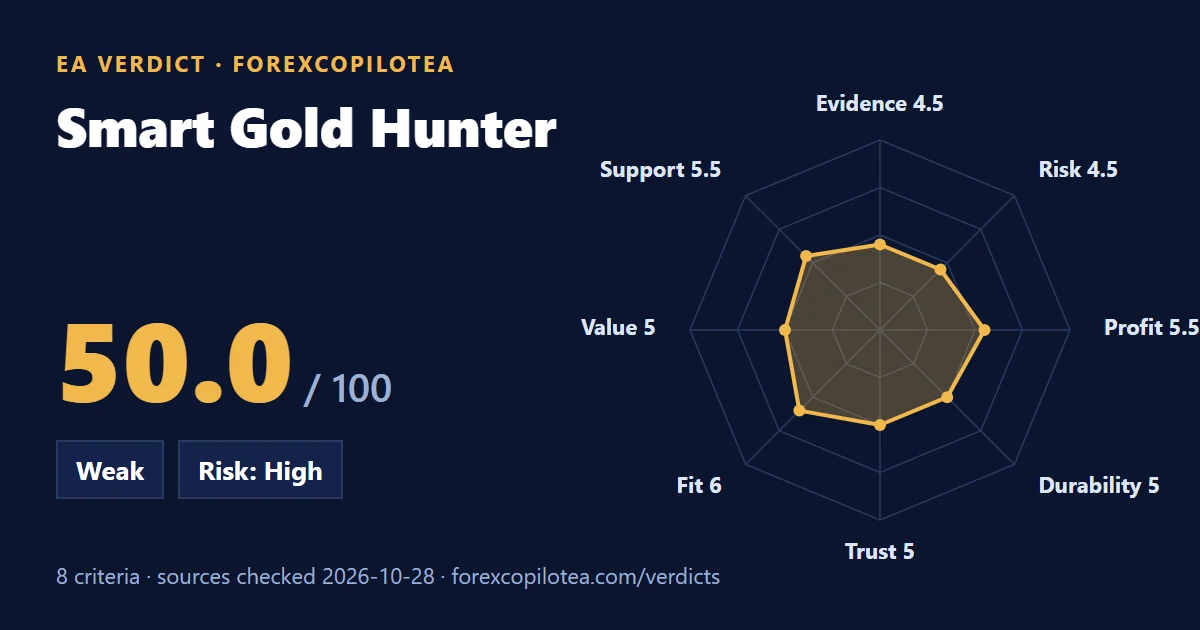
Smart Gold Hunter is a MetaTrader 5 Expert Advisor for gold with several named profiles, including Striker, Ultimate Scalper, Swinger, Prop Scalper, PRR Scalping and Custom. The Market description says it uses single-entry logic and offers optional stops, news, spread, equity and daily protections. One public signal, SMART GOLD HUNTER MAIN ICM, provides a record with 234 trades. On 28 October 2026 it showed a 1.72 profit factor, 73.93% winning trades, 14.02% maximum balance drawdown and only 0.37% monthly growth. MQL5 also displayed repeated warnings that 80% of growth had been achieved in too few days; an indexed signal snippet said two days accounted for 80% of growth over a 65-day period. We score this evidence, not the product's marketing language. Verdict: 50.0/100, Weak band and High risk.
Key takeaways
- Smart Gold Hunter scores 50.0/100 (Weak) with a High risk label. Its active public signal has a positive profit factor, but a short record and growth-concentration notices limit confidence.
- Signal 2365400 showed 234 trades, a 73.93% win rate, PF 1.72 and expected payoff of $0.67. Average losses were $3.60 against average wins of $2.18.
- The same signal reported 14.02% maximal balance drawdown and 3.32% equity drawdown. It had changed leverage between 1:500 and 1:1,000, according to the MQL5 notices.
- MQL5 repeatedly warned that 80% of growth came in a low share of days; an indexed result stated two days out of 65. The latest displayed monthly growth was 0.37%.
- The product page describes multiple profiles and risk controls, but it does not prove that every profile has the same risk or that controls will prevent losses.
- The MQL5 listing showed $349 to buy, or $149 for three months / $199 for six months of rent, with a free demo. ForexCopilotEA's separate mock listing says v3.5.
- 50.0 / 100
- weighted score; Weak band across eight criteria
- 234 trades
- on the main linked MQL5 signal as checked 28 October 2026
- $349
- MQL5 purchase price; rentals and free demo also listed
The verdict: a real signal, but a lumpy and still-young result
Smart Gold Hunter makes a broader product claim than the single live record can validate. The listing presents multiple gold trading profiles, including fast scalping, wider swing-style trade management and modes positioned for prop-firm style use. It also describes risk controls such as daily loss limits, equity protection, spread and news filters. Those functions may help a user configure a system, but one signal cannot establish how each profile performs, what risk it takes or whether the protections work as described in a live event.
The clearest evidence is the main ICM signal, which reports 234 trades and a platform-calculated trade history. It is not a long history: the signal page shows it was opened in March 2026, around seven months before this review. The account is run by a vendor rather than an independent buyer, and MQL5 issued warnings about small sample size and unusually concentrated growth early in its life. The signal has since accumulated hundreds of trades, but that does not erase the platform's later notices that a very low share of days produced most of the growth.
At the review date, the account showed 73.93% winning trades and a profit factor of 1.72. But the average loss was $3.60 and average win $2.18, so the system's result depends on winning often enough to offset larger average losses. Monthly growth was only 0.37% at that snapshot. The platform reported maximum balance drawdown of 14.02% and equity drawdown of 3.32%, metrics that describe different things and should both be read. The account's leverage history also changed from 1:500 to 1:1,000, another reason to follow the risk notices rather than focus only on growth.
The strongest positive is the public traceability: a buyer can inspect the signal's trades, platform warnings and current statistics rather than relying only on a vendor backtest. The strongest negative is the combination of a short vendor-run record, concentrated historical growth, a lopsided average win/loss and no independent profile-by-profile history. We score that mixture rather than labeling the product either a success or a failure.
50.0 / 100
Weighted verdict score
Weak
Verdict band
High
Risk label
| Criterion | Weight | Score | Best evidence | Points |
|---|---|---|---|---|
| Verified evidence | 20 | 4.5/10 | Grade A | 9.0 |
| Risk and drawdown behaviour | 20 | 4.5/10 | Grade A | 9.0 |
| Profitability quality | 15 | 5.5/10 | Grade A | 8.3 |
| Sustainability | 15 | 5/10 | Grade B | 7.5 |
| Transparency and trust | 10 | 5/10 | Grade B | 5.0 |
| Practical fit | 10 | 6/10 | Grade B | 6.0 |
| Cost and value | 5 | 5/10 | Grade B | 2.5 |
| Support and usability | 5 | 5.5/10 | Grade B | 2.8 |
| Total | 100 | 50.0 |
What is Smart Gold Hunter?
The MQL5 listing presents Smart Gold Hunter as a gold Expert Advisor intended for XAUUSD or broker-specific gold symbols such as XAUUSDm or GOLD. It says timeframe is less important than profile and configuration, and recommends stable execution, low spreads and a VPS. The listed profiles are Striker, Ultimate Scalper, Swinger, Prop Scalper, PRR Scalping and Custom. They are marketed for different approaches, from selective entries to faster trading, wider management and user-defined settings.
The description says the EA does not use a grid, martingale, recovery or hedging and characterizes its approach as single-entry or one-shot with stop loss and take profit. It also lists optional break-even, hidden initial stop, stop-from-actual-execution-price, entry randomizer, daily profit target, daily loss limit, equity protection, high-impact news filtering, spread protection and market-close protection. These are seller-described product features. Without public source code or a version-matched audit, this review cannot confirm that each option operates as intended or determine how the signal's settings use them.
| Profile or feature | Vendor's stated purpose | What a buyer should verify |
|---|---|---|
| Striker | Default profile for selective gold entries and managed trades. | Exact settings on the public signal and the intended risk per position. |
| Ultimate Scalper | Faster trading with execution-related options. | Spread, latency, fills and whether a hidden stop can be monitored by the user. |
| Swinger | Wider trade management and potentially longer holds. | Overnight, weekend and swap exposure, plus worst floating loss. |
| Prop Scalper | A profile described for prop-firm-style management. | The exact firm's current rules and all interactions with daily/equity limits. |
| PRR Scalping / Custom | A positive risk-reward preference or user-controlled values. | Version-specific manual, tested stop distance and loss distribution. |
| News, spread and equity controls | Optional protections are listed in the product description. | Default state, data source, server-time behavior and failure mode. |
Profile choice matters. A signal labelled Smart Gold Hunter does not prove that it uses Striker, Prop Scalper or any other profile a buyer may select. Nor does an equity protection setting tell us its threshold, whether it measures floating positions, how it responds to a gap or whether it has been tested. Ask the seller to identify the profile and settings used on signal 2365400, then compare those settings with the download you expect to receive.
The listing warns that gold's spread, slippage, execution speed, liquidity, VPS quality and market conditions can change real results. That is particularly relevant to Ultimate Scalper and Prop Scalper as described by the seller. A buyer should treat the profile names as labels, not as evidence of strategy performance. Check symbol digits and contract size, confirm whether the broker uses a suffix, measure spread at the hours it trades, and run a demo using the intended profile and account type.
The main live signal: 234 trades, high win rate, larger average losses
Signal 2365400, SMART GOLD HUNTER MAIN ICM, is the main public record linked in search and was active when checked. MQL5 showed 234 trades, 173 profitable trades (73.93%) and 61 losing trades (26.07%). The profit factor was 1.72 and expected payoff $0.67. These are meaningful numbers to inspect because they are platform-generated from the signal history. They remain a vendor-run account with a short operating period, and they do not prove that an ordinary buyer can reproduce the same results.
| Measure | MQL5-reported value | Interpretation |
|---|---|---|
| Closed trades | 234 | More than a backtest screenshot, but still a short live sample. |
| Winning trades | 73.93% | A high hit rate does not show average loss size or future hit rate. |
| Profit factor | 1.72 | Gross wins divided by gross losses over the visible history. |
| Expected payoff | $0.67 | Platform-reported average result per trade in account currency. |
| Average profit / average loss | $2.18 / -$3.60 | Average loser is larger; the win rate must remain high. |
| Maximal balance drawdown | 14.02% ($22.58) | Largest platform-measured balance decline in the signal history. |
| Relative equity drawdown | 3.32% ($4.60) | A separate measure that includes floating equity changes. |
| Max deposit load | 7.02% | Peak margin usage measure; not the same as drawdown. |
| Monthly growth | 0.37% | The platform's displayed recent monthly figure on the review date. |
The ratio of average win to average loss is important. If an account averages $2.18 on a winning trade and loses $3.60 on an average loser, it needs enough wins just to compensate for the larger losses, before fees and execution costs. A 73.93% win rate is historically high in this sample, but it is not a stable property guaranteed by the EA. A change in market conditions, spread or settings can affect both the hit rate and loss size. The platform also showed a worst trade of about $8.73 and a four-trade losing streak of roughly $16.28.
The signal's maximum balance drawdown and equity drawdown should not be collapsed into one claim. Balance statistics reflect closed results, while equity can reveal floating P/L. The values shown can be calculated over distinct periods and bases. An open trade that has not closed at a loss may still create a real account-level drawdown. A buyer should inspect the live open positions and historical equity chart, and ask what account balance and lot settings produced the numbers. Do not infer safety from the smaller of two percentages.
Another important clue is the signal's turnover. It averaged about six trades per week and held trades around 59 seconds. Even if the strategy is not always trading at high frequency, the short average holding time can make the economics sensitive to spreads and fill quality. The signal's provider broker was IC Markets, but subscribers on another server may see different prices and execution. A demo on your own broker can test compatibility and typical spreads; it cannot establish that the account will earn the signal's historical return.
The profit-concentration warning deserves attention
MQL5 attached repeated notices to the signal that a low share of days accounted for 80% of growth. The warning appeared more than once in the signal's event history. Search indexing for the signal captured a specific notice: 80% of growth had been achieved within two days, representing 3.08% of a 65-day signal lifetime at that point. The current signal page later showed 234 trades, but the concentration notice remains relevant historical evidence about how the early growth was distributed.
Concentrated growth means the total result can depend heavily on a small number of good days. It does not prove that those days were luck, and the platform does not say that the system can never repeat them. But it does mean the headline cumulative growth is a poor shortcut for estimating a typical month. A buyer should inspect the monthly chart, daily contribution and flat periods, not simply annualize a growth percentage. In this account, the recent monthly growth was shown as 0.37%, much less dramatic than early growth snippets.
The signal also displayed notices about a newly opened account, too few deals to evaluate trading quality, high growth in the last month and leverage changing within the range 1:500 to 1:1,000. Some earlier warnings were later removed as the record developed, which is normal platform behavior. A removed warning is not an endorsement of the signal; the underlying timeline still helps readers understand how the track record formed. Reviewing that timeline is more informative than copying a single current headline statistic.
What about the other Smart Gold Hunter signals?
Search results surface additional accounts using the Smart Gold Hunter name, including Smart Gold Hunter VT and a Smart Gold Hunter for XAUUSD signal. Search snippets report different trade counts, win rates, deposit loads and drawdowns. These are separate accounts with separate histories and settings; they should not be combined with the MAIN ICM data unless the vendor establishes that they use the same product version and profile. We use the MAIN ICM signal for the score because it is the named primary account linked from the product material.
A result for signal 2389879 was opened during research and returned an MQL5 notice that the signal had been disabled by its provider and was unavailable. That page cannot serve as current live evidence. Its disappearance does not establish a reason for disabling it, and we do not speculate. It does show why a buyer should click every signal link, note whether it remains active and preserve links to the exact account being discussed.
The main ICM account's existence does not erase the status of other signals or mean that all profiles are represented. Ask the seller which live records correspond to the product's current version and each named profile. If a link is disabled, request an explanation and a replacement record before treating another account as a substitute. Records should be compared by their starts, account size, broker, leverage, trading settings, open positions, deposits and withdrawals.
Risk: profile choice, leverage and stops
The seller states that Smart Gold Hunter uses single-entry logic, no grid, no martingale, no recovery and no hedging, with real stops and targets. Those are useful claims to distinguish it from strategies that add to losing trades. But the signal still reports a maximal balance drawdown above 14%, and the average losing trade is larger than the average winner. A stop does not mean every loss is predictable: gaps, fast prices, spreads and execution delay can produce results beyond a nominal stop distance.
The product's several profiles complicate risk comparison. A fast scalp may have many small trades and execution sensitivity; a wider swing profile may hold positions longer and face overnight or weekend exposure; a prop-style profile may include limits that are useful only if configured to match the account's rules. The page lists optional protections, but does not publish a version-matched signal for each one. The main signal's drawdown therefore cannot be assumed to describe every profile.
Leverage is not itself a measure of how much a strategy risks, but changes in account leverage can affect margin capacity. The platform recorded a change between 1:500 and 1:1,000. A user in a regulated jurisdiction may have a much lower leverage limit, and a broker's contract size, margin rules and minimum stop distance may differ. The product page's general low-spread recommendation should not be read as a guarantee that the setup fits a specific broker.
Risk controls need to be tested in realistic ways. Ask whether a daily loss limit uses balance or equity, when the day resets, whether open trades are closed when the cap is reached, and what happens if the news feed fails. Confirm that Friday-close protection is enabled and aligned to the broker's server time. Use a demo to observe how a stop is placed and modified. Keep live size small enough that a loss does not impair essential finances, and avoid using money needed for living expenses.
Price, rental and value
The MQL5 product page showed $349 to buy, $149 for a three-month rental and $199 for six months, plus a free demo. Verify the current checkout because Market pricing can change. Renting for six months costs less than buying, but it does not buy lifetime access and may not include the same terms as a permanent licence. The free demo is the least expensive way to check whether the EA attaches to the desired gold symbol and whether its interface and settings are understandable.
A purchase decision should compare the licence price with the strength of the evidence, not with a vendor's hypothetical return calculation. If the account's typical growth is low or uneven, it may take a long time to recover a software cost—or it may never recover it. The signal's early burst should not be assumed to recur. Running costs such as VPS hosting, spread, commissions, swaps and execution should be included. The Market demo is helpful, but it cannot prove the strategy's future profitability.
Our own store listing adds another cost-and-version consideration. It describes a separate Smart Gold Hunter listing at version 3.5 in the bundled mock catalogue. The MQL5 page may be updated independently, and there is no evidence here that the two products are byte-for-byte identical or that support and licensing terms match. If buying from our store, read that page's exact description and terms rather than assuming this Market review transfers to it unchanged.
A profile comparison should be based on a consistent protocol, not on selecting the best-performing example after the fact. Run one profile at a time, use the same broker, symbol, timeframe, starting balance and risk setting, and record all changes. Include trading costs and keep the settings fixed during the forward period. If a profile is stopped or replaced after a poor period, preserve its full record; removing the underperforming account would make the remaining results look more reliable than the overall product history.
A news filter also needs to be evaluated as an operational dependency. Ask whether it uses a calendar included with the EA or retrieves events from an external service, what happens when the source is stale, and which timezone controls the no-trade window. A protection can fail open or fail closed, each with different consequences. The listing says there is a high-impact news filter, but without test evidence it does not show whether an unexpected geopolitical event or a data outage will be handled in the way the buyer expects.
Hidden initial stops deserve particular attention. The product page lists an option to hide the initial stop and one based on actual execution price. A hidden stop may keep a protective level off the broker server, depending on how the feature is implemented. If the terminal or VPS disconnects, a locally managed stop may not behave like a server-side stop. Ask the seller exactly where the stop exists, when it is transmitted and what protection remains during a disconnection. Test only on demo until that behavior is understood.
Who Smart Gold Hunter may fit
- It may fit a gold trader who is willing to inspect the active signal's equity, profit distribution and settings rather than relying on a profile name.
- It may fit someone who wants a free demo and can compare profile behavior at their own broker before risking funds.
- It does not fit a buyer who expects stable monthly income or interprets a high historical win rate as guaranteed.
- It does not fit a trader who cannot tolerate a balance decline near the signal's historical 14% figure, noting that future drawdown can be larger.
- It is a poor fit for someone buying mainly because of an early growth burst or a claim that a profile is “prop firm” ready.
- It requires caution for short-timeframe profiles at brokers with wide spreads, slow execution or uncertain gold contract specifications.
How to read the signal's win rate and drawdown together
A 73.93% win rate can sound reassuring, but it is not meaningful in isolation. The reported average loss of $3.60 was larger than the average win of $2.18, so the relationship between win size, loss size and frequency matters. Profit factor combines gross gains and losses over the observed sample; it does not show how painful the path was, whether open trades temporarily lost more, or how the next sample will behave. Reviewing individual trades and maximum equity decline provides context that one summary percentage cannot.
The balance and equity drawdown figures also answer different questions. Balance drawdown reflects closed-account value, while equity includes open positions at the snapshot. A lower equity figure in a signal summary does not erase the larger maximum balance drawdown reported across its history, and neither number is a ceiling on future losses. Because the account's leverage changed and the vendor controls the signal, a buyer should look at dated snapshots and position sizing rather than assume the current headline metric describes every period or profile.
The score, criterion by criterion
We score eight criteria using the same methodology as the other verdicts: evidence 20%, risk 20%, profitability 15%, sustainability 15%, trust 10%, fit 10%, cost 5% and support 5%. Each is scored out of ten and combined into a weighted total. Grade A describes the strongest underlying source, here a platform signal; it does not certify that the account is independently audited. Vendor descriptions receive appropriate limits where they cannot be reproduced or checked.
| Criterion | Score | Points | Reason |
|---|---|---|---|
| Verified evidence (weight 20) | 4.5 / 10 | 9.0 | One public vendor-run MQL5 signal has 234 trades, but the history is about seven months, the leverage changed, platform warnings note profit concentration and it is not independently operated. |
| Risk and drawdown behaviour (weight 20) | 4.5 / 10 | 9.0 | The active signal reports 14.02% maximal balance drawdown, 3.32% equity drawdown and losses averaging more than wins; mode-specific and future stress behavior is unknown. |
| Profitability quality (weight 15) | 5.5 / 10 | 8.3 | The signal reports PF 1.72 and positive expected payoff over 234 trades, but monthly growth is 0.37%, win rate alone masks payoff shape, and growth was concentrated in two days. |
| Sustainability (weight 15) | 5 / 10 | 7.5 | Several profiles, protections and ongoing versioned development are described, but the entry logic is closed and the live sample is short and gold-specific. |
| Transparency and trust (weight 10) | 5 / 10 | 5.0 | A detailed product page and live signal are public, but the listing is vendor-authored, one advertised signal is disabled, and the active signal carries concentration warnings. |
| Practical fit (weight 10) | 6 / 10 | 6.0 | Gold-only profiles offer different trading styles and multiple filters, but execution quality and broker conditions matter and mode-specific risk records are not shown. |
| Cost and value (weight 5) | 5 / 10 | 2.5 | $349 purchase or $149 for three months and $199 for six months with a demo is moderate to premium against one short vendor-run signal and a 14% balance drawdown. |
| Support and usability (weight 5) | 5.5 / 10 | 2.8 | A free demo, multiple profiles, manual and clear setup guidance are described; independent evidence of support quality and signal-to-profile mapping is limited. |
Evidence receives credit for a public signal with 234 trades, but it is not independent and it carries platform notices about concentrated growth. Profitability is positive by the displayed profit factor but limited by low monthly growth and the payoff ratio. Fit is a relative strength because the product gives several profiles and protection options; those same options do not increase evidence or remove execution risk. The weighted total is 50.0 out of 100.
Questions to ask before buying
Sources and review date
- MQL5 Market: Smart Gold Hunter, product 170050Vendor product features, profile descriptions, price and demo information; opened 28 October 2026.
- MQL5 Signal: SMART GOLD HUNTER MAIN ICM, 2365400Platform statistics, drawdown, leverage notices and growth-concentration warnings; checked 28 October 2026.
- MQL5 Signal: Smart Gold Hunter, 2389879The signal page returned a notice that the provider disabled the signal; it is not used as active performance evidence.
- ForexCopilotEA Smart Gold Hunter store listingA separate listing; its bundled mock product record says version 3.5, not a verified match to the Market product.
- ForexCopilotEA verdict methodologyShared scoring weights, criteria and source grades.
Frequently asked questions
Is Smart Gold Hunter EA profitable?
The main MQL5 signal showed a profit factor of 1.72 and positive expected payoff across 234 trades when checked on 28 October 2026. That signal also had only about seven months of history, a 14.02% maximum balance drawdown and platform warnings that most growth came in a small number of days. It is not proof of future profitability.
What does Smart Gold Hunter trade?
The MQL5 product page describes a gold EA for XAUUSD and broker-specific gold symbols. It lists several profiles, including scalping and swing-style modes. Confirm symbol suffixes, timeframe recommendations and settings with the current manual.
Does Smart Gold Hunter use martingale or a grid?
The vendor's product page says it does not use grid, martingale, recovery or hedging and describes single-entry logic with stops and targets. We have not audited the source code, so these remain seller statements rather than independently verified facts.
How risky is Smart Gold Hunter?
We assign a High risk label because the main signal reported 14.02% maximum balance drawdown, an average loss larger than the average win and concentrated-growth warnings. Its 3.32% equity figure is a different platform measure. Future drawdown can exceed any historical value.
What is the price of Smart Gold Hunter?
On 28 October 2026, the MQL5 listing showed $349 to buy, $149 for three months of rental or $199 for six months, with a free demo. Check the current checkout price, since Market prices can change.
Does Smart Gold Hunter work for prop firms?
The listing includes a Prop Scalper profile and various risk controls, but those names do not prove compliance with any firm's current rules. Confirm all limits and behavior against the firm's rulebook and test the configuration before an evaluation.
What does the signal growth-concentration warning mean?
MQL5 repeatedly displayed a warning that 80% of growth came in a small share of days. An indexed page snippet said two days accounted for 80% of growth in a 65-day period. This does not establish why those days were unusually profitable, but it means cumulative growth should not be treated as typical monthly performance.
Is the ForexCopilotEA listing the same version?
That has not been verified. Our separate store mock listing says v3.5. The Market page and public signal are separate sources, and the public evidence we checked does not confirm file identity, signal version or matching support terms.
How was the Smart Gold Hunter verdict scored?
Eight weighted criteria produced a score of 50.0/100. We give credit for a public trade record and product documentation, while limiting confidence for the short history, vendor operation, concentrated growth and unknown profile settings. Our store listing is disclosed as a commercial interest at the top.
Gold Expert Advisors in our store
We sell these, so weigh that interest. Put the same eight questions to any of them before you buy: read the manual, run your own backtest, and start on demo.



Keep reading
- EA Verdict #12Gold House EA Review: Verdict and Risk (2026)Is Gold House worth $749? Independent EA verdict: 52.3/100, Medium risk. Two live MQL5 signals, 68 reviews and a rising price ladder scored, checked 28 Oct 2026.
- EA Verdict #9Gold Snap EA Review: Verdict and Risk (2026)Is Gold Snap worth $399? Independent EA verdict: 56.0/100, Medium risk. Three live signals, 31 reviews and a backtest dispute scored, checked 21 Oct 2026.
- EA VerdictScalping Robot Pro EA Review: Risk & ResultsScalping Robot Pro EA review: 45.0/100, live MQL5 signal, 824 trades, drawdown, price and version risk checked 28 Oct 2026.
- Strategy comparisonWhich EA Strategy Wins Long Term?Compare MT5 Expert Advisor strategy types, from scalping and grid to hedging and arbitrage: how each earns, how each fails, and which tend to survive long term.