
EA Verdict
FarmedHedge Pair Trading Dashboard Review (2026): A $459 Pair-Trading Utility for MT5, Mostly Manual, With an Optional Auto Pilot
By Benjamin Lee · Updated · 29 min read
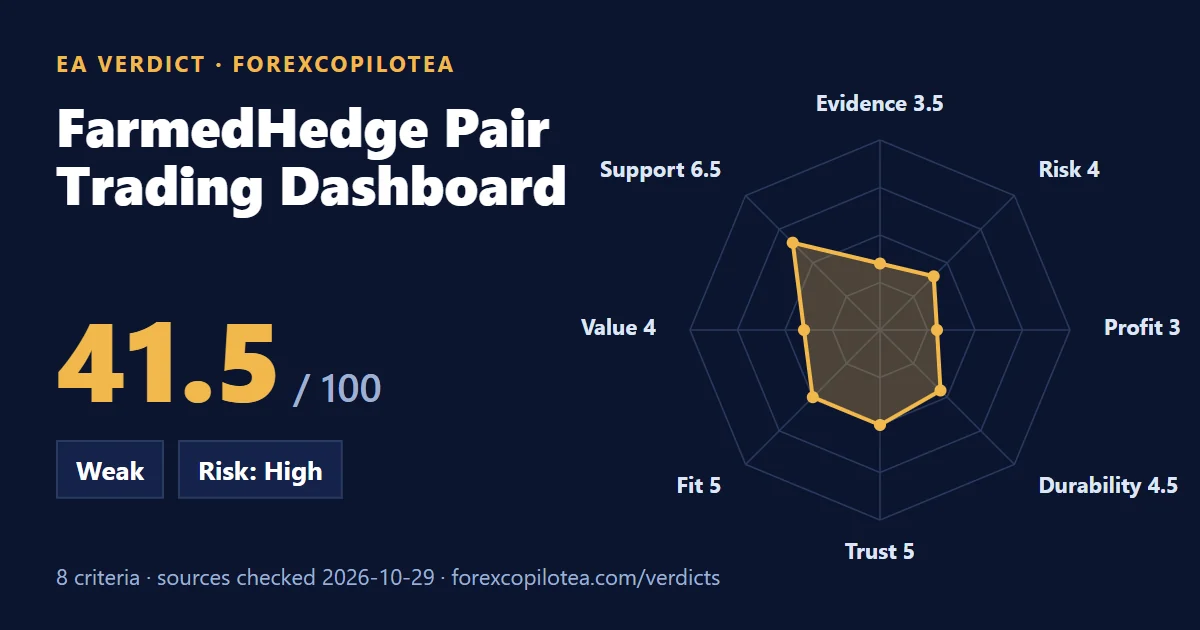
FarmedHedge Pair Trading Dashboard is a MetaTrader 5 utility for pair trading: it looks for two symbols that move together, measures how far they have drifted apart, and lets you trade the gap back toward normal by hand, half by hand, or with an optional Auto Pilot. Its own listing says plainly that it is a manual-focused trading utility and not a fully automated EA, and that the three signals it links include manual trades. On 29 October 2026 the MQL5 Market listing showed version 5.5, a price of $459, a free demo and a 5-star rating from 14 reviews. We read the listing line by line and scored the product on the same eight criteria as every verdict here, as what it is: a decision tool with an automation option, not a robot. The result is 41.5 out of 100 and a High risk label, mainly because nothing we could check shows what the tool earns on its own, and because pair trading can lose heavily when a correlation breaks.
Key takeaways
- FarmedHedge Pair Trading Dashboard scores 41.5 out of 100 (band: Weak) with a High risk label. It is a real, actively updated MT5 utility; the score is held down by evidence, not by any sign of bad faith.
- The listing calls it a 'MANUAL-FOCUSED TRADING UTILITY, not a fully automated EA' with three modes: Manual, Hybrid (manual entry, automatic take profit and stop loss) and Full Auto. Auto Pilot is described as an optional supplementary feature.
- The method is pair mean reversion. A 'Sync Rate' finds highly correlated symbol pairs; a 'Farm Index' measures the gap. The listing gives entry at a Farm Index of 200 or more, take profit at 50 to 100 and a Farm Index stop loss at 400 to 500.
- Three MQL5 signals are linked as verified trading results, but the listing itself says they include manual trades and overall strategic management. We did not open them, so this verdict quotes none of their numbers and grades evidence B.
- We sell a listing under this name. We could not confirm our listing's price or version against the Market's 5.5 when this page was written, so treat it as a separate purchase and check its terms.
- 41.5 / 100
- weighted verdict score on eight published criteria
- $459
- MQL5 Market price on 29 Oct 2026, with a free demo and 14 activations
- v5.5
- current version, updated 22 Oct 2026; first published 18 Jan 2026
The verdict at a glance: an honest tool description, but no proof of the tool's own edge
Most searchers ask four things about a product like this: is it legit, does it work, how risky is it, and what does it cost. Short answers first. It is a legitimate, actively maintained product on the MQL5 Market with a free demo, published key settings and a developer who describes it more modestly than most sellers do. Whether it works is the question the public evidence cannot answer: the linked signals mix manual decisions with the dashboard's signals, so they measure a trader using the tool, not the tool. The risk is High because pair trades can keep diverging after entry, and because the protective stops are settings the user chooses. The price on the MQL5 Market was $459 on 29 October 2026.
That combination puts FarmedHedge in a specific place. It is not a product to buy as a robot that runs itself; the vendor says so. It is a candidate for a trader who already wants to trade correlated pairs by hand and wants a scanner, a spread gauge and one-click two-leg execution. For that trader the main question is whether the dashboard's Farm Index is a better guide than the trader's own spread chart, and the demo is the place to find out. The scorecard and radar below show how the total was built.
41.5 / 100
Weighted verdict score
Weak
Verdict band
High
Risk label
| Criterion | Weight | Score | Best evidence | Points |
|---|---|---|---|---|
| Verified evidence | 20 | 3.5/10 | Grade B | 7.0 |
| Risk and drawdown behaviour | 20 | 4/10 | Grade C | 8.0 |
| Profitability quality | 15 | 3/10 | Grade C | 4.5 |
| Sustainability | 15 | 4.5/10 | Grade B | 6.8 |
| Transparency and trust | 10 | 5/10 | Grade B | 5.0 |
| Practical fit | 10 | 5/10 | Grade B | 5.0 |
| Cost and value | 5 | 4/10 | Grade B | 2.0 |
| Support and usability | 5 | 6.5/10 | Grade B | 3.3 |
| Total | 100 | 41.5 |
What FarmedHedge Pair Trading Dashboard actually is
FarmedHedge Pair Trading Dashboard is listed in the Utilities section of the MQL5 Market as product 162186, by Tanapisit Tepawarapruek. On 29 October 2026 the page showed a price of 459 USD, a free demo downloaded 663 times, publication on 18 January 2026, version 5.5 updated on 22 October 2026, and 14 activations per licence. The product header reads 'Farmed Hedge Yield Farming | All Markets' with the subtitle '(Manual - Hybrid - Semi/Automated EA)'. The listing showed a 5-star rating from 14 reviews and 32 comments. The seller line on the listing showed an overall rating of 4 from 8 votes across his Market products, signals and freelance orders.
The most important sentence on the page is the vendor's own notice, and it deserves to be quoted in full: 'FarmedHedge is a MANUAL-FOCUSED TRADING UTILITY, not a fully automated EA. Results shown on this Signal include manual trades and overall strategic management. If you are looking for a 100% automated, set-and-forget system, FarmedHedge is not designed for that purpose.' The version 5.00 notes repeat the point: manual trading is the primary focus, Auto Pilot is an optional supplementary feature, and full automation is not the main purpose. The page also says the tool can be used to enhance an existing trading system or to build a custom strategy from scratch.
So when this page says 'EA', it means what MetaTrader means: a program attached to a chart that can place orders. FarmedHedge can place orders, in Hybrid and Full Auto modes, but the product is built around a dashboard that a person reads. We score it on that basis. A dashboard that is honest about being a dashboard should not be marked down for not being a robot; it should be marked down only where its evidence, risk and value fall short.
| Item | What the listing says |
|---|---|
| Seller | Tanapisit Tepawarapruek (MQL5 user ma13ion). Seller line shows an overall rating of 4 from 8 votes. |
| Category, platform | Utilities, MetaTrader 5. |
| Price, licence | 459 USD purchase on 29 Oct 2026, with a free demo and 14 activations. |
| Versions | Published 18 Jan 2026; current version 5.5, updated 22 Oct 2026. The page describes features added in version 3 and the trading approach of version 5.00. |
| Type | 'Manual-focused trading utility, not a fully automated EA'. Three modes: Manual, Hybrid and Full Auto. |
| Method | Pair mean reversion: Sync Rate finds highly correlated pairs; Farm Index measures divergence; positions close when the Farm Index returns toward zero. |
| Markets | 'Any asset available on your broker': forex majors, minors and exotics, crypto, stocks, commodities, indices and any CFD. |
| Timeframe | H1 to H4 recommended. |
| Key settings | Lot 0.01 per pair; Farm Index entry 200 to 300; minimum Sync Rate 70% to 80%; max open pairs 2 to 3; Auto TP Farm Index 50 to 100; Auto SL Farm Index 400 to 500. |
| Risk tools | Max open pairs, max Farm Index filter for entry, Sync Rate minimum, max drawdown protection, spread monitoring, cooldown after a stop loss. |
| Track record | Three linked MQL5 signals named Axi Copy, Exn Copy and V Copy, described as verified results that include manual trades. |
| After purchase | Setup Guide and Advanced Setup Guide opened from a Manual button in the EA; Thai language support available. |
| Reach | 663 demo downloads, 14 reviews (5 stars), 32 comments. |
How the FarmedHedge dashboard works: Sync Rate, Farm Index and mean reversion
Pair trading is one of the oldest ideas in systematic trading. Take two instruments that usually move together, such as two currency pairs that share a currency, or two stock indices. When one runs ahead of the other, sell the one that is ahead and buy the one that is behind, and close both when the gap closes. If the relationship holds, the two legs offset most of the market's direction and the trade earns the narrowing of the gap. If the relationship breaks, both legs can lose together, or one leg's loss can keep growing faster than the other leg's gain.
FarmedHedge puts its own names on each step. The listing describes three: a Sync Rate analysis that 'scans all available pairs to find highly correlated combinations'; a Farm Index calculation in which a reading above +200 is a short signal, meaning the first symbol is overvalued against the second, and a reading below minus 200 is a long signal; and the mean-reversion exit, in which 'when FI returns toward zero, positions are closed for profit'. The Farm Index chart tool shows entry signals at 200 or higher and exit signals at 50. The listing does not publish the formula for either index, so we cannot say whether the Farm Index is a z-score, a ratio, a point spread or something else, or over what look-back it is measured.
Version 3 added a Summary Dashboard, called the SRA panel, with quick pair selection and recommendations, where a normal trade is taken at what the listing calls the CL level and a scalp at the SC level. It also added a 'Wind Gauge' indicator, where a high reading is described as a better profit opportunity, and a 'Harvest Time Bar', where 100% means a scalp entry is available. The visual dashboard monitors pair combinations in real time, trades with one click, tracks live profit and loss on open positions, and filters by symbol, Sync Rate and Farm Index. A quick search finds any pair. None of these labels is defined numerically on the page; they are interface names for the tool's own readings.
- Scan. The dashboard ranks combinations by Sync Rate. The suggested filter keeps only pairs at 70% to 80% or higher.
- Wait for a stretch. A trade becomes a candidate when the Farm Index reaches 200 or more in either direction; the suggested entry band is 200 to 300.
- Open two legs. In Manual mode you click; in Hybrid you click and the tool manages the exit; in Full Auto the tool opens when the threshold is reached.
- Exit on reversion. The suggested take profit is a Farm Index of 50 to 100, or a USD target.
- Exit on failure. The suggested stop is a Farm Index of 400 to 500, a drop in Sync Rate, or a USD loss, followed by a cooldown.
Read the suggested settings as numbers that describe a bet. The entry is at 200 to 300, the target at 50 to 100 and the stop at 400 to 500. In Farm Index units, a trade entered at 250 that exits at 75 gains 175 units, and one that is stopped at 450 loses 200 units. That is close to a one-to-one payoff in index units, so the method needs to be right more often than it is wrong after costs. Index units are not dollars, though: two legs of different volatility can turn the same index move into very different account moves, and spreads are paid on both legs. Whether 175 units of reversion pays more than two spreads and any swap is exactly what a record would show and the listing does not.
Is FarmedHedge legit? What the evidence can and cannot show
Evidence on trading tools is never neutral. Here is every party near this product and what each stands to gain, ours included.
- The developer sells the utility and runs the three linked signals. He also tells buyers that those signals include manual trading, which is a disclosure many vendors would leave out.
- MQL5 and MetaQuotes host the Market, the reviews and the signals, and compute signal statistics from broker history.
- Buyers who left reviews gave it 5 stars. The three titles we could read are short and general, and none of them links a record.
- ForexCopilotEA sells a listing under this name. We gain if you buy it, which is why this verdict opens with that fact and applies the same rules as every other.
Evidence ladder: what each rung of proof held for FarmedHedge
Grade A: Independent proof
- None used in this verdict. The listing links MQL5 signals 2356376 (Axi Copy), 2356404 (Exn Copy) and 2357156 (V Copy). MQL5 signals are built from broker history and would normally count here, but we did not open them, and the vendor says they include manual trades, so even when read they describe the vendor's trading with the tool rather than the tool alone.
- MetaQuotes and Myfxbook documentation, used only for how testing reports and verified records work.
Grade B: Checkable vendor material
- The Market listing: version 5.5, publication and update dates, price, activations, demo download count, mode descriptions and recommended key settings.
- The free demo, which runs in the Strategy Tester's visual mode with manual Trade and Close buttons.
Grade C: Claim only
- 'High Wind Gauge = Better profit opportunity' and the Harvest Time Bar's scalp signal: interface claims with no published test.
- 'Auto Pilot: 24/7 automated open/close orders' and 'Max Drawdown protection': described, not demonstrated in a record we read.
Grade D: Conflicted, anonymous or unverifiable
- Review titles such as 'Awesome system', 'Good ea' and 'Good strategy for profitable trading': possibly genuine, not checkable, with no linked results.
Our scoring rules cap the evidence score at 4 out of 10 unless a grade-A source supports it. FarmedHedge sits at 3.5 under that cap. We want to be fair about why. It is not that the vendor shows nothing; it is that the kind of proof a dashboard can offer is different from a robot's. A fully automated EA with a live signal produces a record of the strategy. A manual tool with a live signal produces a record of a person. The vendor's own disclosure, that the signals 'include manual trades and overall strategic management', means that a buyer who reads those signals is reading the developer's discretion as much as the Farm Index. That is useful to know about the developer and much less useful as a forecast of what another trader will do with the same screen.
A dashboard could still be evidenced well. The vendor could run one account in Full Auto with the published settings and no manual intervention, label it as such, and leave it running for twelve months. Or he could publish a Strategy Tester report of the Full Auto mode over several years on named pairs, with the settings attached, so anyone can reproduce it. Either would move the evidence score. Until then, the honest description is that the method is plausible and the record is not separable. For how to read any record you are shown, see our guide on how to verify an EA track record.
The three linked signals: what they are and why we quote no numbers
The listing groups three MQL5 signals under the heading 'Verified trading results'. The names suggest the same approach copied to accounts at different brokers, but we have not confirmed the brokers, start dates, sizes or statistics, so the table below lists only what the listing states.
| Signal name on the listing | MQL5 signal ID | What we can say |
|---|---|---|
| Farmed Hedge Yield Axi Copy | 2356376 | Linked by the vendor; statistics not read by us. |
| Farmed Hedge Yield Exn Copy | 2356404 | Linked by the vendor; statistics not read by us. |
| Farmed Hedge Yield V Copy | 2357156 | Linked by the vendor; statistics not read by us. |
When you open them, read them with four questions in mind. First, how much of the trading is manual? The listing already says some is, and the signal's trade history will show whether trades arrive in clean pairs at Farm Index thresholds or at irregular times. Second, what is the maximum drawdown by equity, not only by balance? Pair trades can sit open for a long time with one leg deep in loss, and a balance figure hides that until the trade closes. Third, how concentrated is the profit? MQL5 notes when most of a signal's growth came from a few days. Fourth, are the accounts the same strategy at three brokers, or three different approaches? If the three curves look alike, that is mild support for the method's repeatability; if they diverge, that is a sign the discretion matters more than the dashboard. Our guide comparing EAs, copy trading and signals explains why a copied signal and a purchased tool are not the same thing.
How risky is FarmedHedge? Correlation breaks, two-leg costs and user-set stops
We label FarmedHedge High risk. That is not a claim that it uses a grid or martingale: the listing describes neither, and its own risk tools point the other way. It is a judgement about what pair mean reversion can do when the pair stops reverting, and about the fact that every protective limit on the page is a setting the user controls. Here are the risks in the order we would check them.
- Correlation breaks. The trade assumes the two symbols will come back together. A central-bank decision, a policy change, a crisis in one currency or one company's earnings can end that relationship for weeks or for good. The listing's answer is a Farm Index stop at 400 to 500 and a stop on a Sync Rate drop. Both help; neither is verified in a record we read.
- Two legs, two costs. Every pair trade pays the spread twice and, when held overnight, swap on both positions. On exotic pairs, crypto and stock CFDs, which the listing says are supported, spreads and swap can be large compared with the reversion the trade aims to capture. The tool includes spread monitoring; it cannot make a wide spread narrow. See our guide to spread, slippage and swap.
- Mismatched leg sizes. The suggested lot is 0.01 per pair. If both legs trade the same lot but have different volatility or contract values, the position is not neutral, and a market move can push both legs' profit and loss in one direction. The listing does not say whether the tool weights the legs.
- Stacking. The suggested limit is 2 to 3 open pairs. Many forex pairs share currencies, so three 'different' pair trades can carry the same underlying bet three times. Our guide on portfolio risk across EAs covers the same overlap problem.
- User-set limits. Max drawdown protection, USD stops and the Farm Index stop are inputs. A user who widens them, or switches them off to avoid taking a loss, removes the only bound the method has.
- Gaps. Positions held over a weekend or a market close, especially on stocks and indices, can open far beyond a stop level. See weekend gaps and rollover risk.
- Account type. Opening two positions on correlated symbols works on a hedging or a netting account when the symbols differ, but some users run several strategies on the same symbols; check how your account handles it. See hedging versus netting accounts.
Against that, the design has real strengths. A cap on open pairs, a minimum Sync Rate, a maximum Farm Index filter that stops the tool entering a gap that is already extreme, a cooldown after a stop loss and an account-level drawdown setting are the right controls for this method. The listing describes them clearly. If they work as written and the user keeps them on, the worst case on any one pair is bounded. We would move the risk label to Medium on a verified record, ideally in Full Auto with the published settings, that showed those bounds holding through at least one episode in which a pair diverged hard.
Interactive: drawdown recovery
Gain needed to get back to break-even
+42.9%
Blue: equity left. Red: equity lost.
Consecutive losing trades to reach this drawdown: 36
Manual, Hybrid or Full Auto: which FarmedHedge mode, and what settings
The three modes are not cosmetic. They decide who is responsible for the result. In Manual mode the dashboard is an information screen with one-click execution, and every entry and exit is your decision. In Hybrid mode you choose the entry and the tool manages the take profit and stop loss by Farm Index or USD target. In Full Auto mode the tool opens when the Farm Index threshold is reached and manages both exits. The listing describes Auto Pilot as 24/7 automated open and close orders, and the version 5.00 notes call it an optional supplementary feature.
For a buyer who wants an EA in the usual sense, Full Auto is the only mode that resembles one, and it is also the mode the vendor says is not the main purpose and, by our reading, the mode the demo does not include. That is the strongest practical reason to ask questions before buying. For a buyer who wants to trade pairs by hand, Hybrid is a sensible middle: a human decides whether the divergence has a reason, and the tool enforces the exit so that a losing trade is not left open in hope.
| Setting | Recommended value | What it controls |
|---|---|---|
| Lot Size | 0.01 | Volume per pair. Start here on any new account. |
| Farm Index Entry | 200 to 300 | How far the pair must diverge before a trade. Higher means fewer, more stretched entries. |
| Min Sync Rate | 70% to 80% | How closely the two symbols must have moved together. Lower admits weaker pairs. |
| Max Open Pairs | 2 to 3 | How many pair trades can run at once, and so the total exposure. |
| Auto TP Farm Index | 50 to 100 | How far back toward zero the gap must close before profit is taken. |
| Auto SL Farm Index | 400 to 500 | How far the gap may widen before the trade is closed at a loss. |
These are the vendor's settings, not a set file we tested. The listing also mentions a max Farm Index filter for entry, USD-based take profit and stop loss, a stop on a Sync Rate drop and a cooldown after a stop. The full Setup Guide and Advanced Setup Guide are opened from a Manual button inside the tool after purchase. For general advice on reading inputs before trusting them, see our guide to EA set files and input settings. If you are new to the question of whether to automate at all, our comparison of automated and manual trading is the place to start.
Broker choice matters more for pair trading than for a single-symbol EA, because costs are paid twice. Pick a broker where both symbols you plan to trade have tight, stable spreads at the hours the tool trades, check swap on both legs, and keep to liquid majors and well-known indices while you learn. The listing's 'any CFD your broker offers' is a capability, not a recommendation; exotic pairs and thin CFDs are where the two-leg cost is largest.
What FarmedHedge buyers say
The listing showed a 5-star rating from 14 reviews on 29 October 2026. We could read the titles of three in the page: 'Awesome system' from Sakon Aram on 24 October 2026, 'Good ea' from Panupong Songsuwan on 13 October 2026, and 'Good strategy for profitable trading' from poosurasak on 13 September 2026. We weigh them as testimony. They are positive and recent, and none of them gives figures, a mode, a broker or a link to a record, so they tell us that some buyers are content without telling us how the tool performed for them.
Two cautions apply to any review count of this size. Fourteen reviews is a small sample, and a perfect average on a small sample says more about who chose to write than about the typical outcome. And a manual tool's reviews describe the reviewer's own trading as much as the software. Read them for the range of experiences, and read the 32 comments for the kinds of questions and problems buyers raise and how the developer answers them.
FarmedHedge price: is $459 worth it for a pair-trading dashboard?
The MQL5 Market price on 29 October 2026 was 459 USD for a purchase with 14 activations, which is generous for a tool a trader may want on a home computer, a laptop and a VPS. We did not see a rental option on the page we read. The free demo, downloaded 663 times, is the main way to judge the tool before paying, with the caveat that the listing indicates Full Auto is for purchase only.
Is it good value? For a trader who already trades correlated pairs by hand, a scanner that ranks combinations, shows the gap and opens both legs in one click saves time and removes execution errors, and that has value independent of any track record. For a buyer who wants a robot that makes money on its own, $459 buys a tool whose automated mode has no separate public record we could read. We score cost at 4 out of 10 for the second buyer, who is the one most likely to search for an 'EA review', and credit the demo and the 14 activations.
Remember the other costs: a VPS if you use Auto Pilot around the clock, two spreads on every trade, and swap on both legs when trades are held. If you buy from a source other than the MQL5 Market, such as our own listing, the price, version and support may differ. We did not confirm our listing's price or version for this page; check its terms before you pay. Our guide on lifetime licences, subscriptions and rentals explains the trade-offs between purchase routes.
The score, criterion by criterion: 41.5 out of 100
| Criterion | Score | Points | Why |
|---|---|---|---|
| Verified evidence (weight 20) | 3.5 / 10 | 7.0 | The listing links three MQL5 signals, but it says they include manual trades and overall strategic management, and we did not open them. What we could check is vendor material: the listing, a demo for the Strategy Tester's visual mode, and published key settings. |
| Risk and drawdown behaviour (weight 20) | 4 / 10 | 8.0 | Optional stops by Farm Index, Sync Rate drop or USD loss, a cooldown after a stop, a max-open-pairs cap and a max drawdown setting are described; none is verified in a record, the stops are user settings, and a correlated pair can stop reverting. |
| Profitability quality (weight 15) | 3 / 10 | 4.5 | No profit factor, win rate or drawdown was verified by us. The signals mix manual decisions with the tool's output, so even once opened they cannot isolate what the dashboard itself earns. |
| Sustainability (weight 15) | 4.5 / 10 | 6.8 | Actively updated (version 5.5 on 22 October 2026 after versions 3 and 5.00 described on the page), and pair mean reversion is a long-studied idea; but under ten months on the Market and an edge that depends on correlations holding. |
| Transparency and trust (weight 10) | 5 / 10 | 5.0 | Unusually candid that it is a manual-focused utility and not set-and-forget, with key settings published before purchase; the setup guides only arrive after purchase and the 'verified results' include manual trading. |
| Practical fit (weight 10) | 5 / 10 | 5.0 | Runs on any symbol the broker offers, H1 to H4, 0.01 lots per pair suggested; but it needs an attentive operator, a hedging-capable account for two-leg trades and conditions that the listing does not quantify. |
| Cost and value (weight 5) | 4 / 10 | 2.0 | $459 on the Market against no verified record that isolates the tool's own contribution; the free demo is the main mitigation. |
| Support and usability (weight 5) | 6.5 / 10 | 3.3 | Free demo with 663 downloads, Setup and Advanced Setup Guides inside the tool after purchase, Thai language support and 32 comments on the listing; the guides are not public beforehand. |
The total is 41.5 out of 100. Evidence, at 3.5 with a B grade, is the decisive line: the only performance records linked are signals that the vendor says include manual trading, and we did not read them. Risk, at 4, credits a sensible set of controls and holds back because none is shown working in a record and all are user settings. Profitability, at 3, is not a finding that the tool loses money; it is a finding that what the tool earns on its own is unmeasured. Trust, at 5, is higher than evidence because the vendor is candid about what the product is and publishes key settings before purchase. Support is the strongest line, at 6.5, for the demo, the built-in guides and language support.
What would move the score? A Full Auto signal with the published settings and no manual trades, running for twelve months, would lift evidence toward the 5 to 6.5 tier and profitability with it, if the numbers were positive. A published tester report of Full Auto over several years on named pairs would lift sustainability and trust. A public definition of the Sync Rate and Farm Index would lift trust. A rental or a demo that included Full Auto would lift cost. None of these requires the vendor to change the product, only to show it.
Who FarmedHedge Pair Trading Dashboard fits, and who it does not
- It fits a trader who wants to trade correlated pairs by hand or in Hybrid mode, understands that a pair can stop reverting, keeps the stops on, and wants a scanner and one-click two-leg execution rather than a strategy to follow blindly.
- It may fit a developer or system trader who wants a correlation and divergence screen to add to an existing method, which the listing names as a use.
- It does not fit anyone looking for a set-and-forget robot. The vendor says so, and the evidence for Full Auto is the thinnest part of the picture.
- It is risky for prop-firm challenges with daily loss limits, unless the drawdown and USD stops are set well inside the rules: a pair trade that keeps diverging can hit a daily limit in one session. See our guide to prop firms and EAs.
- It is a poor choice for a buyer who plans to use exotic pairs, crypto or thin stock CFDs on a wide-spread account, where two spreads and two swaps can absorb the reversion the method aims to earn.
How FarmedHedge compares with the EAs we have scored
Most products in our verdicts are fully automated single-symbol EAs, many of them on gold. FarmedHedge is a different animal: a multi-asset, mostly manual pair-trading utility. Next to a breakout EA such as Gold House, which links vendor-run signals that are fully automated and so speak for the strategy, FarmedHedge's records speak for the developer's trading with the tool. Next to grid systems such as Wave Rider, FarmedHedge's described design is more bounded, with a stop by design rather than a growing basket. Its 41.5 reflects that its main gap is proof, not design. For how strategy families differ in risk, see our strategy comparison, and browse our forex EA category for single-symbol alternatives.
Questions to put to the FarmedHedge developer before you pay
- Can you run and publish one signal in Full Auto mode with the recommended settings and no manual trades?
- What share of the trades on signals 2356376, 2356404 and 2357156 were opened or closed by hand?
- How are the Sync Rate and Farm Index calculated, and over what look-back period?
- Does the tool weight the two legs for volatility or contract size, or trade equal lots?
- Can the demo run Full Auto, and is a rental available?
- What is the worst loss you have seen on one pair trade with the recommended stop, and what happened?
- Which pairs and timeframes do you use yourself, and which do you advise a new user to avoid?
Sources and when they were opened
- MQL5 Market: FarmedHedge Pair Trading Dashboard (product 162186), opened 29 October 2026Source of the price, version, dates, activations, demo downloads, rating, review titles, modes, method description, recommended settings and the signal IDs. Written by the vendor and, for reviews, by buyers.
- MQL5 seller page: Tanapisit Tepawarapruek (ma13ion), as linked from the listing, 29 October 2026Seller identity and the overall seller rating shown on the listing. Profile pages not otherwise read.
- Myfxbook Help: VerificationHow a trading account's track record is verified on Myfxbook.
- MetaTrader 5 Help: Testing ReportWhat each figure in the tester's report means, including drawdown.
- MetaTrader 5 Help: Strategy TestingThe Strategy Tester: testing modes, settings and forward testing.
- ESMA: ESMA agrees to prohibit binary options and restrict CFDs to protect retail investorsThe EU leverage limits, margin close-out, negative balance protection and risk-warning rules for retail CFD accounts.
- CFTC Customer Advisory: AI Won't Turn Trading Bots into Money MachinesA US regulator's warning about trading-bot claims of unusually high returns.
Frequently asked questions
Is FarmedHedge Pair Trading Dashboard legit?
It is a real, actively updated MT5 utility on the MQL5 Market, published on 18 January 2026 and at version 5.5 on 22 October 2026, with a free demo and a 5-star rating from 14 reviews. We do not allege wrongdoing; the vendor is unusually candid that it is a manual-focused tool. It scores 41.5 out of 100 because nothing we could check shows what the tool earns on its own.
Is FarmedHedge a fully automated EA?
No, by the vendor's own description. The listing calls it a manual-focused trading utility, not a fully automated EA, with Manual, Hybrid and Full Auto modes. Auto Pilot is described as an optional supplementary feature, and the listing indicates that Full Auto is available only after purchase.
How does the FarmedHedge Farm Index work?
The listing says a Sync Rate finds highly correlated symbol pairs and a Farm Index measures how far they have diverged. A reading above +200 is a short signal on the first symbol against the second, below minus 200 a long signal, and positions close as the index returns toward zero. The formula is not published.
How much does FarmedHedge Pair Trading Dashboard cost?
On 29 October 2026 the MQL5 Market price was 459 USD for a purchase with 14 activations, plus a free demo. We did not see a rental option. A VPS, spreads on both legs and swap are extra. Other sellers, including our own listing, may differ in price, version and terms.
What are the recommended FarmedHedge settings?
For H1 to H4 the listing suggests 0.01 lots per pair, a Farm Index entry of 200 to 300, a minimum Sync Rate of 70% to 80%, a maximum of 2 to 3 open pairs, an Auto TP at a Farm Index of 50 to 100 and an Auto SL at 400 to 500. The full setup guides come with the purchase.
Does FarmedHedge use a grid or martingale?
The listing describes neither. It describes two-leg pair trades with take profit and stop loss by Farm Index, Sync Rate drop or USD amount, a cooldown after a stop and a max open pairs limit. We cannot read the code, so this rests on the listing. We still rate it High risk because correlations can break and the stops are user settings.
How was the score calculated?
Eight weighted criteria (evidence 20, risk 20, profitability 15, sustainability 15, trust 10, fit 10, cost 5, support 5), each scored out of ten against written anchors. Sources are graded A to D and unverified claims cannot count as proof. We sell a listing under this name, which is disclosed at the top. The total here is 41.5 out of 100.
Gold Expert Advisors in our store
We sell these, so weigh that interest. Put the same eight questions to any of them before you buy: read the manual, run your own backtest, and start on demo.

Keep reading
- VerificationHow to Verify an EA Track Record: What Proves WhatHow to verify an EA track record on Myfxbook, FX Blue or MQL5 Signals: what verified means, red flags, a 10-step checklist and a backtest comparison.
- Account setupHedging vs Netting Accounts: Which One Does Your EA Need?MT5 hedging and netting accounts explained: how positions, margin and EAs behave on each, which EAs need hedging, and how to check yours.
- Risk managementEA in Drawdown: What to Do (and What Not to Do)What to do when your Expert Advisor is in drawdown: separate normal from broken, check the logs, compare with the backtest, and decide to hold, reduce or stop.
- EA Verdict #12Gold House EA Review: Verdict and Risk (2026)Is Gold House worth $749? Independent EA verdict: 52.3/100, Medium risk. Two live MQL5 signals, 68 reviews and a rising price ladder scored, checked 28 Oct 2026.