
EA Verdict
GoldenShot EA Review (2026): A One-Position Gold EA With a 5-to-1 Stop, an 89% Win Rate and a 10-Week Live Signal
By Benjamin Lee · Updated · 39 min read
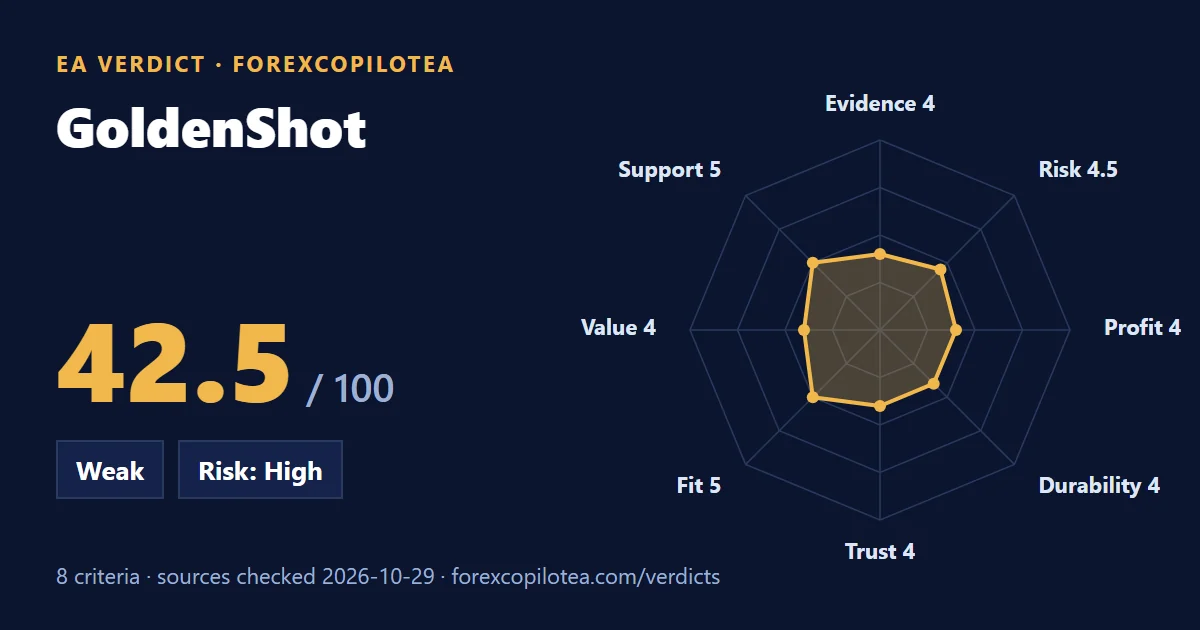
This GoldenShot EA review covers a MetaTrader 5 Expert Advisor for gold (XAUUSD) by Adam Hrncir of the Czech Republic, sold on the MQL5 Market since 28 August 2026. It takes one position at a time, always with a broker-side stop loss, and says it uses no grid, no martingale and no lot scaling. The price on 29 October 2026 is 249 USD with a stated ladder to 299 and a final 399 USD. Its only GoldenShot-specific live record is a 10-week signal with 57 trades, an 89.47% win rate, a profit factor of 1.21 and an average loss that is 7.0 times the average win. We read the listing, the version notes, 61 comments, the 20 reviews we could open and the signal, and scored GoldenShot on the same eight criteria as every verdict here. The result is 42.5 out of 100, band Weak, with a High risk label: a carefully described, frequently updated system whose evidence is young and whose losses are large next to its wins.
Key takeaways
- GoldenShot scores 42.5 out of 100 (band: Weak) with a High risk label. The rules are unusually well documented; the proof is 10 weeks and 57 trades long, so evidence is capped at 4 out of 10.
- The developer's signal (MQL5 signal 2387381, 'GoldenShot High Risk') shows 51 wins and 6 losses, a profit factor of 1.21, an average win of 2.07 USD and an average loss of minus 14.51 USD. It needs a win rate of about 87.5% to break even and has 89.47%, so the margin is two percentage points.
- The signal began with 100 USD, received 175 USD of deposits and shows 18.41 USD of profit, a balance of 293.41 USD and monthly growth of minus 0.43%. The headline 'growth 15.79%' is not the return on the money put in, which is about 6.7%.
- The developer says two of the signal's documented stop losses came from Friday trading left on by mistake and from the 28 September 2026 war-news spike. Since version 1.25 the commercial build does not trade Fridays. The Market page has 61 comments and a rating of 4.33, but the 20 reviews we could read split 13 five-star and 7 one-star, with nothing in between.
- We sell a listing called GoldenShot. It is version 1.12 at 26.99 USD against the Market's version 1.46 at 249 USD, ships a compiled file and a manual with no setfile and no source, and comes without the developer's support. It is a different purchase from the one reviewed here.
- 42.5 / 100
- weighted verdict score on eight published criteria
- PF 1.21
- profit factor of the developer's 10-week signal over 57 trades, with an average loss 7.0 times the average win
- $249
- Market price on 29 Oct 2026, with a stated ladder to $299 and a final $399 and a free demo
GoldenShot EA review: the verdict at a glance
GoldenShot earns points for being honest about its shape. The developer states its stop sizes, its targets, its trading windows and the cost of a loss per 0.01 lot, which is more than most gold EAs publish, and says plainly that it will not trade every day and that a full stop loss can still happen. It loses points on what is proven. A live record of 57 trades, six of them losses, cannot separate a real edge from a lucky run, and the shape of the trades, many small wins and rare stops about five times the size of a target, makes the result fragile to a handful of extra losses. The scorecard and radar below show how the total was built.
42.5 / 100
Weighted verdict score
Weak
Verdict band
High
Risk label
| Criterion | Weight | Score | Best evidence | Points |
|---|---|---|---|---|
| Verified evidence | 20 | 4/10 | Grade B | 8.0 |
| Risk and drawdown behaviour | 20 | 4.5/10 | Grade B | 9.0 |
| Profitability quality | 15 | 4/10 | Grade B | 6.0 |
| Sustainability | 15 | 4/10 | Grade B | 6.0 |
| Transparency and trust | 10 | 4/10 | Grade B | 4.0 |
| Practical fit | 10 | 5/10 | Grade B | 5.0 |
| Cost and value | 5 | 4/10 | Grade B | 2.0 |
| Support and usability | 5 | 5/10 | Grade B | 2.5 |
| Total | 100 | 42.5 |
What GoldenShot actually is
GoldenShot is a single-position Expert Advisor for MetaTrader 5, sold on the MQL5 Market by Adam Hrncir (login adamhtrading), a software developer in the Czech Republic whose profile shows a seller rating of 4.6 from 77 votes, two products and three signals, two of them published. His other product is Wave Rider EA MT5. The bio reads, in part, 'Every EA I release is something I trade with myself.' GoldenShot was published on 28 August 2026, shows version 1.46 updated on 15 October 2026, allows 10 activations, offers a free demo that had been downloaded 2,292 times, and carries a rating of 4.33 with 35 reviews listed and 61 comments.
The Market description opens with 'One shot. One target. Zero recovery.' and promises a gold EA built for controlled, long-term trading: it waits for a qualified setup, takes one trade with a real stop loss, and if the idea fails it manages the trade instead of rescuing it. There is no grid, no martingale and no lot scaling. It trades market orders, not pending orders placed at widely watched support and resistance levels, and it opens no second position, so it cannot hedge itself or add to a loser. A cooldown of 7 minutes follows every close. The seller also lists what it will never do: no averaging, no trade without a broker-side stop, no hidden recovery layer, no deposit games and no broker chosen to flatter a curve.
| Item | What the vendor says |
|---|---|
| Seller | Adam Hrncir, Czech Republic. Seller rating 4.6 from 77 votes; 2 products, 3 signals (2 published). Also sells Wave Rider EA MT5. |
| Price | 249 USD on 29 Oct 2026, '10 licences left at $249, $299 next, $399 final price'. Free demo (2,292 downloads). No rental option shown. All language versions we checked show 249.00 USD. |
| Strategy | Two independent strategies, Pullback and Momentum, on XAUUSD, one position at a time, market execution, trading windows by server time. |
| Pullback | Stop 200 pips, target 40 pips, trailing starts at 12 pips of profit in steps of 3, window 06:00 to 21:00 server time, breakeven on SELL after 8 pips, rapid-failure rule once a position is at least 15 minutes old. |
| Momentum | Stop 250 pips, target 50 pips, trailing starts at 24 pips (adaptive 18 to 24 from M15 ATR) in steps of 6, window 01:15 to 20:00 server time, no rapid-failure rule. |
| Cost of a stop | About 20 USD (Pullback) and 25 USD (Momentum) per 0.01 lot, by the developer's figures. |
| Risk controls | Broker-side stop on every trade; default risk per trade 1%; maximum spread default 50 points; news windows; daily drawdown protection and a limit on losing trades per day for prop-firm use. |
| Requirements | MT5, XAUUSD, any timeframe, hedging account, RAW or ECN preferred, leverage 1:100 or more, VPS recommended, WebRequest URL https://nfs.faireconomy.media/ whitelisted for the news calendar. |
| Deposit | Minimum 250 USD with a fixed 0.01 lot; 500 USD or more recommended; 2,000 to 2,500 USD 'if you want true 1% risk'. |
| Reach | Rating 4.33, 35 reviews listed, 61 comments, 10 activations, '7 purchases per month'. |
| Versions | 1.46, updated 15 Oct 2026; first update listed 1 Sep 2026 (1.12); nine version notes in total. |
How we judged it, and who has something to sell
Evidence on EAs is never neutral. Here is every party near this product and what each stands to gain, ours included.
- The developer sells the EA at a rising price, sells a monthly signal subscription (99 USD a month on this signal, with no subscribers shown) and sells another EA. His record is public, which counts for something, and it is also his sales page.
- MQL5 and MetaQuotes host the Market, the reviews, the comments and the signal. The signal statistics and each notice on its page are computed by the platform.
- Buyers who wrote reviews include 13 five-star and 7 one-star authors among the 20 we could read. Several name the same stop loss. Testimony, not data, and none can be checked from outside.
- Competing sellers and critics. The developer says one critical reviewer is a seller of two competing gold EAs. We report that as his statement; we did not check it.
- ForexCopilotEA sells an older build of this EA at 26.99 USD. We gain if you buy it, which is why this verdict opens with that fact and applies the same rules as every other.
Evidence ladder: what each rung of proof held for GoldenShot
Grade A: Independent proof
- MQL5 signal 2387381, 'GoldenShot High Risk': platform-computed statistics from a real VantageMarkets-Live 14 account over 10 weeks. The developer runs it, so his interest is noted; but it is 57 trades long, fed by deposits, stamped 'newly opened' by the platform and does not state which build it runs, so we treat it as a thin B for scoring and cap evidence at 4.
- MetaQuotes and Myfxbook documentation, used for how test reports and verified records work.
Grade B: Checkable vendor material
- The Market listing: price, version, parameters, requirements, a nine-entry version history, 61 comments and dated reviews with the developer's replies.
- The developer's blog post 775431 (6 September 2026) on how the EA was built, and the free demo.
Grade C: Claim only
- 'Built, tested and tuned ... real ticks, seven broker feeds, 2025 to the current day': described in words, with back-test images and no figures in the page text. We did not reproduce them.
- The validation-layer statistic that full-stop losses fell 'from 32 to 9' across four broker feeds in the back-test, and the per-update gains of '15 to 18% more profit': relative claims from the developer's own tests.
- 'No fake AI, no manipulated back-tests, no hidden recovery layers': assertions about the developer's own work.
Grade D: Conflicted, anonymous or unverifiable
- Five-star reviews written in the first weeks ('so far', 'zero losses', 'two weeks'): they may be genuine and describe too short a period to prove anything.
- A commenter's suggestion that some reviews might be purchased, and a one-star reviewer's report of a 15% real-account loss after two months: both unproven, neither is counted.
GoldenShot live signal: the numbers, one by one
A platform-computed signal is the best public evidence a vendor can show. The GoldenShot signal is the only one specific to this product that we found, and it is small: a 100 USD start, 175 USD of deposits and a balance of 293.41 USD at 0.01 lot scale. The developer promised a second signal on a new broker after the September losses; as of 29 October only this one and a Wave Rider signal are published. Here is what the GoldenShot signal shows on that date.
| Statistic | Value |
|---|---|
| Broker, leverage, symbol | VantageMarkets-Live 14, 1:500, XAUUSD+ only (36 short deals, 63.16%; 21 long, 36.84%) |
| Started, age | 19 Aug 2026 (before the 28 Aug product launch), 10 weeks, 67 days |
| Initial deposit, deposits, withdrawals | 100.00 USD, 175.00 USD, 0.00 USD |
| Growth, profit, balance, equity | +15.79%, 18.41 USD, 293.41 USD, 293.41 USD |
| Trades, win rate | 57 trades, 89.47% (51 wins, 6 losses) |
| Gross profit, gross loss | 105.44 USD, minus 87.03 USD |
| Profit factor, expected payoff | 1.21, 0.32 USD per trade |
| Average win, average loss | 2.07 USD, minus 14.51 USD |
| Best, worst trade | +4.87 USD, minus 25.43 USD |
| Longest winning, losing run | 17 wins (+38.24 USD), 1 loss (minus 25.43 USD) |
| Maximal drawdown by balance | 33.15 USD, 26.03% |
| Relative drawdown by balance, by equity | 10.95% (33.12 USD), 9.06% (10.10 USD) |
| Recovery factor, Sharpe ratio | 0.56, 0.09 |
| Trading days, average hold | 22 days (32.84% of 67), 35 minutes |
| Maximum deposit load, trading activity | 9.48%, 2.40% |
| Monthly growth, subscribers, price | Minus 0.43%, 0 subscribers, 99 USD a month |
Read the numbers together. The average win is 2.07 USD and the average loss is 14.51 USD, so one loss costs about 7.0 wins. Break-even therefore needs a win rate of 14.51 divided by the sum of 2.07 and 14.51, which is 87.5%. The signal shows 89.47%. The profit of 18.41 USD is what is left after 105.44 USD of wins and 87.03 USD of losses, a margin of 17% of the gross loss. The Sharpe ratio is 0.09 and the recovery factor 0.56, which means the largest balance drawdown, 33.15 USD, was larger than the whole net profit.
A thought experiment shows how thin that is. Keep the 51 wins and add two more average losses of 14.51 USD: the gross loss becomes about 116 USD, the profit factor about 0.91 and the account is down on the trades. That is not a forecast. It is the arithmetic of a system that earns a few cents on each win and gives back a dollar and a half on each loss; six losses in 57 trades cannot tell us whether the true loss rate is 5% or 15%, and the answer decides whether the system makes money.
The platform's notices add three cautions. It still marks the account as newly opened and says results 'may be of random nature'. It says 80% of the growth was achieved within one day, which is 1.49% of the 67 days. And over the 10 weeks it has flagged 'no trading activity' for the last six days on three occasions (9 September, 20 September and 4 October, each later cleared). Those silent stretches match what buyers say about the EA not trading in choppy markets, and the developer says so himself on the listing. It trades on 22 of 67 days. The signal's own 'trades per week' figure of 18 does not agree with 57 trades in 10 weeks, about 5.7 a week; we report the count and not the rate.
- Maximal, by balance26.0%
33.15 USD
- Relative, by balance10.9%
33.12 USD
- Relative, by equity9.1%
10.10 USD
Why the 15.79% growth is not the return you would have earned
The platform's growth figure is time-weighted. The account started at 100 USD, and 175 USD was added later, so a profit of 18.41 USD was earned on a base that grew from 100 to 275 USD. Growth of 15.79% reflects the early weeks on the small base. On the 275 USD actually put in, the profit is about 6.7% over 10 weeks, and the platform's current monthly growth is minus 0.43%. The signal page calls the same period 'growth since 2026: 16%', which is the same figure under another label.
The developer's listing says 'no signal tricks: no deposit games, no reset accounts, no broker chosen to flatter the curve'. We found no evidence of resets, and we do not suggest that a top-up is a trick: with a 0.01 lot and a 20 to 25 USD stop, a 100 USD account is exactly the account he tells buyers not to use, so adding money is a sensible response. But the claim and the page differ, and a reader comparing the headline with the cash should use the cash. The developer's explanation of the deposits is not on the page.
GoldenShot stop loss: one full stop erases about seven wins
The two strategies are built the same way: a stop of 200 or 250 pips and a target of 40 or 50 pips, a ratio of 5 to 1, with a trailing stop that starts once the trade is 12 or 24 pips in profit and locks in small gains. If every trade ran to its full target or full stop, the strategies would need to win 83% of the time before costs just to break even. In practice the trailing stop closes many winners early for smaller gains, which is why the signal's average win of 2.07 USD is lower than the 4 to 5 USD a 40-to-50-pip target would suggest at 0.01 lot, and why the win rate it needs is higher still: 87.5%.
This is a legitimate design. Many mean-reversion and pullback systems have a high win rate and a low payoff, and the developer is open about it: he writes that 'a full stop loss can still happen', and in the comments that the stop 'could be 20-25 USD per 0.01. And thats a lot for 100 USD account.' The trouble is the arithmetic of the stop against the account. At the stated 250 USD minimum a Pullback stop is about 8% of the account and a Momentum stop 10%. At the 2,000 to 2,500 USD the developer says 1% risk needs, it is about 1%. The signal's 25.43 USD worst trade matches the Momentum stop and is 8.7% of the 293.41 USD balance.
- Martingale
- Grid
- Trend
- Scalper
Interactive: win rate is not edge
- Expected result per trade
- +0.35
- Profit factor
- 1.64
- Break-even win rate
- 33%
At these numbers the system has a positive edge before costs. Add spread, commission and slippage per trade and re-check.
Use the calculator with the signal's own inputs: a win rate of 89.47%, an average win of 2.07 and an average loss of 14.51. Then lower the win rate to 85% and see the sign change. That sensitivity, more than any single statistic, is what a buyer is paying 249 USD to carry.
GoldenShot back-test: what 2025 to now can and cannot show
The developer says GoldenShot was 'built, tested, and tuned on the market as it is now - real ticks, seven broker feeds, 2025 to the current day', and that 'history quality is not trusted for 2024 and earlier'. A comment puts the target optimisation 'across 8 brokers i tested for last 2 years', the update notes say eight brokers, and the blog post says the edge appears 'roughly from final quarter of 2024 - NOW'. These are three slightly different descriptions of the same window. The listed brokers are Vantage, VT Markets, IC Markets, BlackBull, FXTRADING and Exness (three-digit gold). The main test described in the blog uses 1% risk on a Vantage ECN Pro US feed from 2025 to the present.
There is a fair argument behind the short window, and the developer makes it: gold has behaved differently in recent years, old tick data on many brokers is poor, and a test on years that no longer resemble the market proves little. There is also a fair objection. The listing says that most authors use 'blocked dates' to look profitable and that GoldenShot is honest about how it is built, and says 'no manipulated back-tests'. A test that deliberately starts when the strategy began to work is a choice of window; it is disclosed, which is to his credit, but it means the back-test covers roughly one gold regime, a strong and volatile one, and cannot say how the system behaves when gold ranges for a year.
We found no numeric back-test statistics, such as profit factor, trade count, drawdown or net profit, in the text of the Market page or the blog; the results are pictures. The blog describes four build stages, ending with Friday entries disabled and all protections enabled, which it calls the 'default commercial version build', and says these layers are things 'you cannot as end consumer test yourself'. We could not reproduce a single figure, so the back-test is a grade C claim and it is not counted as proof. For how back-tests and live results differ, read our guide to backtest versus live results and our guide to reading an MT5 backtest report.
Eight updates in 6.5 weeks: improvement or in-sample tuning?
The version history is the most informative document on the page, because it shows how the EA changes when it meets the market. The notes are specific and dated, and each one states a measured benefit.
| Version, date | What the developer says changed |
|---|---|
| 1.12, 1 Sep | Momentum trailing-start tweak and clearer strategy cards. This is the version in our listing. |
| 1.20, 7 Sep | Daily drawdown protection isolated; trailing improvements; early stop protection on Momentum BUY; Momentum SELL late-entry filter. Claimed gain 0.5% to 2% of net profit; on one broker it 'removed the only large loss of the period'. |
| 1.21, 8 Sep | Better Momentum BUY and SELL entries; '1 to 2% more trades'. |
| 1.25, 13 Sep | News filter stability; more Momentum SELL entries; 'Fridays are now fixed to no new trades ... Friday was the only losing weekday in our tests'. |
| 1.30, 21 Sep | Momentum also trades M30 signals; '5 to 10% more trades'. |
| 1.40, 25 Sep | 'Over the same five months on six brokers, trades rose 4 to 7% and net profit 6 to 9%.' |
| 1.41, 29 Sep | News-shock stop added after the war-news spike; HIGH SPREAD status; 'the only full-stop loss of the test period no longer occurs'. |
| 1.45, 5 Oct | Momentum upgrade: 'about 29% more trades and 24 to 28% more profit', whole EA 'about 15% more trades and 15 to 18% more profit'. |
| 1.46, 15 Oct | Calendar fallback; back-tests pause on US bank holidays (built-in calendar for 2025 and 2026); Full Day Block option; a lower trade count that the developer says loses no real trade. |
Two readings are possible, and both are partly true. The generous reading is that the developer watches the live account, finds a failure mode, fixes it and documents it in public. The Friday block and the news-shock stop are both of that kind: they followed real losses, and the notes say so. That is how a careful developer behaves, and it deserves credit under sustainability and trust.
The cautious reading is that every gain quoted is measured on the same history the EA was tuned on. Each release adds filters and entries, tests them on 2025 to now, and reports a larger profit on that window. Successive in-sample tuning of this kind is how an overfitted system is made, and the 24 to 28% Momentum gain in version 1.45 is the type of number that does not survive a new regime. Two of the fixes, the Friday block and the news-shock stop, were also made after a loss and then confirmed on history that already contained the loss. A filter that removes 'the only full-stop loss of the test period' is, almost by construction, a fit to the test period. The next unseen months are the only honest test of versions 1.41 to 1.46, and the signal does not state which version it runs. See our guide on optimising an EA without overfitting for what to ask in such a case.
A practical consequence follows. The signal's weeks 1 to 7 were traded on older builds, so its record describes a product that no longer exists in the form you would buy. If the version 1.46 build behaves differently, its record starts at zero.
The Friday episode and the 28 September stop loss
Two events shape the review page, and the facts come from the developer's own comments. On 11 September the developer wrote that the signal 'had Fridays ON by accident' and that 'with default configuration nobody should have any loss today'. A buyer, Shahid Saghir, commented the next day that he had no trade on that Friday while the signal showed a profit; the developer replied, 'I accidently left the Friday trading on which is not recommended and was my mistake.' He later wrote that Friday trading 'has been tested and it doesn't perform well'. In other words, part of the signal's early record includes a trade the commercial build would not take, and the developer says so in public. We count that as a point for his honesty and against the signal as evidence for the default build.
The second event was the full stop loss on 28 September. The developer says it was 'caused by Iran War news, the price spiked up dramatically and reached full SL', and that the signal has two losses: the Friday one and the war spike. That is a claim; the platform shows six losses in the 57 trades and a worst loss of 25.43 USD, which is consistent with one full Momentum stop, but the signal does not label its losses by cause. Version 1.41 added a news-shock stop in response. Its note says the full-stop loss 'no longer occurs' in the test, again on a history that included the event.
The two readings of these events matter for a buyer. If you accept the developer's account, the system had two preventable losses and now has protections against both. If you take a risk-first view, any system with a stop five times its target will meet an event that no filter predicted, and the next one will not be a Friday or a war headline. The listing's own warning agrees: 'A full stop loss can still happen.'
GoldenShot reviews: 13 five-star, 7 one-star and nothing between
The Market shows a rating of 4.33 with 35 reviews listed and 33 counted in the page's structured data. We could read 20 of them; the second page loads by script and could not be fetched. The 20 split into 13 five-star and 7 one-star, with no reviews between. A plain average of those 20 ratings is 3.6, below the 4.33 on the page. We could not resolve the difference: the platform may weight ratings in a way it does not explain, our star values come from the page's markup rather than its display, or the unread reviews are almost all five-star. One review marked five stars in the markup has negative text, so we read stars with caution.
The positive reviews cluster in the first weeks. They say the EA is selective, trades only when all conditions are met and does not enter at typical breakout levels, and several say 'so far': 'Been running for 2 weeks. 0 losses so far', 'win rate being close to 100% so far ... non-grid', 'After running GoldenShot EA for 3 weeks, the results have been impressive'. One buyer praises 'a close match between Strategy Tester results and actual trading' and notes that 'the internal entry logic is quite closed, so it is difficult to understand why some setups are accepted and others rejected'. The newest review, from 26 October, praises a developer who 'continually improves it'. A comment on the same day says the EA gave 12 trades, all winning, after six weeks. Those are consistent with the signal's 89.47% win rate and with its profit factor of 1.21, which is what a high win rate with large rare losses looks like before the losses arrive.
The negative reviews describe the other side of the same shape and mostly come after 28 September. In summary, and as their own statements, a German-language reviewer (29 September) writes of few small wins and then one big stop loss that takes everything back; another reviewer (29 September) says a stop wiped out last month's profit and that on a 2,500 USD account at 0.01 lot payback of the 249 USD 'can take years'; an Italian-language reviewer (24 September) calls it a bot that trades little but when it loses is a catastrophe, and reports a real account down 15% after two months, which we could not verify and which is hard to square with a purchase date he gives of 3 September; one reviewer (18 September) says it made one dollar of profit and then a huge loss on a 100 USD account; another (17 September) says one loss eats the profit of more than 20 orders and objects to a one-dollar target on gold. A fifth-star reviewer on 22 September gives five stars but writes of 'only 2 small profit and one BE in 15 days'.
A reviewer on 11 October gave one star because 'the biggest problem is the risk-to-reward ratio. One losing trade can wipe out a month or more of accumulated profits ... After approximately two to three months, my balance remains around where it started.' That reviewer also writes that he was blocked from messaging the developer. These are allegations from buyers, not findings, and the same applies to a second reviewer's note that the author blocked him after his review.
Two buyers say they received no reply to their messages, and one says he has had no trade. A commenter on 11 September asked whether the early reviews were real or purchased, with no evidence offered; we give it no weight and mention it because it is on the page. What is clear is that the page is polarised, that the strongest praise comes before the first stop loss and the strongest criticism after it, and that the developer answers criticism quickly and with force. Whether a reviewer's account was small or large, 'one loss erases a month' is a statement about the shape of the trades, and the signal confirms that shape.
GoldenShot drawdown and risk: why the label is High
GoldenShot has the features that earn credit under risk: a broker-side stop on every trade, one position at a time, no averaging, no grid, no martingale, a spread cap, a news filter, a daily drawdown protection and a limit on losing trades per day. By the signal it has never held more than one trade, its maximum deposit load was 9.48% and its worst trade was 25.43 USD. Those are real controls and we weigh them. They are the reason the label is not Extreme.
The label is High because the shape of the trades concentrates the loss. A stop about five times the target and an average loss 7.0 times the average win means a short run of stops, or one stop at the wrong size, produces a drawdown that takes weeks to recover. The verified balance drawdown was 26.03%, and the developer's own signal carries the label 'High Risk'. A stop is 8% to 10% of the 250 USD minimum. The listing's sizing advice, 500 USD or more recommended and 2,000 to 2,500 USD for 1%, is honest and also three to ten times the minimum, so the account size you choose decides whether this is a Medium or a High risk system. At the sizing the developer recommends for true 1% risk it would be Medium; at the stated minimum it is High, and we label for the minimum the page invites.
- Stop-to-target shape. Stops about five times the target mean the win rate has to stay above roughly 87.5% on the signal. A fall of two or three points changes the sign of the result.
- Small-account sensitivity. A full stop of about 20 to 25 USD per 0.01 lot is 8% to 10% of a 250 USD account and about 1% of a 2,500 USD one.
- Gap and news risk. A broker-side stop limits the loss but not the slippage in a spike, and the news filter depends on a calendar fed from a third-party URL you must whitelist. The developer's version 1.46 added a fallback for that feed.
- Broker dependence. The developer says two brokers can take different trades from the same code because one strategy enters on M5; the TMGM report shows a missed first trade and a different close.
- Version drift. Nine versions in 6.5 weeks. A setting or filter that changed the trade count by 15% is a different EA each time.
- Selective trading. Silent stretches of six days or more occurred three times in 10 weeks. That is by design, and a trader who needs activity will switch it off at the wrong moment.
Interactive: drawdown recovery
Gain needed to get back to break-even
+42.9%
Blue: equity left. Red: equity lost.
Consecutive losing trades to reach this drawdown: 36
Is GoldenShot a grid or martingale? How it compares with other styles
No, by every public statement and by the signal. The listing says no grid, no martingale and no lot scaling, the signal shows a single trade at a time and one losing run of one trade, and the worst trade matches a stated stop. We cannot read the code, so this rests on the listing and the signal. The design is closer to a pullback and momentum scalper that holds for tens of minutes: the average hold on the signal is 35 minutes. Its weakness is not recovery logic but the payoff shape.
Among gold EAs we have scored, Gold Beaver and One Man Army also win often and lose rarely and heavily, so the comparison is the nearest one; MoonDog and Pulse Engine sit at the other pole, with smaller payoffs and more balanced win rates. GoldenShot's honesty about its design is better than most of them. Its record is younger than theirs. For how these types differ see our strategy comparison and our gold EA category.
GoldenShot requirements: broker, account size, news feed and prop firms
GoldenShot trades only XAUUSD, on any timeframe, and needs a hedging MT5 account. The developer recommends a RAW or ECN account, leverage of 1:100 or more and a VPS. The news filter requires you to whitelist the URL https://nfs.faireconomy.media/ in the terminal's WebRequest settings; without it the filter cannot download its calendar. The default maximum spread is 50 points, and the version 1.41 notes added a HIGH SPREAD status, which suggests that standard accounts with wide gold spreads will often see no trades. Trading windows run on server time, so the broker's time zone matters: the Exness reply says to adjust the time setting for a GMT 0 broker.
Capital is the central fit question. The developer gives three numbers on the same page: a 250 USD minimum with a fixed 0.01 lot, 500 USD or more recommended, and 2,000 to 2,500 USD for true 1% risk. In a comment about a 5,000 USD account he suggests that the system 'generally' risks 0.5% to 2%. He also says he does not recommend small accounts because a stop could be 20 to 25 USD, which 'is a lot for 100 USD account'. We score fit on the premise that a typical buyer will start nearer the minimum than 2,500 USD. For prop-firm use, a daily drawdown protection and a limit on losing trades per day exist, but we found no prop-firm results, and a system whose loss is concentrated in single trades needs the daily limit set well inside the firm's limit.
Our own listing suggests testing on a demo or cent account first. The developer says cent accounts 'might not work' and are not recommended, so we advise a demo account on a RAW or ECN broker with gold quoted to two decimals, and the Exness three-digit gold feed treated separately.
GoldenShot price: 249 dollars, 399 at the end, and our 26.99 listing
The Market price on 29 October 2026 was 249 USD, with the page saying '10 licences left at $249, $299 next, $399 final price. The earlier you decide, the less you pay.' There is no rental on the page, and every language version we checked shows 249.00 USD. The 'licences left' device is a pricing ladder, and the tier is the kind of pressure that our methodology counts as a minor trust concern. It is how many Market products are sold.
Set the price against the signal. The signal has produced 18.41 USD of profit in 10 weeks on a balance that is now 293.41 USD. At that rate a licence at 249 USD takes years to repay, and it is not repaid at all if the platform's current monthly growth of minus 0.43% continues. That is not the whole story: a 0.01 lot understates what a larger account would earn, and the developer says he built the EA for long-term trading. A fair view is that the price is high for the evidence shown today and that the free demo, downloaded 2,292 times, is the only mitigation. Add a VPS and a deposit that makes a stop proportionate to the account.
Our listing is a separate matter. It costs 26.99 USD one time with 'lifetime updates' promised, and is version 1.12 dated 1 September 2026 on the Market. Eight releases separate it from the product reviewed, including the Friday block, the news-shock stop and the Momentum upgrade, and our page says all sales are final with no refunds. A low price for an old build is not a discount on version 1.46. If you want the version this verdict describes, with the developer's support and updates, the Market is where it is sold.
The score, criterion by criterion: 42.5 out of 100
| Criterion | Score | Points | Why |
|---|---|---|---|
| Verified evidence (weight 20) | 4 / 10 | 8.0 | One MQL5 signal, 10 weeks old and 57 trades long, run by the developer with 275 USD of deposits on a 100 USD start, a version that is not stated and settings that are not published; the back-test is shown as pictures with no numbers in the page text. |
| Risk and drawdown behaviour (weight 20) | 4.5 / 10 | 9.0 | A broker-side stop on every trade, one position at a time and no grid or martingale; but a stop about five times the target, an average loss 7.0 times the average win, a verified balance drawdown of 26.03% and a full stop that is 8% to 10% of the 250 USD minimum deposit. |
| Profitability quality (weight 15) | 4 / 10 | 6.0 | A verified profit factor of 1.21 and an expected payoff of 0.32 USD per trade over only 57 trades; the win rate of 89.47% sits just above the 87.5% needed to break even, and the platform shows monthly growth of minus 0.43% and an 80%-in-one-day notice. |
| Sustainability (weight 15) | 4 / 10 | 6.0 | Eight updates in 6.5 weeks, each measured on the same 2025-to-now history, a design tuned for a window the developer says is the only one he trusts, and a seller with two products and a first live record that is 10 weeks old. |
| Transparency and trust (weight 10) | 4 / 10 | 4.0 | Rules, stops and parameters are described in unusual detail and the developer admitted his Friday mistake; against that, a headline of 'no manipulated back-tests', open disputes with reviewers, replies that read as defensive, and allegations of blocked messages. |
| Practical fit (weight 10) | 5 / 10 | 5.0 | XAUUSD only, a hedging RAW or ECN account, a WebRequest whitelist and a GMT-sensitive setup that differs between brokers; a stated 250 USD minimum against the developer's own 2,000 to 2,500 USD for true 1% risk; prop-firm protections exist. |
| Cost and value (weight 5) | 4 / 10 | 2.0 | 249 USD on the Market with a ladder to 399 USD, against a live record that has earned 18.41 USD; a free demo with 2,292 downloads is the only mitigation, and our own 26.99 USD listing is a separate, older build. |
| Support and usability (weight 5) | 5 / 10 | 2.5 | A free demo, tested settings that ship in place, detailed update notes and a developer who answers publicly; several buyers say messages went unanswered or that they were blocked, and the entry logic is closed. |
The total is 42.5 out of 100. Evidence at 4 is the cap for a record without independent confirmation of 12 months: a real, platform-built signal exists, but it is 10 weeks old, run by the developer, fed by deposits, flagged as newly opened and silent on the version it runs. Risk at 4.5 reflects good controls and a hard shape: bounded risk per trade, a balance drawdown of 26.03% and a stop that is large for the minimum deposit. Profitability at 4 is a verified positive expectancy of 0.32 USD per trade that is too small a sample to trust. Sustainability, trust, cost and support land between 4 and 5 for reasons set out in the table. Fit is the highest at 5: the setup is documented, if specific.
What would raise the score: a verified record of six to twelve months on the exact version on sale, with the build and settings stated; a published back-test report with numbers; a second broker's signal; and a year in which the win rate stays above the break-even line. What would lower it: a further fall of two or three points in win rate, a second full stop in a short period, or a version change that is not tracked on the signal.
Is GoldenShot legit? What we can and cannot say
GoldenShot is a real product from an identifiable seller with a public history, a live signal on a real account, a blog post on how it was built, 61 comments and nine documented updates. Rules are disclosed to an unusual degree. We make no allegation of wrongdoing, and we do not call it a scam. What we can say is narrower: the record is too short to prove an edge, the signal is run by the developer and funded by deposits, the headline 'no manipulated back-tests' sits beside a chosen test window and eight rounds of tuning, and the review page is split between short-term praise and a specific, repeated complaint about the stop loss. The verdict, 42.5 out of 100 and High risk, is a statement about the evidence on 29 October 2026.
Who GoldenShot fits, and who it does not
- It fits a trader with 2,000 USD or more for a gold-only system, who accepts days or weeks with no trades, understands that a full stop is about seven wins, and will judge the EA over a year, not a month.
- It does not fit a trader starting near the 250 USD minimum, anyone who needs steady weekly activity, anyone who cannot keep a RAW or ECN broker and a VPS, or anyone whose risk plan cannot absorb two stops in a short period.
- It is suitable for a free-demo test on your own broker, comparing its trades with the signal's to see how much your feed differs.
- It is a poor choice for a buyer who is paying mainly because the price will rise to 299 or 399, or who expects the early 'no losses so far' reviews to describe the long run.
Questions to put to the developer before you pay
- Which version and settings does signal 2387381 run, and from which date has it run version 1.46?
- Can you publish a back-test report with trade count, profit factor, maximum drawdown and net profit for each broker feed?
- Why were 175 USD of deposits added to a 100 USD signal, and will the next signal use a larger starting balance?
- What was the win rate and loss size of the Momentum and Pullback strategies separately in the live account?
- How did the back-test perform before 2025, even on lower-quality data, and what does it show for a flat year in gold?
- How does a buyer on a broker that differs from Vantage compare with the signal, and which brokers do you advise against?
- What is your policy on messages from buyers who left a critical review?
Sources and when they were opened
- MQL5 Market: GoldenShot (product 185207), opened 29 October 2026Source of the price, version, parameters, requirements, comments and the 20 readable reviews with the developer's replies. Written by the vendor and by buyers.
- MQL5 Market: GoldenShot version history (product 185207 updates), opened 29 October 2026Source of the nine dated version notes and the gains the developer claims for each.
- MQL5 Signals: GoldenShot High Risk (signal 2387381), opened 29 October 2026Source of every performance figure, notice and drawdown in this verdict. The developer operates the account.
- MQL5 blog post 775431, 'GoldenShot - Is the back-test too good to be true and how was the EA created?', posted 6 September 2026, opened 29 October 2026The developer's account of how the EA was built, its test configuration and its four build stages.
- MQL5 seller profile: Adam Hrncir (adamhtrading), opened 29 October 2026Source of the seller rating, product and signal counts and the bio.
- ForexCopilotEA store listing: GoldenShot v1.12, opened 29 October 2026Source of our version, price, delivery terms and refund terms, as stated on our own page.
- Myfxbook Help: VerificationHow a trading account's track record is verified on Myfxbook.
- MetaTrader 5 Help: Testing ReportWhat each figure in the tester's report means, including drawdown.
- MetaTrader 5 Help: Strategy TestingThe Strategy Tester: testing modes, settings and forward testing.
- ESMA: ESMA agrees to prohibit binary options and restrict CFDs to protect retail investorsThe EU leverage limits, margin close-out, negative balance protection and risk-warning rules for retail CFD accounts.
- CFTC Customer Advisory: AI Won't Turn Trading Bots into Money MachinesA US regulator's warning about trading-bot claims of unusually high returns.
Frequently asked questions
Is GoldenShot EA legit?
It is a real, regularly updated product from an identifiable seller, with a public signal on a real account, a blog post on its construction and 61 comments on the MQL5 Market. We make no allegation of wrongdoing. The live record is 10 weeks and 57 trades long, with a profit factor of 1.21, which is why it scores 42.5 out of 100 with a High risk label.
Does GoldenShot use martingale or a grid?
The listing says no grid, no martingale and no lot scaling, one position at a time, and a broker-side stop loss on every trade. The signal agrees: it shows a single trade at a time, a longest losing run of one trade and a worst loss of 25.43 USD that matches a stated stop. We cannot read the code, so this rests on the listing and the signal.
How much does GoldenShot cost?
The MQL5 Market price on 29 October 2026 was 249 USD, with a free demo and a stated ladder to 299 USD and a final 399 USD. A VPS and a RAW or ECN gold account are extra. ForexCopilotEA sells an older build, version 1.12, at 26.99 USD, which is not the Market's version 1.46 and comes without the developer's support, so check the version and what is included.
What is the GoldenShot win rate and profit factor?
On the developer's live signal, 51 of 57 trades won, a win rate of 89.47%, and the profit factor is 1.21. The average win is 2.07 USD and the average loss minus 14.51 USD, so break-even needs a win rate of about 87.5%. The sample is small and the platform marks the account as newly opened.
What drawdown does GoldenShot have?
The signal shows a maximal balance drawdown of 26.03% (33.15 USD), a relative drawdown by balance of 10.95% and by equity of 9.06%. The gap comes from a small base and deposits during the run. The developer says a full stop is about 20 to 25 USD per 0.01 lot, so the account size sets the percentage.
What is the minimum deposit for GoldenShot?
The listing states a 250 USD minimum with a fixed 0.01 lot and recommends 500 USD or more. For true 1% risk per trade the developer says 2,000 to 2,500 USD. At 250 USD one full stop is about 8% to 10% of the account, which is why we label the risk High at the stated minimum.
Does GoldenShot trade on Fridays?
Not in the current commercial build. Version 1.25 (13 September 2026) set Fridays to no new trades because, the developer says, Friday was the only losing weekday in his tests. He also said that the signal had Friday trading on by mistake early on. Our older version 1.12 listing predates that change.
How was the score calculated?
Eight weighted criteria (evidence 20, risk 20, profitability 15, sustainability 15, trust 10, fit 10, cost 5, support 5), each scored out of ten against written anchors. Sources are graded A to D, unverified claims cannot count as proof, and evidence is capped at 4 without a grade A source. We sell a listing for this EA, which is disclosed at the top. The total here is 42.5 out of 100.
Gold Expert Advisors in our store
We sell these, so weigh that interest. Put the same eight questions to any of them before you buy: read the manual, run your own backtest, and start on demo.



Keep reading
- EA VerdictGold Beaver EA Review: Verdict and Risk (2026)Is Gold Beaver worth $449? Independent EA verdict: 48.8/100, Medium risk. A 23-week MQL5 signal, 13 presets and a 94% win rate scored, checked 29 Oct 2026.
- EA Verdict #14One Man Army EA Review: Verdict and Risk (2026)Is One Man Army EA worth $599? Independent EA verdict: 56.0/100, Medium risk. A 55-week MQL5 signal, 546 trades and a 0.41 payoff ratio scored, checked 28 Oct 2026.
- EA VerdictPulse Engine EA Review: Verdict and Risk (2026)Is Pulse Engine worth $599? Independent EA verdict: 52.8/100, Medium risk. A 36-week MQL5 signal, 2,271 trades and a 1.06 profit factor scored, checked 29 Oct 2026.
- BacktestingWhy EA Live Results Differ From Backtests (and What to Do)Why EA live results differ from backtests: spread, slippage, delay, data, overfitting and more. Eleven causes, how to check each and how to close the gap.
- Risk managementEA in Drawdown: What to Do (and What Not to Do)What to do when your Expert Advisor is in drawdown: separate normal from broken, check the logs, compare with the backtest, and decide to hold, reduce or stop.