
EA Verdict
The Gold Space EA Review (2026): Six Months of Real-Tick Tests, a Live Signal Check and What the Code Hard-Wires
By Benjamin Lee · Updated · 28 min read
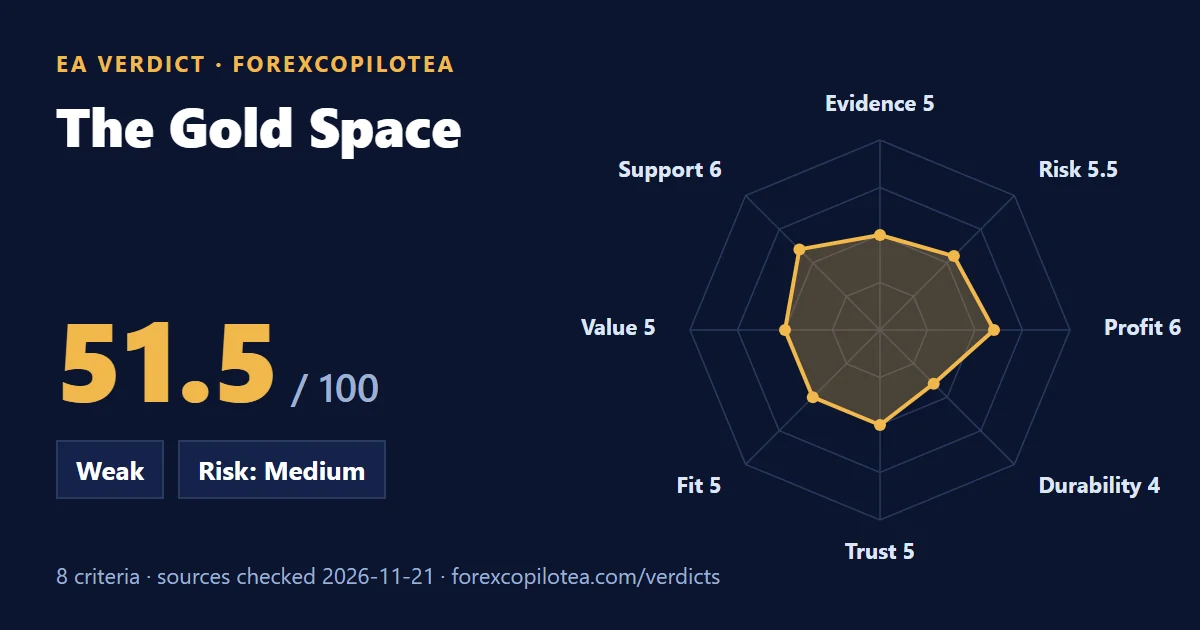
The Gold Space is a gold Expert Advisor for MetaTrader 5 that places buy stops above recent swing highs and sell stops below recent swing lows on several timeframes, then trails each position tightly behind price. It costs 249.99 USD on the MQL5 Market, was published on 3 June 2026 and is at version 3.7. Its seller, Ayush V Jain, shows a live signal and a long comment thread. We did something the other write-ups of this EA do not: on 21 November 2026 we ran the compiled v3.7 file in the MetaTrader 5 Strategy Tester on real ticks, lined its trades up against the live signal week for week, pushed its stop and target settings around, added execution delay, and read the decompiled code for what is hard-wired. The result is 51.5 out of 100, in the Weak band, with a Medium risk label. The tester and the signal agree more closely than we expected on profit and win rate. They disagree on trade count and on the worst loss, and that gap is where a buyer's money is exposed.
Key takeaways
- Six months of real ticks (19 May to 19 Nov 2026, 1,000 USD, default inputs, fixed 0.01 lot) gave +800.09 USD on 405 trades, profit factor 4.36, 80.5% winners and a 1.39% equity drawdown. Of the 405 exits, 400 were stops and five were other closes; not one reached the 4,000-point take-profit.
- On the same 33 trading days as the vendor's live signal, the tester made +146.07 USD on 122 trades; the signal made +158.56 USD on 88 trades. The signal took 28% fewer trades, had a larger worst loss (9.26 USD against 3.70 in the tester) and a higher profit factor (4.44 against 3.07).
- The tester reports an average holding time of 57 seconds and a longest position of 16 minutes 33 seconds. The average trade earns about 1.98 USD at 0.01 lot, so an extra 198 points of cost per trade would erase all profit. A one-second execution delay cut the profit by 3.1% to 775.01 USD and raised the equity drawdown from 1.39% to 3.40%.
- Moving the stop from 250 to 200 or 300 points changed the six-month profit by less than 1.5% (796.21 and 811.31 USD), because every winner is a trailing stop. We did not find the stop distance to be a fitted setting.
- On 1 April to 18 May 2026, before the V3 engine existed and entirely inside the owner's real-tick history, the same file made +251.32 USD on 102 trades at a profit factor of 4.61. The result does not fade backward, though we cannot know whether its author had looked at that data.
- The decompiled v3.7 code carries 94 US news events from 5 January 2024 to 10 December 2026 inside the file, plus a hard-coded wider blackout for the evening of 16 September 2026. After 10 December the built-in calendar has nothing left to filter on. None appears in the reconstruction, which a decompiler may not render completely.
- The Gold Space scores 51.5 out of 100 (band: Weak) with a Medium risk label. We sell a listing for it, and the verdict opens with that disclosure.
Where Gold Space ranks
- All 42 EAs we have scored
- joint 7 of 42
- Breakout designs
- joint 5 of 15
Gold Space scores 51.5 against a median of 43.4 across all 42 verdicts. It is above the median on verified evidence, risk and drawdown behaviour, profitability quality, transparency and trust, cost and value.
| Criterion (weight) | Gold Space | Median | Rank of 42 |
|---|---|---|---|
| Verified evidence (20) | 5 | 4 | 7 |
| Risk and drawdown behaviour (20) | 5.5 | 4.5 | 6 |
| Profitability quality (15) | 6 | 4.8 | 2 |
| Sustainability (15) | 4 | 4 | 20 |
| Transparency and trust (10) | 5 | 4 | 4 |
| Practical fit (10) | 5 | 5 | 14 |
| Cost and value (5) | 5 | 4 | 1 |
| Support and usability (5) | 6 | 6 | 8 |
Computed from every published verdict; ties share a rank. See the full data.
- 51.5 / 100
- weighted verdict score on eight published criteria
- +800.09 USD
- our six-month real-tick result at 0.01 lot on 1,000 USD, from 405 trades, profit factor 4.36
- 57 seconds
- average time a position stayed open in that test; the longest was 16 minutes 33 seconds
Is The Gold Space legit? The verdict at a glance
The Gold Space is a real, maintained product with a platform-verified signal whose numbers our own test reproduces in shape. We found no allegation of lost deposits and make none. The score is moderate because the record is eight weeks old and belongs to an engine the seller replaced on 30 September 2026, and because a system that holds positions for seconds lives or dies on execution that a tester cannot show.
51.5 / 100
Weighted verdict score
Weak
Verdict band
Medium
Risk label
| Criterion | Weight | Score | Best evidence | Points |
|---|---|---|---|---|
| Verified evidence | 20 | 5/10 | Grade A | 10.0 |
| Risk and drawdown behaviour | 20 | 5.5/10 | Grade B | 11.0 |
| Profitability quality | 15 | 6/10 | Grade A | 9.0 |
| Sustainability | 15 | 4/10 | Grade B | 6.0 |
| Transparency and trust | 10 | 5/10 | Grade B | 5.0 |
| Practical fit | 10 | 5/10 | Grade B | 5.0 |
| Cost and value | 5 | 5/10 | Grade B | 2.5 |
| Support and usability | 5 | 6/10 | Grade B | 3.0 |
| Total | 100 | 51.5 |
What The Gold Space actually is
The Market page, read on 21 November 2026, describes a swing breakout system for gold. It finds confirmed swing highs and lows, puts a buy stop just above a high and a sell stop just below a low, and enters only if price breaks through. Each position carries a stop loss and a take profit from the start, defaulting to 250 and 4,000 points, which is 2.50 and 40.00 USD of price on a two-digit gold symbol. In its default Auto mode the stop then follows price at a distance scaled to 85% of each strategy's own value. The seller says it never adds trades or raises the lot after a loss, and that it avoids martingale, grids and averaging down.
| Item | What the page says |
|---|---|
| Seller | Ayush V Jain, India. Seller rating 5 from 25 votes; 5 products and 2 signals. The same seller lists a grid EA and a 'controlled martingale' EA (The Gold Universe, The Gold Fusion), which this product is not. |
| Price and age | 249.99 USD to buy, no rental. Published 3 June 2026, version 3.7, updated 15 November 2026. |
| Reach | 20 reviews with a 5-star rating, 128 comments, about 1,485 demo downloads, 'Activations: 10'. The page also shows 29 to 32 purchases per month. |
| Strategies | S1 to S9 on H1, H4 and D1 swings, S11 on the previous day's high and low, S12 on the previous week's. An optional M30 strategy, S10, is off by default. |
| Entries | Buy Stop and Sell Stop at swing levels; orders within 200 points count as one level; at most four positions and pendings per side per level. |
| Exits | Stop 250 and take profit 4,000 points; Auto trailing at 85% of each strategy's values, or one manual distance of 30 points. |
| Sizing | A fixed 0.01 lot, or an automatic lot that risks 2% measured on balance, on equity or on whichever is smaller; a ceiling lot can be set. |
| Protection | Built-in FOMC, NFP and CPI calendar with no internet use, 60 minutes before and after; holiday filter; spread filter at 60 points; optional daily drawdown and total risk limits; optional stop re-anchor after bad fills. |
| Requirements | XAUUSD only, hedging account, low spread or ECN, a VPS recommended, one chart on any timeframe. |
| Track record | A live signal, The Gold Space V3 (MQL5 signal 2393691), started on 30 September 2026. |
How we judged it, and who has something to sell
- The seller sells The Gold Space at 249.99 USD and sells its signal for 299 USD a month, with no subscribers on 21 November. He also sells four other gold products, two of them grid-based.
- MQL5 and MetaQuotes host the listing, the signal statistics and the comment thread. The signal figures are computed from broker history, which is why we grade it A even though the seller runs the account.
- Buyers. One buyer wrote 12 of the 128 comments, including a long review of version 3.5 that ends by offering broker recommendations by private message. We read that as an enthusiastic user with a possible referral interest, and we do not rely on it.
- ForexCopilotEA sells a compiled copy of the file at 26.99 USD, ran the tests below on its own computer, and has an interest in the product selling.
Evidence ladder: what each rung of proof held for The Gold Space
Grade A: Independent proof
- MQL5 signal 2393691, 'The Gold Space V3', at VantageMarkets-Live 15: 88 trades, 8 weeks, built from broker history. The seller runs it, and the platform shows notices for a newly opened account and a high risk of negative slippage when copying.
- Our Strategy Tester runs, run on real ticks at 100% history quality and reproducible by anyone with the same compiled file: the tester's report is the source, not a claim.
Grade B: Checkable vendor material
- The Market description, the inputs it lists, the version note and a free demo anyone can run in the tester.
- The decompiled reconstruction of v3.7 held by the site owner, used only for the code observations and labelled as such.
Grade C: Claim only
- 'No martingale, grid or averaging down': consistent with the 0.01-lot tester run and the signal's worst trade of 9.26 USD, but a claim about design.
- A buyer's report of 100 to 144 euros in 28 days on 0.01 lots, and another buyer's report of about 12,000 USD in two weeks across two accounts of unstated size.
Grade D: Conflicted or unverifiable
- Seller comments that announce profits, new highs on the signal and price rises: promotion on a product page.
- The 'PropFirm Ready' comment of 16 June 2026 and the screenshots attached to the early comments, which we could not tie to an account record.
Our backtest of The Gold Space v3.7
On 21 November 2026 the compiled v3.7 file was run in the MetaTrader 5 Strategy Tester on the site owner's computer, on the XAUUSD H1 chart with default inputs and no set file, so the lot stayed at 0.01. The listing says the EA reads its own timeframes whatever chart is open, and a buyer comment says the chart timeframe no longer matters since V3. The window is the latest six months the owner's tick history covers.
| Setting | Value |
|---|---|
| File and inputs | The Gold Space v3.7 (compiled .ex5), default inputs, no set file: fixed 0.01 lot, stop 250 and take profit 4,000 points, Auto trailing at 85%, news filter on |
| Symbol, chart | XAUUSD, H1 |
| Dates | 19 May 2026 up to 19 November 2026, about six months |
| Tick data | 89,337,974 real ticks; history quality reported as 100% |
| Feed | IC Markets demo account on the ICMarketsSC-Demo server (Raw Trading Ltd) |
| Account | 1,000 USD, 1:500 leverage; the main run uses the tester's default order execution, with no delay added |
| Platform | MetaTrader 5 IC Markets Global, x64 build 6230 |
| Costs in the result | The feed's recorded spread, commission of 32.40 USD over 405 trades as the tester applied it, and swap (none charged: positions last minutes). No slippage. Every profit figure is net of commission and swap |
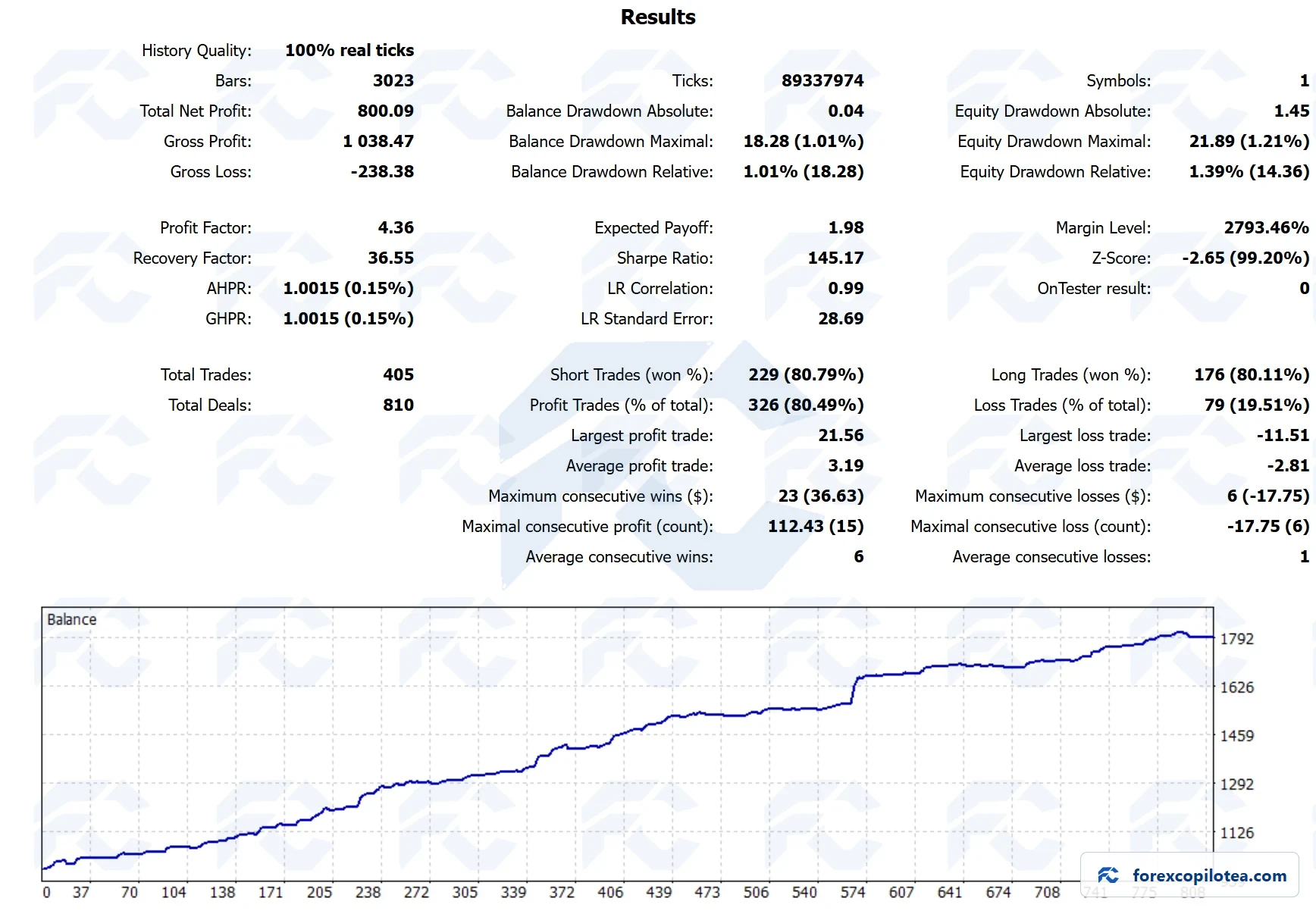
- +800.09 USD
- net profit on 1,000 USD at 0.01 lot in six months, profit factor 4.36, recovery factor 36.55
- 405 trades, 80.49% won
- 326 winners; the average winner made 3.19 USD and the average loser lost 2.81 USD
- 1.39% equity drawdown
- 14.36 USD at the worst point; the longest losing run was 6 trades for 17.75 USD
Those figures look excellent and need their size put beside them. A 0.01 lot on 1,000 USD risks about 0.25% of the account per stop, so the drawdown is small because the position is small; the same system with the 2% automatic lot the listing offers would show a drawdown many times larger. What the 800 USD measures is the quality of the trade stream, and the stream is made of about 2 USD trades.
Where the profit comes from, strategy by strategy
| Strategy | Trades | Winners | Profit factor | Net (USD) |
|---|---|---|---|---|
| S1 (H1 swing) | 26 | 76.9% | 3.07 | +34.06 |
| S2 (H1 swing) | 37 | 91.9% | 16.51 | +125.63 |
| S3 (H1 swing) | 50 | 82.0% | 7.06 | +144.79 |
| S4 (short H1 swing) | 174 | 76.4% | 3.17 | +257.97 |
| S5 (H1 swing) | 36 | 94.4% | 22.74 | +123.26 |
| S6 (D1 swing) | 6 | 100% | none lost | +26.62 |
| S7 (H4 swing) | 10 | 90.0% | 10.48 | +28.17 |
| S8 (H1 swing) | 43 | 81.4% | 3.65 | +63.78 |
| S11 (previous-day levels) | 21 | 57.1% | 0.69 | -7.82 |
| S12 (previous-week levels) | 2 | 100% | none lost | +3.63 |
| S9 (D1 swing) | 0 | no trades | n/a | 0 |
One strategy, S4, took 174 of the 405 trades and 257.97 USD, a third of the profit. Five strategies show profit factors between 7 and 23 on 10 to 50 trades each, and the arithmetic of small samples says those will not hold at that height. The one strategy the description labels 'lower priority', S11 on the previous day's range, lost 7.82 USD at a profit factor of 0.69. S9 never traded in six months. The ten that did trade add to the full 800.09.
No exit reached a take-profit
The default take profit is 4,000 points, 40 USD of price. In 405 closed trades, 400 ended with a broker stop-loss order and five with another instruction; none reached the target. The biggest winner made 21.56 USD at 0.01 lot, about half the distance to the target. In practice the take-profit input does nothing in this window, and every winner is a trailing stop that got stopped in profit. That makes the trailing settings, not the stop or target, the part of the EA that earns the money, and which is why the stress runs below vary the stop and the target and show how little they matter.
Months, hours and holding time
| Month | Trades | Winners | Profit (USD) |
|---|---|---|---|
| May 2026 (from the 19th) | 37 | 30 | +59.92 |
| June | 52 | 41 | +107.38 |
| July | 65 | 54 | +161.88 |
| August | 64 | 56 | +201.40 |
| September | 65 | 49 | +134.76 |
| October | 75 | 59 | +69.82 |
| November (to the 19th) | 47 | 37 | +81.13 |
Every month closed in profit and no month made less than 59.92 USD. The weakest full month was October, which had the most trades, 75, and the second-lowest profit. In server time, hours 15 to 18 made 337.82 USD (42% of the profit) and hours 2 and 3 made 197.14 USD (25%), so two short parts of the day carry two-thirds of the result. Monday was the best weekday at 240.08 USD from 73 trades.
Holding time is the unusual number. The tester reports an average of 57 seconds, a shortest position of 1 second and a longest of 16 minutes 33 seconds, and its holding-time chart shows nearly all 405 positions closing within the first few minutes. A breakout stopped out inside a minute is a trade whose result is decided by the fill, so a clean tester fill can look very different from a fill through a retail feed during a news spike.
The tester against the live signal, week for week
The seller's signal started on 30 September 2026 at 17:28 server time with 90.54 USD. It has run 33 trading days. We cut our tester trades to the same start and the same 33 trading days, and compared the two. The signal is a record of real fills at VantageMarkets-Live 15; the tester is a replay on IC Markets ticks. They should be close and cannot be identical.
| Statistic | Live signal | Tester, same window |
|---|---|---|
| Trading days | 33 | 33 |
| Trades | 88 | 122 |
| Winners | 73 (82.95%) | 96 (78.69%) |
| Net profit | +158.56 USD | +146.07 USD |
| Profit factor | 4.44 | 3.07 |
| Average win, average loss | +2.80, -3.08 USD | +2.26, -2.71 USD |
| Best trade, worst trade | +14.42, -9.26 USD | +9.63, -3.70 USD |
| Long, short | 35 (40%), 53 (60%) | 44 (36%), 78 (64%) |
Net profit lands within 8%. The shape differs in three ways, each telling. The account took 72% of the trades the tester took, which fits entries that the live feed filled late or did not fill. Its worst trade lost 9.26 USD against a tester worst of 3.70, which at 0.01 lot means a loser about 3.7 times the 2.50 USD stop: a slipped fill, since a stop on gold in a fast market is a request, not a guarantee. And its profit factor is higher, 4.44 against 3.07, because it lost on fewer trades. We cannot tell from public numbers whether the signal runs exactly 0.01 lot all the time, so we read this as a close match in direction and an open question about how much execution costs.
- Live signal (Vantage)158.56
- Our tester (IC Markets)146.07
A second comparison is less friendly to the tester. On 12 November 2026 a buyer wrote that his 0.01-lot account went from 100 to 144 euros in 28 days. Our tester made 112.37 USD in the 28 days to 12 November. His broker, lot handling and currency are unstated, which makes the figure anecdotal. It still serves as a reminder: the record that matches the tester most closely is the seller's own, on the broker the seller chose.
How fragile is it? Our stress runs
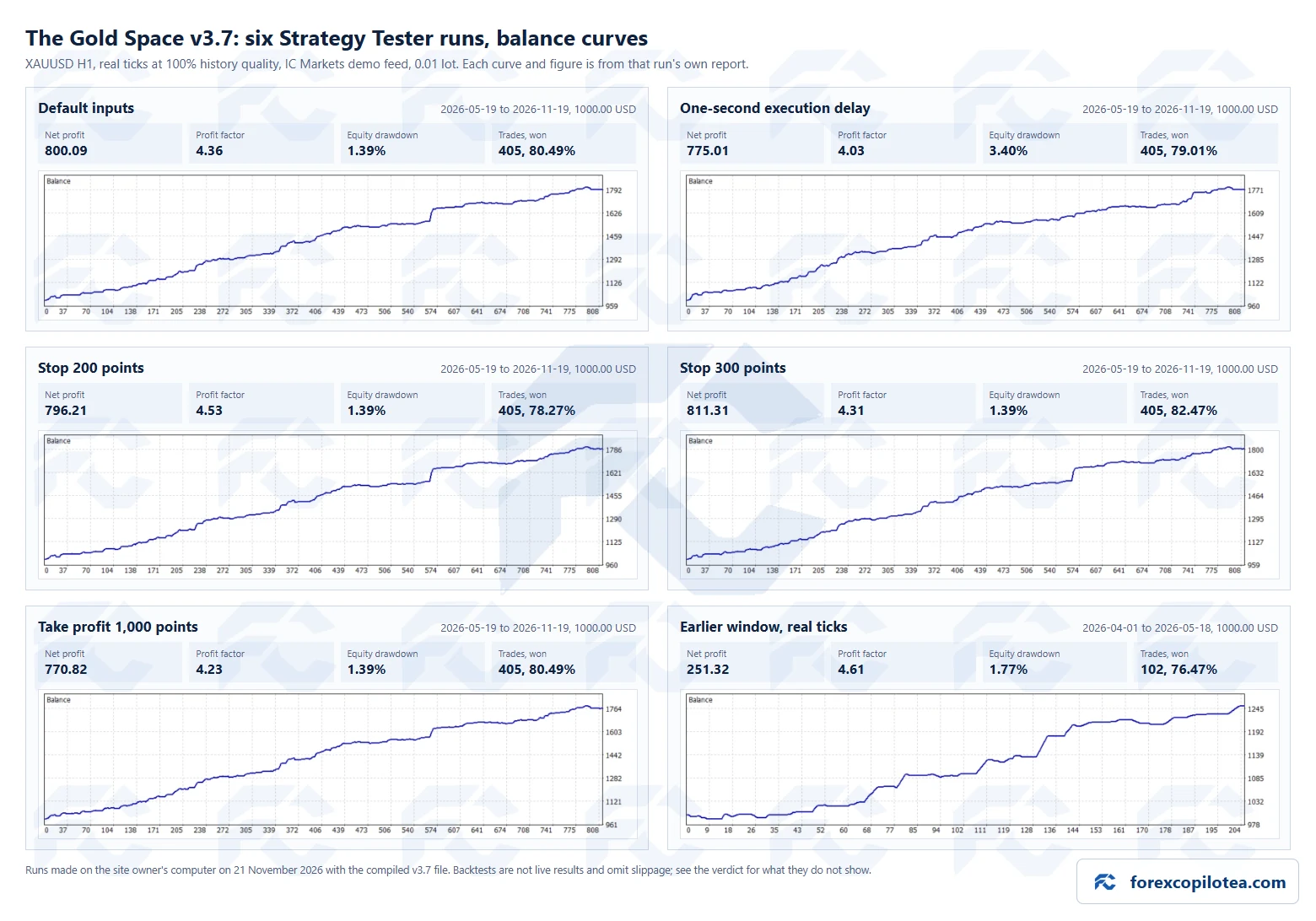
A system with many tuned numbers can look wonderful in the window it was tuned on and weaker everywhere else. We ran the same compiled file under changes to the things a buyer can change, and on dates earlier than the ones the seller mentions. All runs use real ticks at 0.01 lot from a 1,000 USD deposit.
| Stop (points) | Target (points) | Net (USD) | Profit factor | Equity drawdown | Winners |
|---|---|---|---|---|---|
| 200 | 4,000 | +796.21 | 4.53 | 1.39% | 317 (78.27%) |
| 250 (default) | 4,000 | +800.09 | 4.36 | 1.39% | 326 (80.49%) |
| 300 | 4,000 | +811.31 | 4.31 | 1.39% | 334 (82.47%) |
| 250 | 1,000 | +770.82 | 4.23 | 1.39% | 326 (80.49%) |
The profit hardly moves. A tighter stop lowers the win rate and shrinks the average loss from 3.23 to 2.38 USD; a wider one does the reverse; the total stays within 1.5% across all three, and every run took the same 405 trades. The entries decide how many trades there are and the trailing stop decides what each earns, so the stop is a safety net more than a tuned input. The target matters only when it is pulled in close: at 1,000 points, a quarter of the default, 20 trades ended at the target instead of the trailing stop and the profit fell 3.7% to 770.82 USD. That is a point in the product's favour: the part of the system a buyer is most likely to change is not the part that makes the money.
| Run | Net (USD) | Profit factor | Trades | Winners | Equity drawdown |
|---|---|---|---|---|---|
| Default, no delay (19 May to 19 Nov) | +800.09 | 4.36 | 405 | 326 (80.49%) | 1.39% |
| One-second execution delay, same dates | +775.01 | 4.03 | 405 | 320 (79.01%) | 3.40% |
| Earlier window, 1 April to 18 May 2026 | +251.32 | 4.61 | 102 | 78 (76.47%) | 1.77% |
A one-second delay costs 3.1% of the profit and nearly triples the equity drawdown, from 1.39% to 3.40%, because stops that move a second late give back a little on each trail. The tester's delay applies to the order requests the EA sends; it does not model a quote that arrives late or a pending order that fills worse than its price, which is the slippage the seller and the signal page both warn about. So the tester leaves the largest live risk unmeasured. A rough ceiling is arithmetic: the average trade earns 1.98 USD at 0.01 lot, which is 198 points on gold, so an extra cost of 50 points per trade would remove a quarter of the profit, 100 points half, and 198 points all of it. The earlier-window run adds a second observation. In the seven weeks before the window the seller's comments call the new engine's best run, the file earned 251.32 USD with a profit factor of 4.61 and a 1.77% drawdown, so the shape does not depend on one stretch of the calendar. The seller's own list of bad days (4 August, 9 September, 2 October) is not in that window, and a window this short cannot say what a bad month looks like.
What the code hard-wires
We hold a decompiled reconstruction of the v3.7 compiled file: 1,642 lines, rebuilt from the binary. It is not the vendor's source, names and comments are rebuilt, and some logic may read differently from the original. We use it for facts that survive that: constants, tables and calls the file makes. The picture below shows 14 of its 1,642 lines.
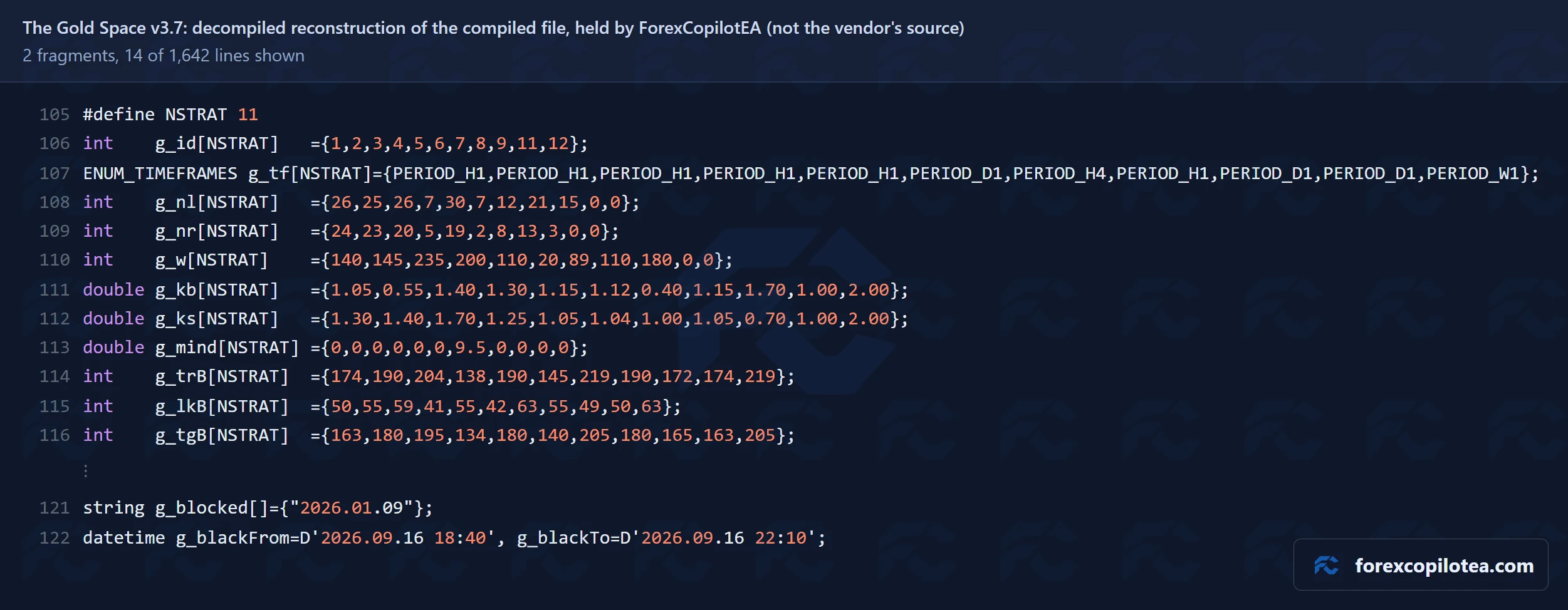
- Eleven strategies, about one hundred tuned numbers. Each strategy has its own lookback on the left and right, search window, buy and sell offsets and three trailing values. Values such as 26 and 24, 25 and 23, 235, 1.40 and 0.55 look like the output of a search for what worked, which is how breakout systems are built; it also means each one was fitted to a stretch of price.
- The S10 strategy in the description has no switch. The description lists an optional M30 strategy S10. The reconstruction has ids 1 to 9, 11 and 12, and the inputs list of the file we ran has a 'STRATEGIES' header with nothing under it. We could not tell whether the Market build has the switch and ours does not.
- A news calendar that ends. 94 events are written into the file: 24 FOMC statements, 35 payroll reports and 35 CPI releases, from 5 January 2024 to 10 December 2026. After that date a v3.7 file has nothing to pause for. The seller's description says the calendar needs no internet; it also needs an update before December.
- One-off patches. A single blocked date, 9 January 2026, and one blackout from 18:40 to 22:10 server time on 16 September 2026, the evening of an FOMC statement already in the table. That blackout falls inside our test window, so it is in the results we quote.
- No network call, DLL or expiry in the reconstruction. It contains no WebRequest call, DLL import or deadline comparison, and uses the account number only to name a per-account state file. A decompiler can drop or reshape logic, so this is an absence in our reconstruction and not a guarantee about the file you download. A buyer comment on 31 August describes an older test build with a built-in expiry date; we found none in v3.7.
What buyers report, in date order
The thread is long, and 83 of its 128 comments are the seller's. Read for what it records about the product, the dated events are these.
| Date (2026) | Who | What was said |
|---|---|---|
| 19 to 24 June | Seller | He said the live signal would have gained roughly twice as much, with a drawdown under 5%, had the news filter 'worked properly' and not had a 'bug'. |
| 4 August | Seller | 'All profits got killed in slippage today.' A buyer the same day saw two trades with different magic numbers at once; the seller said it was a fixed bug. |
| 24 and 28 August | Buyer on a 200 USD account | Down on day one, with a 60% win rate; then reported the news filter kept adding orders during a Fed speech. The seller replied that the filter covers only FOMC, CPI and NFP and that breakouts do better without it. |
| 31 August | Seller | A buyer's EA stopped trading: it was a v1.8 test build with a built-in expiry date; the Market version has none. |
| 13 September | Buyer | A 0.01-lot test from 2023: weak and slightly losing in 2023, marginal in 2024, strong in 2025, 'exceptional and potentially optimized' January to May 2026; 'the EA seems to be made for this time period'. |
| 2 October | Seller | A day's loss was 'my mistake. NFP filter didn't work. I have fixed it.' |
| 27 October | Buyer | Version 3.5 praised for stop re-anchoring after adverse slippage, with a note that broker quality, latency and slippage 'still matter'. |
| 11 November | Reviewer | After the 30 September engine, 79.6% winners; the older version had looked like 'another fake EA'. |
Three lessons come out of it. The product has been repaired in public several times in five months, which is good service and also means the file has changed often. The news filter, the feature that is supposed to protect the account on the days that matter most, failed or was disputed on at least four occasions. And the only multi-year test posted by a buyer matches the shape we would expect from a fitted system: much better in the window the seller cites than before it.
The Gold Space risk and drawdown
Per trade the risk is small and defined. A 250-point stop is 2.50 USD at 0.01 lot, and the signal's worst trade, 9.26 USD, is 3.7% of its current 249.10 USD balance and 10% of its 90.54 USD start. The ways it can hurt are about exposure and execution, not blow-up arithmetic.
- Stacked entries. Up to four positions per side at one level, and several strategies, can be open together. The most positions our run held at once was five, which is small at 0.01 lot and not small at 2% risk per entry.
- Automatic lot. At the listing's 2% setting every stop costs 2% of the account, and five at once is a 10% day. The test above says nothing about it, and nor does the signal, which is fixed at 0.01.
- Slippage and latency. With an average hold of 57 seconds, a one-second delay or a 100-point slip changes the result materially. The signal's own page carries a warning of high risk of negative slippage when copying.
- A closing market. The EA cancels pending orders 30 minutes before the daily close and waits 15 minutes after the open, which removes gap risk from pendings but not from an open position.
The Gold Space price: 249.99 USD here, 26.99 USD at ours
The Market price on 21 November 2026 was 249.99 USD. The comment thread shows it moving: 199.99 for 24 hours on 24 July, 249.99, then a stated return to 349.99 and a rule of 299 and then 349 when the signals passed 100% and 200%. On 21 November the page again shows 249.99, so the ladder was not followed in a straight line, and a 31 October comment thanks buyers for another discounted promotion. A buyer has no way to tell whether a price notice is a fact about demand, and the safe reading is to treat the price as a number the seller sets. Our listing sells the compiled file for 26.99 USD, and the page lists neither a setfile nor a manual nor seller support, so the difference buys a seller who answers questions and delivers a set file by message.
Setting up The Gold Space: broker, account and VPS
The listing asks for a hedging account with a low spread, one XAUUSD chart on any timeframe, and a VPS. For this EA the broker choice is the largest decision, because the seller's own comments name two brokers with poor slippage on particular days and a third that did well. Test the demo on the broker you intend to use, set a fixed 0.01 lot for the first weeks, and keep the news filter on. The AutoGMT setting is described as automatic, and our file needs no web access, so there is nothing to allow-list. Check the date of your file against 10 December 2026, when its built-in news table runs out.
Will it last? The developer and the engine's age
The seller has five products, a rating of 5 from 25 votes and a habit of fast, visible fixes. Against that, the engine that produced the signal's numbers is eight weeks old. One buyer's multi-year test describes a system that did little in 2023 and 2024, and the seller's own comment of 18 August says breakout scalpers were all down that week and The Gold Space was 20% off its high on the signal. A breakout system earns when gold trends or spikes and pays when it chops. Six months of tests, a rising gold price and a new engine do not show what it does in a long range.
The score, criterion by criterion: 51.5 out of 100
51.5 / 100
Weighted verdict score
Weak
Verdict band
Medium
Risk label
| Criterion | Weight | Score | Best evidence | Points |
|---|---|---|---|---|
| Verified evidence | 20 | 5/10 | Grade A | 10.0 |
| Risk and drawdown behaviour | 20 | 5.5/10 | Grade B | 11.0 |
| Profitability quality | 15 | 6/10 | Grade A | 9.0 |
| Sustainability | 15 | 4/10 | Grade B | 6.0 |
| Transparency and trust | 10 | 5/10 | Grade B | 5.0 |
| Practical fit | 10 | 5/10 | Grade B | 5.0 |
| Cost and value | 5 | 5/10 | Grade B | 2.5 |
| Support and usability | 5 | 6/10 | Grade B | 3.0 |
| Total | 100 | 51.5 |
| Criterion | Score | Points | Why |
|---|---|---|---|
| Verified evidence (weight 20) | 5 / 10 | 10.0 | A platform-built signal that the seller runs and a tester profile that lines up with it; eight weeks old and tied to a rewritten engine, so the score stops at 5. |
| Risk and drawdown behaviour (weight 20) | 5.5 / 10 | 11.0 | A stop on every order and no grid or martingale; seconds-long holds make slippage the main risk and the automatic lot multiplies the exposure. |
| Profitability quality (weight 15) | 6 / 10 | 9.0 | Profit factor above 4 in both the tester and the signal; about 2 USD per trade leaves a thin margin for execution cost. |
| Sustainability (weight 15) | 4 / 10 | 6.0 | A new engine, a buyer's multi-year test that looked fitted to 2026, a finite news table and about 100 tuned numbers. |
| Transparency and trust (weight 10) | 5 / 10 | 5.0 | Honest, fast public fixes against promotion in the thread, price notices and a description that mentions a switch our file lacks. |
| Practical fit (weight 10) | 5 / 10 | 5.0 | One symbol, a hedging account, raw spread and a VPS; broker quality decides whether the tester's result is reachable. |
| Cost and value (weight 5) | 5 / 10 | 2.5 | 249.99 USD with a free demo is defensible for a product with a live signal; price notices weaken the case. |
| Support and usability (weight 5) | 6 / 10 | 3.0 | A demo, a responsive seller and free updates, with the manual and set files only by private message. |
Who The Gold Space fits, and who it does not
- It fits a trader who wants a small, defined-risk gold system, will run it at fixed lot on a low-latency broker, and accepts that profits are many small trades.
- It does not fit a buyer on a retail spread feed, a trader who wants a high win-rate system with large wins, or anyone who will switch on the 2% automatic lot before watching it for a month at 0.01.
- It is a poor choice as the only gold EA in an account if you already run other gold breakout systems: their positions point the same way at the same moments. Our portfolio study measures how much two of them overlapped.
How it compares with other EAs we have scored
Among the gold EAs we have scored, The Gold Space is unusual for how small each trade is and how many there are. Cosmos Orion took 48 trades in the same six months at about 17 USD each; The Gold Space took 405 at about 2 USD. Gold House and Gold Snap sell for more and publish less. For a cheaper reference on how we read breakout records see how to read an MT5 backtest report.
Questions to put to the seller before you pay
Sources and when they were opened
- MQL5 Market: The Gold Space (product 179831), opened 21 November 2026Source of the price, version, strategies, inputs, requirements, reviews and the 128 comments. Written by the seller and by buyers.
- MQL5 Signals: The Gold Space V3 (signal 2393691), opened 21 November 2026Source of the live statistics. Built from broker trade history; the seller operates the account.
- MQL5 Market comments for The Gold Space, pages 1 to 7, opened 21 November 2026Source of the dated statements in the table above and of the count of seller comments.
- ForexCopilotEA tester runs, 21 November 2026Source of every backtest figure: reports from MetaTrader 5 on the site owner's computer, real ticks, IC Markets demo feed.
- MetaTrader 5 Help: Real and Generated TicksThe difference between ticks recorded from the broker and ticks the tester generates.
- MetaTrader 5 Help: Testing ReportWhat each figure in the tester's report means, including drawdown.
- Myfxbook Help: VerificationHow a trading account's track record is verified on Myfxbook.
- CFTC Customer Advisory: AI Won't Turn Trading Bots into Money MachinesA US regulator's warning about trading-bot claims of unusually high returns.
Frequently asked questions
Is The Gold Space EA legit?
It is a real, actively updated product with a platform-verified live signal of 88 trades, 20 reviews and a seller who fixes problems in public. We found no allegation of lost deposits and make none. It scores 51.5 out of 100 with a Medium risk label because the record is eight weeks old, the engine was rewritten on 30 September 2026 and results depend on execution.
Does The Gold Space use martingale or a grid?
The listing rules out martingale, grids and averaging down, and says the EA never raises the lot after a loss. In our real-tick run every trade was 0.01 lot and the worst loss was 11.51 USD, which fits that. It can stack up to four positions per side at one level, which is exposure, not averaging down.
How much does The Gold Space cost?
249.99 USD on the MQL5 Market on 21 November 2026, with a free demo. The seller has changed the price several times in the comments. Check the terms and the build version of the seller you buy from.
What drawdown does The Gold Space have?
At fixed 0.01 lot our six-month test showed a 1.39% equity drawdown on 1,000 USD, and the signal shows 1.26% by equity. Both are small because the position is small. The automatic lot at 2% risk would scale that up and has not been shown in any record we found.
What is the minimum deposit for The Gold Space?
No minimum is stated. The live signal started with 90.54 USD at 0.01 lot, and a buyer reported a 100 euro account. Because a stop on gold costs about 2.50 USD at 0.01 lot, a very small account has room for several stops but little cushion against slippage.
Can The Gold Space trade anything besides gold?
No. It is built for XAUUSD only and reads its own timeframes, so the chart timeframe does not matter. The seller sells a separate MT4 edition.
Gold Expert Advisors in our store
We sell these, so weigh that interest. Put the same eight questions to any of them before you buy: read the manual, run your own backtest, and start on demo.
 Featured
 Featured
 FREE + source code
Keep reading
- EA VerdictCosmos Orion EA Review: Verdict and Risk (2026)Is Cosmos Orion worth $299? Independent EA verdict: 37.0/100, Medium risk. An H2 gold breakout EA with no public record, scored on 29 Oct 2026.
- EA Verdict #12Gold House EA Review: Verdict and Risk (2026)Is Gold House worth $749? Independent EA verdict: 52.3/100, Medium risk. Two live MQL5 signals, 68 reviews and a rising price ladder scored, checked 28 Oct 2026.
- PortfolioRunning Several EAs at Once: Portfolio Risk ExplainedHow to run several MT5 Expert Advisors on one account: correlation, a shared risk budget, magic numbers, margin and monitoring, with worked examples in euros.
- BacktestingWhy EA Live Results Differ From Backtests (and What to Do)Why EA live results differ from backtests: spread, slippage, delay, data, overfitting and more. Eleven causes, how to check each and how to close the gap.
- BacktestingHow to Read an MT5 Backtest ReportRead an MT5 Strategy Tester report line by line: drawdown, profit factor, Z-score, trade quality, robustness checks and the red flags of a weak EA.
- ResearchEA Portfolio Correlation: Six EAs Measured Over Six MonthsWe ran six MT5 Expert Advisors on the same six months of real ticks and measured their correlation, shared gold exposure and drawdown. Build your own mix.